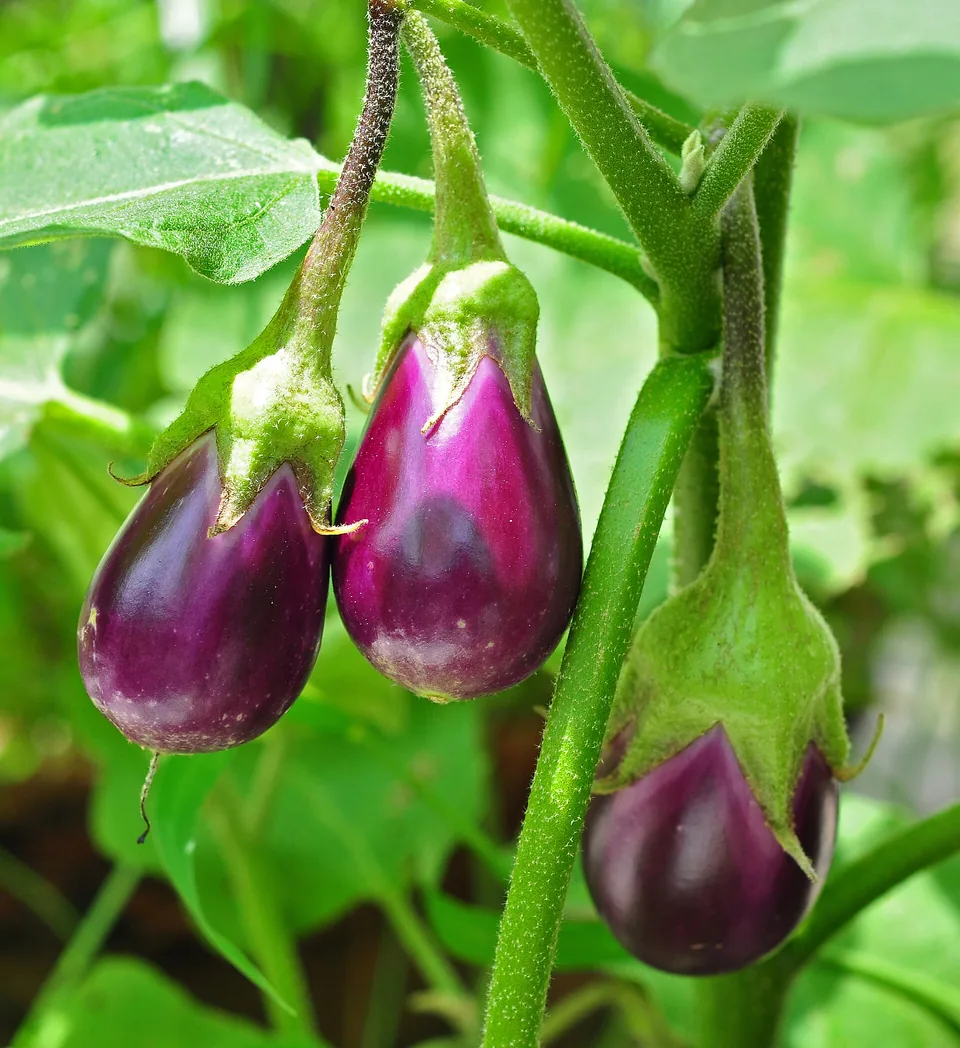


Cómo cultivar y cuidar Berenjena
Solanum melongena
Escrito por Emilio Marruso · última revisión
Tóxica para: Gatos, Perros, Caballos, Personas · Por qué
De un vistazo
Las berenjenas son plantas amantes del calor que disfrutan del sol pleno y te regalan frutos brillantes y firmes. Siembra en interior seis u ocho semanas antes de la última helada y trasplanta en primavera, cuando la tierra se haya calentado. Riega a fondo y con constancia, de 2,5 a 5 cm por semana, y cosecharás tus primeros frutos entre 65 y 80 días después del trasplante.
- Sol
Sol pleno
Qué dicen las fuentes (2)
Luz: Pleno sol
The eggplant grows best in full sun. It prefers moist, well-drained, fertile, sandy, and loamy soils with a pH range of 5.5 to 6.8.
— Solanum melongena (Aubergine, Brinjal, Eggplant, Mad Apple, Raging Apple) | North Carolina Extension Gardener Plant Toolbox [1] Eggplants need a well-drained soil that receives eight to 10 hours of sunlight per day.
— Home Garden Eggplant | CAES Field Report [3] - Riego
2,5–5 cm a la semana, a fondo y constante; la humedad irregular amarga el fruto
Qué dicen las fuentes (6)
Riego: 1 a 2 pulgadas [2,5–5,1 cm] de agua por semana, empapando el suelo profundamente (humedecido a una profundidad de al menos 6 pulgadas [15 cm]) y manteniendo la humedad del suelo constante
Eggplant should receive about 1 inch of water per week, soaking the soil deeply to prevent blossom end rot and/or shallow root development.
— Eggplant: How to Grow It [2] Eggplants require between 1 to 2 inches of water per week for best production.
— Home Garden Eggplant | CAES Field Report [3] Water sufficiently to moisten the soil to a depth of at least 6 inches.
— Eggplant | Home & Garden Information Center [4] Notas sobre el riego: La humedad inconsistente hace que la fruta sea amarga y reduce el rendimiento; evita el riego por aspersión; el período crítico para la humedad del suelo es la formación y desarrollo del fruto; el mantillo ayuda a retener la humedad
When moisture levels are inconsistent, eggplants can become bitter and will not produce well.
— Eggplant: How to Grow It [2] Avoid overhead sprinkling, as wet leaves are more disease-prone
— Eggplant: How to Grow It [2] The critical period for soil moisture is during fruit set and fruit development. Mulching can help retain consistent soil moisture, conserve water, and reduce weeds.
— Eggplant | Home & Garden Information Center [4] - Frío
Aguanta inviernos de hasta −6,7 °C (20 °F)
Rústica en inviernos normales · USDA 9a · RHS H4 · Z9
Qué dicen las fuentes (2)
Rusticidad, zona más fría: 9a [mínima invernal de −6,7 a −3,9 °C (de 20 a 25 °F)]
USDA Plant Hardiness Zone: 9a, 9b, 10a, 10b, 11a, 11b, 12a, 12b
— Solanum melongena (Aubergine, Brinjal, Eggplant, Mad Apple, Raging Apple) | North Carolina Extension Gardener Plant Toolbox [1] Rusticidad, zona más cálida: 12b [mínima invernal de 12,8 a 15,6 °C (de 55 a 60 °F)]
USDA Plant Hardiness Zone: 9a, 9b, 10a, 10b, 11a, 11b, 12a, 12b
— Solanum melongena (Aubergine, Brinjal, Eggplant, Mad Apple, Raging Apple) | North Carolina Extension Gardener Plant Toolbox [1] - Distancia
76 cm entre hileras
Qué dicen las fuentes (2)
- Siembra
Siembra en interior 6–8 semanas antes de la última helada; germina en 8–12 días
Qué dicen las fuentes (9)
Siembra: En interiores de seis a ocho semanas antes de plantar al aire libre (aproximadamente de seis a ocho semanas antes de la última helada)
Sur de Georgia: Start the seeds indoors about six to eight weeks before the last frost. In south Georgia, this will be about the third week of February.
— Home Garden Eggplant | CAES Field Report [3] Norte de Georgia: In north Georgia, this will be the last week of March.
— Home Garden Eggplant | CAES Field Report [3] Dakota del Sur (Extensión SDSU): If starting indoors, plant the seeds six to eight weeks before planting outdoors.
— Eggplant: How to Grow It [2] If starting indoors, plant the seeds six to eight weeks before planting outdoors.
— Eggplant: How to Grow It [2] Start the seeds indoors about six to eight weeks before the last frost.
— Home Garden Eggplant | CAES Field Report [3] Días de germinación: 8-12
It is propagated by seeds and germination occurs in 8 -12 days.
— Solanum melongena (Aubergine, Brinjal, Eggplant, Mad Apple, Raging Apple) | North Carolina Extension Gardener Plant Toolbox [1] Germinación: Germina en 8-12 días; rápidamente a temperaturas del suelo de 21.1-32.2 °C [70–90 °F], óptimo 29.4 °C [85 °F]; no germina por debajo de 15.6 °C [60 °F].
It is propagated by seeds and germination occurs in 8 -12 days.
— Solanum melongena (Aubergine, Brinjal, Eggplant, Mad Apple, Raging Apple) | North Carolina Extension Gardener Plant Toolbox [1] Seeds germinate quickly at soil temperatures between 70 to 90 °F.
— Eggplant | Home & Garden Information Center [4] Optimal soil temperature for germination is 85 degrees Fahrenheit; they will not germinate below 60 degrees Fahrenheit.
— Eggplant: How to Grow It [2] - Plantación
Trasplanta en primavera después de la última helada y cuando la tierra se haya calentado
Qué dicen las fuentes (7)
Plantación: Primavera, después de la última posibilidad de helada y una vez que el suelo se haya calentado por completo; fechas de trasplante en Carolina del Sur: Piedmont 1 de mayo - 30 de junio, Costa 1 de abril - 30 de abril (otoño Costa 1 de agosto - 31 de agosto); Dakota del Sur a fines de mayo o principios de junio
Piedmont (Carolina del Sur), primavera: Spring | Fall | Piedmont | May 1 – Jun 30 | Not recommended
— Eggplant | Home & Garden Information Center [4] Costa (Carolina del Sur), primavera y otoño: Coastal | Apr 1 – Apr 30 | Aug 1 – Aug 31
— Eggplant | Home & Garden Information Center [4] Dakota del Sur (Extensión SDSU): Transplant eggplant seedlings into the garden in late May or early June when night temperatures are consistently above 60 degrees Fahrenheit and the soil is warm.
— Eggplant: How to Grow It [2] Georgia (Extensión UGA): The soil temperature should reach 65-70°F before planting the transplants in the garden.
— Home Garden Eggplant | CAES Field Report [3] Plant in the spring after the last chance of frost and the soil has thoroughly warmed.
— Eggplant | Home & Garden Information Center [4] Transplanting Dates | Area | Spring | Fall | Piedmont | May 1 – Jun 30 | Not recommended | Coastal | Apr 1 – Apr 30 | Aug 1 – Aug 31
— Eggplant | Home & Garden Information Center [4] Transplant eggplant seedlings into the garden in late May or early June when night temperatures are consistently above 60 degrees Fahrenheit and the soil is warm.
— Eggplant: How to Grow It [2] - Abonado
Abona antes de plantar y luego dos veces más, cada 3–4 semanas; con exceso de nitrógeno da hojas, no flores
Qué dicen las fuentes (7)
Cuándo: Antes de plantar, se incorpora al suelo; abono lateral tres o cuatro semanas después de la plantación y nuevamente tres o cuatro semanas más tarde
Apply preplant fertilizer according to soil test recommendations. Broadcast the fertilizer evenly and incorporate it into the soil by tilling or discing
— Eggplant | Home & Garden Information Center [4] Side dress plants with 5 pounds of calcium nitrate (15.5-0-0) per 1000 square feet or 300 feet of row three to four weeks after planting.
— Eggplant | Home & Garden Information Center [4] Side dress another 5 pounds per 1000 square feet or ½ pound per 100 square feet three to four weeks after that.
— Eggplant | Home & Garden Information Center [4] Frecuencia: Una aplicación antes de la siembra y dos abonos laterales con tres o cuatro semanas de diferencia
Side dress plants with 5 pounds of calcium nitrate (15.5-0-0) per 1000 square feet or 300 feet of row three to four weeks after planting.
— Eggplant | Home & Garden Information Center [4] Side dress another 5 pounds per 1000 square feet or ½ pound per 100 square feet three to four weeks after that.
— Eggplant | Home & Garden Information Center [4] Signos de exceso: Más hojas que flores por demasiado nitrógeno; raíces o follaje quemados por fertilizante mal colocado
Beware that too much nitrogen can cause a plant to grow more leaves than flowers.
— Eggplant: How to Grow It [2] To avoid burning the roots, place side-dress fertilizer 4 to 6 inches away from the plants.
— Eggplant | Home & Garden Information Center [4] - Cosecha
Cosecha 65–80 días después del trasplante, con la piel brillante y el fruto firme; corta, no arranques
Qué dicen las fuentes (5)
Cómo cosechar: Cosecha cuando la piel esté brillante y el fruto esté firme; la piel opaca o bronceada significa que el fruto está demasiado maduro y amargo. Corta el fruto con un cuchillo afilado o tijeras de podar, dejando 2.5 cm (1 pulgada) de tallo en cada fruto; no lo jales ni lo tuerzas para sacarlo de la planta.
Harvest while the skin is still shiny and the fruit is firm. A dull or bronze-colored skin denotes that the eggplant is overripe and bitter-tasting.
— Eggplant: How to Grow It [2] Clip them off with knife or sharp shears and leave an inch of stem on each fruit. Do not pull the fruit off the plant, as you can damage both the fruit and the plant.
— Eggplant: How to Grow It [2] Cut the fruit with a sharp knife or pruners. Never twist the fruit to break it from the stem as this might limit future crop production.
— Home Garden Eggplant | CAES Field Report [3] Días hasta la madurez: 65-80 días después del trasplante (100-120 días cuando se siembra desde semilla)
Eggplant requires warm weather and will ripen about 65 to 80 days after transplanting.
— Eggplant: How to Grow It [2] Eggplants should be ready for harvest in about 65 to 80 days after transplanting, depending on the variety. When starting from seed, expect 100 to 120 days to reach maturity.
— Eggplant | Home & Garden Information Center [4] - Plagas
Escarabajos pulga, gusanos del tomate, pulgones; arranca las plantas con verticilosis, no tiene cura en casa
Qué dicen las fuentes (4)
Plagas: escarabajos pulga, gusanos del tomate, escarabajos de la patata de Colorado, gusanos cortadores, ácaros araña, pulgones, moscas blancas, nematodos de la raíz
Flea beetles, tomato hornworms, Colorado potato beetles, and cutworms are potential pests.
— Solanum melongena (Aubergine, Brinjal, Eggplant, Mad Apple, Raging Apple) | North Carolina Extension Gardener Plant Toolbox [1] Other less-common pests you may encounter are cutworms, Colorado potato beetles, and spider mites.
— Eggplant: How to Grow It [2] The major pests that feed on eggplant include flea beetles, Colorado potato beetles, aphids, whiteflies, hornworms, and mites.
— Eggplant | Home & Garden Information Center [4] Other commonly seen pests and diseases in the home garden include root-knot nematodes, Phytophthora blight, bacterial wilt, Southern blight, and Phomopsis blight.
— Eggplant | Home & Garden Information Center [4] - Seguridad
Solo se comen el fruto y las semillas, cocinados; hojas, flores, tallos y raíces son tóxicos
Resumen
La berenjena es una hortaliza de clima cálido muy sensible al frío y crece mejor a pleno sol. [1] Los trasplantes se colocan después de la última posibilidad de heladas una vez que el suelo se ha calentado, y las plantas necesitan humedad uniforme del suelo. [4] El fruto es comestible, mientras que el resto de la planta es venenoso y el fruto no debe comerse crudo. [1]
Citado en inglés, como en la fuente.
Cuidados
Las medidas entre corchetes son nuestra conversión al otro sistema de unidades; el texto citado no cambia.
Riego
Riego
1 a 2 pulgadas [2,5–5,1 cm] de agua por semana, empapando el suelo profundamente (humedecido a una profundidad de al menos 6 pulgadas [15 cm]) y manteniendo la humedad del suelo constante
Qué dicen las fuentes (3)
Eggplant should receive about 1 inch of water per week, soaking the soil deeply to prevent blossom end rot and/or shallow root development.Eggplants require between 1 to 2 inches of water per week for best production.Water sufficiently to moisten the soil to a depth of at least 6 inches.Notas sobre el riego
La humedad inconsistente hace que la fruta sea amarga y reduce el rendimiento; evita el riego por aspersión; el período crítico para la humedad del suelo es la formación y desarrollo del fruto; el mantillo ayuda a retener la humedad
Qué dicen las fuentes (3)
When moisture levels are inconsistent, eggplants can become bitter and will not produce well.Avoid overhead sprinkling, as wet leaves are more disease-proneThe critical period for soil moisture is during fruit set and fruit development. Mulching can help retain consistent soil moisture, conserve water, and reduce weeds.Luz
Pleno sol
Qué dicen las fuentes (2)
The eggplant grows best in full sun. It prefers moist, well-drained, fertile, sandy, and loamy soils with a pH range of 5.5 to 6.8.Eggplants need a well-drained soil that receives eight to 10 hours of sunlight per day.Clima y frío
Rusticidad, zona más fría
9a [mínima invernal de −6,7 a −3,9 °C (de 20 a 25 °F)]
Qué dicen las fuentes (1)
USDA Plant Hardiness Zone:
9a, 9b, 10a, 10b, 11a, 11b, 12a, 12bRusticidad, zona más cálida
12b [mínima invernal de 12,8 a 15,6 °C (de 55 a 60 °F)]
Qué dicen las fuentes (1)
USDA Plant Hardiness Zone:
9a, 9b, 10a, 10b, 11a, 11b, 12a, 12bSuelo
pH del suelo, mínimo
Las fuentes dan valores distintos según la región, la zona o las condiciones de cultivo.
Lo que dice cada fuente
Según NC State Extension: 5.5
Georgia (Extensión UGA): 6.0
Carolina del Sur (Extensión de Clemson): 6.0
Qué dicen las fuentes (3)
Según NC State Extension: It prefers moist, well-drained, fertile, sandy, and loamy soils with a pH range of 5.5 to 6.8.Georgia (Extensión UGA): The soil pH should be between 6.0 and 7.0 for best growth.Carolina del Sur (Extensión de Clemson): Follow the results of a soil test to maintain a soil pH between 6.0 and 6.5.pH del suelo, máximo
Las fuentes dan valores distintos según la región, la zona o las condiciones de cultivo.
Lo que dice cada fuente
Según NC State Extension: 6.8
Georgia (Extensión UGA): 7.0
Carolina del Sur (Extensión de Clemson): 6.5
Qué dicen las fuentes (3)
Según NC State Extension: It prefers moist, well-drained, fertile, sandy, and loamy soils with a pH range of 5.5 to 6.8.Georgia (Extensión UGA): The soil pH should be between 6.0 and 7.0 for best growth.Carolina del Sur (Extensión de Clemson): Follow the results of a soil test to maintain a soil pH between 6.0 and 6.5.Dónde cultivarla
En maceta
Sí
Distancia de plantación
Las fuentes dan valores distintos según la región, la zona o las condiciones de cultivo.
Lo que dice cada fuente
Dakota del Sur (Extensión SDSU): 45,7 cm (18 pulgadas) entre plantas, hileras a 76,2 cm (30 pulgadas) de distancia
Georgia (Extensión UGA): 45,7 cm (18 pulgadas) entre plantas, hileras al menos a 76,2 cm (30 pulgadas) de distancia
Carolina del Sur (Extensión de Clemson): 61,0-76,2 cm (2 a 2,5 pies) entre plantas, hileras a 91,4-121,9 cm (3 a 4 pies) de distancia
Qué dicen las fuentes (3)
Dakota del Sur (Extensión SDSU): Place the plants in a row 18 inches apart, with 30 inches separating the rows.Georgia (Extensión UGA): Plant eggplants in a row, spacing them 18 inches apart, with at least 30 inches in between rows.Carolina del Sur (Extensión de Clemson): Space plants 2 to 2½ feet apart in rows that are 3 to 4 feet apart.Propagación
Semilla; trasplantes
Qué dicen las fuentes (2)
It is propagated by seeds and germination occurs in 8 -12 days.Set out 6 to 8-week-old transplants to get a head start toward harvest.Cultivo
La planta
Ciclo de vida
anual o perenne de vida corta
Qué dicen las fuentes (2)
Eggplant is an annual or short-lived perennial plant that is very sensitive to cold temperatures.In North Carolina, eggplant is considered an annual.Familia
Solanáceas
Qué dicen las fuentes (1)
Eggplant or Aubergine is a member of the Solanaceae or nightshade family which also includes tomatoes, potatoes, and peppers.Altura adulta
61-122 cm (2 a 4 pies)
Qué dicen las fuentes (1)
The plant may grow 2 to 4 feet tall and is multi-branched.Anchura adulta
30-91 cm (1 a 3 pies)
Qué dicen las fuentes (1)
Dimensions: Height: 2 ft. 0 in. - 4 ft. 0 in. Width: 1 ft. 0 in. - 3 ft. 0 in.Siembra y crecimiento
Días de germinación
8-12
Qué dicen las fuentes (1)
It is propagated by seeds and germination occurs in 8 -12 days.Distancia entre hileras
76 cm (30 pulgadas)
Días hasta la madurez
65-80 días después del trasplante (100-120 días cuando se siembra desde semilla)
Qué dicen las fuentes (2)
Eggplant requires warm weather and will ripen about 65 to 80 days after transplanting.Eggplants should be ready for harvest in about 65 to 80 days after transplanting, depending on the variety. When starting from seed, expect 100 to 120 days to reach maturity.Cosecha y conservación
Cómo cosechar
Cosecha cuando la piel esté brillante y el fruto esté firme; la piel opaca o bronceada significa que el fruto está demasiado maduro y amargo. Corta el fruto con un cuchillo afilado o tijeras de podar, dejando 2.5 cm (1 pulgada) de tallo en cada fruto; no lo jales ni lo tuerzas para sacarlo de la planta.
Qué dicen las fuentes (3)
Harvest while the skin is still shiny and the fruit is firm. A dull or bronze-colored skin denotes that the eggplant is overripe and bitter-tasting.Clip them off with knife or sharp shears and leave an inch of stem on each fruit. Do not pull the fruit off the plant, as you can damage both the fruit and the plant.Cut the fruit with a sharp knife or pruners. Never twist the fruit to break it from the stem as this might limit future crop production.Conservación
La berenjena es muy perecedera y es mejor usarla pronto después de la cosecha. Se conserva a temperatura ambiente por no más de unos días y en el refrigerador por unos cinco días a una semana, idealmente a 7-10 °C (45 a 50 °F) y 90 por ciento de humedad relativa; también se puede congelar después de pelarla, rebanarla y blanquearla.
Qué dicen las fuentes (4)
For best results, store eggplant at room temperature for no longer than four days and in the refrigerator for about five days.Eggplant is highly perishable and should be used soon after harvesting.Harvested eggplant will store in the refrigerator for a week. The optimal conditions for storage are temperatures of 45 to 50 °F and 90-percent relative humidity.Eggplants can also be stored in the freezer if they are skinned, sliced and blanched before freezing.Plagas y enfermedades
Plagas
escarabajos pulga, gusanos del tomate, escarabajos de la patata de Colorado, gusanos cortadores, ácaros araña, pulgones, moscas blancas, nematodos de la raíz
Qué dicen las fuentes (4)
Flea beetles, tomato hornworms, Colorado potato beetles, and cutworms are potential pests.Other less-common pests you may encounter are cutworms, Colorado potato beetles, and spider mites.The major pests that feed on eggplant include flea beetles, Colorado potato beetles, aphids, whiteflies, hornworms, and mites.Other commonly seen pests and diseases in the home garden include root-knot nematodes, Phytophthora blight, bacterial wilt, Southern blight, and Phomopsis blight.Enfermedades
marchitez por Verticillium, tizón temprano, tizón por Phytophthora, marchitez bacteriana, tizón sureño, tizón por Phomopsis
Qué dicen las fuentes (3)
Verticillium wilt is the most-common eggplant disease.Early blight can infect eggplant, although this is not common.Other commonly seen pests and diseases in the home garden include root-knot nematodes, Phytophthora blight, bacterial wilt, Southern blight, and Phomopsis blight.Abonado
Cuándo
Antes de plantar, se incorpora al suelo; abono lateral tres o cuatro semanas después de la plantación y nuevamente tres o cuatro semanas más tarde
Qué dicen las fuentes (3)
Apply preplant fertilizer according to soil test recommendations. Broadcast the fertilizer evenly and incorporate it into the soil by tilling or discingSide dress plants with 5 pounds of calcium nitrate (15.5-0-0) per 1000 square feet or 300 feet of row three to four weeks after planting.Side dress another 5 pounds per 1000 square feet or ½ pound per 100 square feet three to four weeks after that.Frecuencia
Una aplicación antes de la siembra y dos abonos laterales con tres o cuatro semanas de diferencia
Qué dicen las fuentes (2)
Side dress plants with 5 pounds of calcium nitrate (15.5-0-0) per 1000 square feet or 300 feet of row three to four weeks after planting.Side dress another 5 pounds per 1000 square feet or ½ pound per 100 square feet three to four weeks after that.Abonos naturales
Compost u otra materia orgánica incorporada al suelo nativo
Qué dicen las fuentes (1)
Adding organic matter in the form of topsoil, compost or a bagged amendment and incorporating it into the native soil can improve results.Abonos minerales
Sin prueba de suelo: fertilizante completo como 10-10-10 o 13-13-13 a 146.4 g/m²; abono lateral con nitrato de calcio (15.5-0-0) a 24.4 g/m², o 24.8 g por metro de hilera
Lo que dice cada fuente
donde las pruebas de suelo indiquen que solo se necesita nitrógeno: Fertilizante para césped solo con nitrógeno como 26-0-0, nunca un producto de césped y alimento que contenga herbicida
donde las pruebas de suelo indiquen que solo se necesita nitrógeno: Fertilizante para césped 26-0-0, nunca un producto de césped y alimento, a 12.2 g/m².
fertilizante pre-siembra: Distribuye uniformemente e incorpora al suelo a una profundidad de 15.2 cm [6 in].
Qué dicen las fuentes (6)
donde las pruebas de suelo indiquen que solo se necesita nitrógeno: In that case, a lawn fertilizer such as 26-0-0 (be sure it is not a “weed and feed” product, which also contains herbicide) can be useddonde las pruebas de suelo indiquen que solo se necesita nitrógeno: a lawn fertilizer such as 26-0-0 (be sure it is not a “weed and feed” product, which also contains herbicide) can be used, at a rate of about 0.25 pounds (4 ounces) per 100 square feet.fertilizante pre-siembra: Broadcast the fertilizer evenly and incorporate it into the soil by tilling or discing to a depth of around 6 inches.In the absence of a soil test, a complete fertilizer such as 10-10-10 or 13-13-13 can be applied at the rate of 3 pounds per 100 square feet of garden.Side dress plants with 5 pounds of calcium nitrate (15.5-0-0) per 1000 square feet or 300 feet of row three to four weeks after planting.For smaller gardens, use ½ pound of calcium nitrate fertilizer per 100 square feet or 30 feet of row.Evitar
Demasiado nitrógeno; abono lateral más cerca de 10.2-15.2 cm [4–6 in] de las plantas; gránulos dejados en las hojas; productos de césped y alimento con herbicida
Qué dicen las fuentes (4)
Beware that too much nitrogen can cause a plant to grow more leaves than flowers.To avoid burning the roots, place side-dress fertilizer 4 to 6 inches away from the plants.If fertilizer is broadcast, avoid burning the plant foliage by watering overhead after the application to wash any fertilizer granules off the leaves.a lawn fertilizer such as 26-0-0 (be sure it is not a “weed and feed” product, which also contains herbicide)Signos de exceso
Más hojas que flores por demasiado nitrógeno; raíces o follaje quemados por fertilizante mal colocado
Distancias
Entre plantas
Las fuentes no coinciden:
Lo que dice cada fuente
South Dakota and Georgia (USA): 46 cm [18 in] in the row
Georgia (EE. UU.): 46 cm [18 in] in the row
Carolina del Sur (EE. UU.): 61-76.2 cm [24–30 in] in the row
Qué dicen las fuentes (3)
South Dakota and Georgia (USA): Planting: Place the plants in a row 18 inches apart, with 30 inches separating the rows.Georgia (EE. UU.): Plant eggplants in a row, spacing them 18 inches apart, with at least 30 inches in between rows.Carolina del Sur (EE. UU.): Space plants 2 to 2½ feet apart in rows that are 3 to 4 feet apart.Entre hileras
Las fuentes no coinciden:
Lo que dice cada fuente
South Dakota (USA): 76.2 cm [30 in] between rows
Georgia (EE. UU.): at least 76.2 cm [30 in] between rows
Carolina del Sur (EE. UU.): 91.4-122 cm [36–48 in] between rows
Qué dicen las fuentes (3)
South Dakota (USA): Planting: Place the plants in a row 18 inches apart, with 30 inches separating the rows.Georgia (EE. UU.): Plant eggplants in a row, spacing them 18 inches apart, with at least 30 inches in between rows.Carolina del Sur (EE. UU.): Space plants 2 to 2½ feet apart in rows that are 3 to 4 feet apart.Propagación
Germinación
Germina en 8-12 días; rápidamente a temperaturas del suelo de 21.1-32.2 °C [70–90 °F], óptimo 29.4 °C [85 °F]; no germina por debajo de 15.6 °C [60 °F].
Qué dicen las fuentes (3)
It is propagated by seeds and germination occurs in 8 -12 days.Seeds germinate quickly at soil temperatures between 70 to 90 °F.Optimal soil temperature for germination is 85 degrees Fahrenheit; they will not germinate below 60 degrees Fahrenheit.Tras la cosecha
Conservación
Muy perecedero. Mejor conservado a 7.2-10 °C [45–50 °F] y 90% de humedad relativa; en el refrigerador de cinco días a una semana; a temperatura ambiente no más de cuatro días.
Qué dicen las fuentes (4)
The optimal conditions for storage are temperatures of 45 to 50 °F and 90-percent relative humidity.Harvested eggplant will store in the refrigerator for a week.For best results, store eggplant at room temperature for no longer than four days and in the refrigerator for about five days.Eggplant is highly perishable and should be used soon after harvesting.Calor y sequía
Calor
Cultivo amante del calor, catalogado como resistente al calor.
Qué dicen las fuentes (2)
who brought this heat-loving member of the Solanaceus family from EuropeResistance To Challenges: Heat Problems: Problem for CatsProblemas
Escarabajos de la pulga
Síntoma: Muchos agujeros pequeños y redondos mordisqueados en las hojas, que pueden debilitar las plantas y el crecimiento de los frutos
Qué hacer: Planta más tarde para evitar la primera generación, usa cultivos trampa y cubiertas de hileras
Qué dicen las fuentes (2)
Flea beetles chew many small, round holes into eggplant leaves. This can weaken plants and fruit growth.
— Eggplant: How to Grow It [2] Cultural controls for flea beetles include planting later to avoid the first generation, trap crops, and row covers.
— Eggplant: How to Grow It [2] Marchitez por Verticillium
Síntoma: Se transmite por el suelo; las hojas se vuelven amarillas y se enrollan hacia adentro, luego se secan y se ponen marrones
Qué hacer: Sin tratamiento para jardineros domésticos, retira las plantas; prevén con variedades resistentes a enfermedades y rotación de cultivos
Qué dicen las fuentes (2)
It is soilborne and causes the leaves to turn yellow and curl inward. As the disease progresses, leaves dry out and turn brown. There is no treatment for homeowners; the plants should be removed.
— Eggplant: How to Grow It [2] It is best prevented by planting disease-resistant cultivars and rotation of crops.
— Solanum melongena (Aubergine, Brinjal, Eggplant, Mad Apple, Raging Apple) | North Carolina Extension Gardener Plant Toolbox [1] Fruto amargo por humedad desigual
Síntoma: Las berenjenas pueden volverse amargas y no producirán bien cuando la humedad del suelo sea inconsistente
Qué hacer: Mantén un nivel de humedad del suelo constante
Qué dicen las fuentes (1)
Maintaining a consistent soil moisture level is the best way to ensure strong fruit development.
— Eggplant: How to Grow It [2]
Remedios
Cada remedio indica qué dicen las fuentes oficiales; los remedios tradicionales sin fuente oficial aparecen marcados. Los perjudiciales están para que sepas evitarlos.
Cuidar la planta
pulgones
chorro de agua fuerte Fuente oficial, sin prueba independiente
Cómo: Rocía las plantas resistentes con un chorro fuerte de agua para eliminar los pulgones de las hojas.
sturdy plants can be sprayed with a strong jet of water to knock aphids from leaves
— plantvillage.psu.edu [5] spray de jabón insecticida Funciona
always check the labels of the products for specific usage guidelines prior to use
— plantvillage.psu.edu [5] Cómo: Jabón insecticida, usado según la etiqueta del producto.
insecticidal soaps or oils such as neem or canola oil are usually the best method of control
— plantvillage.psu.edu [5] Qué dicen las pruebas For example, insecticidal soap is a safe, effective organic insecticide with minimal environmental impact.
— extension.psu.edu [6] spray de aceite de neem Funciona
always check the labels of the products for specific usage guidelines prior to use
— plantvillage.psu.edu [5] Cómo: Aceite de neem, usado según la etiqueta del producto.
insecticidal soaps or oils such as neem or canola oil are usually the best method of control
— plantvillage.psu.edu [5] Qué dicen las pruebas Neem oil is found in the seeds of the neem tree. The active component found in this biological pesticide reduces insect feeding, interferes with hormones
— extension.illinois.edu [7] infusión de hojas de nogal No verificado
Remedio tradicional, no verificado por una fuente oficial.
spray on plants after testing on a single plant for 3–4 hours.
— gardenvive.com [9] While these natural remedies can be effective against pathogens, on the other hand, they may also carry some chemical properties that are not good for human health.
— gardenvive.com [9] Cómo: Llena un cubo metálico hasta dos tercios con hojas de nogal otoñales, vierte agua hirviendo sobre ellas, sella bien y deja infusionar durante el otoño, el invierno y la primavera; diluye 1–2 litros de concentrado en 8–10 litros de agua y rocía después de probar en una sola planta durante 3–4 horas.
infusión de ceniza de hierba para rociar No verificado
Remedio tradicional, no verificado por una fuente oficial.
While these natural remedies can be effective against pathogens, on the other hand, they may also carry some chemical properties that are not good for human health.
— gardenvive.com [9] Cómo: Mezcla 1–1.5 tazas de ceniza en 10 litros de agua, déjala reposar un día, cuélala y rocía; añade jabón verde o de lavandería para una mejor adherencia.
decocción de diente de león, cebolla y ajo No verificado
Remedio tradicional, no verificado por una fuente oficial.
While these natural remedies can be effective against pathogens, on the other hand, they may also carry some chemical properties that are not good for human health.
— gardenvive.com [9] Cómo: Mezcla una taza de hojas de diente de león, cebolla y ajo en 10 litros de agua con 1–2 cucharadas de jabón; déjalo reposar durante 2–3 horas, cuela y rocía.
escarabajo de la papa de Colorado
recogiendo a mano en agua jabonosa Funciona
Cómo: Recoge a mano los adultos y las larvas de las plantas y échalos en agua jabonosa para eliminarlos.
adults and larvae should be hand picked from plants and destroyed in soapy water
— plantvillage.psu.edu [5] Qué dicen las pruebas Mechanical control includes handpicking insects. This is an easy strategy for larger, slow-moving insects, such as hornworms and Colorado potato beetles.
— hgic.clemson.edu [8] decocción de diente de león, cebolla y ajo No verificado
Remedio tradicional, no verificado por una fuente oficial.
While these natural remedies can be effective against pathogens, on the other hand, they may also carry some chemical properties that are not good for human health.
— gardenvive.com [9] Cómo: Mezcla una taza de hojas de diente de león, cebolla y ajo en 10 litros de agua con 1–2 cucharadas de jabón; déjalo reposar durante 2–3 horas, cuela y rocía.
gusanos cortadores
recolección manual por la noche Funciona
Cómo: Recoge las larvas a mano después del anochecer.
hand-pick larvae after dark; spread diatomaceous earth around the base of the plants (this creates a sharp barrier
— plantvillage.psu.edu [5] Qué dicen las pruebas Mechanical control includes handpicking insects. This is an easy strategy for larger, slow-moving insects, such as hornworms and Colorado potato beetles.
— hgic.clemson.edu [8] barrera de tierra de diatomeas Fuente oficial, sin prueba independiente
Cómo: Esparce tierra de diatomeas alrededor de la base de las plantas; crea una barrera afilada que corta a los insectos que se arrastran sobre ella.
spread diatomaceous earth around the base of the plants (this creates a sharp barrier that will cut the insects if they try and crawl over it)
— plantvillage.psu.edu [5] collares de papel de aluminio Fuente oficial, sin prueba independiente
Cómo: Coloca collares de plástico o papel de aluminio alrededor de los tallos, cubriendo las 3 pulgadas inferiores por encima de la línea del suelo y extendiéndolos un par de pulgadas dentro del suelo.
plastic or foil collars fitted around plant stems to cover the bottom 3 inches above the soil line and extending a couple of inches into the soil can prevent larvae severing plants
— plantvillage.psu.edu [5]
escarabajos de la pulga
spray de aceite de neem Funciona
Cómo: Los aceites como el aceite de neem son efectivos para los cultivadores orgánicos.
application on diamotecoeus earth or oils such as neem oil are effective control methods for organic growers
— plantvillage.psu.edu [5] Qué dicen las pruebas Neem oil is found in the seeds of the neem tree. The active component found in this biological pesticide reduces insect feeding, interferes with hormones
— extension.illinois.edu [7] cultivos trampa crucíferos Fuente oficial, sin prueba independiente
Cómo: Los cultivos trampa pueden proporcionar cierto control; las plantas crucíferas son las mejores.
trap crops may provide a measure of control - cruciferous plants are best
— plantvillage.psu.edu [5]
gusanos cornudos
recolección manual Funciona
Cómo: Recoge las larvas a mano de las plantas, dejando las larvas parasitadas para promover los enemigos naturales.
Hand pick larvae from plants leaving any parasitized larvae behind to promote populations of natural enemies
— plantvillage.psu.edu [5] Qué dicen las pruebas Mechanical control includes handpicking insects. This is an easy strategy for larger, slow-moving insects, such as hornworms and Colorado potato beetles.
— hgic.clemson.edu [8]
chinches apestosas
spray de jabón insecticida Funciona
Cómo: Los jabones insecticidas son un método de control aceptado orgánicamente.
organically accepted control methods include the use of insecticidal soaps, kaolin clay and preservation of natural enemies
— plantvillage.psu.edu [5] Qué dicen las pruebas For example, insecticidal soap is a safe, effective organic insecticide with minimal environmental impact.
— extension.psu.edu [6]
ácaros araña
chorro de agua fuerte Fuente oficial, sin prueba independiente
Cómo: Rocía las plantas con un chorro fuerte de agua para reducir la acumulación de poblaciones de araña roja.
In the home garden, spraying plants with a strong jet of water can help reduce buildup of spider mite populations
— plantvillage.psu.edu [5] spray de jabón insecticida Funciona
Cómo: Si los ácaros se vuelven problemáticos, aplica jabón insecticida a las plantas.
if mites become problematic apply insecticidal soap to plants
— plantvillage.psu.edu [5] Qué dicen las pruebas For example, insecticidal soap is a safe, effective organic insecticide with minimal environmental impact.
— extension.psu.edu [6]
Venenosa para los animales
Según la fuente, citada textualmente. No es un consejo médico ni veterinario: si una persona o un animal pudo haber ingerido esta planta, contacta con un centro de toxicología o con un veterinario.
Animales
#problem for dogs #problem for horses #problem for cats
[1]La fuente señala el riesgo para este animal pero no explica por qué.
Personas
Calendario
Siembra
En interiores de seis a ocho semanas antes de plantar al aire libre (aproximadamente de seis a ocho semanas antes de la última helada)
Lo que dice cada fuente
Sur de Georgia: Alrededor de la tercera semana de febrero (en interiores, de seis a ocho semanas antes de la última helada)
Norte de Georgia: La última semana de marzo (en interiores)
Dakota del Sur (Extensión SDSU): En interiores de seis a ocho semanas antes de plantar al aire libre; los trasplantes se pueden comenzar en abril
Qué dicen las fuentes (5)
Sur de Georgia: Start the seeds indoors about six to eight weeks before the last frost. In south Georgia, this will be about the third week of February.Norte de Georgia: In north Georgia, this will be the last week of March.Dakota del Sur (Extensión SDSU): If starting indoors, plant the seeds six to eight weeks before planting outdoors.If starting indoors, plant the seeds six to eight weeks before planting outdoors.Start the seeds indoors about six to eight weeks before the last frost.Plantación
Primavera, después de la última posibilidad de helada y una vez que el suelo se haya calentado por completo; fechas de trasplante en Carolina del Sur: Piedmont 1 de mayo - 30 de junio, Costa 1 de abril - 30 de abril (otoño Costa 1 de agosto - 31 de agosto); Dakota del Sur a fines de mayo o principios de junio
Lo que dice cada fuente
Piedmont (Carolina del Sur), primavera: 1 de mayo a 30 de junio
Costa (Carolina del Sur), primavera y otoño: 1 de abril a 30 de abril; otoño 1 de agosto a 31 de agosto
Dakota del Sur (Extensión SDSU): A fines de mayo o principios de junio
Georgia (Extensión UGA): Después de que haya pasado el peligro de las heladas, cuando la temperatura del suelo alcance los 65-70°F [18–21 °C]
Qué dicen las fuentes (7)
Piedmont (Carolina del Sur), primavera: Spring | Fall | Piedmont | May 1 – Jun 30 | Not recommendedCosta (Carolina del Sur), primavera y otoño: Coastal | Apr 1 – Apr 30 | Aug 1 – Aug 31Dakota del Sur (Extensión SDSU): Transplant eggplant seedlings into the garden in late May or early June when night temperatures are consistently above 60 degrees Fahrenheit and the soil is warm.Georgia (Extensión UGA): The soil temperature should reach 65-70°F before planting the transplants in the garden.Plant in the spring after the last chance of frost and the soil has thoroughly warmed.Transplanting Dates
| Area
| Spring
| Fall
| Piedmont
| May 1 – Jun 30
| Not recommended
| Coastal
| Apr 1 – Apr 30
| Aug 1 – Aug 31Transplant eggplant seedlings into the garden in late May or early June when night temperatures are consistently above 60 degrees Fahrenheit and the soil is warm.Cosecha
Las fuentes dan valores distintos según la región, la zona o las condiciones de cultivo.
Lo que dice cada fuente
Carolina del Sur, desde trasplantes (Extensión Clemson): Aproximadamente de 65 a 80 días después del trasplante
Carolina del Sur, desde semilla (Extensión Clemson): De 100 a 120 días hasta la madurez
Georgia (Extensión UGA): De 64 a 80 días, según la variedad
Dakota del Sur (Extensión SDSU): Agosto, septiembre y posiblemente principios de octubre
Según NC State Extension: Aproximadamente 105-133 días
Qué dicen las fuentes (6)
Carolina del Sur, desde trasplantes (Extensión Clemson): Eggplants should be ready for harvest in about 65 to 80 days after transplanting, depending on the variety.Carolina del Sur, desde semilla (Extensión Clemson): When starting from seed, expect 100 to 120 days to reach maturity.Georgia (Extensión UGA): Eggplants will be ready for harvest, depending on the variety, in 64 to 80 days.Dakota del Sur (Extensión SDSU): Eggplant transplants can be started in April; planted in late May and early June; and harvested in August, September, and possibly early October depending on the yearSegún NC State Extension: The fruits may be harvested in about 105-133 days.Eggplants should be ready for harvest in about 65 to 80 days after transplanting, depending on the variety. When starting from seed, expect 100 to 120 days to reach maturity.Meses tal como los dan las fuentes, en su mayoría de Estados Unidos (hemisferio norte). En el hemisferio sur se desplazan unos seis meses.
Respecto a las heladas
Estimación menos precisa: no hay ninguna estación meteorológica a menos de 300 km.
Busca las fechas de heladas por código postal o ciudad
Siembra en interior: de 6 a 8 semanas antes de la última helada
Start the seeds indoors about six to eight weeks before the last frost.
— Home Garden Eggplant | CAES Field Report [3] Plantación: hacia la última helada
Plant in the spring after the last chance of frost and the soil has thoroughly warmed.
— Eggplant | Home & Garden Information Center [4]
Cuenta desde las fechas medias de las heladas de tu zona.
Comestibilidad
Según la fuente, citada textualmente. No comas una planta basándote solo en esta página: los errores de identificación pueden ser peligrosos.
Valores orientativos
Valores de una fuente secundaria, no comprobados palabra por palabra como el resto de esta página. Úselos como punto de partida.
- Resiste la sequía
- SíValor orientativo, adáptalo a tu clima · Fuente secundaria
- En interior
- SíValor orientativo, adáptalo a tu clima · Fuente secundaria
- Nivel de cuidado
- MedioValor orientativo, adáptalo a tu clima · Fuente secundaria
- Crecimiento
- BajoValor orientativo, adáptalo a tu clima · Fuente secundaria
- Poda
- Diciembre, enero, febrero, marzo, abril, mayo, marzo, abril, mayo, junio, julio, agosto, septiembre, mayo, diciembre, enero, febrero, mayoValor orientativo, adáptalo a tu clima · Fuente secundaria
Plantas similares
- Dulcamara Solanum dulcamara
- Brazilian nightshade Solanum seaforthianum
- Patata Solanum tuberosum
- Sticky nightshade Solanum sisymbriifolium
- Tomate Solanum lycopersicum
- Manzana de sodoma Solanum mammosum
- Natre Solanum crispum
- Trompetero Brugmansia suaveolens
Fuentes
Cada valor anterior se cita de estos documentos. Los enlaces llevan al editor original.
- Solanum melongena (Aubergine, Brinjal, Eggplant, Mad Apple, Raging Apple) | North Carolina Extension Gardener Plant Toolbox · plants.ces.ncsu.edu, consultado
- Eggplant: How to Grow It · extension.sdstate.edu, consultado
- Home Garden Eggplant | CAES Field Report · extension.uga.edu, consultado
- Eggplant | Home & Garden Information Center · hgic.clemson.edu, consultado
- plantvillage.psu.edu · plantvillage.psu.edu
- extension.psu.edu · extension.psu.edu
- extension.illinois.edu · extension.illinois.edu
- hgic.clemson.edu · hgic.clemson.edu
- gardenvive.com · gardenvive.com
Escrito por Emilio Marruso · última revisión