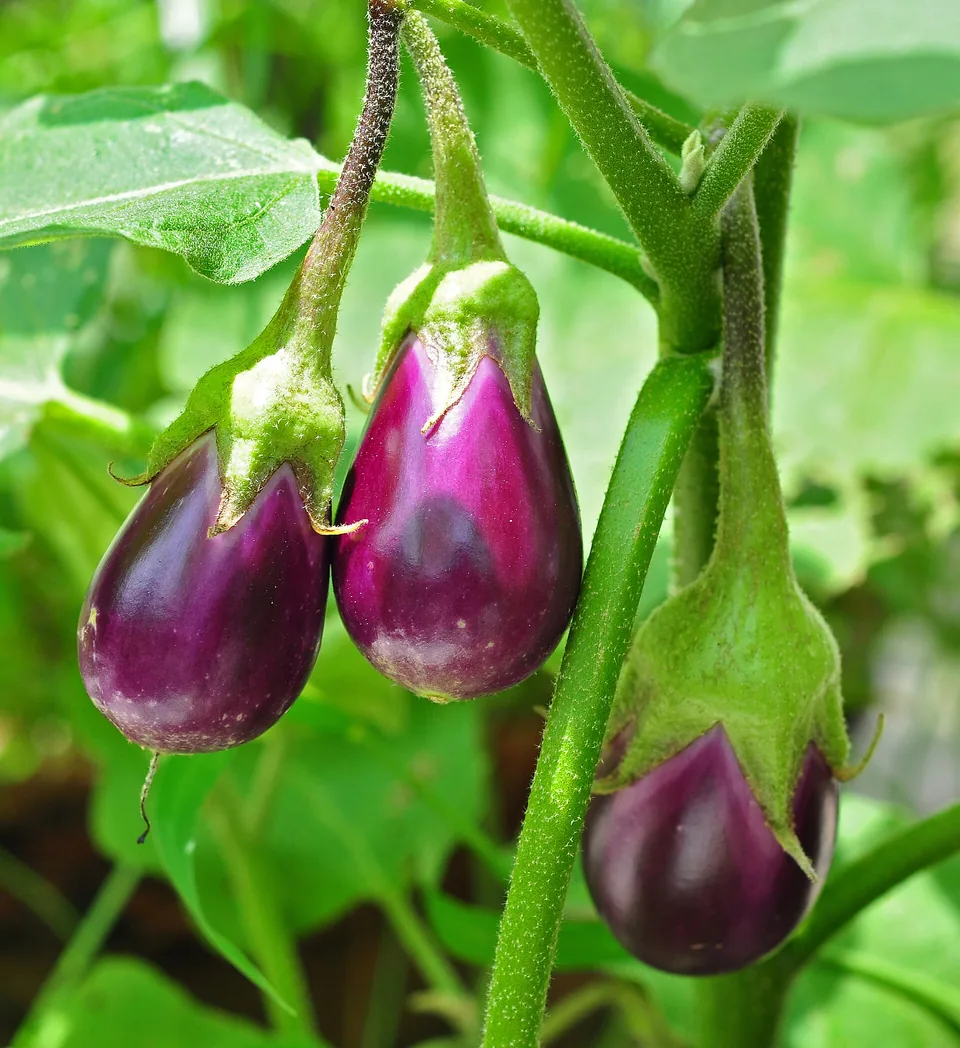


How to Grow and Care for Eggplant
Solanum melongena
Written by Emilio Marruso · last checked
Toxic to: Cats, Dogs, Horses, People · Why
At a glance
Eggplants are heat-loving plants that thrive in full sun and reward you with shiny, firm fruit. Start seeds indoors six to eight weeks before the last frost, then plant out in spring once the soil has warmed. Water deeply and steadily, 1 to 2 inches a week, and you can pick your first fruit 65 to 80 days after transplanting.
- Sun
Full sun
What the sources say (2)
Light: Full sun
The eggplant grows best in full sun. It prefers moist, well-drained, fertile, sandy, and loamy soils with a pH range of 5.5 to 6.8.
— Solanum melongena (Aubergine, Brinjal, Eggplant, Mad Apple, Raging Apple) | North Carolina Extension Gardener Plant Toolbox [1] Eggplants need a well-drained soil that receives eight to 10 hours of sunlight per day.
— Home Garden Eggplant | CAES Field Report [3] - Water
1–2 inches a week, deep and consistent; uneven moisture makes fruit bitter
What the sources say (6)
Watering: 1 to 2 inches [2.5–5.1 cm] of water per week, soaking the soil deeply (moistened to a depth of at least 6 inches [15 cm]) and keeping soil moisture consistent
Eggplant should receive about 1 inch of water per week, soaking the soil deeply to prevent blossom end rot and/or shallow root development.
— Eggplant: How to Grow It [2] Eggplants require between 1 to 2 inches of water per week for best production.
— Home Garden Eggplant | CAES Field Report [3] Water sufficiently to moisten the soil to a depth of at least 6 inches.
— Eggplant | Home & Garden Information Center [4] Watering notes: Inconsistent moisture makes fruit bitter and reduces yield; avoid overhead sprinkling; the critical period for soil moisture is fruit set and fruit development; mulch helps retain moisture
When moisture levels are inconsistent, eggplants can become bitter and will not produce well.
— Eggplant: How to Grow It [2] Avoid overhead sprinkling, as wet leaves are more disease-prone
— Eggplant: How to Grow It [2] The critical period for soil moisture is during fruit set and fruit development. Mulching can help retain consistent soil moisture, conserve water, and reduce weeds.
— Eggplant | Home & Garden Information Center [4] - Cold
Survives winters down to 20 °F (−6.7 °C)
Hardy in average winters · USDA 9a · RHS H4 · Z9
What the sources say (2)
Hardiness, coldest zone: 9a [winter low −6.7 to −3.9 °C (20 to 25 °F)]
USDA Plant Hardiness Zone: 9a, 9b, 10a, 10b, 11a, 11b, 12a, 12b
— Solanum melongena (Aubergine, Brinjal, Eggplant, Mad Apple, Raging Apple) | North Carolina Extension Gardener Plant Toolbox [1] Hardiness, warmest zone: 12b [winter low 12.8 to 15.6 °C (55 to 60 °F)]
USDA Plant Hardiness Zone: 9a, 9b, 10a, 10b, 11a, 11b, 12a, 12b
— Solanum melongena (Aubergine, Brinjal, Eggplant, Mad Apple, Raging Apple) | North Carolina Extension Gardener Plant Toolbox [1] - Spacing
30 inches between rows
What the sources say (2)
- Sowing
Sow indoors 6–8 weeks before the last frost; germinates in 8–12 days
What the sources say (9)
Sowing: Indoors six to eight weeks before planting outdoors (about six to eight weeks before the last frost)
South Georgia: Start the seeds indoors about six to eight weeks before the last frost. In south Georgia, this will be about the third week of February.
— Home Garden Eggplant | CAES Field Report [3] North Georgia: In north Georgia, this will be the last week of March.
— Home Garden Eggplant | CAES Field Report [3] South Dakota (SDSU Extension): If starting indoors, plant the seeds six to eight weeks before planting outdoors.
— Eggplant: How to Grow It [2] If starting indoors, plant the seeds six to eight weeks before planting outdoors.
— Eggplant: How to Grow It [2] Start the seeds indoors about six to eight weeks before the last frost.
— Home Garden Eggplant | CAES Field Report [3] Days to germination: 8-12
It is propagated by seeds and germination occurs in 8 -12 days.
— Solanum melongena (Aubergine, Brinjal, Eggplant, Mad Apple, Raging Apple) | North Carolina Extension Gardener Plant Toolbox [1] Germination: Germinates in 8-12 days; quickly at soil temperatures of 21.1-32.2 °C [70–90 °F], optimum 29.4 °C [85 °F]; no germination below 15.6 °C [60 °F].
It is propagated by seeds and germination occurs in 8 -12 days.
— Solanum melongena (Aubergine, Brinjal, Eggplant, Mad Apple, Raging Apple) | North Carolina Extension Gardener Plant Toolbox [1] Seeds germinate quickly at soil temperatures between 70 to 90 °F.
— Eggplant | Home & Garden Information Center [4] Optimal soil temperature for germination is 85 degrees Fahrenheit; they will not germinate below 60 degrees Fahrenheit.
— Eggplant: How to Grow It [2] - Planting
Plant out in spring after the last frost and once the soil has warmed
What the sources say (7)
Planting: Spring, after the last chance of frost and once the soil has thoroughly warmed; South Carolina transplanting dates: Piedmont May 1 - Jun 30, Coastal Apr 1 - Apr 30 (fall Coastal Aug 1 - Aug 31); South Dakota late May or early June
Piedmont (South Carolina), spring: Spring | Fall | Piedmont | May 1 – Jun 30 | Not recommended
— Eggplant | Home & Garden Information Center [4] Coastal (South Carolina), spring and fall: Coastal | Apr 1 – Apr 30 | Aug 1 – Aug 31
— Eggplant | Home & Garden Information Center [4] South Dakota (SDSU Extension): Transplant eggplant seedlings into the garden in late May or early June when night temperatures are consistently above 60 degrees Fahrenheit and the soil is warm.
— Eggplant: How to Grow It [2] Georgia (UGA Extension): The soil temperature should reach 65-70°F before planting the transplants in the garden.
— Home Garden Eggplant | CAES Field Report [3] Plant in the spring after the last chance of frost and the soil has thoroughly warmed.
— Eggplant | Home & Garden Information Center [4] Transplanting Dates | Area | Spring | Fall | Piedmont | May 1 – Jun 30 | Not recommended | Coastal | Apr 1 – Apr 30 | Aug 1 – Aug 31
— Eggplant | Home & Garden Information Center [4] Transplant eggplant seedlings into the garden in late May or early June when night temperatures are consistently above 60 degrees Fahrenheit and the soil is warm.
— Eggplant: How to Grow It [2] - Feeding
Feed before planting, then twice more 3–4 weeks apart; too much nitrogen gives leaves, not flowers
What the sources say (7)
When: Before planting, worked into the soil; side-dress three to four weeks after planting and again three to four weeks later
Apply preplant fertilizer according to soil test recommendations. Broadcast the fertilizer evenly and incorporate it into the soil by tilling or discing
— Eggplant | Home & Garden Information Center [4] Side dress plants with 5 pounds of calcium nitrate (15.5-0-0) per 1000 square feet or 300 feet of row three to four weeks after planting.
— Eggplant | Home & Garden Information Center [4] Side dress another 5 pounds per 1000 square feet or ½ pound per 100 square feet three to four weeks after that.
— Eggplant | Home & Garden Information Center [4] How often: One pre-plant application and two side-dressings three to four weeks apart
Side dress plants with 5 pounds of calcium nitrate (15.5-0-0) per 1000 square feet or 300 feet of row three to four weeks after planting.
— Eggplant | Home & Garden Information Center [4] Side dress another 5 pounds per 1000 square feet or ½ pound per 100 square feet three to four weeks after that.
— Eggplant | Home & Garden Information Center [4] Signs of excess: More leaves than flowers from too much nitrogen; burned roots or foliage from misplaced fertilizer
Beware that too much nitrogen can cause a plant to grow more leaves than flowers.
— Eggplant: How to Grow It [2] To avoid burning the roots, place side-dress fertilizer 4 to 6 inches away from the plants.
— Eggplant | Home & Garden Information Center [4] - Harvest
Pick 65–80 days after transplanting, when the skin is shiny and the fruit firm; cut, don't pull
What the sources say (5)
How to harvest: Harvest when the skin is shiny and the fruit is firm; dull or bronze skin means the fruit is overripe and bitter. Cut the fruit with a sharp knife or pruners, leaving 2.5 cm (1 inch) of stem on each fruit; do not pull or twist the fruit off the plant.
Harvest while the skin is still shiny and the fruit is firm. A dull or bronze-colored skin denotes that the eggplant is overripe and bitter-tasting.
— Eggplant: How to Grow It [2] Clip them off with knife or sharp shears and leave an inch of stem on each fruit. Do not pull the fruit off the plant, as you can damage both the fruit and the plant.
— Eggplant: How to Grow It [2] Cut the fruit with a sharp knife or pruners. Never twist the fruit to break it from the stem as this might limit future crop production.
— Home Garden Eggplant | CAES Field Report [3] Days to maturity: 65-80 days after transplanting (100-120 days when starting from seed)
Eggplant requires warm weather and will ripen about 65 to 80 days after transplanting.
— Eggplant: How to Grow It [2] Eggplants should be ready for harvest in about 65 to 80 days after transplanting, depending on the variety. When starting from seed, expect 100 to 120 days to reach maturity.
— Eggplant | Home & Garden Information Center [4] - Pests
Flea beetles, hornworms, aphids; remove plants with verticillium wilt, there is no home cure
What the sources say (4)
Pests: flea beetles, tomato hornworms, Colorado potato beetles, cutworms, spider mites, aphids, whiteflies, root-knot nematodes
Flea beetles, tomato hornworms, Colorado potato beetles, and cutworms are potential pests.
— Solanum melongena (Aubergine, Brinjal, Eggplant, Mad Apple, Raging Apple) | North Carolina Extension Gardener Plant Toolbox [1] Other less-common pests you may encounter are cutworms, Colorado potato beetles, and spider mites.
— Eggplant: How to Grow It [2] The major pests that feed on eggplant include flea beetles, Colorado potato beetles, aphids, whiteflies, hornworms, and mites.
— Eggplant | Home & Garden Information Center [4] Other commonly seen pests and diseases in the home garden include root-knot nematodes, Phytophthora blight, bacterial wilt, Southern blight, and Phomopsis blight.
— Eggplant | Home & Garden Information Center [4] - Safety
Only the fruit and seeds are edible, cooked; leaves, flowers, stems and roots are toxic
Overview
Eggplant is a warm-season vegetable that is very sensitive to cold and grows best in full sun. [1] Transplants go out after the last chance of frost once the soil has warmed, and plants need uniform soil moisture. [4] The fruit is edible, while the rest of the plant is poisonous and the fruit should not be eaten raw. [1]
Eggplant care
Measurements in square brackets are our conversion into the other unit system; the quoted text is unchanged.
How to water Eggplant
Watering
1 to 2 inches [2.5–5.1 cm] of water per week, soaking the soil deeply (moistened to a depth of at least 6 inches [15 cm]) and keeping soil moisture consistent
What the sources say (3)
Eggplant should receive about 1 inch of water per week, soaking the soil deeply to prevent blossom end rot and/or shallow root development.Eggplants require between 1 to 2 inches of water per week for best production.Water sufficiently to moisten the soil to a depth of at least 6 inches.Watering notes
Inconsistent moisture makes fruit bitter and reduces yield; avoid overhead sprinkling; the critical period for soil moisture is fruit set and fruit development; mulch helps retain moisture
What the sources say (3)
When moisture levels are inconsistent, eggplants can become bitter and will not produce well.Avoid overhead sprinkling, as wet leaves are more disease-proneThe critical period for soil moisture is during fruit set and fruit development. Mulching can help retain consistent soil moisture, conserve water, and reduce weeds.How much light Eggplant needs
Full sun
What the sources say (2)
The eggplant grows best in full sun. It prefers moist, well-drained, fertile, sandy, and loamy soils with a pH range of 5.5 to 6.8.Eggplants need a well-drained soil that receives eight to 10 hours of sunlight per day.How much cold Eggplant can take
Hardiness, coldest zone
9a [winter low −6.7 to −3.9 °C (20 to 25 °F)]
What the sources say (1)
USDA Plant Hardiness Zone:
9a, 9b, 10a, 10b, 11a, 11b, 12a, 12bHardiness, warmest zone
12b [winter low 12.8 to 15.6 °C (55 to 60 °F)]
What the sources say (1)
USDA Plant Hardiness Zone:
9a, 9b, 10a, 10b, 11a, 11b, 12a, 12bBest soil for Eggplant
Soil pH, minimum
The sources give different values depending on region, zone or growing conditions.
What each source says
According to NC State Extension: 5.5
Georgia (UGA Extension): 6.0
South Carolina (Clemson Extension): 6.0
What the sources say (3)
According to NC State Extension: It prefers moist, well-drained, fertile, sandy, and loamy soils with a pH range of 5.5 to 6.8.Georgia (UGA Extension): The soil pH should be between 6.0 and 7.0 for best growth.South Carolina (Clemson Extension): Follow the results of a soil test to maintain a soil pH between 6.0 and 6.5.Soil pH, maximum
The sources give different values depending on region, zone or growing conditions.
What each source says
According to NC State Extension: 6.8
Georgia (UGA Extension): 7.0
South Carolina (Clemson Extension): 6.5
What the sources say (3)
According to NC State Extension: It prefers moist, well-drained, fertile, sandy, and loamy soils with a pH range of 5.5 to 6.8.Georgia (UGA Extension): The soil pH should be between 6.0 and 7.0 for best growth.South Carolina (Clemson Extension): Follow the results of a soil test to maintain a soil pH between 6.0 and 6.5.Where to grow Eggplant
In containers
Yes
Spacing
The sources give different values depending on region, zone or growing conditions.
What each source says
South Dakota (SDSU Extension): 45.7 cm (18 in) between plants, rows 76.2 cm (30 in) apart
Georgia (UGA Extension): 45.7 cm (18 in) between plants, rows at least 76.2 cm (30 in) apart
South Carolina (Clemson Extension): 61.0-76.2 cm (2 to 2.5 ft) between plants, rows 91.4-121.9 cm (3 to 4 ft) apart
What the sources say (3)
South Dakota (SDSU Extension): Place the plants in a row 18 inches apart, with 30 inches separating the rows.Georgia (UGA Extension): Plant eggplants in a row, spacing them 18 inches apart, with at least 30 inches in between rows.South Carolina (Clemson Extension): Space plants 2 to 2½ feet apart in rows that are 3 to 4 feet apart.How to propagate Eggplant
Seed; transplants
What the sources say (2)
It is propagated by seeds and germination occurs in 8 -12 days.Set out 6 to 8-week-old transplants to get a head start toward harvest.How to grow Eggplant
The plant
Life cycle
annual or short-lived perennial
What the sources say (2)
Eggplant is an annual or short-lived perennial plant that is very sensitive to cold temperatures.In North Carolina, eggplant is considered an annual.Family
Solanaceae
What the sources say (1)
Eggplant or Aubergine is a member of the Solanaceae or nightshade family which also includes tomatoes, potatoes, and peppers.Mature height
61-122 cm (2 to 4 feet)
What the sources say (1)
The plant may grow 2 to 4 feet tall and is multi-branched.Mature width
30-91 cm (1 to 3 feet)
What the sources say (1)
Dimensions: Height: 2 ft. 0 in. - 4 ft. 0 in. Width: 1 ft. 0 in. - 3 ft. 0 in.Sowing and growth
Days to germination
8-12
What the sources say (1)
It is propagated by seeds and germination occurs in 8 -12 days.Row spacing
76 cm (30 inches)
Days to maturity
65-80 days after transplanting (100-120 days when starting from seed)
What the sources say (2)
Eggplant requires warm weather and will ripen about 65 to 80 days after transplanting.Eggplants should be ready for harvest in about 65 to 80 days after transplanting, depending on the variety. When starting from seed, expect 100 to 120 days to reach maturity.Harvest and storage
How to harvest
Harvest when the skin is shiny and the fruit is firm; dull or bronze skin means the fruit is overripe and bitter. Cut the fruit with a sharp knife or pruners, leaving 2.5 cm (1 inch) of stem on each fruit; do not pull or twist the fruit off the plant.
What the sources say (3)
Harvest while the skin is still shiny and the fruit is firm. A dull or bronze-colored skin denotes that the eggplant is overripe and bitter-tasting.Clip them off with knife or sharp shears and leave an inch of stem on each fruit. Do not pull the fruit off the plant, as you can damage both the fruit and the plant.Cut the fruit with a sharp knife or pruners. Never twist the fruit to break it from the stem as this might limit future crop production.Storage
Eggplant is highly perishable and best used soon after harvest. It keeps at room temperature for no more than a few days and in the refrigerator for about five days to a week, ideally at 7-10 °C (45 to 50 °F) and 90 percent relative humidity; it can also be frozen after skinning, slicing and blanching.
What the sources say (4)
For best results, store eggplant at room temperature for no longer than four days and in the refrigerator for about five days.Eggplant is highly perishable and should be used soon after harvesting.Harvested eggplant will store in the refrigerator for a week. The optimal conditions for storage are temperatures of 45 to 50 °F and 90-percent relative humidity.Eggplants can also be stored in the freezer if they are skinned, sliced and blanched before freezing.Pests and diseases
Pests
flea beetles, tomato hornworms, Colorado potato beetles, cutworms, spider mites, aphids, whiteflies, root-knot nematodes
What the sources say (4)
Flea beetles, tomato hornworms, Colorado potato beetles, and cutworms are potential pests.Other less-common pests you may encounter are cutworms, Colorado potato beetles, and spider mites.The major pests that feed on eggplant include flea beetles, Colorado potato beetles, aphids, whiteflies, hornworms, and mites.Other commonly seen pests and diseases in the home garden include root-knot nematodes, Phytophthora blight, bacterial wilt, Southern blight, and Phomopsis blight.Diseases
Verticillium wilt, early blight, Phytophthora blight, bacterial wilt, Southern blight, Phomopsis blight
What the sources say (3)
Verticillium wilt is the most-common eggplant disease.Early blight can infect eggplant, although this is not common.Other commonly seen pests and diseases in the home garden include root-knot nematodes, Phytophthora blight, bacterial wilt, Southern blight, and Phomopsis blight.Fertilizing
When
Before planting, worked into the soil; side-dress three to four weeks after planting and again three to four weeks later
What the sources say (3)
Apply preplant fertilizer according to soil test recommendations. Broadcast the fertilizer evenly and incorporate it into the soil by tilling or discingSide dress plants with 5 pounds of calcium nitrate (15.5-0-0) per 1000 square feet or 300 feet of row three to four weeks after planting.Side dress another 5 pounds per 1000 square feet or ½ pound per 100 square feet three to four weeks after that.How often
One pre-plant application and two side-dressings three to four weeks apart
What the sources say (2)
Side dress plants with 5 pounds of calcium nitrate (15.5-0-0) per 1000 square feet or 300 feet of row three to four weeks after planting.Side dress another 5 pounds per 1000 square feet or ½ pound per 100 square feet three to four weeks after that.Natural fertilizers
Compost or other organic matter incorporated into the native soil
What the sources say (1)
Adding organic matter in the form of topsoil, compost or a bagged amendment and incorporating it into the native soil can improve results.Mineral fertilizers
Without a soil test: complete fertilizer such as 10-10-10 or 13-13-13 at 146.4 g/m²; side-dress with calcium nitrate (15.5-0-0) at 24.4 g/m², or 24.8 g per m of row
What each source says
where soil tests indicate a need only for nitrogen: Nitrogen-only lawn fertilizer such as 26-0-0, never a weed-and-feed product containing herbicide
where soil tests indicate a need only for nitrogen: 26-0-0 lawn fertilizer, never a weed-and-feed product, at 12.2 g/m².
pre-plant fertilizer: Broadcast evenly and incorporated into the soil to a depth of 15.2 cm [6 in].
What the sources say (6)
where soil tests indicate a need only for nitrogen: In that case, a lawn fertilizer such as 26-0-0 (be sure it is not a “weed and feed” product, which also contains herbicide) can be usedwhere soil tests indicate a need only for nitrogen: a lawn fertilizer such as 26-0-0 (be sure it is not a “weed and feed” product, which also contains herbicide) can be used, at a rate of about 0.25 pounds (4 ounces) per 100 square feet.pre-plant fertilizer: Broadcast the fertilizer evenly and incorporate it into the soil by tilling or discing to a depth of around 6 inches.In the absence of a soil test, a complete fertilizer such as 10-10-10 or 13-13-13 can be applied at the rate of 3 pounds per 100 square feet of garden.Side dress plants with 5 pounds of calcium nitrate (15.5-0-0) per 1000 square feet or 300 feet of row three to four weeks after planting.For smaller gardens, use ½ pound of calcium nitrate fertilizer per 100 square feet or 30 feet of row.Avoid
Too much nitrogen; side-dress fertilizer closer than 10.2-15.2 cm [4–6 in] to the plants; granules left on the leaves; weed-and-feed lawn products containing herbicide
What the sources say (4)
Beware that too much nitrogen can cause a plant to grow more leaves than flowers.To avoid burning the roots, place side-dress fertilizer 4 to 6 inches away from the plants.If fertilizer is broadcast, avoid burning the plant foliage by watering overhead after the application to wash any fertilizer granules off the leaves.a lawn fertilizer such as 26-0-0 (be sure it is not a “weed and feed” product, which also contains herbicide)Signs of excess
More leaves than flowers from too much nitrogen; burned roots or foliage from misplaced fertilizer
Spacing
Between plants
The sources disagree:
What each source says
South Dakota and Georgia (USA): 46 cm [18 in] in the row
Georgia (USA): 46 cm [18 in] in the row
South Carolina (USA): 61-76.2 cm [24–30 in] in the row
What the sources say (3)
South Dakota and Georgia (USA): Planting: Place the plants in a row 18 inches apart, with 30 inches separating the rows.Georgia (USA): Plant eggplants in a row, spacing them 18 inches apart, with at least 30 inches in between rows.South Carolina (USA): Space plants 2 to 2½ feet apart in rows that are 3 to 4 feet apart.Between rows
The sources disagree:
What each source says
South Dakota (USA): 76.2 cm [30 in] between rows
Georgia (USA): at least 76.2 cm [30 in] between rows
South Carolina (USA): 91.4-122 cm [36–48 in] between rows
What the sources say (3)
South Dakota (USA): Planting: Place the plants in a row 18 inches apart, with 30 inches separating the rows.Georgia (USA): Plant eggplants in a row, spacing them 18 inches apart, with at least 30 inches in between rows.South Carolina (USA): Space plants 2 to 2½ feet apart in rows that are 3 to 4 feet apart.Propagation
Germination
Germinates in 8-12 days; quickly at soil temperatures of 21.1-32.2 °C [70–90 °F], optimum 29.4 °C [85 °F]; no germination below 15.6 °C [60 °F].
What the sources say (3)
It is propagated by seeds and germination occurs in 8 -12 days.Seeds germinate quickly at soil temperatures between 70 to 90 °F.Optimal soil temperature for germination is 85 degrees Fahrenheit; they will not germinate below 60 degrees Fahrenheit.After harvest
Storage
Highly perishable. Best kept at 7.2-10 °C [45–50 °F] and 90% relative humidity; in the refrigerator five days to a week; at room temperature no longer than four days.
What the sources say (4)
The optimal conditions for storage are temperatures of 45 to 50 °F and 90-percent relative humidity.Harvested eggplant will store in the refrigerator for a week.For best results, store eggplant at room temperature for no longer than four days and in the refrigerator for about five days.Eggplant is highly perishable and should be used soon after harvesting.Heat and drought
Heat
Heat-loving crop, listed as heat resistant.
What the sources say (2)
who brought this heat-loving member of the Solanaceus family from EuropeResistance To Challenges: Heat Problems: Problem for CatsEggplant pests and problems
Flea beetles
Symptom: Many small, round holes chewed in leaves, which can weaken plants and fruit growth
What to do: Plant later to avoid the first generation, use trap crops and row covers
What the sources say (2)
Flea beetles chew many small, round holes into eggplant leaves. This can weaken plants and fruit growth.
— Eggplant: How to Grow It [2] Cultural controls for flea beetles include planting later to avoid the first generation, trap crops, and row covers.
— Eggplant: How to Grow It [2] Verticillium wilt
Symptom: Soilborne; leaves turn yellow and curl inward, then dry out and turn brown
What to do: No treatment for homeowners, remove the plants; prevent with disease-resistant cultivars and crop rotation
What the sources say (2)
It is soilborne and causes the leaves to turn yellow and curl inward. As the disease progresses, leaves dry out and turn brown. There is no treatment for homeowners; the plants should be removed.
— Eggplant: How to Grow It [2] It is best prevented by planting disease-resistant cultivars and rotation of crops.
— Solanum melongena (Aubergine, Brinjal, Eggplant, Mad Apple, Raging Apple) | North Carolina Extension Gardener Plant Toolbox [1] Bitter fruit from uneven moisture
Symptom: Eggplants can become bitter and will not produce well when soil moisture is inconsistent
What to do: Maintain a consistent soil moisture level
What the sources say (1)
Maintaining a consistent soil moisture level is the best way to ensure strong fruit development.
— Eggplant: How to Grow It [2]
Remedies
Each remedy shows what official sources say about it; traditional remedies without an official source are marked as such. Harmful ones are listed so you know to avoid them.
Treating the plant
aphids
strong water spray Official source, not independently tested
How: Spray sturdy plants with a strong jet of water to knock aphids from the leaves.
sturdy plants can be sprayed with a strong jet of water to knock aphids from leaves
— plantvillage.psu.edu [5] insecticidal soap spray Works
always check the labels of the products for specific usage guidelines prior to use
— plantvillage.psu.edu [5] How: Insecticidal soap, used according to the product label.
insecticidal soaps or oils such as neem or canola oil are usually the best method of control
— plantvillage.psu.edu [5] What the evidence says For example, insecticidal soap is a safe, effective organic insecticide with minimal environmental impact.
— extension.psu.edu [6] neem oil spray Works
always check the labels of the products for specific usage guidelines prior to use
— plantvillage.psu.edu [5] How: Neem oil, used according to the product label.
insecticidal soaps or oils such as neem or canola oil are usually the best method of control
— plantvillage.psu.edu [5] What the evidence says Neem oil is found in the seeds of the neem tree. The active component found in this biological pesticide reduces insect feeding, interferes with hormones
— extension.illinois.edu [7] walnut leaf infusion Not verified
Traditional remedy, not verified by an official source.
spray on plants after testing on a single plant for 3–4 hours.
— gardenvive.com [9] While these natural remedies can be effective against pathogens, on the other hand, they may also carry some chemical properties that are not good for human health.
— gardenvive.com [9] How: Fill a metal bucket two thirds full with fall walnut leaves, pour boiling water over them, seal tightly and infuse through fall, winter and spring; dilute 1–2 liters of concentrate in 8–10 liters of water and spray after testing on a single plant for 3–4 hours.
grass ash infusion spray Not verified
Traditional remedy, not verified by an official source.
While these natural remedies can be effective against pathogens, on the other hand, they may also carry some chemical properties that are not good for human health.
— gardenvive.com [9] How: Mix 1–1.5 cups of ash in 10 liters of water, let it sit for a day, strain and spray; add green or laundry soap for better adherence.
dandelion onion garlic decoction Not verified
Traditional remedy, not verified by an official source.
While these natural remedies can be effective against pathogens, on the other hand, they may also carry some chemical properties that are not good for human health.
— gardenvive.com [9] How: Blend one cup each of dandelion leaves, onion and garlic in 10 liters of water with 1–2 tablespoons of soap; let it soak for 2–3 hours, strain and spray.
colorado potato beetle
handpicking into soapy water Works
How: Hand pick adults and larvae from the plants and destroy them in soapy water.
adults and larvae should be hand picked from plants and destroyed in soapy water
— plantvillage.psu.edu [5] What the evidence says Mechanical control includes handpicking insects. This is an easy strategy for larger, slow-moving insects, such as hornworms and Colorado potato beetles.
— hgic.clemson.edu [8] dandelion onion garlic decoction Not verified
Traditional remedy, not verified by an official source.
While these natural remedies can be effective against pathogens, on the other hand, they may also carry some chemical properties that are not good for human health.
— gardenvive.com [9] How: Blend one cup each of dandelion leaves, onion and garlic in 10 liters of water with 1–2 tablespoons of soap; let it soak for 2–3 hours, strain and spray.
cutworms
handpicking at night Works
How: Hand-pick larvae after dark.
hand-pick larvae after dark; spread diatomaceous earth around the base of the plants (this creates a sharp barrier
— plantvillage.psu.edu [5] What the evidence says Mechanical control includes handpicking insects. This is an easy strategy for larger, slow-moving insects, such as hornworms and Colorado potato beetles.
— hgic.clemson.edu [8] diatomaceous earth barrier Official source, not independently tested
How: Spread diatomaceous earth around the base of the plants; it creates a sharp barrier that cuts insects crawling over it.
spread diatomaceous earth around the base of the plants (this creates a sharp barrier that will cut the insects if they try and crawl over it)
— plantvillage.psu.edu [5] foil collars Official source, not independently tested
How: Fit plastic or foil collars around the stems, covering the bottom 3 inches above the soil line and extending a couple of inches into the soil.
plastic or foil collars fitted around plant stems to cover the bottom 3 inches above the soil line and extending a couple of inches into the soil can prevent larvae severing plants
— plantvillage.psu.edu [5]
flea beetles
neem oil spray Works
How: Oils such as neem oil are effective for organic growers.
application on diamotecoeus earth or oils such as neem oil are effective control methods for organic growers
— plantvillage.psu.edu [5] What the evidence says Neem oil is found in the seeds of the neem tree. The active component found in this biological pesticide reduces insect feeding, interferes with hormones
— extension.illinois.edu [7] cruciferous trap crops Official source, not independently tested
How: Trap crops may provide a measure of control; cruciferous plants are best.
trap crops may provide a measure of control - cruciferous plants are best
— plantvillage.psu.edu [5]
hornworms
handpicking Works
How: Hand pick larvae from plants, leaving parasitized larvae behind to promote natural enemies.
Hand pick larvae from plants leaving any parasitized larvae behind to promote populations of natural enemies
— plantvillage.psu.edu [5] What the evidence says Mechanical control includes handpicking insects. This is an easy strategy for larger, slow-moving insects, such as hornworms and Colorado potato beetles.
— hgic.clemson.edu [8]
stink bugs
insecticidal soap spray Works
How: Insecticidal soaps are an organically accepted control method.
organically accepted control methods include the use of insecticidal soaps, kaolin clay and preservation of natural enemies
— plantvillage.psu.edu [5] What the evidence says For example, insecticidal soap is a safe, effective organic insecticide with minimal environmental impact.
— extension.psu.edu [6]
spider mites
strong water spray Official source, not independently tested
How: Spray plants with a strong jet of water to reduce buildup of spider mite populations.
In the home garden, spraying plants with a strong jet of water can help reduce buildup of spider mite populations
— plantvillage.psu.edu [5] insecticidal soap spray Works
How: If mites become problematic, apply insecticidal soap to the plants.
if mites become problematic apply insecticidal soap to plants
— plantvillage.psu.edu [5] What the evidence says For example, insecticidal soap is a safe, effective organic insecticide with minimal environmental impact.
— extension.psu.edu [6]
Is Eggplant toxic to pets?
Reported by the source, quoted verbatim. This is not medical or veterinary advice: if a person or an animal may have eaten this plant, contact a poison control centre or a veterinarian.
Animals
#problem for dogs #problem for horses #problem for cats
[1]The source flags the risk for this animal but does not explain why.
People
Calendar
Sowing
Indoors six to eight weeks before planting outdoors (about six to eight weeks before the last frost)
What each source says
South Georgia: About the third week of February (indoors, six to eight weeks before the last frost)
North Georgia: The last week of March (indoors)
South Dakota (SDSU Extension): Indoors six to eight weeks before planting outdoors; transplants can be started in April
What the sources say (5)
South Georgia: Start the seeds indoors about six to eight weeks before the last frost. In south Georgia, this will be about the third week of February.North Georgia: In north Georgia, this will be the last week of March.South Dakota (SDSU Extension): If starting indoors, plant the seeds six to eight weeks before planting outdoors.If starting indoors, plant the seeds six to eight weeks before planting outdoors.Start the seeds indoors about six to eight weeks before the last frost.Planting
Spring, after the last chance of frost and once the soil has thoroughly warmed; South Carolina transplanting dates: Piedmont May 1 - Jun 30, Coastal Apr 1 - Apr 30 (fall Coastal Aug 1 - Aug 31); South Dakota late May or early June
What each source says
Piedmont (South Carolina), spring: May 1 to June 30
Coastal (South Carolina), spring and fall: April 1 to April 30; fall August 1 to August 31
South Dakota (SDSU Extension): Late May or early June
Georgia (UGA Extension): After the danger of frost has passed, when soil temperature reaches 65-70°F [18–21 °C]
What the sources say (7)
Piedmont (South Carolina), spring: Spring | Fall | Piedmont | May 1 – Jun 30 | Not recommendedCoastal (South Carolina), spring and fall: Coastal | Apr 1 – Apr 30 | Aug 1 – Aug 31South Dakota (SDSU Extension): Transplant eggplant seedlings into the garden in late May or early June when night temperatures are consistently above 60 degrees Fahrenheit and the soil is warm.Georgia (UGA Extension): The soil temperature should reach 65-70°F before planting the transplants in the garden.Plant in the spring after the last chance of frost and the soil has thoroughly warmed.Transplanting Dates
| Area
| Spring
| Fall
| Piedmont
| May 1 – Jun 30
| Not recommended
| Coastal
| Apr 1 – Apr 30
| Aug 1 – Aug 31Transplant eggplant seedlings into the garden in late May or early June when night temperatures are consistently above 60 degrees Fahrenheit and the soil is warm.Harvest
The sources give different values depending on region, zone or growing conditions.
What each source says
South Carolina, from transplants (Clemson Extension): About 65 to 80 days after transplanting
South Carolina, from seed (Clemson Extension): 100 to 120 days to maturity
Georgia (UGA Extension): 64 to 80 days, depending on the variety
South Dakota (SDSU Extension): August, September, and possibly early October
According to NC State Extension: About 105-133 days
What the sources say (6)
South Carolina, from transplants (Clemson Extension): Eggplants should be ready for harvest in about 65 to 80 days after transplanting, depending on the variety.South Carolina, from seed (Clemson Extension): When starting from seed, expect 100 to 120 days to reach maturity.Georgia (UGA Extension): Eggplants will be ready for harvest, depending on the variety, in 64 to 80 days.South Dakota (SDSU Extension): Eggplant transplants can be started in April; planted in late May and early June; and harvested in August, September, and possibly early October depending on the yearAccording to NC State Extension: The fruits may be harvested in about 105-133 days.Eggplants should be ready for harvest in about 65 to 80 days after transplanting, depending on the variety. When starting from seed, expect 100 to 120 days to reach maturity.Months as given by the sources, which are mostly from the United States (northern hemisphere). In the southern hemisphere they shift by about six months.
Relative to frost
Less precise estimate: there is no weather station within 300 km.
Find frost dates by ZIP code or city
Sow indoors: 6 to 8 weeks before the last frost
Start the seeds indoors about six to eight weeks before the last frost.
— Home Garden Eggplant | CAES Field Report [3] Plant: around the last frost
Plant in the spring after the last chance of frost and the soil has thoroughly warmed.
— Eggplant | Home & Garden Information Center [4]
Count from the average frost dates where you live.
Edibility
Reported by the source, quoted verbatim. Do not eat a plant on the basis of this page alone: identification mistakes can be dangerous.
Indicative values
Values from a secondary source, not checked word for word like the rest of this page. Use them as a starting point.
- Drought tolerant
- yesIndicative value, adapt it to your climate · Secondary source
- Indoors
- yesIndicative value, adapt it to your climate · Secondary source
- Care level
- MediumIndicative value, adapt it to your climate · Secondary source
- Growth rate
- LowIndicative value, adapt it to your climate · Secondary source
- Pruning
- December, January, February, March, April, May, March, April, May, June, July, August, September, May, December, January, February, MayIndicative value, adapt it to your climate · Secondary source
Similar plants
- Bittersweet Solanum dulcamara
- Brazilian nightshade Solanum seaforthianum
- Potato Solanum tuberosum
- Sticky nightshade Solanum sisymbriifolium
- Tomato Solanum lycopersicum
- Apple of Sodom Solanum mammosum
- Chilean Nightshade Chilean Solanum crispum
- Angel's-tears Brugmansia suaveolens
Sources
Every value above is quoted from these documents. Links lead to the original publisher.
- Solanum melongena (Aubergine, Brinjal, Eggplant, Mad Apple, Raging Apple) | North Carolina Extension Gardener Plant Toolbox · plants.ces.ncsu.edu, consulted
- Eggplant: How to Grow It · extension.sdstate.edu, consulted
- Home Garden Eggplant | CAES Field Report · extension.uga.edu, consulted
- Eggplant | Home & Garden Information Center · hgic.clemson.edu, consulted
- plantvillage.psu.edu · plantvillage.psu.edu
- extension.psu.edu · extension.psu.edu
- extension.illinois.edu · extension.illinois.edu
- hgic.clemson.edu · hgic.clemson.edu
- gardenvive.com · gardenvive.com
Written by Emilio Marruso · last checked