
How to Grow and Care for Brazilian nightshade
Solanum seaforthianum
Written by Emilio Marruso · last checked
Toxic to: People · Why
At a glance
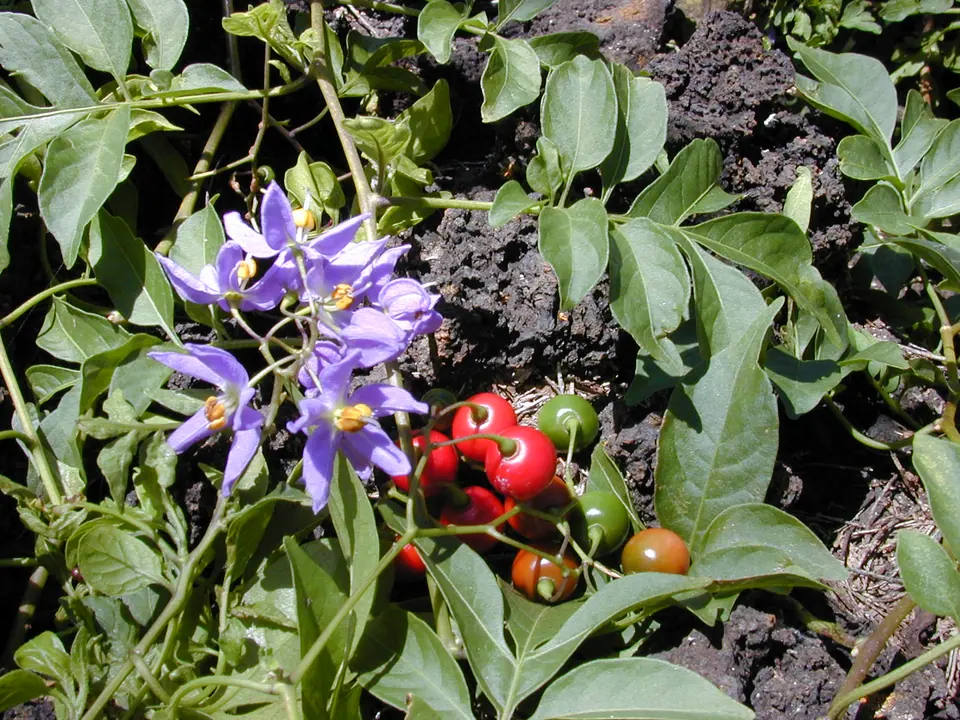
This nightshade vine fills summer with clusters of violet-blue flowers, each 1 inch wide, followed by small red fruits that only birds can eat. It grows in full sun to part shade and stays evergreen where winters are mildest. Start new plants from seeds or stem cuttings, and enjoy it with your eyes only: stems, leaves and fruit are poisonous.
- Sun
Full sun to part shade
What the sources say (1)
Light: Full sun to part shade
Winter hardy to USDA Zones 11-12 where it is best grown in organically rich, medium moisture, well-drained soils in full sun to part shade.
— TAXON: Solanum seaforthianum [1] - Cold
Survives winters down to 40 °F (4.4 °C)
Tender: needs a frost-free greenhouse · USDA 11 · RHS H2 · Z11
What the sources say (2)
Hardiness, coldest zone: 11 [winter low 4.4 to 10 °C (40 to 50 °F)]
Winter hardy to USDA Zones 11-12 where it is best grown in organically rich, medium moisture, well-drained soils in full sun to part shade.
— TAXON: Solanum seaforthianum [1] Hardiness, warmest zone: 12 [winter low 10 to 15.6 °C (50 to 60 °F)]
Winter hardy to USDA Zones 11-12 where it is best grown in organically rich, medium moisture, well-drained soils in full sun to part shade.
— TAXON: Solanum seaforthianum [1] - Harvest
Not for eating: the small red fruits are food for birds only
- Propagation
Grow new plants from seeds or stem cuttings
What the sources say (1)
Propagation: Seeds; stem cuttings
It is easily propagated by seeds or stem cuttings.
— TAXON: Solanum seaforthianum [1] - Safety
Poisonous if eaten: stems, leaves and fruit
Overview
Brazilian nightshade is a vine grown as an ornamental that has naturalized in many tropical areas. [1] It is considered a weed in the tropics and can form dense stands in disturbed environments. [3] It is winter hardy to USDA zones 11-12 and grows in full sun to part shade. [1]
This record is incomplete: the sources we read do not cover every field yet.
Not yet covered by our sources: Watering, Pruning
Brazilian nightshade care
How to water Brazilian nightshade
Not stated in the sources we read.
How much light Brazilian nightshade needs
Full sun to part shade
What the sources say (1)
Winter hardy to USDA Zones 11-12 where it is best grown in organically rich, medium moisture, well-drained soils in full sun to part shade.How much cold Brazilian nightshade can take
Hardiness, coldest zone
11 [winter low 4.4 to 10 °C (40 to 50 °F)]
What the sources say (1)
Winter hardy to USDA Zones 11-12 where it is best grown in organically rich, medium moisture, well-drained soils in full sun to part shade.Hardiness, warmest zone
12 [winter low 10 to 15.6 °C (50 to 60 °F)]
What the sources say (1)
Winter hardy to USDA Zones 11-12 where it is best grown in organically rich, medium moisture, well-drained soils in full sun to part shade.How to propagate Brazilian nightshade
Seeds; stem cuttings
What the sources say (1)
It is easily propagated by seeds or stem cuttings.How to grow Brazilian nightshade
The plant
Family
Solanaceae
What the sources say (1)
Family
SOLANACEAE
Genus
Solanum
Species
Solanum seaforthianum Andrews
Common Name
BRAZILIAN NIGHTSHADERemedies
Each remedy shows what official sources say about it; traditional remedies without an official source are marked as such. Harmful ones are listed so you know to avoid them.
First aid
First aid: not a substitute for a doctor
poisoning
take a piece of the plant or a photo to hospital Official source, not independently tested
If the patient is conscious and responsive call the Poisons Information Centre on 13 11 26 or your doctor.
— weeds.dpi.nsw.gov.au [6] How: If going to a hospital take a piece of the plant for identification or take a photo and take it with you to the hospital.
If going to a hospital take a piece of the plant for identification or take a photo and take it with you to the hospital.
— weeds.dpi.nsw.gov.au [6]
Getting rid of it
brazilian nightshade infestation
hand pulling or digging Official source, not independently tested
Ensure that all of the fruit are collected and disposed of. Contact your local council for advice on disposal.
— weeds.dpi.nsw.gov.au [6] How: The seedlings can be pulled out when young. Older plants can be pulled or dug out if the soil is not too hard. Take care to remove all of the roots.
The seedlings can be pulled out when young. Older plants can be pulled or dug out if the soil is not too hard. Take care to remove all of the roots.
— weeds.dpi.nsw.gov.au [6]
Is Brazilian nightshade poisonous?
Reported by the source, quoted verbatim. This is not medical or veterinary advice: if a person or an animal may have eaten this plant, contact a poison control centre or a veterinarian.
Stems, leaves and fruit of this nightshade vine are poisonous if ingested.
[1]- Poisonous parts
Stems, leaves and fruit of this nightshade vine are poisonous if ingested.
[1]- Toxic principle
Solasodine (0.3%) is present in leaf and stem, as well as in the green fruit
[1]- Symptoms
The green berries of Solanum seaforthianum have definite toxicity. There have been reports that the ripe fruit also can cause gastrointestinal irritation.
[1]
Calendar
Pruning
Not stated in the sources we read.
Months as given by the sources, which are mostly from the United States (northern hemisphere). In the southern hemisphere they shift by about six months.
Edibility
Reported by the source, quoted verbatim. Do not eat a plant on the basis of this page alone: identification mistakes can be dangerous.
S. seaforthianum. Brazilian nightshade. Vine; evergreen in mildest winter areas; leaves to 8 inches long; clusters of violet blue, inch-wide flowers in summer, small red fruits edible only to birds.
[5]
Indicative values
Values from a secondary source, not checked word for word like the rest of this page. Use them as a starting point.
- Life cycle
- PerennialIndicative value, adapt it to your climate · Secondary source
- Mature height
- 457.2-609.6 cm (15-20 ft)Indicative value, adapt it to your climate · Secondary source
- Hours of sun
- 4-6 hoursIndicative value, adapt it to your climate · Secondary source
- Watering
- AverageIndicative value, adapt it to your climate · Secondary source
- Drought tolerant
- yesIndicative value, adapt it to your climate · Secondary source
- Soil pH
- 6-7.5Indicative value, adapt it to your climate · Secondary source
- Care level
- MediumIndicative value, adapt it to your climate · Secondary source
- Growth rate
- LowIndicative value, adapt it to your climate · Secondary source
- Pruning
- March, April, May, June, JulyIndicative value, adapt it to your climate · Secondary source
Similar plants
- Bittersweet Solanum dulcamara
- Eggplant Solanum melongena
- Potato Solanum tuberosum
- Sticky nightshade Solanum sisymbriifolium
- Tomato Solanum lycopersicum
- Apple of Sodom Solanum mammosum
- Chilean Nightshade Chilean Solanum crispum
- Angel's-tears Brugmansia suaveolens
Sources
Every value above is quoted from these documents. Links lead to the original publisher.
- TAXON: Solanum seaforthianum · plantpono.org, consulted
- Solanum seaforthianum / [Species detail] / Plant Atlas · florida.plantatlas.usf.edu, consulted
- GISD · iucngisd.org, consulted
- Plants of South Eastern New South Wales · apps.lucidcentral.org, consulted
- How to Grow Solanum - Potato Vine · harvesttotable.com, consulted
- weeds.dpi.nsw.gov.au · weeds.dpi.nsw.gov.au
Written by Emilio Marruso · last checked