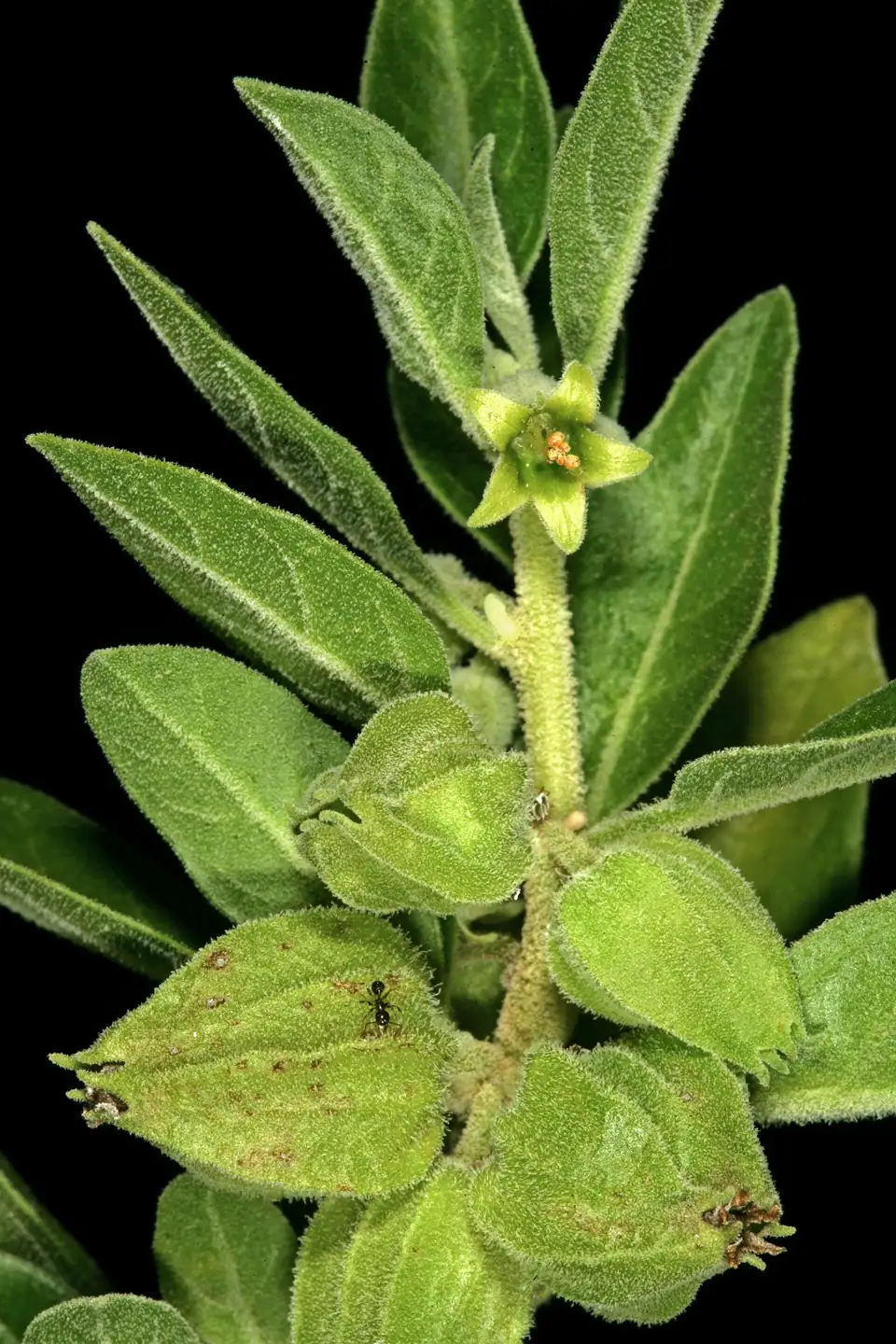


How to Grow and Care for Ashwagandha
Withania somnifera
Written by Emilio Marruso · last checked
Toxic to: People · Why
At a glance
This sun-loving perennial is easy to please: give it full sun, soil that drains well and a drink only when the soil dries out. Sow the seeds once the air warms above 70°F. It grows happily in a pot too, and in colder areas you can enjoy it as an annual. Its prized medicinal roots are ready when flowers and fruits form.
- Sun
Full sun: 6 or more hours of direct sunlight a day
What the sources say (1)
Light: Full sun (6 or more hours of direct sunlight a day)
Full sun (6 or more hours of direct sunlight a day)
— Withania somnifera (Ashwagandha, Ashwagandha, Vedic, Indian Ginseng, Indian Winter Cherry, Poison Gooseberry, Winter Cherry) | North Carolina Extension Gardener Plant Toolbox [1] - Water
Water only when the soil dries out; it needs good drainage
What the sources say (2)
Watering: Water only when the soil dries out
Water the plant only when the soil drys out as it does not like wet feet.
— Withania somnifera (Ashwagandha, Ashwagandha, Vedic, Indian Ginseng, Indian Winter Cherry, Poison Gooseberry, Winter Cherry) | North Carolina Extension Gardener Plant Toolbox [1] Watering notes: Does not like wet feet; good drainage
Water the plant only when the soil drys out as it does not like wet feet.
— Withania somnifera (Ashwagandha, Ashwagandha, Vedic, Indian Ginseng, Indian Winter Cherry, Poison Gooseberry, Winter Cherry) | North Carolina Extension Gardener Plant Toolbox [1] - Cold
Survives winters down to 10 °F (−12.2 °C)
Hardy in cold winters · USDA 8a · RHS H5 · Z8
What the sources say (2)
Hardiness, coldest zone: 8a [winter low −12.2 to −9.4 °C (10 to 15 °F)]
8a, 8b, 9a, 9b, 10a, 10b, 11a, 11b, 12a, 12b
— Withania somnifera (Ashwagandha, Ashwagandha, Vedic, Indian Ginseng, Indian Winter Cherry, Poison Gooseberry, Winter Cherry) | North Carolina Extension Gardener Plant Toolbox [1] Hardiness, warmest zone: 12b [winter low 12.8 to 15.6 °C (55 to 60 °F)]
8a, 8b, 9a, 9b, 10a, 10b, 11a, 11b, 12a, 12b
— Withania somnifera (Ashwagandha, Ashwagandha, Vedic, Indian Ginseng, Indian Winter Cherry, Poison Gooseberry, Winter Cherry) | North Carolina Extension Gardener Plant Toolbox [1] - Sowing
Sow seeds 3/4 inch deep once the air is above 70°F
What the sources say (2)
Sowing: Sow seed 2 centimeters [0.8 in] deep once the air temperature is above 70 degrees F [21 °C]
It does well in pots and can be grown from seed planting them 2 centimeters deep once the air temperature is above 70 degrees F.
— Withania somnifera (Ashwagandha, Ashwagandha, Vedic, Indian Ginseng, Indian Winter Cherry, Poison Gooseberry, Winter Cherry) | North Carolina Extension Gardener Plant Toolbox [1] Sowing depth: 2 cm [0.8 in]
It does well in pots and can be grown from seed planting them 2 centimeters deep once the air temperature is above 70 degrees F.
— Withania somnifera (Ashwagandha, Ashwagandha, Vedic, Indian Ginseng, Indian Winter Cherry, Poison Gooseberry, Winter Cherry) | North Carolina Extension Gardener Plant Toolbox [1] - Feeding
Feed with manure or worm compost; skip heavy doses of manure and fertilizer
What the sources say (5)
Natural fertilizers: Organic manures, such as farmyard manure or vermicompost: the crop responds well to them
field production: It responds well to organic manures and addition of 10 tonnes FYM / 1 tonne vermicompost per hectare is recommended.
— [3] field preparation: The land is well ploughed and pulverized and brought to a fine tilth. 10 to 20 tonnes farm yard manure is applied.
— [3] nursery bed: The nursery bed usually raised from ground level is prepared by thorough mixing with compost and sand.
— [3] It responds well to organic manures and addition of 10 tonnes FYM / 1 tonne vermicompost per hectare is recommended.
— [3] Avoid: Heavy doses of manure and fertilizer: the crop does not need them
The crop does not require heavy doses of manures and fertilizers.
— [3] - Harvest
Dig the roots when flowers and fruits form and the leaves start to dry
What the sources say (2)
Harvest: Roots: when flowers and fruits form and leaves start to dry out
Roots are medicinal, harvest when flowers and fruits form and leaves start to dry out.
— Withania somnifera (Ashwagandha, Ashwagandha, Vedic, Indian Ginseng, Indian Winter Cherry, Poison Gooseberry, Winter Cherry) | North Carolina Extension Gardener Plant Toolbox [1] How to harvest: Harvest the roots when flowers and fruits form and the leaves start to dry out; to use the fruits, remove the seeds first by drying the fruits and crushing them.
Roots are medicinal, harvest when flowers and fruits form and leaves start to dry out. Fruits can also be eaten but remove seeds first, this is best achieved by drying the fruits and crushing them.
— Withania somnifera (Ashwagandha, Ashwagandha, Vedic, Indian Ginseng, Indian Winter Cherry, Poison Gooseberry, Winter Cherry) | North Carolina Extension Gardener Plant Toolbox [1] - Pests
Watch for stem and root rot
What the sources say (1)
Diseases: stem and root rot
Stem and root rot can effect this plant.
— Withania somnifera (Ashwagandha, Ashwagandha, Vedic, Indian Ginseng, Indian Winter Cherry, Poison Gooseberry, Winter Cherry) | North Carolina Extension Gardener Plant Toolbox [1] - Safety
Fruits are poisonous; it can cause dependence and weaken immune-suppressing drugs
Overview
Ashwagandha is a small shrub or herb grown as an annual in zones colder than 8, and as a ground covering perennial in its native habitat. [1] It is placed in full sun and watered only when the soil dries out, since it does not like wet feet. [1] The plant is described as toxic if eaten, and the roots are used in Ayurvedic medicine. [1]
This record is incomplete: the sources we read do not cover every field yet.
Not yet covered by our sources: Pruning
Ashwagandha care
Measurements in square brackets are our conversion into the other unit system; the quoted text is unchanged.
How to water Ashwagandha
Watering
Water only when the soil dries out
What the sources say (1)
Water the plant only when the soil drys out as it does not like wet feet.Watering notes
Does not like wet feet; good drainage
What the sources say (1)
Water the plant only when the soil drys out as it does not like wet feet.How much light Ashwagandha needs
Full sun (6 or more hours of direct sunlight a day)
What the sources say (1)
Full sun (6 or more hours of direct sunlight a day)How much cold Ashwagandha can take
Hardiness, coldest zone
8a [winter low −12.2 to −9.4 °C (10 to 15 °F)]
What the sources say (1)
8a, 8b, 9a, 9b, 10a, 10b, 11a, 11b, 12a, 12bHardiness, warmest zone
12b [winter low 12.8 to 15.6 °C (55 to 60 °F)]
What the sources say (1)
8a, 8b, 9a, 9b, 10a, 10b, 11a, 11b, 12a, 12bWhere to grow Ashwagandha
Yes
What the sources say (1)
It does well in pots and can be grown from seed planting them 2 centimeters deep once the air temperature is above 70 degrees F.How to propagate Ashwagandha
Seed; stem cutting
What the sources say (1)
Life Cycle:
Annual
Perennial
Woody
Recommended Propagation Strategy:
Seed
Stem CuttingHow to grow Ashwagandha
The plant
Life cycle
perennial (grown as an annual in zones colder than 8)
What the sources say (1)
Withania somnifera is a small shrub or herb grown as an annual in zones colder than 8 but in its native habitat it grows as a ground covering perennial.Family
Solanaceae
What the sources say (1)
Attributes: Genus: Withania Species: somnifera Family: Solanaceae Uses (Ethnobotany): An herb used in Ayurvedic medicineSowing and growth
Sowing depth
2 cm [0.8 in]
What the sources say (1)
It does well in pots and can be grown from seed planting them 2 centimeters deep once the air temperature is above 70 degrees F.Harvest and storage
How to harvest
Harvest the roots when flowers and fruits form and the leaves start to dry out; to use the fruits, remove the seeds first by drying the fruits and crushing them.
What the sources say (1)
Roots are medicinal, harvest when flowers and fruits form and leaves start to dry out. Fruits can also be eaten but remove seeds first, this is best achieved by drying the fruits and crushing them.Pests and diseases
Diseases
stem and root rot
What the sources say (1)
Stem and root rot can effect this plant.Fertilizing
When
The sources give different values depending on region, zone or growing conditions.
What each source says
field production: Manure worked into the soil at field preparation, before ridging and transplanting
What the sources say (1)
field production: After the manures are incorporated in the soil, ridges are prepared at 60 cm spacing.Natural fertilizers
Organic manures, such as farmyard manure or vermicompost: the crop responds well to them
What each source says
field production: Farmyard manure 10 t/ha or vermicompost 1 t/ha
field preparation: Farmyard manure 10–20 t/ha
nursery bed: Compost and sand mixed thoroughly into the bed
What the sources say (4)
field production: It responds well to organic manures and addition of 10 tonnes FYM / 1 tonne vermicompost per hectare is recommended.field preparation: The land is well ploughed and pulverized and brought to a fine tilth. 10 to 20 tonnes farm yard manure is applied.nursery bed: The nursery bed usually raised from ground level is prepared by thorough mixing with compost and sand.It responds well to organic manures and addition of 10 tonnes FYM / 1 tonne vermicompost per hectare is recommended.Mineral fertilizers
The sources give different values depending on region, zone or growing conditions.
What each source says
field production: Nitrogen 15 kg [33.1 lb]/ha and phosphorus 15 kg [33.1 lb]/ha, for higher production
What the sources say (1)
field production: Application of 15 kg of Nitrogen and 15 kg of Phosphorous per hectare is beneficial for higher production.Avoid
Heavy doses of manure and fertilizer: the crop does not need them
What the sources say (1)
The crop does not require heavy doses of manures and fertilizers.Ashwagandha pests and problems
Stem and root rot
Symptom: Stem and root rot can affect the plant.
What the sources say (1)
Stem and root rot can effect this plant.
— Withania somnifera (Ashwagandha, Ashwagandha, Vedic, Indian Ginseng, Indian Winter Cherry, Poison Gooseberry, Winter Cherry) | North Carolina Extension Gardener Plant Toolbox [1]
Remedies
Each remedy shows what official sources say about it; traditional remedies without an official source are marked as such. Harmful ones are listed so you know to avoid them.
Getting rid of it
self-seeding
pulling unwanted seedlings Not verified
Traditional remedy, not verified by an official source.
How: Remove unwanted seedlings where they appear in unintended locations.
Is Ashwagandha poisonous?
Reported by the source, quoted verbatim. This is not medical or veterinary advice: if a person or an animal may have eaten this plant, contact a poison control centre or a veterinarian.
Calendar
Sowing
Sow seed 2 centimeters [0.8 in] deep once the air temperature is above 70 degrees F [21 °C]
What the sources say (1)
It does well in pots and can be grown from seed planting them 2 centimeters deep once the air temperature is above 70 degrees F.Harvest
Roots: when flowers and fruits form and leaves start to dry out
What the sources say (1)
Roots are medicinal, harvest when flowers and fruits form and leaves start to dry out.Pruning
Not stated in the sources we read.
Months as given by the sources, which are mostly from the United States (northern hemisphere). In the southern hemisphere they shift by about six months.
Edibility
Reported by the source, quoted verbatim. Do not eat a plant on the basis of this page alone: identification mistakes can be dangerous.
Roots are medicinal, harvest when flowers and fruits form and leaves start to dry out. Fruits can also be eaten but remove seeds first, this is best achieved by drying the fruits and crushing them.
[1]
Similar plants
- Angel's-tears Brugmansia suaveolens
- Belladonna Atropa belladonna
- Bittersweet Solanum dulcamara
- Bladder cherry Alkekengi officinarum
- Brazilian nightshade Solanum seaforthianum
- Brunfelsia Brunfelsia pauciflora
- Cayenne Pepper Capsicum annuum
- Clammy Ground Cherry Physalis heterophylla
Sources
Every value above is quoted from these documents. Links lead to the original publisher.
- Withania somnifera (Ashwagandha, Ashwagandha, Vedic, Indian Ginseng, Indian Winter Cherry, Poison Gooseberry, Winter Cherry) | North Carolina Extension Gardener Plant Toolbox · plants.ces.ncsu.edu, consulted
- Ashwagandha - Withania somnifera | North Carolina Extension Gardener Plant Toolbox · plants.ces.ncsu.edu, consulted
- agritech.tnau.ac.in · agritech.tnau.ac.in
Written by Emilio Marruso · last checked