

How to Grow and Care for Brunfelsia
Brunfelsia pauciflora
Written by Emilio Marruso · last checked
Toxic to: Cats, Dogs, Horses, People · Why
At a glance
Brunfelsia is a perennial shrub that grows happily outdoors in full sun or partial shade, and even indoors with just 3 hours of sun a day. Give it moist, humus-rich soil and a humid spot, and it can reach 3 to 8 feet tall. It also does well in containers, and you can make new plants from softwood cuttings.
- Sun
Full sun to partial shade; indoors, 3 hours of sun a day
What the sources say (2)
Light: Full sun to partial shade; indoors, 3 hours of sun daily
This shrub prefers full sun to partial shade and moist, humus-rich, acidic soil.
— Brunfelsia pauciflora (Brazil Raintree, Brunfelsia, Fransiscan Rain Tree, Kiss-Me-Quick, Lady-of-the-Night, Morning, Noon and Night, Yesterday, Today and Tomorrow Plant) | North Carolina Extension Gardener Plant Toolbox [1] Provide the indoor plant with 3 hours of sun daily
— Brunfelsia pauciflora (Brazil Raintree, Brunfelsia, Fransiscan Rain Tree, Kiss-Me-Quick, Lady-of-the-Night, Morning, Noon and Night, Yesterday, Today and Tomorrow Plant) | North Carolina Extension Gardener Plant Toolbox [1] - Water
Keep the soil moist but not soggy; water less when the plant is resting
What the sources say (2)
Watering: Keep the soil moist but not soggy; cut back on watering when the plant is dormant
keep the soil moist but not soggy. Cut back on watering when the plant is dormant.
— Brunfelsia pauciflora (Brazil Raintree, Brunfelsia, Fransiscan Rain Tree, Kiss-Me-Quick, Lady-of-the-Night, Morning, Noon and Night, Yesterday, Today and Tomorrow Plant) | North Carolina Extension Gardener Plant Toolbox [1] Watering notes: Prefers moist, humus-rich soil and a humid environment
This shrub prefers full sun to partial shade and moist, humus-rich, acidic soil. It also prefers a humid environment.
— Brunfelsia pauciflora (Brazil Raintree, Brunfelsia, Fransiscan Rain Tree, Kiss-Me-Quick, Lady-of-the-Night, Morning, Noon and Night, Yesterday, Today and Tomorrow Plant) | North Carolina Extension Gardener Plant Toolbox [1] - Cold
Survives winters down to 20 °F (−6.7 °C)
Hardy in average winters · USDA 9a · RHS H4 · Z9
What the sources say (2)
Hardiness, coldest zone: 9a [winter low −6.7 to −3.9 °C (20 to 25 °F)]
USDA Plant Hardiness Zone: 9a, 9b, 10a, 10b, 11a, 11b
— Brunfelsia pauciflora (Brazil Raintree, Brunfelsia, Fransiscan Rain Tree, Kiss-Me-Quick, Lady-of-the-Night, Morning, Noon and Night, Yesterday, Today and Tomorrow Plant) | North Carolina Extension Gardener Plant Toolbox [1] Hardiness, warmest zone: 11b [winter low 7.2 to 10 °C (45 to 50 °F)]
USDA Plant Hardiness Zone: 9a, 9b, 10a, 10b, 11a, 11b
— Brunfelsia pauciflora (Brazil Raintree, Brunfelsia, Fransiscan Rain Tree, Kiss-Me-Quick, Lady-of-the-Night, Morning, Noon and Night, Yesterday, Today and Tomorrow Plant) | North Carolina Extension Gardener Plant Toolbox [1] - Soil
Moist soil rich in humus, in a humid spot
What the sources say (1)
Watering notes: Prefers moist, humus-rich soil and a humid environment
This shrub prefers full sun to partial shade and moist, humus-rich, acidic soil. It also prefers a humid environment.
— Brunfelsia pauciflora (Brazil Raintree, Brunfelsia, Fransiscan Rain Tree, Kiss-Me-Quick, Lady-of-the-Night, Morning, Noon and Night, Yesterday, Today and Tomorrow Plant) | North Carolina Extension Gardener Plant Toolbox [1] - Pruning
If it needs a harder pruning, do it in fall
What the sources say (1)
Pruning: Fall for heavier pruning, if needed
Prune to encourage more blooms as they occur on new growth. Heaviest blooming is in spring and early summer. Repeat blooming can occur anytime during the year under favorable conditions. Heavier pruning, if needed, is recommended in the fall.
— Brunfelsia pauciflora (Brazil Raintree, Brunfelsia, Fransiscan Rain Tree, Kiss-Me-Quick, Lady-of-the-Night, Morning, Noon and Night, Yesterday, Today and Tomorrow Plant) | North Carolina Extension Gardener Plant Toolbox [1] - Pests
Watch for spider mites, whiteflies, thrips, mealybugs and aphids
What the sources say (1)
Pests: spider mites, whiteflies, thrips, mealybugs, aphids
This shrub is generally diseases free. Monitor for spider mites, whiteflies, thrips, and mealybugs when grown in a glasshouse or conservatory. Aphids may also weaken the plant.
— Brunfelsia pauciflora (Brazil Raintree, Brunfelsia, Fransiscan Rain Tree, Kiss-Me-Quick, Lady-of-the-Night, Morning, Noon and Night, Yesterday, Today and Tomorrow Plant) | North Carolina Extension Gardener Plant Toolbox [1] - Size
3 to 8 ft tall and 4 to 6 ft wide
What the sources say (2)
Mature height: 91-244 cm (3 ft - 8 ft)
The yesterday, today, and tomorrow plant grows up to 3 to 8 feet tall and 4 to 6 feet wide and has an open airy habit.
— Brunfelsia pauciflora (Brazil Raintree, Brunfelsia, Fransiscan Rain Tree, Kiss-Me-Quick, Lady-of-the-Night, Morning, Noon and Night, Yesterday, Today and Tomorrow Plant) | North Carolina Extension Gardener Plant Toolbox [1] Mature width: 122-183 cm (4 ft - 6 ft)
The yesterday, today, and tomorrow plant grows up to 3 to 8 feet tall and 4 to 6 feet wide and has an open airy habit.
— Brunfelsia pauciflora (Brazil Raintree, Brunfelsia, Fransiscan Rain Tree, Kiss-Me-Quick, Lady-of-the-Night, Morning, Noon and Night, Yesterday, Today and Tomorrow Plant) | North Carolina Extension Gardener Plant Toolbox [1] - Propagation
New plants from softwood stem cuttings
What the sources say (1)
Propagation: Softwood cuttings (stem cuttings)
The plant is best propagated by softwood cuttings.
— Brunfelsia pauciflora (Brazil Raintree, Brunfelsia, Fransiscan Rain Tree, Kiss-Me-Quick, Lady-of-the-Night, Morning, Noon and Night, Yesterday, Today and Tomorrow Plant) | North Carolina Extension Gardener Plant Toolbox [1] - Containers
Grows in containers and indoors too
What the sources say (2)
In containers: Yes
It also can be grown as a container plant or in a glasshouse or conservatory.
— Brunfelsia pauciflora (Brazil Raintree, Brunfelsia, Fransiscan Rain Tree, Kiss-Me-Quick, Lady-of-the-Night, Morning, Noon and Night, Yesterday, Today and Tomorrow Plant) | North Carolina Extension Gardener Plant Toolbox [1] Indoors: Yes
In North Carolina, this plant would need to be brought indoors for the winter. Provide the indoor plant with 3 hours of sun daily
— Brunfelsia pauciflora (Brazil Raintree, Brunfelsia, Fransiscan Rain Tree, Kiss-Me-Quick, Lady-of-the-Night, Morning, Noon and Night, Yesterday, Today and Tomorrow Plant) | North Carolina Extension Gardener Plant Toolbox [1] - Safety
All parts are poisonous to people, cats, dogs and horses, berries most of all; wear gloves
Overview
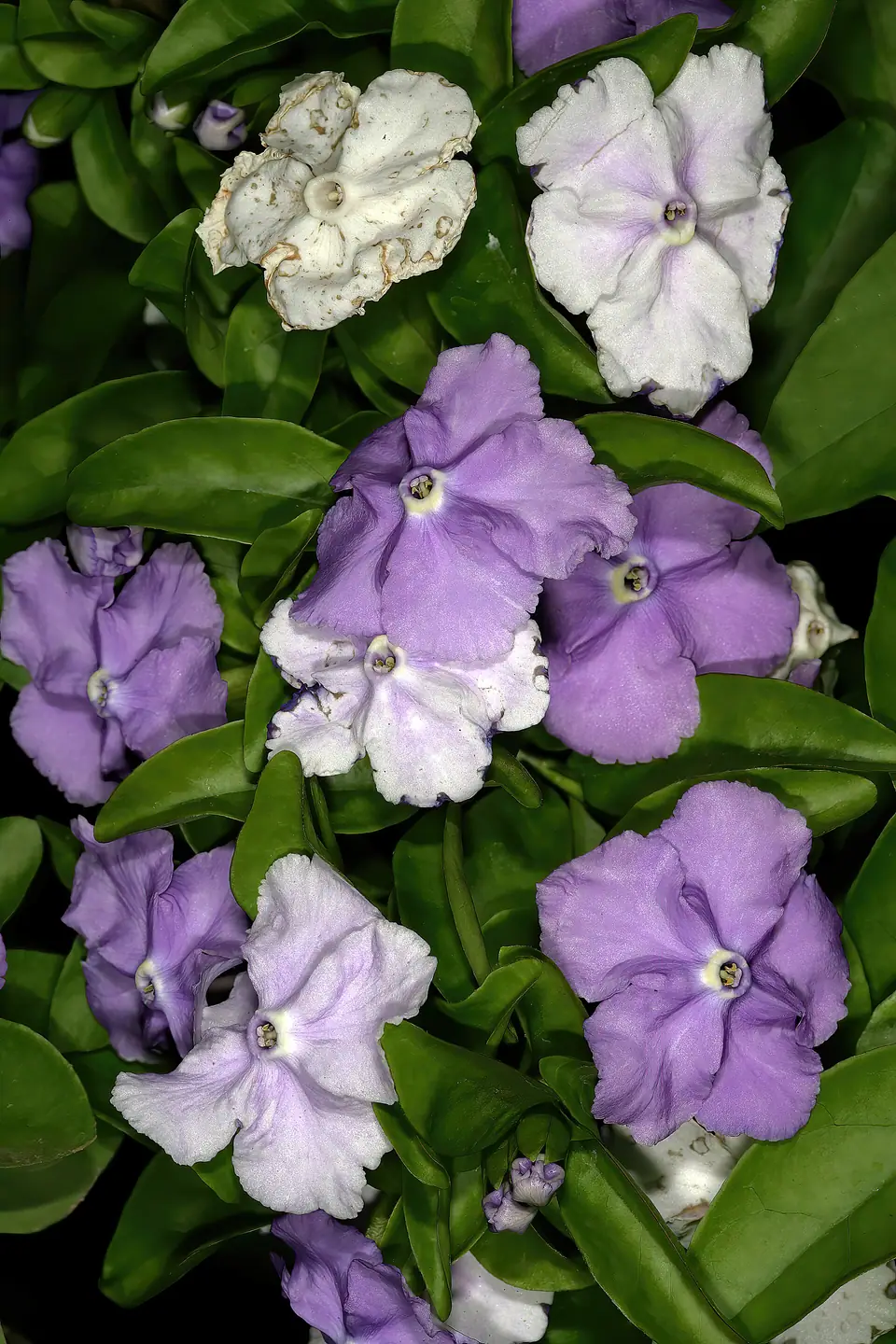
Brunfelsia pauciflora is a bushy, free-flowering perennial shrub whose blooms change from deep purple to lavender to white as they mature. [1] It prefers full sun to partial shade and moist, humus-rich, acidic soil, and can be grown as a screen, hedge, or container plant. [1] All parts are toxic if ingested, especially the berries, to dogs, cats, horses, and humans. [1]
Brunfelsia care
How to water Brunfelsia
Watering
Keep the soil moist but not soggy; cut back on watering when the plant is dormant
What the sources say (1)
keep the soil moist but not soggy. Cut back on watering when the plant is dormant.Watering notes
Prefers moist, humus-rich soil and a humid environment
What the sources say (1)
This shrub prefers full sun to partial shade and moist, humus-rich, acidic soil. It also prefers a humid environment.How much light Brunfelsia needs
Full sun to partial shade; indoors, 3 hours of sun daily
What the sources say (2)
This shrub prefers full sun to partial shade and moist, humus-rich, acidic soil.Provide the indoor plant with 3 hours of sun dailyHow much cold Brunfelsia can take
Hardiness, coldest zone
9a [winter low −6.7 to −3.9 °C (20 to 25 °F)]
What the sources say (1)
USDA Plant Hardiness Zone:
9a, 9b, 10a, 10b, 11a, 11bHardiness, warmest zone
11b [winter low 7.2 to 10 °C (45 to 50 °F)]
What the sources say (1)
USDA Plant Hardiness Zone:
9a, 9b, 10a, 10b, 11a, 11bWhere to grow Brunfelsia
Indoors
Yes
What the sources say (1)
In North Carolina, this plant would need to be brought indoors for the winter. Provide the indoor plant with 3 hours of sun dailyIn containers
Yes
What the sources say (1)
It also can be grown as a container plant or in a glasshouse or conservatory.How to propagate Brunfelsia
Softwood cuttings (stem cuttings)
What the sources say (1)
The plant is best propagated by softwood cuttings.How to grow Brunfelsia
The plant
Life cycle
perennial
What the sources say (1)
The yesterday, today and tomorrow plant is a bushy, free-flowering, perennial shrub in the nightshade family (Solanaceae)Family
Solanaceae
What the sources say (1)
The yesterday, today and tomorrow plant is a bushy, free-flowering, perennial shrub in the nightshade family (Solanaceae)Mature height
91-244 cm (3 ft - 8 ft)
What the sources say (1)
The yesterday, today, and tomorrow plant grows up to 3 to 8 feet tall and 4 to 6 feet wide and has an open airy habit.Mature width
122-183 cm (4 ft - 6 ft)
What the sources say (1)
The yesterday, today, and tomorrow plant grows up to 3 to 8 feet tall and 4 to 6 feet wide and has an open airy habit.Pests and diseases
Pests
spider mites, whiteflies, thrips, mealybugs, aphids
What the sources say (1)
This shrub is generally diseases free. Monitor for spider mites, whiteflies, thrips, and mealybugs when grown in a glasshouse or conservatory. Aphids may also weaken the plant.Brunfelsia pests and problems
Pests
Symptom: Spider mites, whiteflies, thrips, and mealybugs under glass; aphids may weaken the plant.
What to do: Monitor for these pests.
What the sources say (1)
Monitor for spider mites, whiteflies, thrips, and mealybugs when grown in a glasshouse or conservatory. Aphids may also weaken the plant.
— Brunfelsia pauciflora (Brazil Raintree, Brunfelsia, Fransiscan Rain Tree, Kiss-Me-Quick, Lady-of-the-Night, Morning, Noon and Night, Yesterday, Today and Tomorrow Plant) | North Carolina Extension Gardener Plant Toolbox [1]
Remedies
Each remedy shows what official sources say about it; traditional remedies without an official source are marked as such. Harmful ones are listed so you know to avoid them.
Treating the plant
aphids
insecticidal soap spray Not verified
Traditional remedy, not verified by an official source.
How: Aphids, spider mites and whiteflies can usually be managed with insecticidal soap or a strong spray of water.
washing off with a gentle stream of water Not verified
Traditional remedy, not verified by an official source.
How: Wash them off using a gentle stream of water.
spider mites
strong spray of water Not verified
Traditional remedy, not verified by an official source.
How: Aphids, spider mites and whiteflies can usually be managed with insecticidal soap or a strong spray of water.
mealybugs
neem oil spray Not verified
Traditional remedy, not verified by an official source.
How: Try using natural neem oil spray.
whiteflies
neem oil spray Not verified
Traditional remedy, not verified by an official source.
How: Try using natural neem oil spray.
yellow leaves
more acidic soil mix and iron sulphate in water Not verified
Traditional remedy, not verified by an official source.
How: Repot the plant in a more acidic soil mix. You can also use iron sulphate mixed in water to water the plant.
Is Brunfelsia toxic to pets?
Reported by the source, quoted verbatim. This is not medical or veterinary advice: if a person or an animal may have eaten this plant, contact a poison control centre or a veterinarian.
Animals
If ingested, all parts of this shrub are toxic, especially the berries, to dogs, cats, horses, and humans.
[1]- Poisonous parts
Poison Part: Bark Flowers Fruits Leaves Roots Sap/Juice Seeds Stems
[1]- Toxic principle
Poison Toxic Principle: Brunfelsamidine and toxic alkaloids
[1]- Symptoms
Oral irritation, nausea, vomiting, diarrhea, skin and eye irritation, tremor, seizures, lethargy, incoordination, hypersalivation, coughing
[1]- Severity
Poison Severity: Medium
[1]
People
Gloves are recommended when handling this plant since it can cause skin and oral irritation.
[1]
Calendar
Pruning
Fall for heavier pruning, if needed
What the sources say (1)
Prune to encourage more blooms as they occur on new growth. Heaviest blooming is in spring and early summer. Repeat blooming can occur anytime during the year under favorable conditions. Heavier pruning, if needed, is recommended in the fall.Months as given by the sources, which are mostly from the United States (northern hemisphere). In the southern hemisphere they shift by about six months.
Similar plants
- Angel's-tears Brugmansia suaveolens
- Ashwagandha Withania somnifera
- Belladonna Atropa belladonna
- Bittersweet Solanum dulcamara
- Bladder cherry Alkekengi officinarum
- Brazilian nightshade Solanum seaforthianum
- Cayenne Pepper Capsicum annuum
- Clammy Ground Cherry Physalis heterophylla
Sources
Every value above is quoted from these documents. Links lead to the original publisher.
- Brunfelsia pauciflora (Brazil Raintree, Brunfelsia, Fransiscan Rain Tree, Kiss-Me-Quick, Lady-of-the-Night, Morning, Noon and Night, Yesterday, Today and Tomorrow Plant) | North Carolina Extension Gardener Plant Toolbox · plants.ces.ncsu.edu, consulted
- Brunfelsia - Brunfelsia pauciflora | North Carolina Extension Gardener Plant Toolbox · plants.ces.ncsu.edu, consulted
- Morning, Noon and Night - Brunfelsia pauciflora | North Carolina Extension Gardener Plant Toolbox · plants.ces.ncsu.edu, consulted
- Lady-of-the-Night - Brunfelsia pauciflora | North Carolina Extension Gardener Plant Toolbox · plants.ces.ncsu.edu, consulted
- Brazil Raintree - Brunfelsia pauciflora | North Carolina Extension Gardener Plant Toolbox · plants.ces.ncsu.edu, consulted
- Yesterday, Today and Tomorrow Plant - Brunfelsia pauciflora | North Carolina Extension Gardener Plant Toolbox · plants.ces.ncsu.edu, consulted
Written by Emilio Marruso · last checked