Houseplant care in winter: 8 changes to make until spring
Less water, no fertilizer, more light and kinder air: what US extension services change for houseplants from November to spring, with their numbers side by side.
by Emilio MarrusoPublished
In short:
- Water less often, and only when the top inch of soil feels dry [7].
- Skip the fertilizer while plants rest through the short days [10].
- Give them your brightest window, but keep the leaves off the cold glass [5] [8].
Short days, dry heat and cold windows make winter one of the most common times of year for houseplants to decline, says an Illinois Extension horticulture educator, and more of them die from too much water than from too little [3].
Growth slows as sunlight dwindles, so plants simply need less [3]. The good news: the fixes are small, cheap and quick. Here is what US extension services change in November, and why.
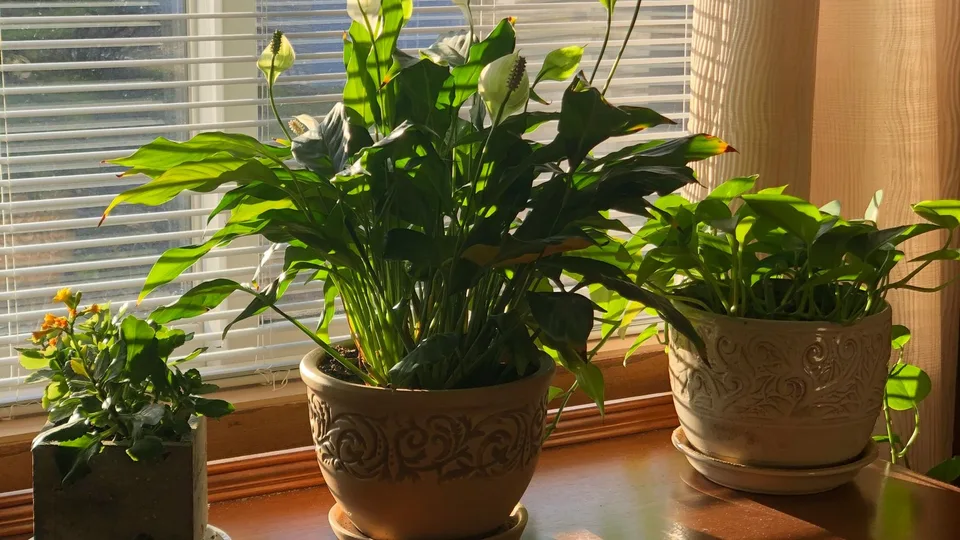
Why winter is tough indoors
Light is the greatest factor limiting houseplant growth in winter, as days get shorter and the sun sits lower [3]. Even a well-lit home is often below 100 foot-candles, while a clear day outdoors can exceed 10,000 [10].
The air dries out too: the University of Missouri notes that winter humidity in the average home is lower than in the Sahara [4], and low humidity can mean slow growth, dried-up flower buds and brown leaf tips [6].
Summer vs winter at a glance
| Spring and summer | Winter | |
|---|---|---|
| Water | Water when the soil is dry to the touch [6] | Less often [7]; overwatering kills more plants [3] |
| Light | More light, longer days [10] | Shorter days, lower sun: move plants closer to windows [3] [5] |
| Fertilizer | Only during active growth [1] | None during the winter rest [10] |
| Humidity | Plants prefer 40–50% [6] | Homes fall below 30% [1], as low as 10% [6] |
Where the extensions agree and differ
| Illinois | Iowa State | Missouri | |
|---|---|---|---|
| Daytime | 65–75°F (18.3–23.9°C) [1] | 65–75°F (18.3–23.9°C) [8] | 65–70°F (18.3–21.1°C) [4] |
| Night | 5–10°F (2.8–5.6°C) cooler [1] | 60–65°F (15.6–18.3°C) [8] | Check near windows on cold nights [4] |
| Danger zone | Cold glass damages foliage [1] | Avoid below 55°F (12.8°C) [6] | Chill injury below 40°F (4.4°C) for some tropicals [4] |
| Target humidity | 40–50% [3] | 40–50% [6] | 40–60% [4] |
| Soil check | 2 inches (5.1 cm) [2] | 1 inch (2.5 cm) [7] | Bottom two-thirds of the pot [4] |
Our reading: all three agree that the soil, not the calendar, decides when to water [2] [4] [7], and the gap on humidity is only in the upper limit.
What you’ll need
Tools
- A soft cloth or sponge
- A soft-bristled brush for fuzzy leaves
- A thermometer and humidity gauge near the plants
- A magnifying glass for tiny pests
Materials
- Shallow trays and pebbles
- Room-temperature water
- Clear plastic for drafty windows
- A humidifier, if you have one
Adjust indoor care for winter
Step 1 Move them closer to the light
The University of Missouri's November gardening tips say plants dropping leaves may need more light: move them closer to windows or to sunnier west- and south-facing exposures [5]. North- and east-facing windows that were fine in summer can become too shaded in winter [3].
Light falls off quickly with distance, and spots more than a few feet from even a bright window are often too dim [6]. Open the curtains and sheers, which greatly reduce light [6]. For dim rooms, see our guide to houseplants for low light.
Step 2 Turn the pot once a week
Leaves orient themselves toward the light, and turning the plant once a week keeps it from growing one-sided [4].
Step 3 Keep the leaves off cold glass
Cold glass can damage foliage [1], so make sure no leaf touches a cold window, as Iowa State's winter temperature advice puts it [8]. Windows are cooler than the rest of the room, and drapes drawn around a plant can leave it too cold [4].
Do not trap plants between the curtain and the pane, where it gets warm in the daytime sun and quite cold at night [6]. With newer windows, a few inches of space from the glass is usually enough; drafty ones can be covered with clear plastic, which does not block enough light to seriously affect most houseplants [13].
Step 4 Steer clear of vents and drafts
Avoid blasts of cold and hot air from windows, radiators and vents [1]. Hot air blowing on a plant often browns leaf edges and can make leaves drop [4], and an opening front door sends in cold drafts [6]. The UNH Extension suggests keeping sun-loving succulents closer to heat sources and tropical foliage plants farther away [13].
Step 5 Water less, and only by touch
Houseplants need less frequent watering in winter than in spring and summer [7]. Iowa State University Extension says to touch the soil and water once it is dry 1 inch (2.5 cm) down, until water flows out of the bottom [7]. Illinois Extension's watering guide tests to 2 inches (5.1 cm), warns that a fixed schedule usually does not work and asks for room-temperature water, never cold [2].
Empty the saucer after 30 to 45 minutes [6]. If leaves are turning yellow, our guide to yellow leaves on houseplants reads the pattern.
Step 6 Put the fertilizer away until spring
During the short days of winter, many indoor plants with little or no artificial light enter a resting stage, and resting plants should not be fed [10]. Fertilizer will not push new growth on a plant in poor conditions and can add injury by raising the salt content of the potting mix [4]. Start again once active growth begins in spring [11].
Step 7 Raise the humidity the smart way
Group plants together [1] [6], set pots on a pebble tray with the pot bottom above the water [6], or run a humidifier, which works well [6]. Kitchens and bathrooms are often more humid, if they have enough light [3].
Misting raises humidity for only a few minutes and can spread disease [6]. Brown leaf tips and edges are a sign the air is too dry [13]. More in our guide to houseplants that like humid air.
Step 8 Dust the leaves
Dust on leaves can inhibit photosynthesis [11]. According to Iowa State's cleaning advice, cleaning improves appearance, stimulates growth and may help control insects and mites [9]. Wipe large leaves with a damp soft cloth or sponge: clear water does the job without the risk dish soap carries for the leaf cuticle [9]. Use a soft brush on fuzzy leaves such as African violets [9] [10].
Winter pests to watch for
Iowa State's spider mite advice notes that winter is when many people first notice spider mites, because dry indoor air and reduced plant vigor favor them [12]. English ivy and Norfolk Island pine are particularly susceptible [12]. Look for tiny yellowish-green speckles on the leaves and fine webbing on leaves and stems [12].
A forceful spray of water in the shower or bathtub can dislodge light infestations [12]. Also keep an eye out for aphids, mealybugs and scale [5]; Clemson adds that mealybugs, scale and fungus gnats take advantage of plants stressed by winter conditions [11]. Our guide to fungus gnats in houseplants covers the last ones.
Frequently asked questions
Should I mist my houseplants in winter?
It does not help much: misting raises humidity for only a few minutes and can spread disease [6]. A pebble tray, grouped plants or a humidifier work better [6].
Bringing patio plants in for the season too? Our guide on how to bring outdoor plants inside for winter covers the move, step by step.
Sources
- Care — Illinois Extension, Houseplants · extension.illinois.edu, consulted
- Watering — Illinois Extension, Houseplants · extension.illinois.edu, consulted
- How to overwinter house plants — Illinois Extension, The Garden Scoop · extension.illinois.edu, consulted
- Healthy Houseplants — University of Missouri, Missouri Environment and Garden · ipm.missouri.edu, consulted
- November Gardening Tips — University of Missouri, Missouri Environment and Garden · ipm.missouri.edu, consulted
- How to Care for Houseplants — Iowa State University Extension, Yard and Garden · yardandgarden.extension.iastate.edu, consulted
- How often should houseplants be watered during the winter months? — Iowa State University Extension, Yard and Garden · yardandgarden.extension.iastate.edu, consulted
- What is the proper temperature for houseplants during the winter months? — Iowa State University Extension, Yard and Garden · yardandgarden.extension.iastate.edu, consulted
- Dust has accumulated on the foliage of my houseplants. How can I clean the plants? — Iowa State University Extension, Yard and Garden · yardandgarden.extension.iastate.edu, consulted
- Indoor Plants – Cleaning, Fertilizing, Containers & Light Requirements — Clemson Cooperative Extension, Home & Garden Information Center · hgic.clemson.edu, consulted
- End-of-Winter Houseplant Care: How to Prepare Indoor Plants for Spring — Clemson Cooperative Extension, Home & Garden Information Center · hgic.clemson.edu, consulted
- Spider Mites on Houseplants — Iowa State University Extension, Yard and Garden · yardandgarden.extension.iastate.edu, consulted
- Houseplant Winter Care Q&A — UNH Extension · extension.unh.edu, consulted
Written by Emilio Marruso · last checked