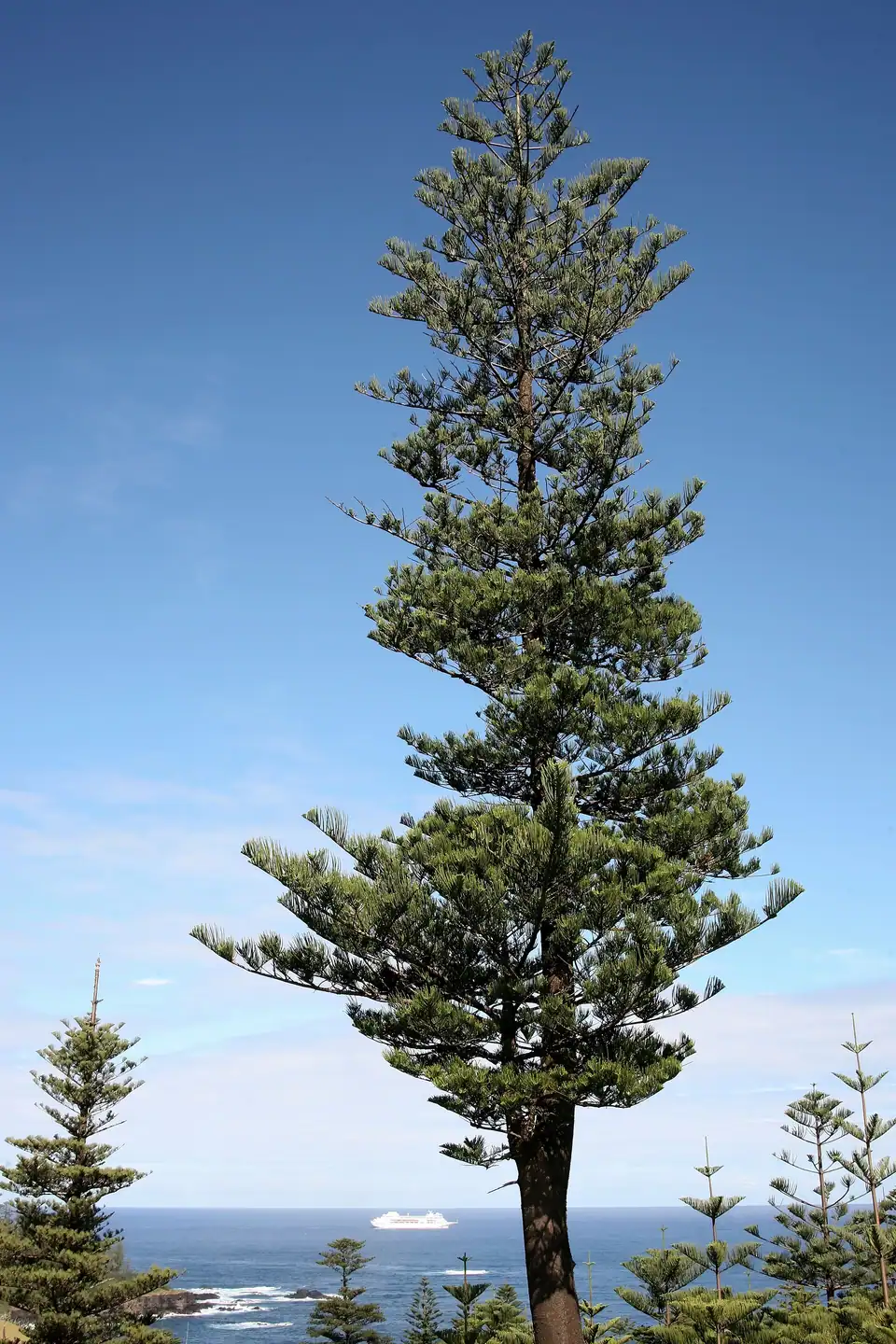


How to Grow and Care for Norfolk Island Pine
Araucaria heterophylla
Written by Emilio Marruso · last checked
Not toxic to cats and dogs, according to the sources · Sources
At a glance
The Norfolk Island pine is a calm, easygoing companion that grows happily in a pot, even indoors as a houseplant. Give it bright light, feed it lightly from spring through fall, and water sparingly in winter. Outdoors it can become a towering 60–80 ft tree, and it is safe around cats, dogs and horses.
- Sun
Bright light; in very low light it drops leaves and lower branches
- Water
Water sparingly in winter and empty the drained water after 15 minutes; too much water costs it branches
What the sources say (3)
Watering notes: In winter, mist in heated rooms and water sparingly; use a pot with drainage holes and discard drained water after about 15 minutes; overwatering can lead to loss of branches
Water regularly spring to autumn, avoiding soil that is too wet. In winter, mist in heated rooms and water sparingly.
— Araucaria heterophylla (Australian Pine, House Pine, Living Christmas Tree, Norfolk Island Pine, Norfolk-Island-Pine, Norfolk Pine, Polynesian Pine, Star Pine, Triangle Tree) | North Carolina Extension Gardener Plant Toolbox [1] After about 15 minutes, discard the water that has drained from the pot.
— Norfolk Island Pines | Good Growing | Illinois Extension | Illinois [2] If the plant is overwatered, it can lead to the loss of branches.
— Norfolk Island Pines | Good Growing | Illinois Extension | Illinois [2] - Feeding
Diluted liquid houseplant food every 1–2 weeks, March to September; never in winter
What the sources say (8)
When: While actively growing, from spring through fall (March to September); not in winter
Consider weekly or biweekly applications of dilute liquid fertilizer from spring through fall.
— Araucaria heterophylla (Australian Pine, House Pine, Living Christmas Tree, Norfolk Island Pine, Norfolk-Island-Pine, Norfolk Pine, Polynesian Pine, Star Pine, Triangle Tree) | North Carolina Extension Gardener Plant Toolbox [1] A diluted liquid house plant fertilizer can be used every two weeks while they are growing (usually March – September).
— Norfolk Island Pines | Good Growing | Illinois Extension | Illinois [2] They often don’t grow much during the winter, so there is no need to fertilize then.
— Norfolk Island Pines | Good Growing | Illinois Extension | Illinois [2] How often: Every 1 to 2 weeks during the growing season
Consider weekly or biweekly applications of dilute liquid fertilizer from spring through fall.
— Araucaria heterophylla (Australian Pine, House Pine, Living Christmas Tree, Norfolk Island Pine, Norfolk-Island-Pine, Norfolk Pine, Polynesian Pine, Star Pine, Triangle Tree) | North Carolina Extension Gardener Plant Toolbox [1] A diluted liquid house plant fertilizer can be used every two weeks while they are growing (usually March – September).
— Norfolk Island Pines | Good Growing | Illinois Extension | Illinois [2] Mineral fertilizers: Dilute liquid houseplant fertilizer
Consider weekly or biweekly applications of dilute liquid fertilizer from spring through fall.
— Araucaria heterophylla (Australian Pine, House Pine, Living Christmas Tree, Norfolk Island Pine, Norfolk-Island-Pine, Norfolk Pine, Polynesian Pine, Star Pine, Triangle Tree) | North Carolina Extension Gardener Plant Toolbox [1] A diluted liquid house plant fertilizer can be used every two weeks while they are growing (usually March – September).
— Norfolk Island Pines | Good Growing | Illinois Extension | Illinois [2] Avoid: Fertilizing in winter, when the plant grows little
They often don’t grow much during the winter, so there is no need to fertilize then.
— Norfolk Island Pines | Good Growing | Illinois Extension | Illinois [2] - Harvest
Its seeds are edible: Indigenous people used to harvest them
- Pests
Usually trouble-free, but it can get scale, sooty mold and leaf spot
What the sources say (2)
Pests: scale
This tree is generally pest free but is susceptible to scale, sooty mold and leaf spot.
— Araucaria heterophylla (Australian Pine, House Pine, Living Christmas Tree, Norfolk Island Pine, Norfolk-Island-Pine, Norfolk Pine, Polynesian Pine, Star Pine, Triangle Tree) | North Carolina Extension Gardener Plant Toolbox [1] Diseases: sooty mold, leaf spot
This tree is generally pest free but is susceptible to scale, sooty mold and leaf spot.
— Araucaria heterophylla (Australian Pine, House Pine, Living Christmas Tree, Norfolk Island Pine, Norfolk-Island-Pine, Norfolk Pine, Polynesian Pine, Star Pine, Triangle Tree) | North Carolina Extension Gardener Plant Toolbox [1] - Watch out
Dry air or dry soil makes needles drop: mist it in heated rooms
What the sources say (3)
Watering notes: In winter, mist in heated rooms and water sparingly; use a pot with drainage holes and discard drained water after about 15 minutes; overwatering can lead to loss of branches
Water regularly spring to autumn, avoiding soil that is too wet. In winter, mist in heated rooms and water sparingly.
— Araucaria heterophylla (Australian Pine, House Pine, Living Christmas Tree, Norfolk Island Pine, Norfolk-Island-Pine, Norfolk Pine, Polynesian Pine, Star Pine, Triangle Tree) | North Carolina Extension Gardener Plant Toolbox [1] After about 15 minutes, discard the water that has drained from the pot.
— Norfolk Island Pines | Good Growing | Illinois Extension | Illinois [2] If the plant is overwatered, it can lead to the loss of branches.
— Norfolk Island Pines | Good Growing | Illinois Extension | Illinois [2] - Size
Outdoors 60–80 ft tall and 12–20 ft wide
What the sources say (3)
Mature height: 1829-2438 cm (60-80 ft) outdoors
indoors as a houseplant: They typically will reach heights of six to eight feet when grown as a houseplant (they can get larger though).
— Norfolk Island Pines | Good Growing | Illinois Extension | Illinois [2] Dimensions: Height: 60 ft. 0 in. - 80 ft. 0 in. Width: 12 ft. 0 in. - 20 ft. 0 in.
— Araucaria heterophylla (Australian Pine, House Pine, Living Christmas Tree, Norfolk Island Pine, Norfolk-Island-Pine, Norfolk Pine, Polynesian Pine, Star Pine, Triangle Tree) | North Carolina Extension Gardener Plant Toolbox [1] Mature width: 366-610 cm (12-20 ft) outdoors
Dimensions: Height: 60 ft. 0 in. - 80 ft. 0 in. Width: 12 ft. 0 in. - 20 ft. 0 in.
— Araucaria heterophylla (Australian Pine, House Pine, Living Christmas Tree, Norfolk Island Pine, Norfolk-Island-Pine, Norfolk Pine, Polynesian Pine, Star Pine, Triangle Tree) | North Carolina Extension Gardener Plant Toolbox [1] - Propagation
Grows from seed
What the sources say (1)
Propagation: Seed
Life Cycle: Perennial Woody Recommended Propagation Strategy: Seed
— Araucaria heterophylla (Australian Pine, House Pine, Living Christmas Tree, Norfolk Island Pine, Norfolk-Island-Pine, Norfolk Pine, Polynesian Pine, Star Pine, Triangle Tree) | North Carolina Extension Gardener Plant Toolbox [1] - Containers
Great in a pot with drainage holes, even indoors as a houseplant
What the sources say (5)
In containers: Yes
Allow the soil to dry out some between waterings and make sure your pot has drainage holes.
— Norfolk Island Pines | Good Growing | Illinois Extension | Illinois [2] Indoors: Yes
It is not native to North America, but is suitable for growing indoors as a houseplant.
— Araucaria heterophylla (Australian Pine, House Pine, Living Christmas Tree, Norfolk Island Pine, Norfolk-Island-Pine, Norfolk Pine, Polynesian Pine, Star Pine, Triangle Tree) | North Carolina Extension Gardener Plant Toolbox [1] Watering notes: In winter, mist in heated rooms and water sparingly; use a pot with drainage holes and discard drained water after about 15 minutes; overwatering can lead to loss of branches
Water regularly spring to autumn, avoiding soil that is too wet. In winter, mist in heated rooms and water sparingly.
— Araucaria heterophylla (Australian Pine, House Pine, Living Christmas Tree, Norfolk Island Pine, Norfolk-Island-Pine, Norfolk Pine, Polynesian Pine, Star Pine, Triangle Tree) | North Carolina Extension Gardener Plant Toolbox [1] After about 15 minutes, discard the water that has drained from the pot.
— Norfolk Island Pines | Good Growing | Illinois Extension | Illinois [2] If the plant is overwatered, it can lead to the loss of branches.
— Norfolk Island Pines | Good Growing | Illinois Extension | Illinois [2] - Safety
Not toxic to cats, dogs or horses
Overview
Norfolk Island pine is a needled evergreen conifer endemic to Norfolk Island that is widely grown as an indoor houseplant. [1][3] Indoors it prefers bright light and a cool room, with regular watering in the growing season and sparing water in winter. [1]
Norfolk Island Pine care
How to water Norfolk Island Pine
Watering
The sources give different values depending on region, zone or growing conditions.
What each source says
According to NC State Extension: Water regularly from spring to autumn, avoiding soil that is too wet
According to Illinois Extension (Good Growing): Allow the soil to dry out some between waterings
According to Illinois Extension (Garden Scoop): Allow the soil to completely dry out between waterings
What the sources say (5)
According to NC State Extension: Water regularly spring to autumn, avoiding soil that is too wet.According to Illinois Extension (Good Growing): Allow the soil to dry out some between waterings and make sure your pot has drainage holes.According to Illinois Extension (Garden Scoop): When watering, allow soil to completely dry out between watering.Water regularly spring to autumn, avoiding soil that is too wet. In winter, mist in heated rooms and water sparingly.Allow the soil to dry out some between waterings and make sure your pot has drainage holes.Watering notes
In winter, mist in heated rooms and water sparingly; use a pot with drainage holes and discard drained water after about 15 minutes; overwatering can lead to loss of branches
What the sources say (3)
Water regularly spring to autumn, avoiding soil that is too wet. In winter, mist in heated rooms and water sparingly.After about 15 minutes, discard the water that has drained from the pot.If the plant is overwatered, it can lead to the loss of branches.How much light Norfolk Island Pine needs
The sources give different values depending on region, zone or growing conditions.
What each source says
According to NC State Extension: Full sun; light afternoon shade may be needed indoors
moved outdoors in warm weather (fonte: Illinois Extension): Bright shade, protected from afternoon sun
What the sources say (3)
According to NC State Extension: Full sun is normally best for developing compact symmetrical growth, but light afternoon shade may be needed to avoid possible foliage bleach (yellow tints).moved outdoors in warm weather (fonte: Illinois Extension): It is generally recommended to place them in bright shade and to make sure they are protected from the afternoon sun.Full sun is normally best for developing compact symmetrical growth, but light afternoon shade may be needed to avoid possible foliage bleach (yellow tints).How much cold Norfolk Island Pine can take
Hardiness, coldest zone
The sources give different values depending on region, zone or growing conditions.
What each source says
According to NC State Extension: 9a [winter low −6.7 to −3.9 °C (20 to 25 °F)]
According to Illinois Extension (Garden Scoop): 10 [winter low −1.1 to 4.4 °C (30 to 40 °F)]
What the sources say (2)
According to NC State Extension: USDA Plant Hardiness Zone:
9a, 9b, 10a, 10b, 11a, 11bAccording to Illinois Extension (Garden Scoop): Here in the US, it is considered hardy in Zone 10 and 11, which limits its use as a landscape plantHardiness, warmest zone
11b [winter low 7.2 to 10 °C (45 to 50 °F)]
What the sources say (1)
USDA Plant Hardiness Zone:
9a, 9b, 10a, 10b, 11a, 11bWhere to grow Norfolk Island Pine
Indoors
Yes
What the sources say (1)
It is not native to North America, but is suitable for growing indoors as a houseplant.In containers
Yes
What the sources say (1)
Allow the soil to dry out some between waterings and make sure your pot has drainage holes.How to propagate Norfolk Island Pine
Seed
What the sources say (1)
Life Cycle:
Perennial
Woody
Recommended Propagation Strategy:
SeedHow to grow Norfolk Island Pine
The plant
Life cycle
perennial
What the sources say (1)
Life Cycle: Perennial Woody Recommended Propagation Strategy: Seed Country Or Region Of Origin: Norfolk IslandFamily
Araucariaceae
What the sources say (1)
Despite their name, these evergreens are not actually pine trees. Instead, they belong to an ancient plant family named Araucariaceae (pines are in the Pinaceae).Mature height
1829-2438 cm (60-80 ft) outdoors
What each source says
indoors as a houseplant:
What the sources say (2)
indoors as a houseplant: They typically will reach heights of six to eight feet when grown as a houseplant (they can get larger though).Dimensions: Height: 60 ft. 0 in. - 80 ft. 0 in. Width: 12 ft. 0 in. - 20 ft. 0 in.Mature width
366-610 cm (12-20 ft) outdoors
What the sources say (1)
Dimensions: Height: 60 ft. 0 in. - 80 ft. 0 in. Width: 12 ft. 0 in. - 20 ft. 0 in.Pests and diseases
Pests
scale
What the sources say (1)
This tree is generally pest free but is susceptible to scale, sooty mold and leaf spot.Diseases
sooty mold, leaf spot
What the sources say (1)
This tree is generally pest free but is susceptible to scale, sooty mold and leaf spot.Fertilizing
When
While actively growing, from spring through fall (March to September); not in winter
What the sources say (3)
Consider weekly or biweekly applications of dilute liquid fertilizer from spring through fall.A diluted liquid house plant fertilizer can be used every two weeks while they are growing (usually March – September).They often don’t grow much during the winter, so there is no need to fertilize then.How often
Every 1 to 2 weeks during the growing season
What the sources say (2)
Consider weekly or biweekly applications of dilute liquid fertilizer from spring through fall.A diluted liquid house plant fertilizer can be used every two weeks while they are growing (usually March – September).Mineral fertilizers
Dilute liquid houseplant fertilizer
What the sources say (2)
Consider weekly or biweekly applications of dilute liquid fertilizer from spring through fall.A diluted liquid house plant fertilizer can be used every two weeks while they are growing (usually March – September).Avoid
Fertilizing in winter, when the plant grows little
What the sources say (1)
They often don’t grow much during the winter, so there is no need to fertilize then.Norfolk Island Pine pests and problems
Scale, sooty mold and leaf spot
Symptom: Susceptible to scale, sooty mold and leaf spot
What to do: Tree is generally pest free
What the sources say (1)
This tree is generally pest free but is susceptible to scale, sooty mold and leaf spot.
— Araucaria heterophylla (Australian Pine, House Pine, Living Christmas Tree, Norfolk Island Pine, Norfolk-Island-Pine, Norfolk Pine, Polynesian Pine, Star Pine, Triangle Tree) | North Carolina Extension Gardener Plant Toolbox [1] Needle drop
Symptom: Needles drop
What to do: Increase humidity around the plant and avoid dry air or dry soil
What the sources say (1)
One of the most common problems with Norfolk Island pines is needle drop. This often occurs because the plants have been exposed to dry air or dry soil.
— Norfolk Island Pines | Good Growing | Illinois Extension | Illinois [2] Low light decline
Symptom: Leaf drop and loss of lower branches after 2-3 years in very low light
What to do: Provide bright light
What the sources say (1)
Indoor plants, tolerate very low light for 2-3 years but may then display leaf drop and loss of lower branches.
— Araucaria heterophylla (Australian Pine, House Pine, Living Christmas Tree, Norfolk Island Pine, Norfolk-Island-Pine, Norfolk Pine, Polynesian Pine, Star Pine, Triangle Tree) | North Carolina Extension Gardener Plant Toolbox [1]
Remedies
Each remedy shows what official sources say about it; traditional remedies without an official source are marked as such. Harmful ones are listed so you know to avoid them.
Treating the plant
pests
neem oil Works
Despite these being biological pesticides, it is important to read the directions on the label and wear safety equipment.
— extension.illinois.edu [6] How: Use neem oil for pest control.
For pest control , you can use soap, neem oil, or just wipe pests off manually with a damp cloth.
— ai-plantfinder.com [5] What the evidence says Neem oil is found in the seeds of the neem tree. The active component found in this biological pesticide reduces insect feeding, interferes with hormones -- making it hard to grow or lay eggs -- and acts as a repellent.
— extension.illinois.edu [6] wiping pests off with a damp cloth Not verified
Traditional remedy, not verified by an official source.
How: Wipe pests off manually with a damp cloth.
spider mites
shower Not verified
Traditional remedy, not verified by an official source.
How: If the infection is mild, a shower might help.
Is Norfolk Island Pine poisonous?
Reported by the source, quoted verbatim. This is not medical or veterinary advice: if a person or an animal may have eaten this plant, contact a poison control centre or a veterinarian.
#Christmas trees #non-toxic for cats #non-toxic for horses #non-toxic for dogs #tropical feel #fpp
[1]The source flags the risk for this animal but does not explain why.
Edibility
Reported by the source, quoted verbatim. Do not eat a plant on the basis of this page alone: identification mistakes can be dangerous.
Indigenous people harvested edible seeds and utilized this tree
[1]
Indicative values
Values from a secondary source, not checked word for word like the rest of this page. Use them as a starting point.
- Hours of sun
- 6-8 hoursIndicative value, adapt it to your climate · Secondary source
- Drought tolerant
- yesIndicative value, adapt it to your climate · Secondary source
- Soil
- Well-drainedIndicative value, adapt it to your climate · Secondary source
- Soil pH
- 5.5-6.5Indicative value, adapt it to your climate · Secondary source
- Care level
- ModerateIndicative value, adapt it to your climate · Secondary source
- Growth rate
- LowIndicative value, adapt it to your climate · Secondary source
- Pruning
- May, December, January, FebruaryIndicative value, adapt it to your climate · Secondary source
Similar plants
- Chilean Pine Araucaria araucana
- Coral Reef Araucaria Araucaria columnaris
- Wollemia Wollemia nobilis
- Aaron's Beard Hypericum calycinum
- Abies grandis Abies grandis
- Abraham Trachystemon orientalis
- Abyssinian banana Ensete ventricosum
- Acacia longifolia Acacia longifolia
Sources
Every value above is quoted from these documents. Links lead to the original publisher.
- Araucaria heterophylla (Australian Pine, House Pine, Living Christmas Tree, Norfolk Island Pine, Norfolk-Island-Pine, Norfolk Pine, Polynesian Pine, Star Pine, Triangle Tree) | North Carolina Extension Gardener Plant Toolbox · plants.ces.ncsu.edu, consulted
- Norfolk Island Pines | Good Growing | Illinois Extension | Illinois · extension.illinois.edu, consulted
- The Norfolk Island Pine | The Garden Scoop | Illinois Extension | Illinois · extension.illinois.edu, consulted
- House Pine - Araucaria heterophylla | North Carolina Extension Gardener Plant Toolbox · plants.ces.ncsu.edu, consulted
- ai-plantfinder.com · ai-plantfinder.com
- extension.illinois.edu · extension.illinois.edu
Written by Emilio Marruso · last checked