

How to Grow and Care for Aaron's Beard
Hypericum calycinum
Written by Emilio Marruso · last checked
Toxic to: People · Why
At a glance
This tough perennial grows happily in sun or shade, though it flowers best in a sunny spot. Once established it shrugs off drought, and it settles into any well-drained soil, even dry ground or heavy clay. Cut it to the ground each spring and it makes a low, tidy ground cover 1 to 1.5 feet tall.
- Sun
Sun or shade; it flowers best in a sunny spot
What the sources say (1)
Light: Sun or shade; flowers best in a sunny position
It will grow in sun or shade, but flowers best in a sunny position.
— Hypericum calycinum (Aaron's Beard, Creeping Aaron's Beard, St. John's Wort) | North Carolina Extension Gardener Plant Toolbox [1] - Water
Moderate watering; once settled in, it handles drought
What the sources say (2)
Watering: Moderate drought tolerance; tolerates drought once established
spreads by underground stems and has moderate drought tolerance.
— Hypericum calycinum (Aaron's Beard, Creeping Aaron's Beard, St. John's Wort) | North Carolina Extension Gardener Plant Toolbox [1] It tolerates cold and drought once established and is ornamental but rapidly spreading by means of stolons.
— Hypericum calycinum (Aaron's Beard, Creeping Aaron's Beard, St. John's Wort) | North Carolina Extension Gardener Plant Toolbox [1] - Cold
Survives winters down to −20 °F (−28.9 °C)
Very hardy · USDA 5a · RHS H7 · Z5
What the sources say (2)
Hardiness, coldest zone: 5a [winter low −28.9 to −26.1 °C (−20 to −15 °F)]
USDA Plant Hardiness Zone: 5a, 5b, 6a, 6b, 7a, 7b, 8a, 8b, 9a, 9b, 10a, 10b
— Hypericum calycinum (Aaron's Beard, Creeping Aaron's Beard, St. John's Wort) | North Carolina Extension Gardener Plant Toolbox [1] Hardiness, warmest zone: 10b [winter low 1.7 to 4.4 °C (35 to 40 °F)]
USDA Plant Hardiness Zone: 5a, 5b, 6a, 6b, 7a, 7b, 8a, 8b, 9a, 9b, 10a, 10b
— Hypericum calycinum (Aaron's Beard, Creeping Aaron's Beard, St. John's Wort) | North Carolina Extension Gardener Plant Toolbox [1] - Soil
Any well-drained soil, even dry or heavy clay; pH 6.0 or lower
What the sources say (2)
Watering notes: Grows in any well-drained but moisture retentive soil, including dry soils and heavy clay
easily grown in any well-drained but moisture retentive soil including dry soils and heavy clay.
— Hypericum calycinum (Aaron's Beard, Creeping Aaron's Beard, St. John's Wort) | North Carolina Extension Gardener Plant Toolbox [1] Soil pH, maximum: 6.0
Soil Texture: Clay Loam (Silt) Sand Soil pH: Acid (<6.0)
— Hypericum calycinum (Aaron's Beard, Creeping Aaron's Beard, St. John's Wort) | North Carolina Extension Gardener Plant Toolbox [1] - Pruning
Cut it to the ground in spring for a thick ground cover
What the sources say (1)
Pruning: Cut to ground level in spring (to maximize use as a ground cover)
To maximize its use as a ground cover, you can cut it to ground level in the spring.
— Hypericum calycinum (Aaron's Beard, Creeping Aaron's Beard, St. John's Wort) | North Carolina Extension Gardener Plant Toolbox [1] - Pests
Watch for rust on the leaves
What the sources say (1)
Diseases: rust
Diseases, Insect Pests, and Other Plant Problems: No significant problems. Rust can sometimes be a problem.
— Hypericum calycinum (Aaron's Beard, Creeping Aaron's Beard, St. John's Wort) | North Carolina Extension Gardener Plant Toolbox [1] - Size
1 to 1.5 ft tall and 1.5 to 2 ft wide
What the sources say (2)
Mature height: 30.5-45.7 cm (1 ft 0 in - 1 ft 6 in)
Dimensions: Height: 1 ft. 0 in. - 1 ft. 6 in. Width: 1 ft. 6 in. - 2 ft. 0 in.
— Hypericum calycinum (Aaron's Beard, Creeping Aaron's Beard, St. John's Wort) | North Carolina Extension Gardener Plant Toolbox [1] Mature width: 45.7-61 cm (1 ft 6 in - 2 ft 0 in)
Dimensions: Height: 1 ft. 0 in. - 1 ft. 6 in. Width: 1 ft. 6 in. - 2 ft. 0 in.
— Hypericum calycinum (Aaron's Beard, Creeping Aaron's Beard, St. John's Wort) | North Carolina Extension Gardener Plant Toolbox [1] - Propagation
Divide the clumps or grow it from seed
What the sources say (1)
Propagation: Division; seed
Recommended Propagation Strategy: Division Seed Country Or Region Of Origin: Southern Europe, Western Asia, Turkey
— Hypericum calycinum (Aaron's Beard, Creeping Aaron's Beard, St. John's Wort) | North Carolina Extension Gardener Plant Toolbox [1] - Safety
Poisonous if eaten; leaves and sap can irritate the skin
Overview
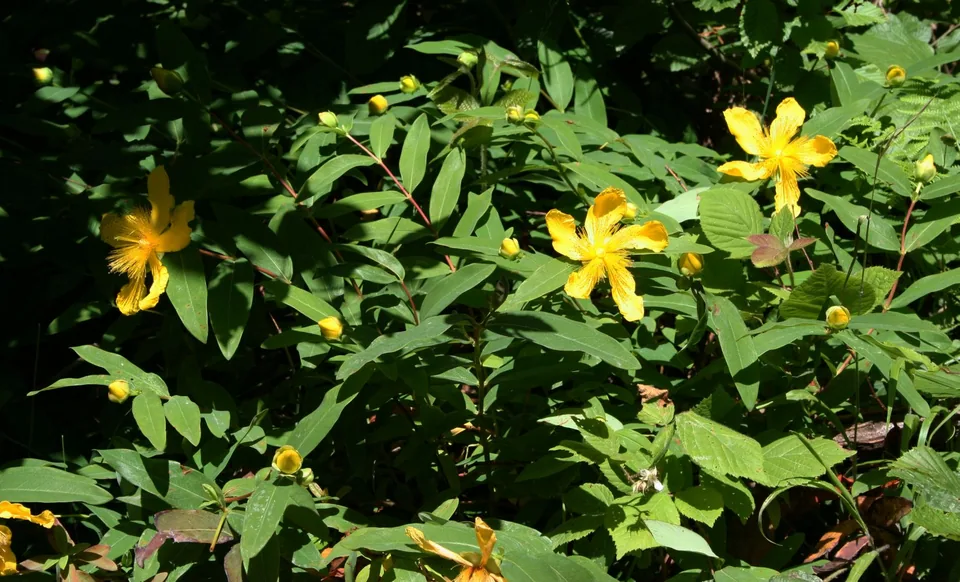
Hypericum calycinum is a spreading, often evergreen shrub used as a groundcover, with yellow summer flowers. [1] It tolerates sun or shade and drought once established, and spreads rapidly by stolons. [1] The source rates it as having high severity poison characteristics. [1]
Aaron's Beard care
How to water Aaron's Beard
Watering
Moderate drought tolerance; tolerates drought once established
What the sources say (2)
spreads by underground stems and has moderate drought tolerance.It tolerates cold and drought once established and is ornamental but rapidly spreading by means of stolons.Watering notes
Grows in any well-drained but moisture retentive soil, including dry soils and heavy clay
What the sources say (1)
easily grown in any well-drained but moisture retentive soil including dry soils and heavy clay.How much light Aaron's Beard needs
Sun or shade; flowers best in a sunny position
What the sources say (1)
It will grow in sun or shade, but flowers best in a sunny position.How much cold Aaron's Beard can take
Hardiness, coldest zone
5a [winter low −28.9 to −26.1 °C (−20 to −15 °F)]
What the sources say (1)
USDA Plant Hardiness Zone:
5a, 5b, 6a, 6b, 7a, 7b, 8a, 8b, 9a, 9b, 10a, 10bHardiness, warmest zone
10b [winter low 1.7 to 4.4 °C (35 to 40 °F)]
What the sources say (1)
USDA Plant Hardiness Zone:
5a, 5b, 6a, 6b, 7a, 7b, 8a, 8b, 9a, 9b, 10a, 10bBest soil for Aaron's Beard
6.0
What the sources say (1)
Soil Texture:
Clay
Loam (Silt)
Sand
Soil pH:
Acid (<6.0)How to propagate Aaron's Beard
Division; seed
What the sources say (1)
Recommended Propagation Strategy:
Division
Seed
Country Or Region Of Origin:
Southern Europe, Western Asia, TurkeyHow to grow Aaron's Beard
The plant
Life cycle
perennial
What the sources say (1)
Life Cycle: PerennialFamily
Hypericaceae
What the sources say (1)
Family: HypericaceaeMature height
30.5-45.7 cm (1 ft 0 in - 1 ft 6 in)
What the sources say (1)
Dimensions: Height: 1 ft. 0 in. - 1 ft. 6 in. Width: 1 ft. 6 in. - 2 ft. 0 in.Mature width
45.7-61 cm (1 ft 6 in - 2 ft 0 in)
What the sources say (1)
Dimensions: Height: 1 ft. 0 in. - 1 ft. 6 in. Width: 1 ft. 6 in. - 2 ft. 0 in.Pests and diseases
Diseases
rust
What the sources say (1)
Diseases, Insect Pests, and Other Plant Problems: No significant problems. Rust can sometimes be a problem.Remedies
Each remedy shows what official sources say about it; traditional remedies without an official source are marked as such. Harmful ones are listed so you know to avoid them.
First aid
First aid: not a substitute for a doctor
contact dermatitis
rinse skin with running water Official source, not independently tested
The local poison control center can be reached directly by calling the national toll-free Poison Help hotline (1-800-222-1222) from anywhere in the United States.
— medlineplus.gov [3] How: Use lots of room temperature running water and rinse for at least 15 minutes.
Use lots of room temperature running water and rinse for at least 15 minutes.
— poison.org [2]
plant ingestion
do not induce vomiting Official source, not independently tested
The local poison control center can be reached directly by calling the national toll-free Poison Help hotline (1-800-222-1222) from anywhere in the United States.
— medlineplus.gov [3] How: Do not induce vomiting. Ipecac syrup is no longer recommended.
Do not induce vomiting. Ipecac syrup is no longer recommended.
— poison.org [2]
Is Aaron's Beard poisonous?
Reported by the source, quoted verbatim. This is not medical or veterinary advice: if a person or an animal may have eaten this plant, contact a poison control centre or a veterinarian.
Calendar
Pruning
Cut to ground level in spring (to maximize use as a ground cover)
What the sources say (1)
To maximize its use as a ground cover, you can cut it to ground level in the spring.Months as given by the sources, which are mostly from the United States (northern hemisphere). In the southern hemisphere they shift by about six months.
Indicative values
Values from a secondary source, not checked word for word like the rest of this page. Use them as a starting point.
- Drought tolerant
- yesIndicative value, adapt it to your climate · Secondary source
- Soil
- Well-drainedIndicative value, adapt it to your climate · Secondary source
- Care level
- MediumIndicative value, adapt it to your climate · Secondary source
- Growth rate
- HighIndicative value, adapt it to your climate · Secondary source
- Pests
- Pest resistant, Disease resistant, Deer resistant, Rabbit resistant, Drought resistantIndicative value, adapt it to your climate · Secondary source
Similar plants
- Atlantic St. John's Wort Hypericum tenuifolium
- Bedstraw Hypericum galioides
- Bushy St. John's Wort Hypericum densiflorum
- Cedarglade St. Johnswort Hypericum frondosum
- Common St. John's-wort Hypericum perforatum
- Mount Olympus St. John's Wort Hypericum olympicum
- Shrubby St. John's Wort Hypericum prolificum
- St. Andrew's Cross Hypericum hypericoides
Sources
Every value above is quoted from these documents. Links lead to the original publisher.
- Hypericum calycinum (Aaron's Beard, Creeping Aaron's Beard, St. John's Wort) | North Carolina Extension Gardener Plant Toolbox · plants.ces.ncsu.edu, consulted
- poison.org · poison.org
- medlineplus.gov · medlineplus.gov
Written by Emilio Marruso · last checked