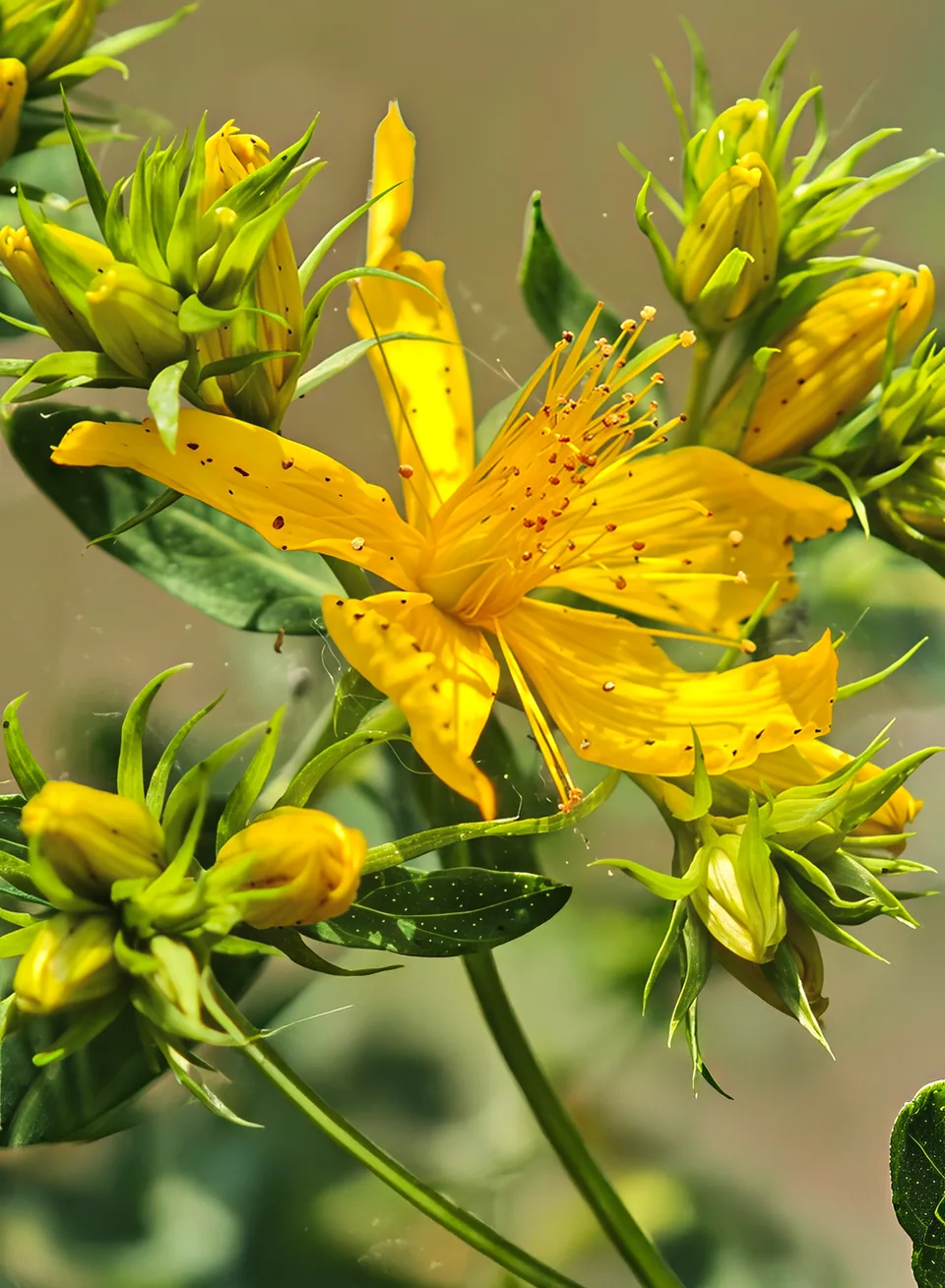


How to Grow and Care for Common St. John's-wort
Hypericum perforatum
Written by Emilio Marruso · last checked
Toxic to: Cats, Dogs, Horses, People · Why
At a glance
St. John's wort is an easygoing perennial that grows happily in full sun or partial shade and tolerates drought in well-drained soil. It reaches 1–3 feet tall, and you can start new plants from seed or by dividing a clump. Keep an eye on it, though: it spreads fast, and a single plant can make up to 100,000 seeds a year.
- Sun
Full sun to partial shade
What the sources say (1)
Light: Full sun to partial shade
It can grow in semi-shade (light woodland) or no shade, but full sun is best for maximum blooms.
— Hypericum perforatum (Common St. John's-wort, Goatweed, Klamath Weed, St. Johns Wort) | North Carolina Extension Gardener Plant Toolbox [1] - Water
Tolerates drought, but likes moist soil
What the sources say (1)
Watering: Tolerates drought; prefers well-drained, moist soil
but prefers well-drained, moist soil. It can grow in semi-shade (light woodland) or no shade, but full sun is best for maximum blooms. It can also tolerate drought.
— Hypericum perforatum (Common St. John's-wort, Goatweed, Klamath Weed, St. Johns Wort) | North Carolina Extension Gardener Plant Toolbox [1] - Cold
Survives winters down to −40 °F (−40 °C)
Very hardy · USDA 3a · RHS H7 · Z3
What the sources say (2)
Hardiness, coldest zone: 3a [winter low −40 to −37.2 °C (−40 to −35 °F)]
3a, 3b, 4a, 4b, 5a, 5b, 6a, 6b, 7a, 7b, 8a, 8b
— Hypericum perforatum (Common St. John's-wort, Goatweed, Klamath Weed, St. Johns Wort) | North Carolina Extension Gardener Plant Toolbox [1] Hardiness, warmest zone: 8b [winter low −9.4 to −6.7 °C (15 to 20 °F)]
3a, 3b, 4a, 4b, 5a, 5b, 6a, 6b, 7a, 7b, 8a, 8b
— Hypericum perforatum (Common St. John's-wort, Goatweed, Klamath Weed, St. Johns Wort) | North Carolina Extension Gardener Plant Toolbox [1] - Soil
Well-drained soil
What the sources say (1)
Watering: Tolerates drought; prefers well-drained, moist soil
but prefers well-drained, moist soil. It can grow in semi-shade (light woodland) or no shade, but full sun is best for maximum blooms. It can also tolerate drought.
— Hypericum perforatum (Common St. John's-wort, Goatweed, Klamath Weed, St. Johns Wort) | North Carolina Extension Gardener Plant Toolbox [1] - Watch out
Spreads fast and crowds out native plants: one plant can make up to 100,000 seeds a year
- Size
1–3 ft tall and 9 in–2 ft wide
What the sources say (2)
Mature height: 30-91 cm (1-3 feet)
Dimensions: Height: 1 ft. 0 in. - 3 ft. 0 in. Width: 0 ft. 9 in. - 2 ft. 0 in.
— Hypericum perforatum (Common St. John's-wort, Goatweed, Klamath Weed, St. Johns Wort) | North Carolina Extension Gardener Plant Toolbox [1] Mature width: 23-61 cm (9 in-2 feet)
Dimensions: Height: 1 ft. 0 in. - 3 ft. 0 in. Width: 0 ft. 9 in. - 2 ft. 0 in.
— Hypericum perforatum (Common St. John's-wort, Goatweed, Klamath Weed, St. Johns Wort) | North Carolina Extension Gardener Plant Toolbox [1] - Propagation
By dividing the clump or from seed
What the sources say (1)
Propagation: Division, seed
Life Cycle: Perennial Recommended Propagation Strategy: Division Seed
— Hypericum perforatum (Common St. John's-wort, Goatweed, Klamath Weed, St. Johns Wort) | North Carolina Extension Gardener Plant Toolbox [1] - Safety
Sap or eating it can make skin sensitive to sun in some people; harmful to dogs, cats and horses
Overview
Hypericum perforatum is a herbaceous perennial that grows in open woods, roadsides and dry sunny places. [1] It tolerates most soil types and drought, and does best in full sun. [1] It spreads by rhizomes and seed and can become invasive. [1]
Common St. John's-wort care
How to water Common St. John's-wort
Tolerates drought; prefers well-drained, moist soil
What the sources say (1)
but prefers well-drained, moist soil. It can grow in semi-shade (light woodland) or no shade, but full sun is best for maximum blooms. It can also tolerate drought.How much light Common St. John's-wort needs
Full sun to partial shade
What the sources say (1)
It can grow in semi-shade (light woodland) or no shade, but full sun is best for maximum blooms.How much cold Common St. John's-wort can take
Hardiness, coldest zone
3a [winter low −40 to −37.2 °C (−40 to −35 °F)]
What the sources say (1)
3a, 3b, 4a, 4b, 5a, 5b, 6a, 6b, 7a, 7b, 8a, 8bHardiness, warmest zone
8b [winter low −9.4 to −6.7 °C (15 to 20 °F)]
What the sources say (1)
3a, 3b, 4a, 4b, 5a, 5b, 6a, 6b, 7a, 7b, 8a, 8bHow to propagate Common St. John's-wort
Division, seed
What the sources say (1)
Life Cycle:
Perennial
Recommended Propagation Strategy:
Division
Seed How to grow Common St. John's-wort
The plant
Life cycle
perennial
What the sources say (1)
St. John's Wort is a herbaceous, perennial, deciduous or evergreen shrub growing to 3 feet high by 2 feet wide.Family
Hypericaceae
What the sources say (1)
Genus: Hypericum Species: perforatum Family: HypericaceaeMature height
30-91 cm (1-3 feet)
What the sources say (1)
Dimensions: Height: 1 ft. 0 in. - 3 ft. 0 in. Width: 0 ft. 9 in. - 2 ft. 0 in.Mature width
23-61 cm (9 in-2 feet)
What the sources say (1)
Dimensions: Height: 1 ft. 0 in. - 3 ft. 0 in. Width: 0 ft. 9 in. - 2 ft. 0 in.Common St. John's-wort pests and problems
Invasive spread
Symptom: Spreads rapidly and can displace native species; a single plant can produce up to 100,000 seeds per year
What to do: Biological control by species that feed on the leaves
What the sources say (2)
No serious insect or disease problems. Invasive spread can displace native species.
— Hypericum perforatum (Common St. John's-wort, Goatweed, Klamath Weed, St. Johns Wort) | North Carolina Extension Gardener Plant Toolbox [1] -biological control, species that feed off their leaves
— Common St. Johnswort - Cooperative Extension: Maine Wild Blueberries - University of Maine Cooperative Extension [2]
Remedies
Each remedy shows what official sources say about it; traditional remedies without an official source are marked as such. Harmful ones are listed so you know to avoid them.
Getting rid of it
invasive spread
hand pulling Partly works
How: Small infestations can be handled manually by digging or pulling St. John's wort weed. Effective St John's wort control with this method comes from removing all the roots and getting rid of St. John's wort before it produces seeds.
Small infestations can be handled manually by digging or pulling St. John's wort weed. Effective St John's wort control with this method comes from removing all the roots and getting rid of St. John's wort before it produces seeds.
— gardeningknowhow.com [3] What the evidence says Hand pulling - only on new small plants
— Common St. Johnswort - Cooperative Extension: Maine Wild Blueberries - University of Maine Cooperative Extension [2] mowing Not proven
How: Mowing may be a somewhat effective method too, according to info on St. John's wort control.
Mowing may be a somewhat effective method too, according to info on St. John's wort control.
— gardeningknowhow.com [3] What the evidence says Hand pulling, digging, mowing, and fire are generally ineffective control measures.
— weedguide.cfaes.osu.edu [4] smothering with newspaper and mulch Official source, not independently tested
How: Lay the material down to prevent sunlight from reaching the unwanted plants, and cover with mulch or other plant-resistant material.
A variety of household items, such as newspapers, can be used as weed barriers. Lay the material down to prevent sunlight from reaching the unwanted plants, and cover with mulch or other plant-resistant material.
— extension.usu.edu [5]
Is Common St. John's-wort toxic to pets?
Reported by the source, quoted verbatim. This is not medical or veterinary advice: if a person or an animal may have eaten this plant, contact a poison control centre or a veterinarian.
Animals
#problem for dogs #problem for horses #problem for cats
[1]The source flags the risk for this animal but does not explain why.
People
Skin contact with the sap, or ingestion of the plant, can cause photosensitivity in some people.
[1]- Poisonous parts
Poison Part: Leaves Sap/Juice Download Print-Friendly QR Code
[1]- Toxic principle
Poison Toxic Principle: Hypericin Causes Contact Dermatitis: Yes
[1]- Symptoms
Common side-effects are gastointestinal disturbances, allergic reactions and fatigue, ulcerative and exudative dermatitis.
[1]- Severity
Poison Severity: Medium Poison Symptoms: Skin contact with
[1]
Indicative values
Values from a secondary source, not checked word for word like the rest of this page. Use them as a starting point.
- Hours of sun
- 6-8 hoursIndicative value, adapt it to your climate · Secondary source
- Soil
- Rocky, gravelly, dry, Well-drainedIndicative value, adapt it to your climate · Secondary source
- Soil pH
- 5.5-7.5Indicative value, adapt it to your climate · Secondary source
- Growth rate
- HighIndicative value, adapt it to your climate · Secondary source
- Pruning
- February, March, AprilIndicative value, adapt it to your climate · Secondary source
- Pests
- Anthracnose, Thrips, Pest resistant, Disease resistant, Deer resistant, Rabbit resistantIndicative value, adapt it to your climate · Secondary source
Similar plants
- Atlantic St. John's Wort Hypericum tenuifolium
- Bedstraw Hypericum galioides
- Bushy St. John's Wort Hypericum densiflorum
- Cedarglade St. Johnswort Hypericum frondosum
- Mount Olympus St. John's Wort Hypericum olympicum
- Shrubby St. John's Wort Hypericum prolificum
- St. Andrew's Cross Hypericum hypericoides
- Aaron's Beard Hypericum calycinum
Sources
Every value above is quoted from these documents. Links lead to the original publisher.
- Hypericum perforatum (Common St. John's-wort, Goatweed, Klamath Weed, St. Johns Wort) | North Carolina Extension Gardener Plant Toolbox · plants.ces.ncsu.edu, consulted
- Common St. Johnswort - Cooperative Extension: Maine Wild Blueberries - University of Maine Cooperative Extension · extension.umaine.edu, consulted
- gardeningknowhow.com · gardeningknowhow.com
- weedguide.cfaes.osu.edu · weedguide.cfaes.osu.edu
- extension.usu.edu · extension.usu.edu
Written by Emilio Marruso · last checked