

How to Grow and Care for Mount Olympus St. John's Wort
Hypericum olympicum
Written by Emilio Marruso · last checked
Toxic to: Cats, Dogs, Horses · Why
At a glance
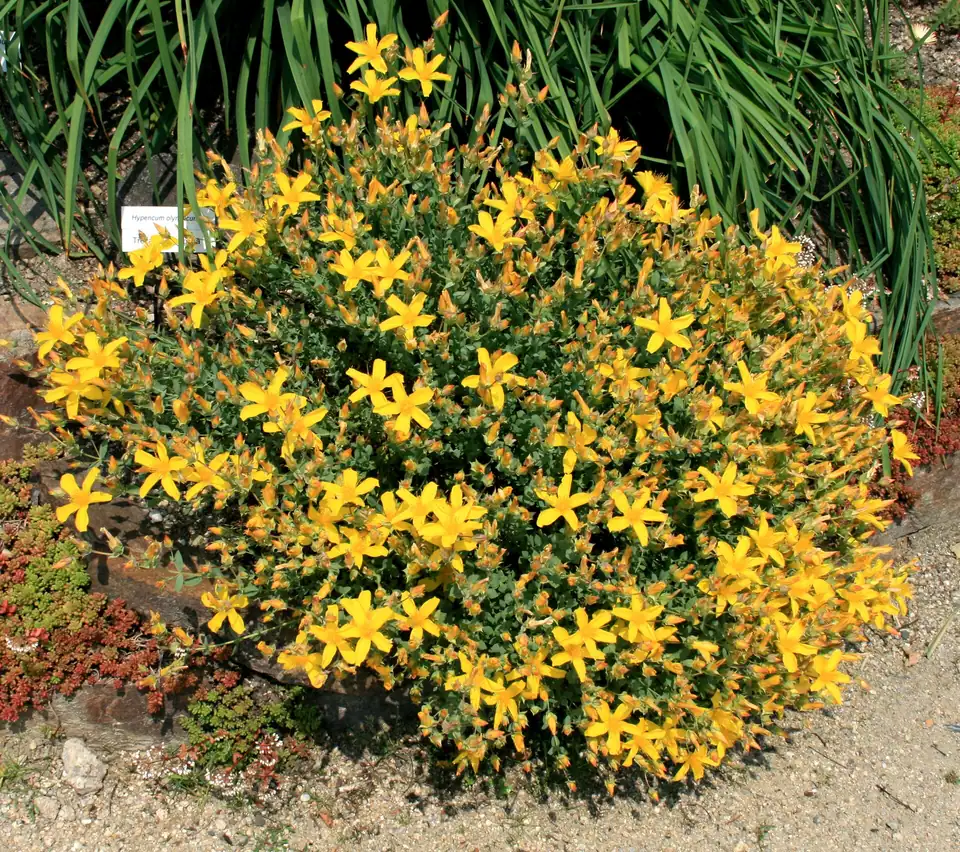
This compact perennial stays small, just 6–15 inches tall and up to 1 foot wide, so it fits easily into a sunny bed or a container. Give it full sun and let it enjoy dry summers: once established, it tolerates drought. It is happy in soil from slightly acidic to alkaline, and you can grow more plants from seed or stem cuttings.
- Sun
Full sun
What the sources say (1)
Light: Full sun
Light: Full sun (6 or more hours of direct sunlight a day)
— Hypericum olympicum (Mount Olympus St. John's Wort, Olympic St John's-wort) | North Carolina Extension Gardener Plant Toolbox [1] - Water
Handles drought once established; likes dry summers
What the sources say (1)
Watering: Drought tolerant once established; prefers dry summer conditions
It is drought-tolerant once established. Prefers dry summer conditions.
— Hypericum olympicum (Mount Olympus St. John's Wort, Olympic St John's-wort) | North Carolina Extension Gardener Plant Toolbox [1] - Cold
Survives winters down to −20 °F (−28.9 °C)
Very hardy · USDA 5a · RHS H7 · Z5
What the sources say (2)
Hardiness, coldest zone: 5a [winter low −28.9 to −26.1 °C (−20 to −15 °F)]
USDA Plant Hardiness Zone: 5a, 5b, 6a, 6b, 7a, 7b, 8a, 8b, 9a, 9b
— Hypericum olympicum (Mount Olympus St. John's Wort, Olympic St John's-wort) | North Carolina Extension Gardener Plant Toolbox [1] Hardiness, warmest zone: 9b [winter low −3.9 to −1.1 °C (25 to 30 °F)]
USDA Plant Hardiness Zone: 5a, 5b, 6a, 6b, 7a, 7b, 8a, 8b, 9a, 9b
— Hypericum olympicum (Mount Olympus St. John's Wort, Olympic St John's-wort) | North Carolina Extension Gardener Plant Toolbox [1] - Soil
Slightly acidic to alkaline soil, pH 6.0–8.0
What the sources say (2)
Soil pH, minimum: 6.0
Soil pH: Neutral (6.0-8.0)
— Hypericum olympicum (Mount Olympus St. John's Wort, Olympic St John's-wort) | North Carolina Extension Gardener Plant Toolbox [1] Soil pH, maximum: 8.0
Soil pH: Neutral (6.0-8.0)
— Hypericum olympicum (Mount Olympus St. John's Wort, Olympic St John's-wort) | North Carolina Extension Gardener Plant Toolbox [1] - Size
6–15 in tall and 6 in to 1 ft wide
What the sources say (2)
Mature height: 15.24-38.1 cm (6-15 in)
Mt. Olympus St. John's wort will grow upright or decumbent, from 6 to 15 inches tall in full sun in well-drained average, sandy or rocky soils.
— Hypericum olympicum (Mount Olympus St. John's Wort, Olympic St John's-wort) | North Carolina Extension Gardener Plant Toolbox [1] Mature width: 15.24-30.48 cm (0 ft 6 in - 1 ft 0 in)
Dimensions: Height: 0 ft. 6 in. - 1 ft. 8 in. Width: 0 ft. 6 in. - 1 ft. 0 in.
— Hypericum olympicum (Mount Olympus St. John's Wort, Olympic St John's-wort) | North Carolina Extension Gardener Plant Toolbox [1] - Propagation
Grow new plants from seed or stem cuttings
What the sources say (1)
Propagation: Seed; stem cutting
Recommended Propagation Strategy: Seed Stem Cutting
— Hypericum olympicum (Mount Olympus St. John's Wort, Olympic St John's-wort) | North Carolina Extension Gardener Plant Toolbox [1] - Containers
Grows in containers too
What the sources say (1)
In containers: Yes
Use in the border of a cottage or English garden or in a container.
— Hypericum olympicum (Mount Olympus St. John's Wort, Olympic St John's-wort) | North Carolina Extension Gardener Plant Toolbox [1] - Safety
Can be toxic to dogs, cats and horses: plant it away from them
Overview
Hypericum olympicum is a deciduous subshrub native to the Balkans and Turkey, grown for its large showy yellow flowers. [1] It grows in full sun in well-drained soils and is drought-tolerant once established. [1] It can be toxic to dogs, cats, and horses. [1]
This record is incomplete: the sources we read do not cover every field yet.
Not yet covered by our sources: Pruning
Mount Olympus St. John's Wort care
How to water Mount Olympus St. John's Wort
Drought tolerant once established; prefers dry summer conditions
What the sources say (1)
It is drought-tolerant once established. Prefers dry summer conditions.How much light Mount Olympus St. John's Wort needs
Full sun
What the sources say (1)
Light:
Full sun (6 or more hours of direct sunlight a day)How much cold Mount Olympus St. John's Wort can take
Hardiness, coldest zone
5a [winter low −28.9 to −26.1 °C (−20 to −15 °F)]
What the sources say (1)
USDA Plant Hardiness Zone:
5a, 5b, 6a, 6b, 7a, 7b, 8a, 8b, 9a, 9bHardiness, warmest zone
9b [winter low −3.9 to −1.1 °C (25 to 30 °F)]
What the sources say (1)
USDA Plant Hardiness Zone:
5a, 5b, 6a, 6b, 7a, 7b, 8a, 8b, 9a, 9bBest soil for Mount Olympus St. John's Wort
Soil pH, minimum
6.0
What the sources say (1)
Soil pH:
Neutral (6.0-8.0)Soil pH, maximum
8.0
What the sources say (1)
Soil pH:
Neutral (6.0-8.0)Where to grow Mount Olympus St. John's Wort
Yes
What the sources say (1)
Use in the border of a cottage or English garden or in a container.How to propagate Mount Olympus St. John's Wort
Seed; stem cutting
What the sources say (1)
Recommended Propagation Strategy:
Seed
Stem CuttingHow to grow Mount Olympus St. John's Wort
The plant
Life cycle
perennial
What the sources say (1)
Genus:
Hypericum
Species:
olympicum
Family:
Hypericaceae
Life Cycle:
Perennial
Recommended Propagation Strategy:Family
Hypericaceae
What the sources say (1)
Mt. Olympus St. John's wort is a deciduous subshrub in the Hypericaceae family native to the Balkans and Turkey.Mature height
15.24-38.1 cm (6-15 in)
What the sources say (1)
Mt. Olympus St. John's wort will grow upright or decumbent, from 6 to 15 inches tall in full sun in well-drained average, sandy or rocky soils.Mature width
15.24-30.48 cm (0 ft 6 in - 1 ft 0 in)
What the sources say (1)
Dimensions:
Height: 0 ft. 6 in. - 1 ft. 8 in.
Width: 0 ft. 6 in. - 1 ft. 0 in.Remedies
Each remedy shows what official sources say about it; traditional remedies without an official source are marked as such. Harmful ones are listed so you know to avoid them.
Treating the plant
rust
remove infected leaves and leaf litter Partly works
How: Remove infected leaves and leaf litter; this may require mowing severely infected plantings, raking all leaves and destroying the infected litter.
Remove infected leaves and leaf litter in the planting site. This may require mowing severely infected plantings, raking all leaves, and destroying infected leaf litter.
— hortsense.cahnrs.wsu.edu [2] What the evidence says Remove infected leaves and leaf litter in the planting site. This may require mowing severely infected plantings, raking all leaves, and destroying infected leaf litter.
— pnwhandbooks.org [3] prune back infected growth Partly works
How: Prune back all above-ground growth and let the plant rejuvenate; rake up and discard the debris, do not compost it.
The best recourse for now is to prune back infected growth (all of the above-ground growth) and let the plant rejuvenate; rake up and discard, do not compost, the debris.
— ask.extension.org [4] What the evidence says The best recourse for now is to prune back infected growth (all of the above-ground growth) and let the plant rejuvenate
— ask.extension.org [4] avoid wetting the foliage when irrigating Partly works
How: Avoid overhead irrigation or apply water so that plants are not wet for extended periods of time.
Avoid overhead irrigation or apply such that plants are not wet for extended periods of time.
— pnwhandbooks.org [3] What the evidence says not irrigating in a way that wets the foliage (if at all avoidable) should help to reduce the severity of any future outbreaks.
— ask.extension.org [4] mowing in dry weather in late spring or summer Partly works
How: Mow in the late spring or summer during dry weather to encourage new, rust-free foliage.
Mowing in the late spring or summer during dry weather will encourage the growth of new, rust-free foliage.
— pnwhandbooks.org [3] What the evidence says Mowing in the late spring or summer during dry weather will encourage the growth of new, rust-free foliage.
— pnwhandbooks.org [3]
Is Mount Olympus St. John's Wort toxic to pets?
Reported by the source, quoted verbatim. This is not medical or veterinary advice: if a person or an animal may have eaten this plant, contact a poison control centre or a veterinarian.
It can be toxic to dogs, cats, and horses, and should be planted away from such animals.
[1]The source flags the risk for this animal but does not explain why.
Calendar
Pruning
Not stated in the sources we read.
Months as given by the sources, which are mostly from the United States (northern hemisphere). In the southern hemisphere they shift by about six months.
Similar plants
- Atlantic St. John's Wort Hypericum tenuifolium
- Bedstraw Hypericum galioides
- Bushy St. John's Wort Hypericum densiflorum
- Cedarglade St. Johnswort Hypericum frondosum
- Common St. John's-wort Hypericum perforatum
- Shrubby St. John's Wort Hypericum prolificum
- St. Andrew's Cross Hypericum hypericoides
- Aaron's Beard Hypericum calycinum
Sources
Every value above is quoted from these documents. Links lead to the original publisher.
- Hypericum olympicum (Mount Olympus St. John's Wort, Olympic St John's-wort) | North Carolina Extension Gardener Plant Toolbox · plants.ces.ncsu.edu, consulted
- hortsense.cahnrs.wsu.edu · hortsense.cahnrs.wsu.edu
- pnwhandbooks.org · pnwhandbooks.org
- ask.extension.org · ask.extension.org
Written by Emilio Marruso · last checked