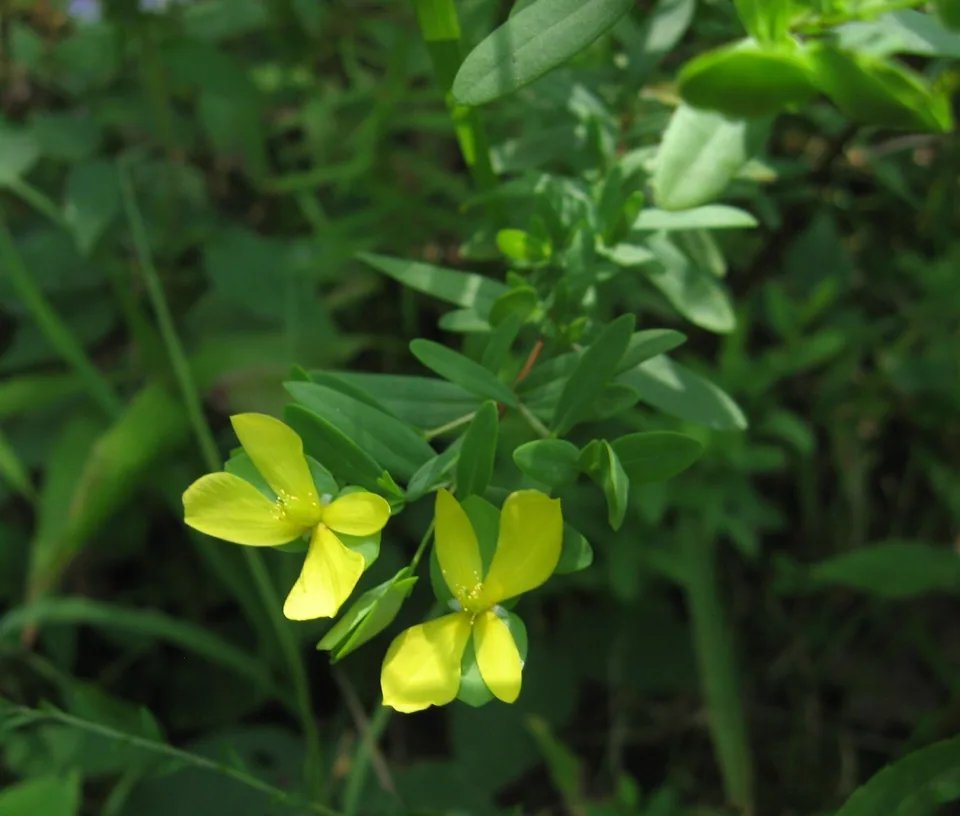


How to Grow and Care for St. Andrew's Cross
Hypericum hypericoides
Written by Emilio Marruso · last checked
At a glance
This easygoing perennial is a friendly choice for beginners: it grows happily in full sun or partial shade and takes soil that is moist or fairly dry. It stays compact, 2 to 4 feet tall, has no significant problems, and you can start new plants from seed or stem cuttings. It is fairly short-lived, so keep a few new plants coming along.
- Sun
Full sun to partial shade
What the sources say (2)
Light: Full sun to partial shade
in full sun to partial shade. It is
— Hypericum hypericoides (St. Andrew's Cross) | North Carolina Extension Gardener Plant Toolbox [1] Light: Full sun (6 or more hours of direct sunlight a day) Partial Shade (Direct sunlight only part of the day, 2-6 hours)
— Hypericum hypericoides (St. Andrew's Cross) | North Carolina Extension Gardener Plant Toolbox [1] - Water
Likes moist to dry soil and handles dry spells fairly well
What the sources say (1)
Watering: Moist to dry soils; fairly drought-tolerant
St. Andrew's cross prefers average, moist to dry sandy or loamy soils in full sun to partial shade. It is very adaptive to various conditions and is fairly drought-tolerant but not salt-tolerant.
— Hypericum hypericoides (St. Andrew's Cross) | North Carolina Extension Gardener Plant Toolbox [1] - Cold
Survives winters down to −20 °F (−28.9 °C)
Very hardy · USDA 5a · RHS H7 · Z5
What the sources say (2)
Hardiness, coldest zone: 5a [winter low −28.9 to −26.1 °C (−20 to −15 °F)]
USDA Plant Hardiness Zone: 5a, 5b, 6a, 6b, 7a, 7b, 8a, 8b, 9a, 9b
— Hypericum hypericoides (St. Andrew's Cross) | North Carolina Extension Gardener Plant Toolbox [1] Hardiness, warmest zone: 9b [winter low −3.9 to −1.1 °C (25 to 30 °F)]
USDA Plant Hardiness Zone: 5a, 5b, 6a, 6b, 7a, 7b, 8a, 8b, 9a, 9b
— Hypericum hypericoides (St. Andrew's Cross) | North Carolina Extension Gardener Plant Toolbox [1] - Soil
Soil from slightly acidic to alkaline, pH 6.0–8.0
What the sources say (2)
Soil pH, minimum: 6.0
Soil pH: Neutral (6.0-8.0) Soil Drainage: Good Drainage
— Hypericum hypericoides (St. Andrew's Cross) | North Carolina Extension Gardener Plant Toolbox [1] Soil pH, maximum: 8.0
Soil pH: Neutral (6.0-8.0) Soil Drainage: Good Drainage
— Hypericum hypericoides (St. Andrew's Cross) | North Carolina Extension Gardener Plant Toolbox [1] - Pests
No significant pest or disease problems
- Watch out
Fairly short-lived: start new plants now and then to keep it in your garden
- Size
2 to 4 ft tall and 1 to 3 ft wide
What the sources say (2)
Mature height: 61-122 cm (2 to 4 feet)
Dimensions: Height: 2 ft. 0 in. - 4 ft. 0 in. Width: 1 ft. 0 in. - 3 ft. 0 in.
— Hypericum hypericoides (St. Andrew's Cross) | North Carolina Extension Gardener Plant Toolbox [1] Mature width: 30-91 cm (1 to 3 feet)
Dimensions: Height: 2 ft. 0 in. - 4 ft. 0 in. Width: 1 ft. 0 in. - 3 ft. 0 in.
— Hypericum hypericoides (St. Andrew's Cross) | North Carolina Extension Gardener Plant Toolbox [1] - Propagation
Grow new plants from seed or stem cuttings
What the sources say (1)
Propagation: Seed, stem cuttings
Propagation is by seed or stem cuttings. Insects,
— Hypericum hypericoides (St. Andrew's Cross) | North Carolina Extension Gardener Plant Toolbox [1]
Overview
St. Andrew's cross is a native semi-evergreen shrub that grows 2-4 feet [0.6–1.2 m] tall and 1-3 feet [30–91 cm] wide. [1] It prefers average, moist to dry sandy or loamy soils in full sun to partial shade and is fairly drought-tolerant. [1] It is used in native and pollinator gardens and naturalized areas. [1]
This record is incomplete: the sources we read do not cover every field yet.
Not yet covered by our sources: Pruning
St. Andrew's Cross care
Measurements in square brackets are our conversion into the other unit system; the quoted text is unchanged.
How to water St. Andrew's Cross
Moist to dry soils; fairly drought-tolerant
What the sources say (1)
St. Andrew's cross prefers average, moist to dry sandy or loamy soils in full sun to partial shade. It is very adaptive to various conditions and is fairly drought-tolerant but not salt-tolerant.How much light St. Andrew's Cross needs
Full sun to partial shade
What the sources say (2)
in full sun to partial shade. It isLight:
Full sun (6 or more hours of direct sunlight a day)
Partial Shade (Direct sunlight only part of the day, 2-6 hours)How much cold St. Andrew's Cross can take
Hardiness, coldest zone
5a [winter low −28.9 to −26.1 °C (−20 to −15 °F)]
What the sources say (1)
USDA Plant Hardiness Zone:
5a, 5b, 6a, 6b, 7a, 7b, 8a, 8b, 9a, 9bHardiness, warmest zone
9b [winter low −3.9 to −1.1 °C (25 to 30 °F)]
What the sources say (1)
USDA Plant Hardiness Zone:
5a, 5b, 6a, 6b, 7a, 7b, 8a, 8b, 9a, 9bBest soil for St. Andrew's Cross
Soil pH, minimum
6.0
What the sources say (1)
Soil pH:
Neutral (6.0-8.0)
Soil Drainage:
Good DrainageSoil pH, maximum
8.0
What the sources say (1)
Soil pH:
Neutral (6.0-8.0)
Soil Drainage:
Good DrainageHow to propagate St. Andrew's Cross
Seed, stem cuttings
What the sources say (1)
Propagation is by seed or stem cuttings.
Insects,How to grow St. Andrew's Cross
The plant
Life cycle
perennial
What the sources say (1)
Family: Hypericaceae Life Cycle: Perennial Recommended Propagation Strategy: Seed Stem CuttingFamily
Hypericaceae
What the sources say (1)
Family: Hypericaceae Life Cycle: Perennial Recommended Propagation Strategy: Seed Stem CuttingMature height
61-122 cm (2 to 4 feet)
What the sources say (1)
Dimensions: Height: 2 ft. 0 in. - 4 ft. 0 in. Width: 1 ft. 0 in. - 3 ft. 0 in.Mature width
30-91 cm (1 to 3 feet)
What the sources say (1)
Dimensions: Height: 2 ft. 0 in. - 4 ft. 0 in. Width: 1 ft. 0 in. - 3 ft. 0 in.St. Andrew's Cross pests and problems
Short life
Symptom: No significant problems; fairly short-lived
What the sources say (1)
No significant problems. Fairly short-lived. See this plant
— Hypericum hypericoides (St. Andrew's Cross) | North Carolina Extension Gardener Plant Toolbox [1]
Remedies
Each remedy shows what official sources say about it; traditional remedies without an official source are marked as such. Harmful ones are listed so you know to avoid them.
Treating the plant
scale insects
scraping off scale with a cotton swab and rubbing alcohol Not verified
Traditional remedy, not verified by an official source.
How: Scrape the pests off plant surfaces with a fingernail or a cotton swab dipped in rubbing alcohol.
rubbing alcohol and insecticidal soap spray Not verified
Traditional remedy, not verified by an official source.
How: Spray severely infested plants every three days for two weeks; add one teaspoon alcohol to a pint of ready to use commercial soap spray.
cutting and burning affected branches Not verified
Traditional remedy, not verified by an official source.
How: To control heavy infestations, cut and burn affected branches.
root-knot nematodes
compost and leaf mold Not verified
Traditional remedy, not verified by an official source.
How: Add lots of compost, especially leaf mold, to the soil to encourage fungi that attack nematodes.
dilute fish emulsion drench Not verified
Traditional remedy, not verified by an official source.
How: Drench the soil near affected shrubs with dilute fish emulsion.
rust
removing infected leaves and debris Partly works
How: Remove infected leaves as soon as possible; remove and destroy diseased plants and nearby yard debris before growth starts in spring.
Remove infected leaves as soon as possible. Remove and destroy diseased plants and all nearby yard debris before growth starts in the spring.
— gardening.yardener.com [2] What the evidence says Cultural control Has been very hard to control in the Pacific Northwest. - Remove infected leaves and leaf litter in the planting site.
— pnwhandbooks.org [3] pruning back infected growth and discarding debris Partly works
How: Prune back all infected above-ground growth and let the plant rejuvenate; rake up and discard the debris, do not compost it.
The best recourse for now is to prune back infected growth (all of the above-ground growth) and let the plant rejuvenate; rake up and discard, do not compost, the debris.
— ask.extension.org [4] What the evidence says The best recourse for now is to prune back infected growth (all of the above-ground growth) and let the plant rejuvenate; rake up and discard, do not compost, the debris.
— ask.extension.org [4] avoiding overhead irrigation Official source, not independently tested
How: Avoid overhead irrigation, or apply water so that plants are not wet for extended periods of time.
Avoid overhead irrigation or apply such that plants are not wet for extended periods of time.
— pnwhandbooks.org [3]
powdery mildew
discarding garden refuse in autumn Not verified
Traditional remedy, not verified by an official source.
How: Collect and discard all aboveground yard and garden refuse in the fall to prevent contagion.
winter windburn
wrapping with burlap or fleece Not verified
Traditional remedy, not verified by an official source.
How: Surround plants with protective material such as burlap or agricultural fleece.
Calendar
Pruning
Not stated in the sources we read.
Months as given by the sources, which are mostly from the United States (northern hemisphere). In the southern hemisphere they shift by about six months.
Similar plants
- Atlantic St. John's Wort Hypericum tenuifolium
- Bedstraw Hypericum galioides
- Bushy St. John's Wort Hypericum densiflorum
- Cedarglade St. Johnswort Hypericum frondosum
- Common St. John's-wort Hypericum perforatum
- Mount Olympus St. John's Wort Hypericum olympicum
- Shrubby St. John's Wort Hypericum prolificum
- Aaron's Beard Hypericum calycinum
Sources
Every value above is quoted from these documents. Links lead to the original publisher.
- Hypericum hypericoides (St. Andrew's Cross) | North Carolina Extension Gardener Plant Toolbox · plants.ces.ncsu.edu, consulted
- gardening.yardener.com · gardening.yardener.com
- pnwhandbooks.org · pnwhandbooks.org
- ask.extension.org · ask.extension.org
Written by Emilio Marruso · last checked