

How to Grow and Care for Cedarglade St. Johnswort
Hypericum frondosum
Written by Emilio Marruso · last checked
At a glance
This easygoing perennial grows happily in full sun or partial shade, and once it settles in, it handles dry spells on its own. A spring pruning is all the trimming it asks for. In hot, humid climates, keep an eye out for wilt and root rot, its main troubles, and you'll enjoy a tough, rewarding plant in your garden.
- Sun
Full sun to partial shade
What the sources say (1)
Light: Full sun to partial shade
It prefers rich sandy loams in full sun to partial shade but is adaptable to other soils if well-drained.
— Hypericum frondosum (Cedarglade St. Johnswort, Golden St. John's wort) | North Carolina Extension Gardener Plant Toolbox [1] - Water
Handles dry spells once it's settled in
What the sources say (1)
Watering: Drought-tolerant once established
It is drought-tolerant once established
— Hypericum frondosum (Cedarglade St. Johnswort, Golden St. John's wort) | North Carolina Extension Gardener Plant Toolbox [1] - Soil
Soil pH up to 8.0
- Pruning
Prune in spring
What the sources say (1)
Pruning: Spring
Prune in spring as blooms appear on new wood.
— Hypericum frondosum (Cedarglade St. Johnswort, Golden St. John's wort) | North Carolina Extension Gardener Plant Toolbox [1] - Pests
Wilt, root rot and tiny root worms, worst in hot, humid climates; also leaf spot, mildew and rust
What the sources say (2)
Pests: nematodes
Susceptible to nematodes, which can cause root rot.
— Hypericum frondosum (Cedarglade St. Johnswort, Golden St. John's wort) | North Carolina Extension Gardener Plant Toolbox [1] Diseases: wilt, root rot, leaf spot, mildew, rust
Wilt and root rot can be significant problems, particularly in hot and humid climates of the South. Susceptible to nematodes, which can cause root rot. Leaf spot, mildew and rust are less threatening.
— Hypericum frondosum (Cedarglade St. Johnswort, Golden St. John's wort) | North Carolina Extension Gardener Plant Toolbox [1]
Overview
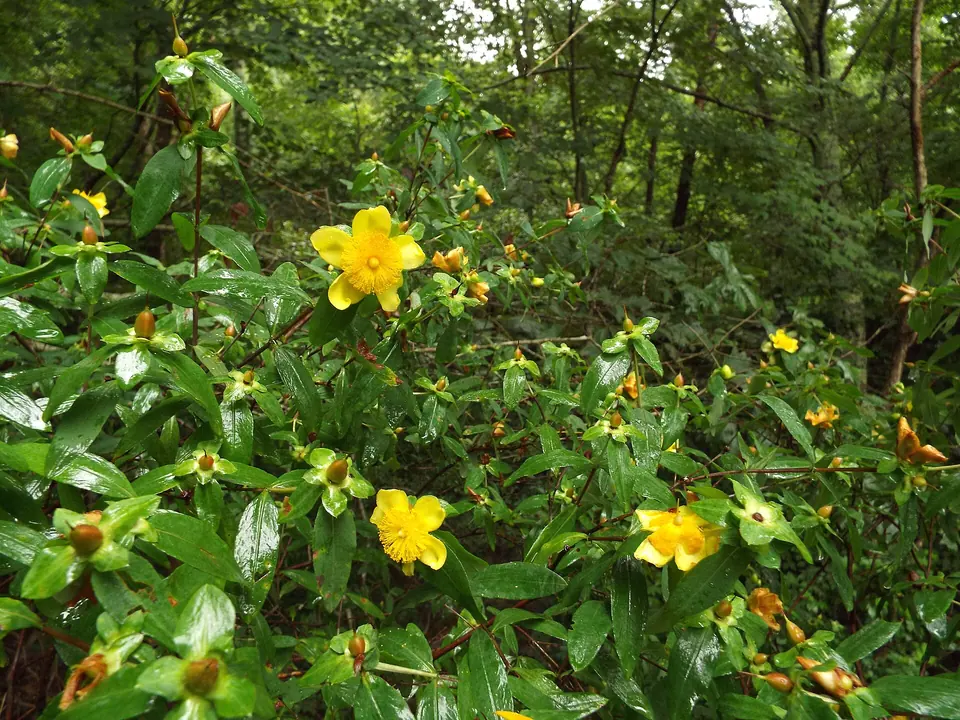
Hypericum frondosum is a small, dense, semi-evergreen to evergreen shrub native to the central and southeastern United States. [1] It prefers full sun to partial shade and is drought-tolerant once established. [1] It carries yellow flowers in June and July and is used as a short hedge or in shrub borders. [1]
This record is incomplete: the sources we read do not cover every field yet.
Not yet covered by our sources: Propagation
Cedarglade St. Johnswort care
How to water Cedarglade St. Johnswort
Drought-tolerant once established
What the sources say (1)
It is drought-tolerant once establishedHow much light Cedarglade St. Johnswort needs
Full sun to partial shade
What the sources say (1)
It prefers rich sandy loams in full sun to partial shade but is adaptable to other soils if well-drained.How much cold Cedarglade St. Johnswort can take
Hardiness, coldest zone
The sources give different values depending on region, zone or growing conditions.
What each source says
According to NC State Extension: 5a [winter low −28.9 to −26.1 °C (−20 to −15 °F)]
According to Cornell Woody Plants Database: 6a [winter low −23.3 to −20.6 °C (−10 to −5 °F)]
What the sources say (3)
According to NC State Extension: USDA Plant Hardiness Zone:
5a, 5b, 6a, 6b, 7a, 7b, 8a, 8bAccording to Cornell Woody Plants Database: Hardy To Zone:
6aUSDA Plant Hardiness Zone:
5a, 5b, 6a, 6b, 7a, 7b, 8a, 8bHardiness, warmest zone
8b [winter low −9.4 to −6.7 °C (15 to 20 °F)]
What the sources say (1)
USDA Plant Hardiness Zone:
5a, 5b, 6a, 6b, 7a, 7b, 8a, 8bBest soil for Cedarglade St. Johnswort
Soil pH, minimum
The sources give different values depending on region, zone or growing conditions.
What each source says
According to NC State Extension: 6.0
According to Cornell Woody Plants Database: 5.0
What the sources say (3)
According to NC State Extension: Soil pH:
Neutral (6.0-8.0)According to Cornell Woody Plants Database: Can tolerate acid to alkaline soil (pH 5.0 to 8.0)Soil pH:
Neutral (6.0-8.0)How to propagate Cedarglade St. Johnswort
Not stated in the sources we read.
How to grow Cedarglade St. Johnswort
The plant
Life cycle
perennial
What the sources say (1)
Cedar glade St. John's-wort is a semi-evergreens to evergreen perennial shrub in the Hypericaceae family native to the central and southeastern United States.Family
Hypericaceae
What the sources say (1)
Cedar glade St. John's-wort is a semi-evergreens to evergreen perennial shrub in the Hypericaceae family native to the central and southeastern United States.Mature height
Pests and diseases
Pests
nematodes
What the sources say (1)
Susceptible to nematodes, which can cause root rot.Diseases
wilt, root rot, leaf spot, mildew, rust
What the sources say (1)
Wilt and root rot can be significant problems, particularly in hot and humid climates of the South. Susceptible to nematodes, which can cause root rot. Leaf spot, mildew and rust are less threatening.Cedarglade St. Johnswort pests and problems
Wilt, root rot and nematodes
Symptom: Wilt and root rot can be significant problems, particularly in hot and humid climates of the South; susceptible to nematodes, which can cause root rot.
What the sources say (1)
Wilt and root rot can be significant problems, particularly in hot and humid climates of the South.
— Hypericum frondosum (Cedarglade St. Johnswort, Golden St. John's wort) | North Carolina Extension Gardener Plant Toolbox [1]
Remedies
Each remedy shows what official sources say about it; traditional remedies without an official source are marked as such. Harmful ones are listed so you know to avoid them.
Treating the plant
rust
removing infected leaves and leaf litter Official source, not independently tested
How: Remove infected leaves and leaf litter in the planting site, mowing severely infected plantings, raking all leaves and destroying the litter.
Remove infected leaves and leaf litter in the planting site. This may require mowing severely infected plantings, raking all leaves, and destroying infected leaf litter.
— hortsense.cahnrs.wsu.edu [5] pruning back infected growth Official source, not independently tested
How: Prune back infected growth, let the plant rejuvenate, and rake up and discard the debris without composting it.
The best recourse for now is to prune back infected growth (all of the above-ground growth) and let the plant rejuvenate; rake up and discard, do not compost, the debris.
— ask.extension.org [6] avoiding overhead irrigation Official source, not independently tested
How: Avoid overhead irrigation or apply water so that plants are not wet for extended periods of time.
Avoid overhead irrigation or apply such that plants are not wet for extended periods of time.
— pnwhandbooks.org [7] mowing in dry weather Official source, not independently tested
How: Mow in late spring or summer during dry weather to encourage new, rust-free foliage.
Mowing in the late spring or summer during dry weather will encourage the growth of new, rust-free foliage.
— pnwhandbooks.org [7]
Calendar
Pruning
Spring
What the sources say (1)
Prune in spring as blooms appear on new wood.Months as given by the sources, which are mostly from the United States (northern hemisphere). In the southern hemisphere they shift by about six months.
Indicative values
Values from a secondary source, not checked word for word like the rest of this page. Use them as a starting point.
- Drought tolerant
- yesIndicative value, adapt it to your climate · Secondary source · Data for the variety Hypericum frondosum 'Sunburst'
- Care level
- EasyIndicative value, adapt it to your climate · Secondary source · Data for the variety Hypericum frondosum 'Sunburst'
- Growth rate
- LowIndicative value, adapt it to your climate · Secondary source · Data for the variety Hypericum frondosum 'Sunburst'
- Propagation
- Cutting, Layering Propagation, Division, Seed Propagation, Grafting PropagationIndicative value, adapt it to your climate · Secondary source · Data for the variety Hypericum frondosum 'Sunburst'
Similar plants
- Atlantic St. John's Wort Hypericum tenuifolium
- Bedstraw Hypericum galioides
- Bushy St. John's Wort Hypericum densiflorum
- Common St. John's-wort Hypericum perforatum
- Mount Olympus St. John's Wort Hypericum olympicum
- Shrubby St. John's Wort Hypericum prolificum
- St. Andrew's Cross Hypericum hypericoides
- Aaron's Beard Hypericum calycinum
Sources
Every value above is quoted from these documents. Links lead to the original publisher.
- Hypericum frondosum (Cedarglade St. Johnswort, Golden St. John's wort) | North Carolina Extension Gardener Plant Toolbox · plants.ces.ncsu.edu, consulted
- Cedarglade St. Johnswort - Hypericum frondosum | North Carolina Extension Gardener Plant Toolbox · plants.ces.ncsu.edu, consulted
- Golden St. John's wort - Hypericum frondosum | North Carolina Extension Gardener Plant Toolbox · plants.ces.ncsu.edu, consulted
- Woody Plants Database · woodyplants.cals.cornell.edu, consulted
- hortsense.cahnrs.wsu.edu · hortsense.cahnrs.wsu.edu
- ask.extension.org · ask.extension.org
- pnwhandbooks.org · pnwhandbooks.org
Written by Emilio Marruso · last checked