How to Propagate Mother-in-Law Tongue by Division or Cuttings
Divide your snake plant to keep its yellow edges, or root leaf sections with the original base down to produce new shoots.
by Emilio MarrusoPublished
Divide a snake plant if you want to keep the yellow edges of a cultivar such as ‘Laurentii’. For a green plant, or if green offspring are fine, root leaf sections with the end that originally faced the roots pointing down. Sources Iowa State University Extension, How to Propagate Houseplants by Leaf Section Cuttings and Iowa State University Extension, How to Propagate Houseplants by Division and Offsets [1] [2]
In short:
- For a striped cultivar, look for a rooted offset or a rooted group of shoots to separate.
- For leaf cuttings, mark the original top before pieces get mixed up.
- Move a cutting into its own pot once it has both sufficient roots and a new shoot.
Which method will give you the plant you want?
| Starting material | Method | What you should look for |
|---|---|---|
| Yellow-edged clump with rooted offsets | Division | A shoot or group of leaves attached to its own roots [1] [2] |
| Healthy green leaf and room for a propagation pot | Leaf sections | An uninjured leaf, with every section marked for orientation [1] |
| Yellow-edged plant with no separate rooted growth | Wait for an offset if keeping the edge color matters | Signs of new growth at the base before taking the pot apart [1] [2] |
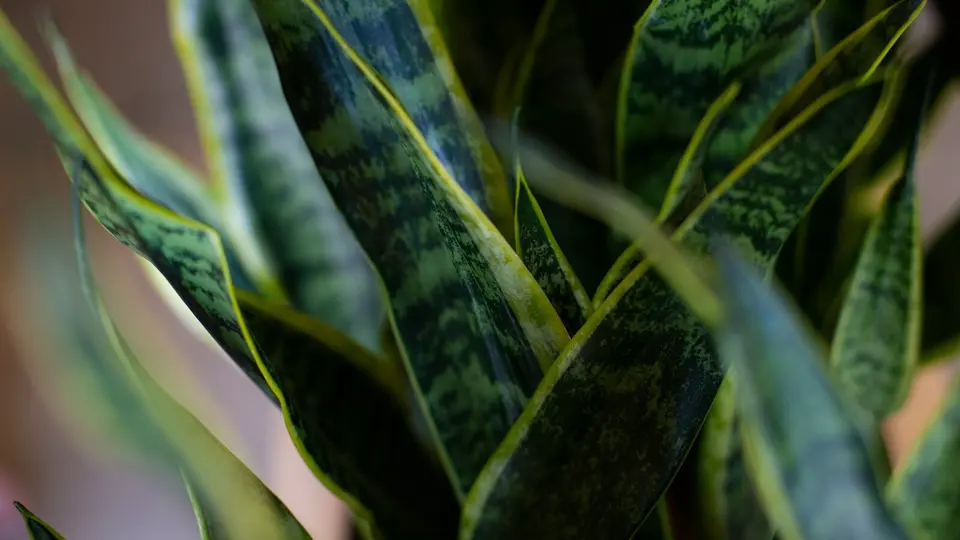
The snake plant may also be labeled Sansevieria or mother-in-law's tongue. The names can refer to the same species on older plant tags and in garden books. Inspect the plant itself. A gold band along the edge of each leaf is the feature you are trying to retain in ‘Laurentii’. New growth from a leaf cutting of that cultivar can come up green even when the original piece still shows the yellow stripe [1].
Look along the edge of the pot before you choose a method. A small cluster emerging away from the oldest leaves may be an offset. If all the leaves emerge from a single growing point with no separate rooted group, splitting the plant would sacrifice that growing point. You can wait for new growth or, if a green plant is acceptable, use a leaf cutting. Set aside any leaf that is soft or decaying and choose healthy material [1] [2].
Divide a rooted offset or clump
Prepare clean pots with drainage and fresh potting mix before disturbing the plant. Take the parent out of its pot, supporting the root ball with your hand. Tease away enough mix to see where the shoots join and where the roots are attached. Look for a natural separation. Each portion you intend to keep should contain growth and roots. If a connection needs cutting, use a clean, sharp blade and place the cut where both sections keep their roots [2].
Plant the divisions individually and settle the mix around the roots. Hold the foliage upright while backfilling so the plant stays centered. Label them immediately if you are working with more than one cultivar. Set the pots in a spot with indirect light while the roots settle. Check that the mix drains and that excess water does not collect in an outer pot. A plant started by division has functioning leaves and roots from the beginning, so its next milestone is new growth after it settles [2].
Root a leaf without losing its orientation
Lay a sound leaf flat on a clean surface with its tip and base in view. Make sections within the stated length range. As soon as you cut each piece, make a small identifying notch at its top, following Iowa State's method. The lower end is always the one that was closer to the base on the intact leaf. This mark helps when pieces are moved or when a middle section has a flat cut at both ends [1].
Fill a clean pot with a moist medium suited to rooting, such as a perlite-based mix, and check that it has holes. In Iowa State's method, the bottom of the section is dipped in rooting hormone before insertion. Set the base down at the stated depth and firm the medium enough to hold the section upright. Water and let it drain. Set the pot in a warm location with bright indirect light. A loose clear cover can help maintain humidity. Check the cuttings and the medium regularly, and adjust as needed [1].
The old leaf section is a support for propagation. Look for a new shoot at its base instead of waiting for the cut top to become a growing tip. The first leaf beside the original piece belongs to the new plantlet. Give it time to develop roots. Move it on when the roots and shoot can be handled without repeatedly lifting it from the medium [1].
What if you see no growth or the base softens?
Start with the conditions you can inspect without uprooting the pieces. Check whether the pot drains, whether the medium has dried, and whether the pieces were inserted with the correct end down. Use the marks you made when cutting. If a piece has turned soft and is deteriorating, remove it and check the remaining cuttings and their medium before restarting with healthy material [1].
Keep a label recording the cultivar, propagation method and date. This matters when the leaf section stays striped while its new shoot is green. Observe the pattern on the new growth and compare it with the parent. If you want a matching plant next time, wait for a rooted division and detach that instead [1] [2].
If you decide to try both methods on the same plant, keep the divisions and leaf pieces in separate pots. They start with different needs: a division already has roots, while a leaf piece needs a rooting environment until it produces a plantlet. Give them separate labels and compare new growth on each. That is especially useful if you are testing a plant with a patterned leaf and want to know which method kept the pattern [1] [2].
Frequently asked questions
Can the upper end of a leaf section go into the rooting medium?
Put the original base end down. Mark the top as soon as you cut each section so you can identify it later [1].
Sources
- Iowa State University Extension, How to Propagate Houseplants by Leaf Section Cuttings · yardandgarden.extension.iastate.edu, consulted
- Iowa State University Extension, How to Propagate Houseplants by Division and Offsets · yardandgarden.extension.iastate.edu, consulted
Written by Emilio Marruso · last checked