Pruning Roses: How and When to Cut Each Type of Rose Bush
Check whether your rose flowers once or repeats, then decide which canes to keep and when to make the main pruning cuts.
by Emilio MarrusoPublished
Prune repeat-flowering hybrid teas and floribundas as spring buds begin to break. Shape once-flowering roses and ramblers just after their display, and preserve the long framework of climbing roses. Use the rose groups described by Illinois Extension, Pruning roses, the winter-damage checks from Iowa State University Extension and Outreach, How to prune roses and the climbing-rose distinctions from Clemson Cooperative Extension, Pruning roses [1] [2] [3].
In short:
- Identify the rose and check whether it flowers once or repeats.
- Remove dead canes first and judge how much sound wood remains.
- Keep a climber's useful long canes attached to its support.
Choose a cut by rose type
| Rose type | When to prune | What to keep |
|---|---|---|
| Hybrid tea, floribunda or grandiflora | Spring as buds begin to grow [1] [2] [3]. | Healthy, well-placed canes. |
| Repeat-flowering landscape shrub | Spring at budbreak for cleanup and thinning [1] [2]. | Enough sound growth to maintain its natural habit. |
| Once-flowering old garden rose | After the display for shaping [1] [2] [3]. | Living stems until they have flowered. |
| Once-flowering rambler or climber | After flowering for the main pruning [1] [3]. | Long useful stems and replacement growth. |
| Repeat-flowering climber | Check for winter damage in spring and maintain the framework [2] [3]. | Strong long canes that can be tied in. |
The word climbing describes how a rose grows. Use a cultivar label or a record of its flowering to decide whether it has one display or several. If you inherited a rose on a trellis, remove confirmed dead wood and watch it for a season before you remove healthy long canes. A severe cut made before you know when those canes flower can remove much of the display [1] [2] [3].
How do you tell live canes from dead ones?
Start by looking for plump buds and sound cane tissue. Iowa State describes healthy pith, the center of the cut stem, as white. Dead wood has brown or gray pith and lacks living buds. If you are working down a winter-damaged cane, check the cut surface and keep the live section if it is useful. Take a cane out at the base if the whole thing is dead [2].
Cold damage changes how much pruning a modern rose can take that spring. Iowa State prioritizes saving live tissue where severe winters kill much of the upper growth. In a milder winter there is more sound wood available for shaping. Use the buds and tissue in front of you to judge each cane. The height of the neighboring rose gives you little information about what survived on this one [2].
Prune a repeat-flowering shrub in order
Step 1 Clear dead and damaged wood
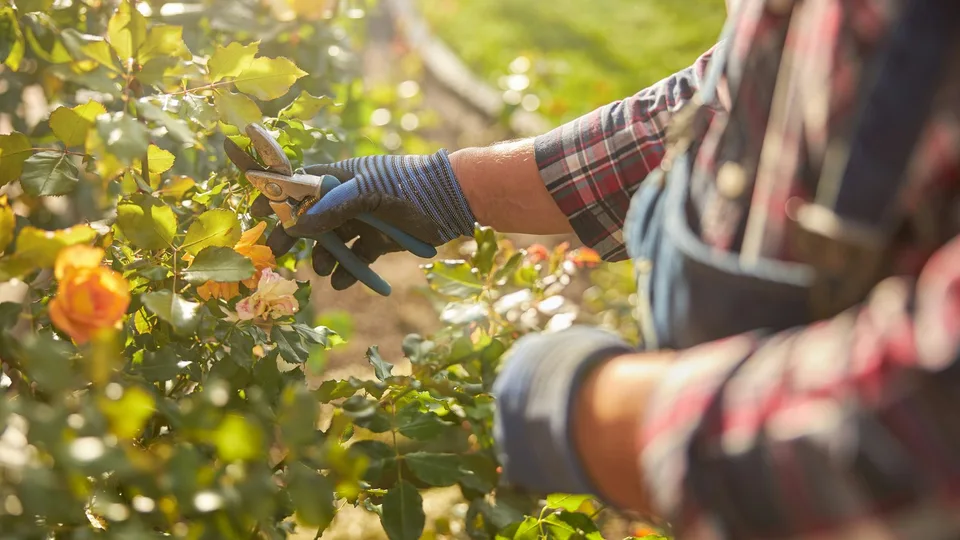
Wear gloves and use sharp pruners that can cut through the cane without crushing it. Remove the dead stems first. Once you have opened up the plant, step back and see how many healthy canes remain. The living material now visible determines where you can afford to thin or shorten [1] [2] [3].
Step 2 Thin where the canes crowd each other
Look for inward or crossing stems in a congested center. Remove or shorten selected canes to make room for the better placed growth. A hybrid tea usually needs more pruning than a landscape shrub. With an established shrub that has plenty of room and healthy growth, start with cleanup and thin only where it solves a specific problem [1] [2].
Step 3 Shorten above a healthy outward bud
Follow the cane down to a healthy bud pointing toward open space. Iowa State recommends using 0.25 in (0.6 cm) as a guide for the distance above an outward-facing bud. Check the direction of the bud before cutting so the growth you encourage has somewhere to go. Preserve enough living cane after winter damage to give the plant a sound starting point [2].
How do you prune a rose that flowers once?
Let healthy flowering stems carry their spring display. After it finishes, choose the branches that are blocking a path, crossing the center or crowding healthy replacement stems. Make individual cuts rather than shortening the entire shrub to the same height. Some old garden roses and species roses have attractive hips, which form from flowers you leave on the plant [1] [2] [3].
If the plant resembles rugosa rose, confirm the cultivar and watch its actual bloom pattern. A profile helps with identification, and the timing of its own flowers guides your work. When hips are part of what you want from the shrub, leave some spent blooms and limit shaping to the branches that need it [1] [2].
How do you keep a climbing rose in flower?
Separate the long structural canes from their side shoots before you cut. Look for sound canes you can spread across the support. Tie in useful young replacements and make selective cuts where a branch is dead, worn out or in the way. On a once-flowering climber, save live flowering wood until the display has passed [1] [2] [3].
A cane that sticks out toward a walkway may be trainable back onto the support. See whether it can be tied in without forcing it before deciding to remove it. Trace the cane to its base first because several shoots can overlap. Cut after you can see exactly which parts of the framework will remain [2] [3].
Look again when the first growth appears. If a cane you kept has no living buds and shows the same dead tissue you found on the removed canes, take it out. If growth is strong on one side, use the next shaping decision to keep the healthy canes distributed across the space you have available [2].
Frequently asked questions
Sources
- Illinois Extension, Pruning roses · extension.illinois.edu, consulted
- Iowa State University Extension and Outreach, How to prune roses · yardandgarden.extension.iastate.edu, consulted
- Clemson Cooperative Extension, Pruning roses · hgic.clemson.edu, consulted
Written by Emilio Marruso · last checked