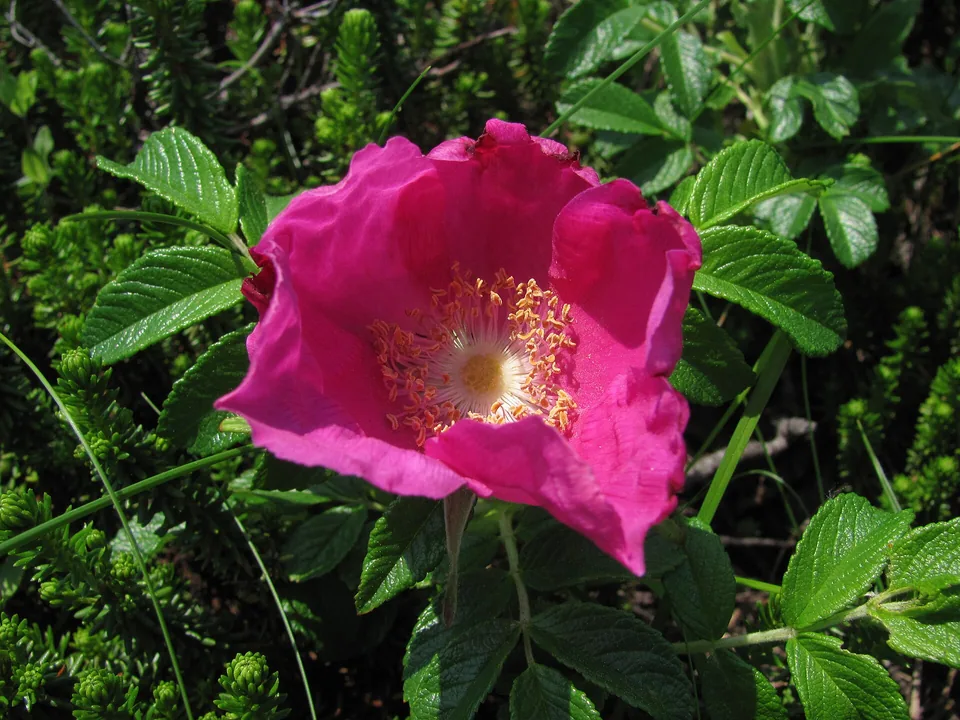


How to Grow and Care for Rugosa Rose
Rosa rugosa
Written by Emilio Marruso · last checked
At a glance
It prefers moist, acidic to neutral, well-drained soils
- Sun
Full sun.
What the sources say (1)
Light: Full sun.
Full sun.
— Rugosa Rose | NDSU Agriculture [4] - Water
Medium water needs.
What the sources say (1)
Watering: Medium water needs.
Medium water needs.
— Rugosa Rose | NDSU Agriculture [4] - Cold
Survives winters down to −50 °F (−45.6 °C)
Very hardy · USDA 2a · RHS H7 · Z2
What the sources say (7)
Hardiness, coldest zone: 2a [winter low −45.6 to −42.8 °C (−50 to −45 °F)]
According to NC State Extension: 2a, 2b, 3a, 3b, 4a, 4b, 5a, 5b, 6a, 6b, 7a, 7b
— Rosa rugosa (Beach Tomato, Japanese Rose, Rugosa Rose, Seaside Rose, Sea Tomato, Shrub Rose, Wild Rose) | North Carolina Extension Gardener Plant Toolbox [1] According to NDSU Extension: Scientific Name: Rosa rugosa Family: Rosaceae (Rose) Hardiness: Zone 2
— Rugosa Rose | NDSU Agriculture [4] According to University of Illinois Extension: USDA Hardiness Zone 3 - 7
— Rugosa Rose (Rosa rugosa)-Hort Answers - University of Illinois Extension [2] 2a, 2b, 3a, 3b, 4a, 4b, 5a, 5b, 6a, 6b, 7a, 7b
— Rosa rugosa (Beach Tomato, Japanese Rose, Rugosa Rose, Seaside Rose, Sea Tomato, Shrub Rose, Wild Rose) | North Carolina Extension Gardener Plant Toolbox [1] Hardiness, warmest zone: 7b [winter low −15 to −12.2 °C (5 to 10 °F)]
According to NC State Extension: 2a, 2b, 3a, 3b, 4a, 4b, 5a, 5b, 6a, 6b, 7a, 7b
— Rosa rugosa (Beach Tomato, Japanese Rose, Rugosa Rose, Seaside Rose, Sea Tomato, Shrub Rose, Wild Rose) | North Carolina Extension Gardener Plant Toolbox [1] According to University of Illinois Extension: USDA Hardiness Zone 3 - 7
— Rugosa Rose (Rosa rugosa)-Hort Answers - University of Illinois Extension [2] 2a, 2b, 3a, 3b, 4a, 4b, 5a, 5b, 6a, 6b, 7a, 7b
— Rosa rugosa (Beach Tomato, Japanese Rose, Rugosa Rose, Seaside Rose, Sea Tomato, Shrub Rose, Wild Rose) | North Carolina Extension Gardener Plant Toolbox [1] - Watch out
The shrub will sucker and form thickets, crowding out other plants.
- Pruning
Wait until late winter/early spring.
What the sources say (1)
Pruning: wait until late winter/early spring
wait until late winter/early spring
— University of Maine Cooperative Extension — When is the best time to prune beach roses? [9] - Feeding
For species roses, a spring application of general-purpose fertilizer is usually adequate for the season.
What the sources say (1)
How often: For species roses, a spring application of general-purpose fertilizer is usually adequate for the season.
For species roses, a spring application of general-purpose fertilizer is usually adequate for the season.
— University of Illinois Extension — Rose care [10]
Overview
Rugosa rose is a hardy, multi-stemmed, deciduous suckering shrub rose native to eastern Asia. [1] It grows in full sun and is drought and salt tolerant. [1] It has become invasive in parts of North America, especially along coastal areas. [1] Withstands pruning and can be turned into a hedge if desired. [4]
Rugosa Rose care
How to water Rugosa Rose
Watering
Medium water needs.
What the sources say (1)
Medium water needs.Watering notes
Prefers moist, well-drained soil; avoid wet soils
What the sources say (2)
It prefers moist, acidic to neutral, well-drained soils and is poor soil tolerant in full sun. It is also drought and salt-tolerant.Avoid wet soils. The Clemson Cooperative Extension Home and Garden Information Center has a factsheet on common rose diseasesHow much light Rugosa Rose needs
Full sun.
What the sources say (1)
Full sun.How much cold Rugosa Rose can take
Hardiness, coldest zone
2a [winter low −45.6 to −42.8 °C (−50 to −45 °F)]
What each source says
According to NC State Extension: 2a [winter low −45.6 to −42.8 °C (−50 to −45 °F)]
According to NDSU Extension: 2 [winter low −45.6 to −40 °C (−50 to −40 °F)]
According to University of Illinois Extension: 3 [winter low −40 to −34.4 °C (−40 to −30 °F)]
What the sources say (4)
According to NC State Extension: 2a, 2b, 3a, 3b, 4a, 4b, 5a, 5b, 6a, 6b, 7a, 7bAccording to NDSU Extension: Scientific Name: Rosa rugosa
Family: Rosaceae (Rose)
Hardiness: Zone 2According to University of Illinois Extension: USDA Hardiness Zone
3 - 72a, 2b, 3a, 3b, 4a, 4b, 5a, 5b, 6a, 6b, 7a, 7bHardiness, warmest zone
7b [winter low −15 to −12.2 °C (5 to 10 °F)]
What each source says
According to NC State Extension: 7b [winter low −15 to −12.2 °C (5 to 10 °F)]
According to University of Illinois Extension: 7 [winter low −17.8 to −12.2 °C (0 to 10 °F)]
What the sources say (3)
According to NC State Extension: 2a, 2b, 3a, 3b, 4a, 4b, 5a, 5b, 6a, 6b, 7a, 7bAccording to University of Illinois Extension: USDA Hardiness Zone
3 - 72a, 2b, 3a, 3b, 4a, 4b, 5a, 5b, 6a, 6b, 7a, 7bHow to propagate Rugosa Rose
Stem cutting
What the sources say (1)
Recommended Propagation Strategy:
Stem CuttingHow to grow Rugosa Rose
The plant
Family
Rosaceae
What the sources say (2)
Rugosa rose is a hardy, multi-stemmed, disease-resistant deciduous suckering shrub rose in the Rosaceae familyScientific Name: Rosa rugosa Family: Rosaceae (Rose) Hardiness: Zone 2Mature height
The sources disagree:
Mature width
122-183 cm (4 ft - 6 ft)
What the sources say (2)
Height: 4 ft. 0 in. - 6 ft. 0 in. Width: 4 ft. 0 in. - 6 ft. 0 in.Mature Height 4-6 Feet Size Small Medium Mature Width 4-6 FeetPests and diseases
Pests
aphids, beetles (including Japanese beetle), borers, scales, rose midges, leafhoppers, spider mites (including twospotted spider mite), thrips, meadow spittlebug
What the sources say (2)
This shrub is also susceptible to aphids, beetles, borers, scales, rose midges leafhoppers, spider mites, and thrips.Insect Damage - Japanese Beetle ( Popilla japonica ) - Meadow Spittlebug ( Philaenus spumarius ) Insect Relative Damage - Twospotted Spidermite [Ornamentals] ( Tetranychus urticae )Diseases
rust, rose rosette, black spot, powdery mildew, crown gall, cankers, dieback/canker, gray mold, wood rots and decays
What the sources say (3)
Potential diseases may include rust, rose rosette, black spots, and powdery mildew.Bacterial Disease - Crown Gall ( Agrobacterium tumefaciens ) Environmental Damage - Drought - Drowning and Edema Fungal Disease - Black Spot ( Diplocarpon rosae )- Gray Mold [Trees and Shrubs] ( Botrytis cinerea and other species ) - Powdery Mildew [Shrubs and Trees] ( Many genus and species involved ) - Wood Rots and Decays ( Many genus and species involved )Fertilizing
When
Early spring, before growth starts
What each source says
as an alternative, in fall: After the plants have gone dormant; the nutrients are available when growth resumes in spring
What the sources say (3)
as an alternative, in fall: Roses can be fall fertilized after the plants have gone dormant. Applying fertilizer at this time will not encourage growth but will be available as the plants start to grow in the spring.If you decide to fertilize, the best time to fertilize roses is in the early spring before growth starts to appear.For species roses, a spring application of general-purpose fertilizer is usually adequate for the season.How often
For species roses, a spring application of general-purpose fertilizer is usually adequate for the season.
What the sources say (1)
For species roses, a spring application of general-purpose fertilizer is usually adequate for the season.Mineral fertilizers
General-purpose fertilizer such as 10-10-10 or 12-12-12, 119 to 237 mL per plant
What the sources say (1)
For species roses, a spring application of general-purpose fertilizer is usually adequate for the season. General-purpose fertilizers such as 10-10-10 or 12-12-12 are used at about one-half to one cup per plant.Avoid
High-nitrogen fertilizer late in summer; stop fertilizing in late summer as the plants go dormant
What the sources say (2)
Be careful not to fertilize your roses with high nitrogen formulas late in the summer (end of August/September).You can fertilize every four to six weeks during the growing season, but stop fertilization in late summer (late August or early September) as the roses begin to go dormant.Pruning
Flowering wood
The sources give different values depending on region, zone or growing conditions.
What each source says
rose arbustive in generale: Flowers on new wood (this year's growth)
What the sources say (1)
rose arbustive in generale: Prune them in the winter or spring before new growth begins; these plants develop flowers on growth produced during the spring. Examples are shrub roses, beautyberry, abelia, and rose of Sharon.When to prune
The sources give different values depending on region, zone or growing conditions.
What each source says
rose arbustive in generale: Winter or spring, before new growth begins.
What the sources say (1)
rose arbustive in generale: Prune them in the winter or spring before new growth begins; these plants develop flowers on growth produced during the spring. Examples are shrub roses, beautyberry, abelia, and rose of Sharon.Rugosa Rose pests and problems
Invasive suckering
Symptom: Suckers and forms thickets, crowding out other plants
What to do: The source suggests choosing a cultivar that is better behaved than the species
What the sources say (2)
has many prickles and will sucker and form thickets, crowding out other plants.
— Rosa rugosa (Beach Tomato, Japanese Rose, Rugosa Rose, Seaside Rose, Sea Tomato, Shrub Rose, Wild Rose) | North Carolina Extension Gardener Plant Toolbox [1] Please choose a cultivar that is better behaved than the species.
— Rosa rugosa (Beach Tomato, Japanese Rose, Rugosa Rose, Seaside Rose, Sea Tomato, Shrub Rose, Wild Rose) | North Carolina Extension Gardener Plant Toolbox [1] Diseases
Symptom: Rust, rose rosette, black spots and powdery mildew may occur
What to do: Most disease-resistant when planted in full sun with good air circulation
What the sources say (1)
The plant is most disease-resistant when planted in full sun with good air circulation. Potential diseases may include rust, rose rosette, black spots, and powdery mildew.
— Rosa rugosa (Beach Tomato, Japanese Rose, Rugosa Rose, Seaside Rose, Sea Tomato, Shrub Rose, Wild Rose) | North Carolina Extension Gardener Plant Toolbox [1] Japanese beetles
Symptom: Japanese beetles are a damaging pest
What to do: The source gives no specific treatment
What the sources say (1)
Less troubled by the common rose diseases (black spot and powdery mildew), than other roses; Japanese beetles are a damaging pest.
— Rugosa Rose (Rosa rugosa)-Hort Answers - University of Illinois Extension [2]
Remedies
Each remedy shows what official sources say about it; traditional remedies without an official source are marked as such. Harmful ones are listed so you know to avoid them.
Treating the plant
spider mites
strong water jet Official source, not independently tested
How: A high-pressure washing with water from a garden hose directed to the underside of the leaves every 2-3 days.
A high-pressure washing with water from a garden hose directed to the underside of the leaves every 2-3 days can manage mites.
— extension.illinois.edu [14]
rose slugs
hand-picking Works
How: Rose slugs can be controlled by handpicking. They can also be removed by spraying with water.
Rose slugs can be controlled by handpicking. They can also be removed by spraying with water. Once dislodged, they cannot climb back onto the plant.
— hgic.clemson.edu [15] What the evidence says Rose slugs can be controlled by handpicking. They can also be removed by spraying with water. Once dislodged, they cannot climb back onto the plant.
— hgic.clemson.edu [15]
powdery mildew
baking soda spray Not verified
Traditional remedy, not verified by an official source.
However, too much baking soda on plants can lead to salt buildup, which is harmful to plants, so it should be used sparingly.
— gardeningknowhow.com [16] Homemade remedies make me nervous. Many of the products used are not developed for or tested on plants and may cause damage.
— melindamyers.com [17] Always perform a spot test to ensure your plants don’t experience any adverse reactions.
— rosehomegarden.com [18] How: Mix one tablespoon of baking soda and one teaspoon of horticulture oil or insecticidal soap in one gallon of water.
milk spray Not verified
Traditional remedy, not verified by an official source.
Homemade remedies make me nervous. Many of the products used are not developed for or tested on plants and may cause damage.
— melindamyers.com [17] How: Dilute 1 part milk in 7 parts water and spray on your roses; apply again if it rains, once the leaves are dry.
black spot
baking soda spray Not verified
Traditional remedy, not verified by an official source.
However, too much baking soda on plants can lead to salt buildup, which is harmful to plants, so it should be used sparingly.
— gardeningknowhow.com [16] For example, spraying home remedies that contain dish detergent on plants on a sunny day can injure the plant, essentially burning it.
— extension.psu.edu [19] Homemade remedies make me nervous. Many of the products used are not developed for or tested on plants and may cause damage.
— melindamyers.com [17] How: 1 gallon of water, 1 tablespoon of baking soda, 1 tablespoon of white vinegar, 1 tablespoon of vegetable oil, 1 teaspoon of dish soap; treat roses weekly.
cider vinegar spray Not verified
Traditional remedy, not verified by an official source.
Spray on plant early morning or evening to prevent leaf burn.
— countryfarm-lifestyles.com [20] Use cautiously around plants—vinegar in strong concentrations may damage leaves and soil microbiomes.
— jacksonandperkins.com [21] Homemade remedies make me nervous. Many of the products used are not developed for or tested on plants and may cause damage.
— melindamyers.com [17] How: Mix 3 tablespoons of cider vinegar to 5 quarts (5 liters) of water, add 1 teaspoon of vegetable oil and a good squirt of soft soap.
chamomile and nettle tea spray Not verified
Traditional remedy, not verified by an official source.
Homemade remedies make me nervous. Many of the products used are not developed for or tested on plants and may cause damage.
— melindamyers.com [17] How: 1 part stinging nettles to 1 part chamomile flowers; the strong tea spray is used every week during the hot summer months.
garlic spray Not verified
Traditional remedy, not verified by an official source.
Spray leaves early in the morning or during cloudy conditions to prevent leaf burn.
— rosehomegarden.com [18] Always perform a spot test to ensure your plants don’t experience any adverse reactions.
— rosehomegarden.com [18] Homemade remedies make me nervous. Many of the products used are not developed for or tested on plants and may cause damage.
— melindamyers.com [17] How: Crush 10 garlic cloves and soak them overnight in one quart of water; strain and spray onto roses weekly.
neem oil spray Not verified
Traditional remedy, not verified by an official source.
Avoid spraying neem oil solutions where beneficial insects, such as bees and ladybugs, are actively visiting the plant.
— gardeningknowhow.com [16] For example, spraying home remedies that contain dish detergent on plants on a sunny day can injure the plant, essentially burning it.
— extension.psu.edu [19] How: Dilute 1-2 tablespoons of neem oil in 1 gallon (3.5L) of water, add 1-2 teaspoons of liquid dish soap, and apply as a foliar spray every seven days.
aphids
vegetable oil and dish soap spray Not verified
Traditional remedy, not verified by an official source.
For example, spraying home remedies that contain dish detergent on plants on a sunny day can injure the plant, essentially burning it.
— extension.psu.edu [19] Homemade remedies make me nervous. Many of the products used are not developed for or tested on plants and may cause damage.
— melindamyers.com [17] How: 1 cup of vegetable oil mixed with 1 Tblsp. of dish washing liquid; then 1 Tblsp. of this concoction mixed with 1 cup of water.
Calendar
Pruning
wait until late winter/early spring
What the sources say (1)
wait until late winter/early springMonths as given by the sources, which are mostly from the United States (northern hemisphere). In the southern hemisphere they shift by about six months.
Edibility
Reported by the source, quoted verbatim. Do not eat a plant on the basis of this page alone: identification mistakes can be dangerous.
Indicative values
Values from a secondary source, not checked word for word like the rest of this page. Use them as a starting point.
- Life cycle
- PerennialIndicative value, adapt it to your climate · Secondary source
- Drought tolerant
- yesIndicative value, adapt it to your climate · Secondary source
- Soil
- Acidic, Rocky, gravelly, dryIndicative value, adapt it to your climate · Secondary source
- Soil pH
- 6-6.8Indicative value, adapt it to your climate · Secondary source
- Care level
- MediumIndicative value, adapt it to your climate · Secondary source
- Growth rate
- HighIndicative value, adapt it to your climate · Secondary source
Similar plants
- Apple Rose Rosa villosa
- Burnet Rose Rosa spinosissima
- Carolina Rose Rosa carolina
- Cherokee Rose Rosa laevigata
- Climbing Prairie Rose Rosa setigera
- Dog rose Rosa canina
- Lady Banks Rosa banksiae
- Memorial Rose Rosa lucieae
Sources
Every value above is quoted from these documents. Links lead to the original publisher.
- Rosa rugosa (Beach Tomato, Japanese Rose, Rugosa Rose, Seaside Rose, Sea Tomato, Shrub Rose, Wild Rose) | North Carolina Extension Gardener Plant Toolbox · plants.ces.ncsu.edu, consulted
- Rugosa Rose (Rosa rugosa)-Hort Answers - University of Illinois Extension · web.extension.illinois.edu, consulted
- Rugosa Rose (Rosa rugosa) - Selecting Shrubs for Your Home - University of Illinois Extension · web.extension.illinois.edu, consulted
- Rugosa Rose | NDSU Agriculture · ndsu.edu, consulted
- Rugosa rose - Cooperative Extension: Maine Wild Blueberries - University of Maine Cooperative Extension · extension.umaine.edu, consulted
- Shrub Rose - Rosa rugosa | North Carolina Extension Gardener Plant Toolbox · plants.ces.ncsu.edu, consulted
- Hansen Hedge Rose | NDSU Agriculture · ndsu.edu, consulted
- Wild Rose - Rosa rugosa | North Carolina Extension Gardener Plant Toolbox · plants.ces.ncsu.edu, consulted
- University of Maine Cooperative Extension — When is the best time to prune beach roses? · extension.umaine.edu, consulted
- University of Illinois Extension — Rose care · extension.illinois.edu, consulted
- ask.extension.org · ask.extension.org
- extension.oregonstate.edu · extension.oregonstate.edu
- extension.umd.edu · extension.umd.edu
- extension.illinois.edu · extension.illinois.edu
- hgic.clemson.edu · hgic.clemson.edu
- gardeningknowhow.com · gardeningknowhow.com
- melindamyers.com · melindamyers.com
- rosehomegarden.com · rosehomegarden.com
- extension.psu.edu · extension.psu.edu
- countryfarm-lifestyles.com · countryfarm-lifestyles.com
- jacksonandperkins.com · jacksonandperkins.com
Written by Emilio Marruso · last checked