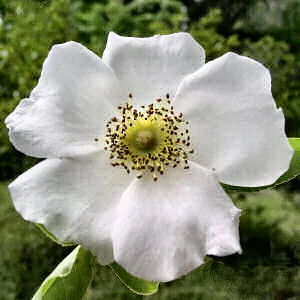


How to Grow and Care for Cherokee Rose
Rosa laevigata
Written by Emilio Marruso · last checked
At a glance
This rose can grow 15 to 33 feet tall, thriving in full sun or partial shade. Water it deeply and regularly, and spread mulch in summer to help the soil hold moisture. Come summer, it rewards you with large orange-red rose hips you can eat. Feed it once in early spring and prune it in late winter.
- Sun
Full sun to partial shade
What the sources say (2)
Light: Full sun to partial shade
Plant it in full sun to partial shade and moist soil. Water deeply and regularly. A summer application of mulch helps retain moisture.
— Rosa laevigata (Cherokee Rose) | North Carolina Extension Gardener Plant Toolbox [1] The best flowering and disease resistance occurs in full sun.
— Rosa laevigata (Cherokee Rose) | North Carolina Extension Gardener Plant Toolbox [1] - Water
Water deeply and regularly; summer mulch helps keep the soil moist
What the sources say (2)
Watering: Water deeply and regularly
Plant it in full sun to partial shade and moist soil. Water deeply and regularly. A summer application of mulch helps retain moisture.
— Rosa laevigata (Cherokee Rose) | North Carolina Extension Gardener Plant Toolbox [1] Watering notes: A summer application of mulch helps retain moisture
Plant it in full sun to partial shade and moist soil. Water deeply and regularly. A summer application of mulch helps retain moisture.
— Rosa laevigata (Cherokee Rose) | North Carolina Extension Gardener Plant Toolbox [1] - Cold
Survives winters down to 0 °F (−17.8 °C)
Hardy in very cold winters · USDA 7a · RHS H6 · Z7
What the sources say (2)
Hardiness, coldest zone: 7a [winter low −17.8 to −15 °C (0 to 5 °F)]
USDA Plant Hardiness Zone: 7a, 7b, 8a, 8b, 9a, 9b, 10a, 10b
— Rosa laevigata (Cherokee Rose) | North Carolina Extension Gardener Plant Toolbox [1] Hardiness, warmest zone: 10b [winter low 1.7 to 4.4 °C (35 to 40 °F)]
USDA Plant Hardiness Zone: 7a, 7b, 8a, 8b, 9a, 9b, 10a, 10b
— Rosa laevigata (Cherokee Rose) | North Carolina Extension Gardener Plant Toolbox [1] - Feeding
Once a year in early spring, before growth starts; no high-nitrogen feed in late summer
What the sources say (6)
When: Early spring, before growth starts
as an alternative, in fall: Roses can be fall fertilized after the plants have gone dormant. Applying fertilizer at this time will not encourage growth but will be available as the plants start to grow in the spring.
— [3] If you decide to fertilize, the best time to fertilize roses is in the early spring before growth starts to appear.
— [4] For species roses, a spring application of general-purpose fertilizer is usually adequate for the season.
— [3] How often: Once a year, in spring
For species roses, a spring application of general-purpose fertilizer is usually adequate for the season.
— [3] Avoid: High-nitrogen fertilizer late in summer; stop fertilizing in late summer as the plants go dormant
Be careful not to fertilize your roses with high nitrogen formulas late in the summer (end of August/September).
— [4] You can fertilize every four to six weeks during the growing season, but stop fertilization in late summer (late August or early September) as the roses begin to go dormant.
— [5] - Pruning
Prune in late winter
What the sources say (1)
Pruning: Late winter
it can be pruned into a 6-foot shrub. Pruning should be accomplished in the late winter.
— Rosa laevigata (Cherokee Rose) | North Carolina Extension Gardener Plant Toolbox [1] - Harvest
Large orange-red rose hips you can eat, picked in summer
What the sources say (1)
Harvest: Summer
Display/Harvest Time: Summer Fruit Description: Large orange-red edible rose hips.
— Rosa laevigata (Cherokee Rose) | North Carolina Extension Gardener Plant Toolbox [1] - Pests
Japanese beetles, thrips and mites; powdery mildew and leaf spots
What the sources say (2)
Pests: Fuller rose beetles, Japanese beetles, rose chafer, rose thrips, southern red mites, two spotted mites
Fuller rose beetles, Japanese beetles, rose chafer, rose thrips, southern red mites, and two spotted mites are pest problems for roses.
— Rosa laevigata (Cherokee Rose) | North Carolina Extension Gardener Plant Toolbox [1] Diseases: botrytis, blights, powdery mildew, leaf spots, anthracnose
Disease problems include botrytis, blights, powdery mildew, leaf spots, and anthracnose.
— Rosa laevigata (Cherokee Rose) | North Carolina Extension Gardener Plant Toolbox [1] - Size
15 to 33 ft tall and 3 to 4 ft wide
What the sources say (2)
Mature height: 457-1006 cm (15-33 ft)
Dimensions: Height: 15 ft. 0 in. - 33 ft. 0 in. Width: 3 ft. 0 in. - 4 ft. 0 in.
— Rosa laevigata (Cherokee Rose) | North Carolina Extension Gardener Plant Toolbox [1] Mature width: 91-122 cm (3-4 ft)
Dimensions: Height: 15 ft. 0 in. - 33 ft. 0 in. Width: 3 ft. 0 in. - 4 ft. 0 in.
— Rosa laevigata (Cherokee Rose) | North Carolina Extension Gardener Plant Toolbox [1]
Overview
Cherokee rose is a woody, deciduous, sprawling shrub in the rose family. [1] It grows best in full sun to partial shade and moist soil, with the best flowering in full sun. [1] It may spread aggressively in the southeastern United States and is listed as invasive in some places. [1]
This record is incomplete: the sources we read do not cover every field yet.
Not yet covered by our sources: Propagation
Cherokee Rose care
How to water Cherokee Rose
Watering
Water deeply and regularly
What the sources say (1)
Plant it in full sun to partial shade and moist soil. Water deeply and regularly. A summer application of mulch helps retain moisture.Watering notes
A summer application of mulch helps retain moisture
What the sources say (1)
Plant it in full sun to partial shade and moist soil. Water deeply and regularly. A summer application of mulch helps retain moisture.How much light Cherokee Rose needs
Full sun to partial shade
What the sources say (2)
Plant it in full sun to partial shade and moist soil. Water deeply and regularly. A summer application of mulch helps retain moisture.The best flowering and disease resistance occurs in full sun.How much cold Cherokee Rose can take
Hardiness, coldest zone
7a [winter low −17.8 to −15 °C (0 to 5 °F)]
What the sources say (1)
USDA Plant Hardiness Zone:
7a, 7b, 8a, 8b, 9a, 9b, 10a, 10bHardiness, warmest zone
10b [winter low 1.7 to 4.4 °C (35 to 40 °F)]
What the sources say (1)
USDA Plant Hardiness Zone:
7a, 7b, 8a, 8b, 9a, 9b, 10a, 10bHow to propagate Cherokee Rose
Not stated in the sources we read.
How to grow Cherokee Rose
The plant
Life cycle
woody, deciduous
What the sources say (1)
Cherokee rose is a woody, deciduous, sprawling shrub in the rose family (Rosaceae) that is native to central and southern China to Vietnam and Taiwan.Family
Rosaceae
What the sources say (1)
Cherokee rose is a woody, deciduous, sprawling shrub in the rose family (Rosaceae) that is native to central and southern China to Vietnam and Taiwan.Mature height
457-1006 cm (15-33 ft)
What the sources say (1)
Dimensions:
Height: 15 ft. 0 in. - 33 ft. 0 in.
Width: 3 ft. 0 in. - 4 ft. 0 in.Mature width
91-122 cm (3-4 ft)
What the sources say (1)
Dimensions:
Height: 15 ft. 0 in. - 33 ft. 0 in.
Width: 3 ft. 0 in. - 4 ft. 0 in.Pests and diseases
Pests
Fuller rose beetles, Japanese beetles, rose chafer, rose thrips, southern red mites, two spotted mites
What the sources say (1)
Fuller rose beetles, Japanese beetles, rose chafer, rose thrips, southern red mites, and two spotted mites are pest problems for roses.Diseases
botrytis, blights, powdery mildew, leaf spots, anthracnose
What the sources say (1)
Disease problems include botrytis, blights, powdery mildew, leaf spots, and anthracnose.Fertilizing
When
Early spring, before growth starts
What each source says
as an alternative, in fall: After the plants have gone dormant; the nutrients are available when growth resumes in spring
What the sources say (3)
as an alternative, in fall: Roses can be fall fertilized after the plants have gone dormant. Applying fertilizer at this time will not encourage growth but will be available as the plants start to grow in the spring.If you decide to fertilize, the best time to fertilize roses is in the early spring before growth starts to appear.For species roses, a spring application of general-purpose fertilizer is usually adequate for the season.How often
Once a year, in spring
What the sources say (1)
For species roses, a spring application of general-purpose fertilizer is usually adequate for the season.Mineral fertilizers
General-purpose fertilizer such as 10-10-10 or 12-12-12, 119 to 237 mL per plant
What the sources say (1)
For species roses, a spring application of general-purpose fertilizer is usually adequate for the season. General-purpose fertilizers such as 10-10-10 or 12-12-12 are used at about one-half to one cup per plant.Avoid
High-nitrogen fertilizer late in summer; stop fertilizing in late summer as the plants go dormant
What the sources say (2)
Be careful not to fertilize your roses with high nitrogen formulas late in the summer (end of August/September).You can fertilize every four to six weeks during the growing season, but stop fertilization in late summer (late August or early September) as the roses begin to go dormant.Remedies
Each remedy shows what official sources say about it; traditional remedies without an official source are marked as such. Harmful ones are listed so you know to avoid them.
Treating the plant
aphids
insecticidal soap spray Works
Most dish soaps are not naturally occurring substances nor are they biodegradable. They can contain detergents and degreasers that are harmful to groundwater and aquatic and soil organisms.
— ucanr.edu [8] How: Mix 1 to 2 tbsp. liquid soap with a quart of water and spray on the plants.
Insecticidal soap mixed with water and sprayed on plants is effective against many common rose pests, including spider mites and aphids.
— gardenguides.com [6] What the evidence says insecticidal soap is a safe, effective organic insecticide with minimal environmental impact
— extension.psu.edu [7]
powdery mildew
baking soda and oil spray Works
Many of the products used are not developed for or tested on plants and may cause damage.
— melindamyers.com [10] How: Mix 1 tsp. baking soda and 1/2 tsp. oil in 1 qt. water and spray on rose bushes.
Mix 1 tsp. baking soda and ½ tsp. oil in 1 qt. water and spray on rose bushes to control powdery mildew.
— gardenguides.com [6] What the evidence says Fungicide sprays recommended for use in the home garden include propiconazole, thiophanate-methyl, myclobutanil, sulfur, neem oil (clarified hydrophobic extract), or baking soda mixed with horticultural oil.
— hgic.clemson.edu [9]
black spot
removing infected leaves Works
How: Remove and dispose of infected leaves as they appear during the growing season.
During the growing season, remove and dispose of infected leaves as they appear.
— hgic.clemson.edu [9] What the evidence says During the growing season, remove and dispose of infected leaves as they appear.
— hgic.clemson.edu [9]
Calendar
Harvest
Summer
What the sources say (1)
Display/Harvest Time:
Summer
Fruit Description:
Large orange-red edible rose hips.Pruning
Late winter
What the sources say (1)
it can be pruned into a 6-foot shrub. Pruning should be accomplished in the late winter.Months as given by the sources, which are mostly from the United States (northern hemisphere). In the southern hemisphere they shift by about six months.
Edibility
Reported by the source, quoted verbatim. Do not eat a plant on the basis of this page alone: identification mistakes can be dangerous.
Display/Harvest Time: Summer Fruit Description: Large orange-red edible rose hips.
[1]
Indicative values
Values from a secondary source, not checked word for word like the rest of this page. Use them as a starting point.
- Hours of sun
- 6-8 hoursIndicative value, adapt it to your climate · Secondary source
- Drought tolerant
- yesIndicative value, adapt it to your climate · Secondary source
- Soil pH
- 5.5-6.5Indicative value, adapt it to your climate · Secondary source
- Care level
- MediumIndicative value, adapt it to your climate · Secondary source
- Growth rate
- LowIndicative value, adapt it to your climate · Secondary source
- Propagation
- Cutting, Layering Propagation, Grafting Propagation, Division, Seed PropagationIndicative value, adapt it to your climate · Secondary source
Similar plants
- Apple Rose Rosa villosa
- Burnet Rose Rosa spinosissima
- Carolina Rose Rosa carolina
- Climbing Prairie Rose Rosa setigera
- Dog rose Rosa canina
- Lady Banks Rosa banksiae
- Memorial Rose Rosa lucieae
- Multiflora Rose Rosa multiflora
Sources
Every value above is quoted from these documents. Links lead to the original publisher.
- Rosa laevigata (Cherokee Rose) | North Carolina Extension Gardener Plant Toolbox · plants.ces.ncsu.edu, consulted
- Cherokee Rose - Rosa laevigata | North Carolina Extension Gardener Plant Toolbox · plants.ces.ncsu.edu, consulted
- extension.illinois.edu · extension.illinois.edu
- ask.extension.org · ask.extension.org
- extension.oregonstate.edu · extension.oregonstate.edu
- gardenguides.com · gardenguides.com
- extension.psu.edu · extension.psu.edu
- ucanr.edu · ucanr.edu
- hgic.clemson.edu · hgic.clemson.edu
- melindamyers.com · melindamyers.com
Written by Emilio Marruso · last checked