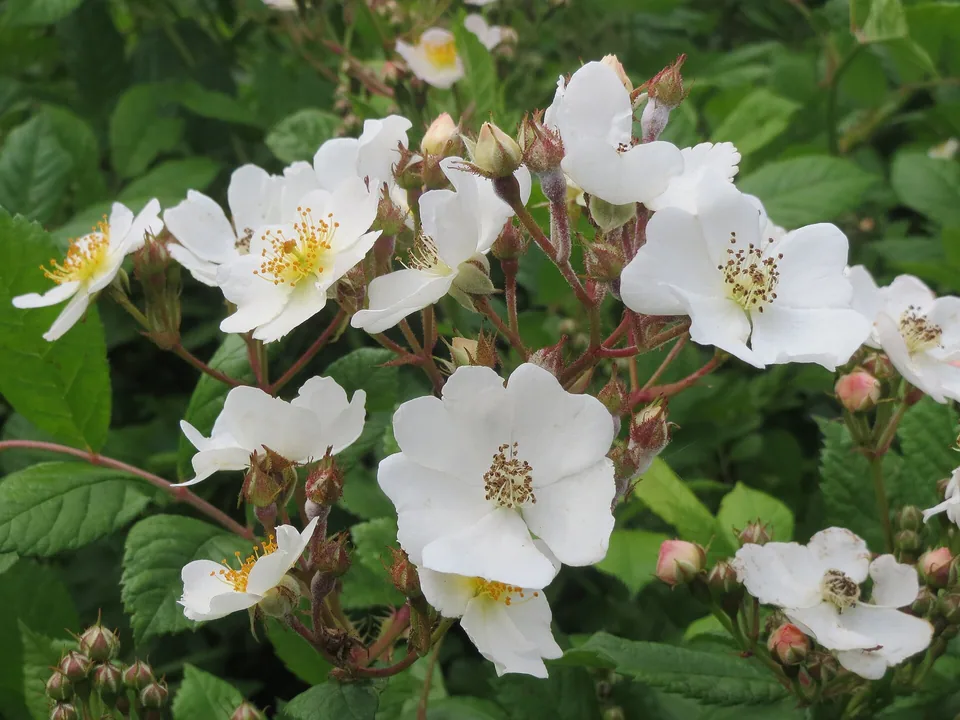


How to Grow and Care for Multiflora Rose
Rosa multiflora
Written by Emilio Marruso · last checked
At a glance
Multiflora rose is a woody shrub that drops its leaves in winter and asks for little: full sun or partial shade suits it, and one feeding a year in early spring is enough. In fall and winter its rose hips feed birds and small mammals. Just keep an eye on it, because it spreads on its own by seed and root sprouts.
- Sun
Full sun to partial shade
What the sources say (1)
Light: Full sun to partial shade
It prefers full sun to partial shade but can also survive in a shady forest.
— Rosa multiflora (Multiflora Rose) | North Carolina Extension Gardener Plant Toolbox [1] - Feeding
Once a year in early spring: ½ to 1 cup of balanced fertilizer per plant; no high-nitrogen feed in late summer
What the sources say (7)
When: Early spring, before growth starts
as an alternative, in fall: Roses can be fall fertilized after the plants have gone dormant. Applying fertilizer at this time will not encourage growth but will be available as the plants start to grow in the spring.
— [9] If you decide to fertilize, the best time to fertilize roses is in the early spring before growth starts to appear.
— [10] For species roses, a spring application of general-purpose fertilizer is usually adequate for the season.
— [9] How often: Once a year, in spring
For species roses, a spring application of general-purpose fertilizer is usually adequate for the season.
— [9] Mineral fertilizers: General-purpose fertilizer such as 10-10-10 or 12-12-12, 119 to 237 mL per plant
For species roses, a spring application of general-purpose fertilizer is usually adequate for the season. General-purpose fertilizers such as 10-10-10 or 12-12-12 are used at about one-half to one cup per plant.
— [9] Avoid: High-nitrogen fertilizer late in summer; stop fertilizing in late summer as the plants go dormant
Be careful not to fertilize your roses with high nitrogen formulas late in the summer (end of August/September).
— [10] You can fertilize every four to six weeks during the growing season, but stop fertilization in late summer (late August or early September) as the roses begin to go dormant.
— [11] - Pests
Mites can spread rose rosette disease, which disfigures the leaves
What the sources say (4)
Pests: Agrilus cuprescens, Megastigmus aculeatus, mites (vectors of rose rosette disease)
Dos insectos no nativos y naturalizados, el escarabajo perforador del tallo de la rosa ( Agrilus cuprescens ) y la avispa calcidoidea de la semilla de rosa ( Megastigmus aculeatus ), pueden matar plantas individuales
— Rosa Multiflora [4] Leaves may be disfigured by rose rosette disease , a viral infection transmitted by tiny mites.
— Multiflora Rose | University of Maryland Extension [2] Diseases: rose rosette disease
Leaves may be disfigured by rose rosette disease , a viral infection transmitted by tiny mites.
— Multiflora Rose | University of Maryland Extension [2] Rose rosette disease causes red stems and foliage, another symptom is witches broom.
— Multiflora rose | Integrated Crop Management [7] - Watch out
Spreads on its own: birds scatter the seeds from its hips, and roots send up new shoots
What the sources say (1)
Propagation: Seed, root sprouting and layering (natural spread)
Spreading through seed, root sprouting, and layering, multiflora rose, Rosa multiflora, does well on poor growing sites with full to moderate sunlight but tolerates a variety of sites.
— Multiflora Rose | Invasives | Illinois Extension | Illinois [3] - Propagation
From seed, root sprouts or layering
What the sources say (1)
Propagation: Seed, root sprouting and layering (natural spread)
Spreading through seed, root sprouting, and layering, multiflora rose, Rosa multiflora, does well on poor growing sites with full to moderate sunlight but tolerates a variety of sites.
— Multiflora Rose | Invasives | Illinois Extension | Illinois [3]
Overview
Multiflora rose is a deciduous, multi-stemmed shrub in the rose family that is listed as invasive in North Carolina. [1] It prefers full sun to partial shade and spreads through seed, root sprouting, and layering. [1][3]
This record is incomplete: the sources we read do not cover every field yet.
Not yet covered by our sources: Hardiness, coldest zone, Hardiness, warmest zone
Multiflora Rose care
How much light Multiflora Rose needs
Full sun to partial shade
What the sources say (1)
It prefers full sun to partial shade but can also survive in a shady forest.How much cold Multiflora Rose can take
Hardiness, coldest zone
Not stated in the sources we read.
Hardiness, warmest zone
Not stated in the sources we read.
How to propagate Multiflora Rose
Seed, root sprouting and layering (natural spread)
What the sources say (1)
Spreading through seed, root sprouting, and layering, multiflora rose, Rosa multiflora, does well on poor growing sites with full to moderate sunlight but tolerates a variety of sites.How to grow Multiflora Rose
The plant
Life cycle
perennial (woody, deciduous shrub)
What the sources say (1)
Multiflora rose is a woody perennial, deciduous, multi-stemmed shrub in the rose family (Rosaceae).Family
Rosaceae
What the sources say (1)
Multiflora rose is a woody perennial, deciduous, multi-stemmed shrub in the rose family (Rosaceae).Mature height
Pests and diseases
Pests
Agrilus cuprescens, Megastigmus aculeatus, mites (vectors of rose rosette disease)
What the sources say (2)
Dos insectos no nativos y naturalizados, el escarabajo perforador del tallo de la rosa ( Agrilus cuprescens ) y la avispa calcidoidea de la semilla de rosa ( Megastigmus aculeatus ), pueden matar plantas individualesLeaves may be disfigured by rose rosette disease , a viral infection transmitted by tiny mites.Diseases
rose rosette disease
What the sources say (2)
Leaves may be disfigured by rose rosette disease , a viral infection transmitted by tiny mites.Rose rosette disease causes red stems and foliage, another symptom is witches broom.Fertilizing
When
Early spring, before growth starts
What each source says
as an alternative, in fall: After the plants have gone dormant; the nutrients are available when growth resumes in spring
What the sources say (3)
as an alternative, in fall: Roses can be fall fertilized after the plants have gone dormant. Applying fertilizer at this time will not encourage growth but will be available as the plants start to grow in the spring.If you decide to fertilize, the best time to fertilize roses is in the early spring before growth starts to appear.For species roses, a spring application of general-purpose fertilizer is usually adequate for the season.How often
Once a year, in spring
What the sources say (1)
For species roses, a spring application of general-purpose fertilizer is usually adequate for the season.Mineral fertilizers
General-purpose fertilizer such as 10-10-10 or 12-12-12, 119 to 237 mL per plant
What the sources say (1)
For species roses, a spring application of general-purpose fertilizer is usually adequate for the season. General-purpose fertilizers such as 10-10-10 or 12-12-12 are used at about one-half to one cup per plant.Avoid
High-nitrogen fertilizer late in summer; stop fertilizing in late summer as the plants go dormant
What the sources say (2)
Be careful not to fertilize your roses with high nitrogen formulas late in the summer (end of August/September).You can fertilize every four to six weeks during the growing season, but stop fertilization in late summer (late August or early September) as the roses begin to go dormant.Multiflora Rose pests and problems
Rose rosette disease
Symptom: Leaves may be disfigured.
What to do: No management given in the source.
What the sources say (1)
Leaves may be disfigured by rose rosette disease , a viral infection transmitted by tiny mites.
— Multiflora Rose | University of Maryland Extension [2]
Remedies
Each remedy shows what official sources say about it; traditional remedies without an official source are marked as such. Harmful ones are listed so you know to avoid them.
Treating the plant
powdery mildew
milk spray Not verified
Traditional remedy, not verified by an official source.
How: Dilute 1 part milk in 7 parts water and spray on the roses; apply again if it rains, after the leaves are dry.
black spot
cider vinegar spray Not verified
Traditional remedy, not verified by an official source.
Spray on plant early morning or evening to prevent leaf burn.
— countryfarm-lifestyles.com [12] How: Mix 3 tablespoons of cider vinegar into 5 quarts (5 liters) of water, add 1 teaspoon of vegetable oil and a squirt of soft soap; spray early morning or evening to prevent leaf burn, reapply after rain.
Getting rid of it
unwanted multiflora rose
repeated mowing Partly works
How: Repeated mowing defoliates the plant and depletes its root reserves; successful control needs mowing three to six times per season for more than one year.
Repeated mowing, up to six times per growing season for two to four years, may control the spread of multiflora rose
— Invasives in Your Woodland: Multiflora Rose (updated 2025) | University of Maryland Extension [8] What the evidence says Repeated mowing defoliates the plant, depleting its root food reserves and eventually killing it. Unfortunately, repeated mowing can become quite costly, time-consuming, and laborious.
— extension.psu.edu [13] cutting down and removing every new sprout Partly works
How: After the shrub is cut down, remove any new sprouts promptly so the roots cannot store energy; may take several years of cutting off all top growth about six times a year.
After a shrub is cut down, any new sprouts must be removed promptly so they do not have time to make and store energy reserves for regrowth.
— Multiflora Rose | University of Maryland Extension [2] What the evidence says Cutting the shrub down will not eradicate multiflora rose unless additional or follow-up measures are taken.
— Multiflora Rose | University of Maryland Extension [2] digging up small plants with all roots Partly works
Poblaciones pequeñas y jóvenes se pueden arrancar a mano (usando protección contra las espinas), asegurando que se extrae toda la raíz.
— Rosa Multiflora [4] How: Small plants can be dug up or hand pulled; remove all of the roots to avoid resprouting and keep monitoring the area.
Individual small plants can be dug up or hand pulled. Efforts should be made to remove all of the roots to avoid resprouting.
— Invasive in the Spotlight: Multiflora Rose | Extension [6] What the evidence says Excavating is only effective if all roots with shoot buds are removed, or shoots from remaining roots are controlled with follow-up tactics.
— extension.psu.edu [13] goat grazing Works
How: Goats and sheep eat brush and weedy broadleaves; an initial stocking rate of 8 to 10 mature goats and/or sheep per acre for four seasons or more is cited for infested pastures.
Goats and sheep can help control multiflora rose. They eat brush and other weedy broadleaves, allowing pastureland species to prosper and improving grazing conditions for livestock.
— extension.psu.edu [13] What the evidence says If used properly, animals, especially goats, can be good alternatives to chemical or mechanical control methods for multiflora rose and other brush species.
— extension.psu.edu [13]
Edibility
Reported by the source, quoted verbatim. Do not eat a plant on the basis of this page alone: identification mistakes can be dangerous.
Birds and small mammals eat the rose hips as a fall and winter food source and disperse the seeds.
[1]
Indicative values
Values from a secondary source, not checked word for word like the rest of this page. Use them as a starting point.
- Hours of sun
- 6-8 hoursIndicative value, adapt it to your climate · Secondary source
- Watering
- AverageIndicative value, adapt it to your climate · Secondary source
- Soil pH
- 6-6.8Indicative value, adapt it to your climate · Secondary source
- USDA hardiness zones
- 5-9 [winter low −28.9 to −1.1 °C (−20 to 30 °F)]Indicative value, adapt it to your climate · Secondary source
- Care level
- MediumIndicative value, adapt it to your climate · Secondary source
- Growth rate
- HighIndicative value, adapt it to your climate · Secondary source
- Pruning
- February, March, AprilIndicative value, adapt it to your climate · Secondary source
Similar plants
- Cherokee Rose Rosa laevigata
- Rugosa Rose Rosa rugosa
- Sweet-briar Rosa rubiginosa
- Apple Rose Rosa villosa
- Burnet Rose Rosa spinosissima
- Carolina Rose Rosa carolina
- Climbing Prairie Rose Rosa setigera
- Dog rose Rosa canina
Sources
Every value above is quoted from these documents. Links lead to the original publisher.
- Rosa multiflora (Multiflora Rose) | North Carolina Extension Gardener Plant Toolbox · plants.ces.ncsu.edu, consulted
- Multiflora Rose | University of Maryland Extension · extension.umd.edu, consulted
- Multiflora Rose | Invasives | Illinois Extension | Illinois · extension.illinois.edu, consulted
- Rosa Multiflora · extension.psu.edu, consulted
- Multiflora Rose | Mississippi State University Extension Service · extension.msstate.edu, consulted
- Invasive in the Spotlight: Multiflora Rose | Extension · extension.unh.edu, consulted
- Multiflora rose | Integrated Crop Management · crops.extension.iastate.edu, consulted
- Invasives in Your Woodland: Multiflora Rose (updated 2025) | University of Maryland Extension · extension.umd.edu, consulted
- extension.illinois.edu · extension.illinois.edu
- ask.extension.org · ask.extension.org
- extension.oregonstate.edu · extension.oregonstate.edu
- countryfarm-lifestyles.com · countryfarm-lifestyles.com
- extension.psu.edu · extension.psu.edu
Written by Emilio Marruso · last checked