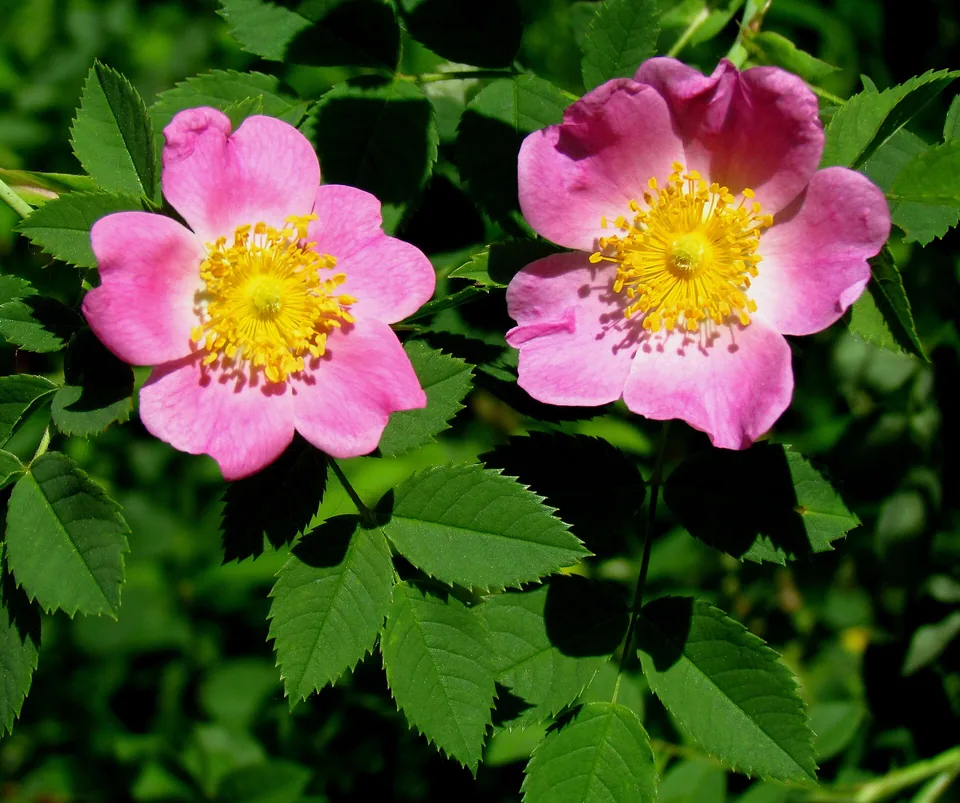


How to Grow and Care for Carolina Rose
Rosa carolina
Written by Emilio Marruso · last checked
At a glance
Carolina rose is an easygoing wild rose that thrives in full sun or partial shade and even tolerates occasionally dry soil. Its flowers are edible: remove the bitter white base of the petals, then use them to garnish desserts or freeze them in ice cubes. Later in the season, the hips are edible too and make a lovely tea or jelly.
- Sun
Full sun to partial shade
What the sources say (1)
Light: Full sun to partial shade
Carolina rose requires moist, well-drained soils in full sun to partial shade.
— Rosa carolina (Carolina Rose, Pasture Rose) | North Carolina Extension Gardener Plant Toolbox [1] - Water
Keep the soil moist; it can handle a dry spell now and then
What the sources say (2)
Watering: Moist, well-drained soil; tolerates occasionally dry soil
Carolina rose requires moist, well-drained soils in full sun to partial shade.
— Rosa carolina (Carolina Rose, Pasture Rose) | North Carolina Extension Gardener Plant Toolbox [1] It tolerates heat and occasionally dry soil.
— Rosa carolina (Carolina Rose, Pasture Rose) | North Carolina Extension Gardener Plant Toolbox [1] - Cold
Survives winters down to −30 °F (−34.4 °C)
Very hardy · USDA 4a · RHS H7 · Z4
What the sources say (2)
Hardiness, coldest zone: 4a [winter low −34.4 to −31.7 °C (−30 to −25 °F)]
USDA Plant Hardiness Zone: 4a, 4b, 5a, 5b, 6a, 6b, 7a, 7b, 8a, 8b, 9a, 9b
— Rosa carolina (Carolina Rose, Pasture Rose) | North Carolina Extension Gardener Plant Toolbox [1] Hardiness, warmest zone: 9b [winter low −3.9 to −1.1 °C (25 to 30 °F)]
USDA Plant Hardiness Zone: 4a, 4b, 5a, 5b, 6a, 6b, 7a, 7b, 8a, 8b, 9a, 9b
— Rosa carolina (Carolina Rose, Pasture Rose) | North Carolina Extension Gardener Plant Toolbox [1] - Soil
Moist soil that drains well
What the sources say (2)
Watering: Moist, well-drained soil; tolerates occasionally dry soil
Carolina rose requires moist, well-drained soils in full sun to partial shade.
— Rosa carolina (Carolina Rose, Pasture Rose) | North Carolina Extension Gardener Plant Toolbox [1] It tolerates heat and occasionally dry soil.
— Rosa carolina (Carolina Rose, Pasture Rose) | North Carolina Extension Gardener Plant Toolbox [1] - Feeding
Once a year in early spring, 1/2 to 1 cup of all-purpose fertilizer; no nitrogen feed in late summer
What the sources say (7)
When: Early spring, before growth starts
as an alternative, in fall: Roses can be fall fertilized after the plants have gone dormant. Applying fertilizer at this time will not encourage growth but will be available as the plants start to grow in the spring.
— [2] If you decide to fertilize, the best time to fertilize roses is in the early spring before growth starts to appear.
— [3] For species roses, a spring application of general-purpose fertilizer is usually adequate for the season.
— [2] How often: Once a year, in spring
For species roses, a spring application of general-purpose fertilizer is usually adequate for the season.
— [2] Mineral fertilizers: General-purpose fertilizer such as 10-10-10 or 12-12-12, 119 to 237 mL per plant
For species roses, a spring application of general-purpose fertilizer is usually adequate for the season. General-purpose fertilizers such as 10-10-10 or 12-12-12 are used at about one-half to one cup per plant.
— [2] Avoid: High-nitrogen fertilizer late in summer; stop fertilizing in late summer as the plants go dormant
Be careful not to fertilize your roses with high nitrogen formulas late in the summer (end of August/September).
— [3] You can fertilize every four to six weeks during the growing season, but stop fertilization in late summer (late August or early September) as the roses begin to go dormant.
— [4] - Pruning
Prune from late winter to early spring
What the sources say (1)
Pruning: Late winter to early spring
Prune in late winter to early spring.
— Rosa carolina (Carolina Rose, Pasture Rose) | North Carolina Extension Gardener Plant Toolbox [1] - Harvest
Edible flowers (remove the bitter white base); the hips make tea or jelly
- Pests
Japanese beetles, rose chafers, thrips, aphids and spider mites
What the sources say (1)
Pests: fuller rose beetles, Japanese beetles, rose chafer beetle, flower thrips, rose aphids, spider mites
Rose petals or leaves are consumed by fuller rose beetles, Japanese beetles, and the rose chafer beetle. Roses are also susceptible to flower thrips, rose aphids, and spider mites.
— Rosa carolina (Carolina Rose, Pasture Rose) | North Carolina Extension Gardener Plant Toolbox [1] - Size
6 in to 5 ft tall and 1 to 5 ft wide
What the sources say (2)
Mature height: 15-152 cm (6 in-5 ft)
Dimensions: Height: 0 ft. 6 in. - 5 ft. 0 in. Width: 1 ft. 0 in. - 5 ft. 0 in.
— Rosa carolina (Carolina Rose, Pasture Rose) | North Carolina Extension Gardener Plant Toolbox [1] Mature width: 30-152 cm (1-5 ft)
Dimensions: Height: 0 ft. 6 in. - 5 ft. 0 in. Width: 1 ft. 0 in. - 5 ft. 0 in.
— Rosa carolina (Carolina Rose, Pasture Rose) | North Carolina Extension Gardener Plant Toolbox [1] - Propagation
From root cuttings, stem cuttings or seed
What the sources say (1)
Propagation: Root cutting, stem cutting, seed
Propagate this shrub by root cutting, stem cutting, or seed.
— Rosa carolina (Carolina Rose, Pasture Rose) | North Carolina Extension Gardener Plant Toolbox [1]
Overview
Carolina rose is a woody, deciduous shrub native to eastern and central North America. [1] It requires moist, well-drained soil in full sun to partial shade and flowers best in full sun. [1] The hips and flower petals are edible. [1]
Carolina Rose care
How to water Carolina Rose
Moist, well-drained soil; tolerates occasionally dry soil
What the sources say (2)
Carolina rose requires moist, well-drained soils in full sun to partial shade.It tolerates heat and occasionally dry soil.How much light Carolina Rose needs
Full sun to partial shade
What the sources say (1)
Carolina rose requires moist, well-drained soils in full sun to partial shade.How much cold Carolina Rose can take
Hardiness, coldest zone
4a [winter low −34.4 to −31.7 °C (−30 to −25 °F)]
What the sources say (1)
USDA Plant Hardiness Zone:
4a, 4b, 5a, 5b, 6a, 6b, 7a, 7b, 8a, 8b, 9a, 9bHardiness, warmest zone
9b [winter low −3.9 to −1.1 °C (25 to 30 °F)]
What the sources say (1)
USDA Plant Hardiness Zone:
4a, 4b, 5a, 5b, 6a, 6b, 7a, 7b, 8a, 8b, 9a, 9bHow to propagate Carolina Rose
Root cutting, stem cutting, seed
What the sources say (1)
Propagate this shrub by root cutting, stem cutting, or seed.How to grow Carolina Rose
The plant
Life cycle
woody
What the sources say (1)
Carolina rose is a woody, deciduous shrub in the rose family (Rosaceae) and native to eastern and central North America.Family
Rosaceae
What the sources say (1)
Carolina rose is a woody, deciduous shrub in the rose family (Rosaceae) and native to eastern and central North America.Mature height
15-152 cm (6 in-5 ft)
What the sources say (1)
Dimensions:
Height: 0 ft. 6 in. - 5 ft. 0 in.
Width: 1 ft. 0 in. - 5 ft. 0 in.Mature width
30-152 cm (1-5 ft)
What the sources say (1)
Dimensions:
Height: 0 ft. 6 in. - 5 ft. 0 in.
Width: 1 ft. 0 in. - 5 ft. 0 in.Pests and diseases
Pests
fuller rose beetles, Japanese beetles, rose chafer beetle, flower thrips, rose aphids, spider mites
What the sources say (1)
Rose petals or leaves are consumed by fuller rose beetles, Japanese beetles, and the rose chafer beetle. Roses are also susceptible to flower thrips, rose aphids, and spider mites.Fertilizing
When
Early spring, before growth starts
What each source says
as an alternative, in fall: After the plants have gone dormant; the nutrients are available when growth resumes in spring
What the sources say (3)
as an alternative, in fall: Roses can be fall fertilized after the plants have gone dormant. Applying fertilizer at this time will not encourage growth but will be available as the plants start to grow in the spring.If you decide to fertilize, the best time to fertilize roses is in the early spring before growth starts to appear.For species roses, a spring application of general-purpose fertilizer is usually adequate for the season.How often
Once a year, in spring
What the sources say (1)
For species roses, a spring application of general-purpose fertilizer is usually adequate for the season.Mineral fertilizers
General-purpose fertilizer such as 10-10-10 or 12-12-12, 119 to 237 mL per plant
What the sources say (1)
For species roses, a spring application of general-purpose fertilizer is usually adequate for the season. General-purpose fertilizers such as 10-10-10 or 12-12-12 are used at about one-half to one cup per plant.Avoid
High-nitrogen fertilizer late in summer; stop fertilizing in late summer as the plants go dormant
What the sources say (2)
Be careful not to fertilize your roses with high nitrogen formulas late in the summer (end of August/September).You can fertilize every four to six weeks during the growing season, but stop fertilization in late summer (late August or early September) as the roses begin to go dormant.Carolina Rose pests and problems
Beetles, thrips, aphids and spider mites
Symptom: Petals or leaves consumed by fuller rose beetles, Japanese beetles and rose chafer; roses also susceptible to flower thrips, rose aphids and spider mites
What to do: Not specified in the document
What the sources say (1)
Rose petals or leaves are consumed by fuller rose beetles, Japanese beetles, and the rose chafer beetle. Roses are also susceptible to flower thrips, rose aphids, and spider mites.
— Rosa carolina (Carolina Rose, Pasture Rose) | North Carolina Extension Gardener Plant Toolbox [1]
Remedies
Each remedy shows what official sources say about it; traditional remedies without an official source are marked as such. Harmful ones are listed so you know to avoid them.
Treating the plant
aphids
strong water spray Official source, not independently tested
How: hose off with a strong stream of water directed above and below the leaves, repeated as needed
Aphids can be hosed off with a strong stream of water directed above and below the leaves. Spraying with water should be repeated as frequently as needed, focusing in particular on new growth.
— hgic.clemson.edu [5] insecticidal soap spray Works
How: spray the soap onto the aphids, repeat three times at 5 to 7-day intervals
Insecticidal soap must be sprayed onto the aphids to be effective. Repeat the insecticidal soap spray three times at 5 to 7-day intervals.
— hgic.clemson.edu [5] What the evidence says Roses can also be sprayed with insecticidal soap to control aphids. Insecticidal soap must be sprayed onto the aphids to be effective.
— hgic.clemson.edu [5]
spider mites
strong water spray Works
How: spray lower leaf surfaces and repeat as needed
A strong spray of water is a non-chemical control option that removes eggs, larvae (six-legged immature stage), nymphs (eight-legged immature mites), and adult mites.
— hgic.clemson.edu [5] What the evidence says A strong spray of water is a non-chemical control option that removes eggs, larvae (six-legged immature stage), nymphs (eight-legged immature mites), and adult mites.
— hgic.clemson.edu [5] insecticidal soap spray Works
Foliar injury from soaps and oils may occur on plants under drought stress. Water the plants well before spraying.
— hgic.clemson.edu [5] Do not spray with soaps or oils if the temperature exceeds 85 °F, and always spray in the evening to slow the drying time of the soap or oil.
— hgic.clemson.edu [5] How: good coverage is critical; reapply as determined by follow-up monitoring
Good coverage is critical to ensure contact with the pest when using these products, and reapplication may be needed as determined by follow-up monitoring for the pest.
— hgic.clemson.edu [5] What the evidence says Insecticidal soaps and horticultural oils are effective control options for spider mites, and they are essentially nontoxic to humans, wildlife, and pets, and only minimally toxic to beneficial predators.
— hgic.clemson.edu [5]
japanese beetles
handpicking into soapy water Official source, not independently tested
How: handpick the beetles and drop them into soapy water
They can be handpicked and destroyed by dropping them into soapy water.
— hgic.clemson.edu [5] fine netting over the bush Official source, not independently tested
How: place fine netting or spunbound polyester fabric over the bush or individual blossoms
When only a few plants are involved, fine netting, such as tulle fabric, or spunbound polyester fabric, such as [nome commerciale], can be placed over the bush or individual blossoms to exclude the beetles.
— hgic.clemson.edu [5]
flower thrips
removing and destroying infested blossoms Official source, not independently tested
How: remove and destroy infested blossoms; keep grass and weeds mowed or removed
Control of thrips is difficult. Infested rose blossoms should be removed and destroyed. Grass and weeds in the area should be kept mowed or removed when possible.
— hgic.clemson.edu [5]
Getting rid of it
spreading by suckers
removing rhizomatous growth as it occurs Not verified
Traditional remedy, not verified by an official source.
How: remove rhizomatous growth as it occurs
digging up the suckers Not verified
Traditional remedy, not verified by an official source.
How: dig up the suckers and replant them where another bush is wanted
Calendar
Pruning
Late winter to early spring
What the sources say (1)
Prune in late winter to early spring.Months as given by the sources, which are mostly from the United States (northern hemisphere). In the southern hemisphere they shift by about six months.
Edibility
Reported by the source, quoted verbatim. Do not eat a plant on the basis of this page alone: identification mistakes can be dangerous.
Indicative values
Values from a secondary source, not checked word for word like the rest of this page. Use them as a starting point.
- Hours of sun
- 6-8 hoursIndicative value, adapt it to your climate · Secondary source
- Soil
- Sandy Loamy RockyIndicative value, adapt it to your climate · Secondary source
- Soil pH
- 6-7Indicative value, adapt it to your climate · Secondary source
- Growth rate
- LowIndicative value, adapt it to your climate · Secondary source
Similar plants
- Apple Rose Rosa villosa
- Burnet Rose Rosa spinosissima
- Cherokee Rose Rosa laevigata
- Climbing Prairie Rose Rosa setigera
- Dog rose Rosa canina
- Lady Banks Rosa banksiae
- Memorial Rose Rosa lucieae
- Musk rose Rosa moschata
Sources
Every value above is quoted from these documents. Links lead to the original publisher.
- Rosa carolina (Carolina Rose, Pasture Rose) | North Carolina Extension Gardener Plant Toolbox · plants.ces.ncsu.edu, consulted
- extension.illinois.edu · extension.illinois.edu
- ask.extension.org · ask.extension.org
- extension.oregonstate.edu · extension.oregonstate.edu
- hgic.clemson.edu · hgic.clemson.edu
Written by Emilio Marruso · last checked