
How to Grow and Care for Lady Banks
Rosa banksiae
Written by Emilio Marruso · last checked
At a glance
Lady Banks rose is a perennial rose that grows happily in full sun or partial shade and, once established, shrugs off dry spells. It is described as disease-resistant, so black spot and powdery mildew trouble it less than other roses. Water it regularly at first, feed it after the spring bloom, and enjoy a rose that asks for very little.
- Sun
Full sun to partial shade
What the sources say (2)
Light: Full sun to partial shade
It grows in full sun or partial shade and requires moist, but well-draining, acidic to neutral, loamy soil and good air circulation.
— Rosa banksiae (Lady Banks, Lady Banks Rose) | North Carolina Extension Gardener Plant Toolbox [1] It is best in full sun or light shade in any well-drained garden soil.
— Rosa banksiae Lady Banks Rose [3] - Water
Water regularly until it settles in; after that it handles drought
What the sources say (3)
Watering: Drought tolerant once established
After planting, water regularly until the rose is established. Once established, it is drought tolerant.
— The Lady Banks Rose | Home & Garden Information Center [2] Watering notes: Water regularly after planting until established; the species requires moist but well-draining soil
After planting, water regularly until the rose is established.
— The Lady Banks Rose | Home & Garden Information Center [2] It grows in full sun or partial shade and requires moist, but well-draining, acidic to neutral, loamy soil and good air circulation.
— Rosa banksiae (Lady Banks, Lady Banks Rose) | North Carolina Extension Gardener Plant Toolbox [1] - Soil
Moist soil that drains well
What the sources say (2)
Watering notes: Water regularly after planting until established; the species requires moist but well-draining soil
After planting, water regularly until the rose is established.
— The Lady Banks Rose | Home & Garden Information Center [2] It grows in full sun or partial shade and requires moist, but well-draining, acidic to neutral, loamy soil and good air circulation.
— Rosa banksiae (Lady Banks, Lady Banks Rose) | North Carolina Extension Gardener Plant Toolbox [1] - Feeding
Slow-release rose fertilizer after the spring bloom
What the sources say (2)
When: After the spring bloom
Use a slow-release fertilizer labeled for roses after it blooms in spring.
— The Lady Banks Rose | Home & Garden Information Center [2] Mineral fertilizers: Slow-release rose fertilizer
Use a slow-release fertilizer labeled for roses after it blooms in spring.
— The Lady Banks Rose | Home & Garden Information Center [2] - Harvest
The leaves are edible
- Pests
Can get black spot and powdery mildew, but resists them better than other roses
What the sources say (1)
Diseases: powdery mildew, black spot
This rose is disease-resistant. It may occasionally have powdery mildew or black spot.
— The Lady Banks Rose | Home & Garden Information Center [2]
Overview
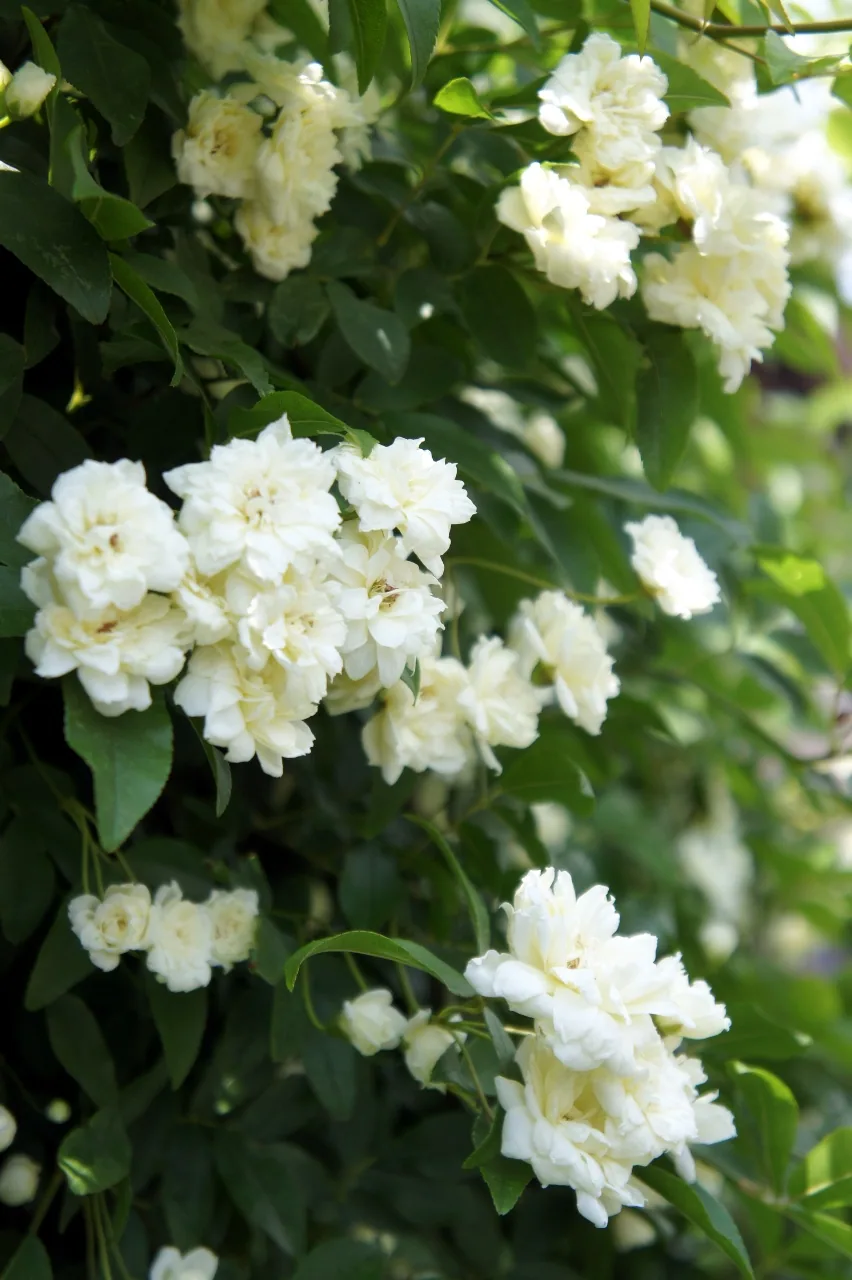
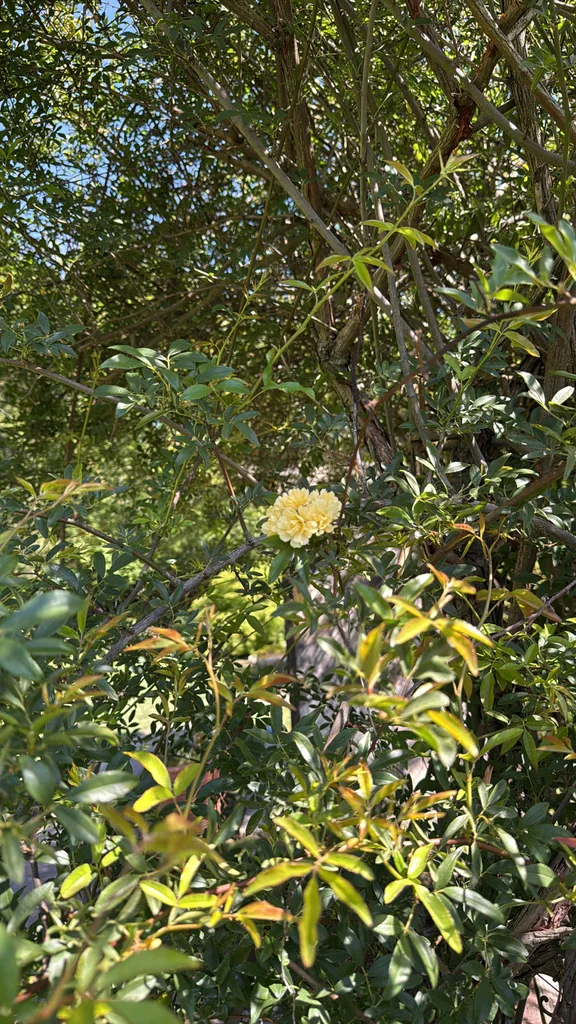
Lady Banks rose is a big, sprawling evergreen rose that is essentially thornless. [3] It grows in full sun or partial shade and is drought tolerant once established. [1][2] It is pruned after it blooms. [2]
This record is incomplete: the sources we read do not cover every field yet.
Not yet covered by our sources: Propagation
Lady Banks care
How to water Lady Banks
Watering
Drought tolerant once established
What the sources say (1)
After planting, water regularly until the rose is established. Once established, it is drought tolerant.Watering notes
Water regularly after planting until established; the species requires moist but well-draining soil
What the sources say (2)
After planting, water regularly until the rose is established.It grows in full sun or partial shade and requires moist, but well-draining, acidic to neutral, loamy soil and good air circulation.How much light Lady Banks needs
Full sun to partial shade
What the sources say (2)
It grows in full sun or partial shade and requires moist, but well-draining, acidic to neutral, loamy soil and good air circulation.It is best
in full sun or light shade in any well-drained garden soil.How much cold Lady Banks can take
Hardiness, coldest zone
The sources give different values depending on region, zone or growing conditions.
What each source says
According to NC State Extension: 6a [winter low −23.3 to −20.6 °C (−10 to −5 °F)]
According to Clemson HGIC: 7 [winter low −17.8 to −12.2 °C (0 to 10 °F)]
According to University of Arkansas Extension: 7 [winter low −17.8 to −12.2 °C (0 to 10 °F)]
What the sources say (4)
According to NC State Extension: USDA Plant Hardiness Zone:
6a, 6b, 7a, 7b, 8a, 8b, 9a, 9b, 10a, 10bAccording to Clemson HGIC: This rose is hardy in planting zones 7 to 10 and evergreen in zones 8 and above.According to University of Arkansas Extension: It is winter hardy in
zones 7-9.USDA Plant Hardiness Zone:
6a, 6b, 7a, 7b, 8a, 8b, 9a, 9b, 10a, 10bHardiness, warmest zone
The sources give different values depending on region, zone or growing conditions.
What each source says
According to NC State Extension: 10b [winter low 1.7 to 4.4 °C (35 to 40 °F)]
According to Clemson HGIC: 10 [winter low −1.1 to 4.4 °C (30 to 40 °F)]
According to University of Arkansas Extension: 9 [winter low −6.7 to −1.1 °C (20 to 30 °F)]
What the sources say (4)
According to NC State Extension: USDA Plant Hardiness Zone:
6a, 6b, 7a, 7b, 8a, 8b, 9a, 9b, 10a, 10bAccording to Clemson HGIC: This rose is hardy in planting zones 7 to 10 and evergreen in zones 8 and above.According to University of Arkansas Extension: It is winter hardy in
zones 7-9.USDA Plant Hardiness Zone:
6a, 6b, 7a, 7b, 8a, 8b, 9a, 9b, 10a, 10bHow to propagate Lady Banks
Not stated in the sources we read.
How to grow Lady Banks
The plant
Life cycle
perennial
What the sources say (1)
Genus: Rosa Species: bansiae Family: Rosaceae Uses (Ethnobotany): Leaves and fruits were used in herbal medicine. Tannin obtained from the root bark is used as a brown dye Life Cycle: PerennialFamily
Rosaceae
What the sources say (1)
Genus: Rosa Species: bansiae Family: Rosaceae Uses (Ethnobotany): Leaves and fruits were used in herbal medicine. Tannin obtained from the root bark is used as a brown dye Life Cycle: PerennialMature height
Pests and diseases
Diseases
powdery mildew, black spot
What the sources say (1)
This rose is disease-resistant. It may occasionally have powdery mildew or black spot.Fertilizing
When
After the spring bloom
What the sources say (1)
Use a slow-release fertilizer labeled for roses after it blooms in spring.Mineral fertilizers
Slow-release rose fertilizer
What the sources say (1)
Use a slow-release fertilizer labeled for roses after it blooms in spring.Lady Banks pests and problems
Black spot and powdery mildew
Symptom: Leaf diseases; symptoms not described in the sources
What to do: Less problematic for Lady Banks rose than for other roses; described as disease-resistant
What the sources say (2)
Common leaf diseases like black spot and mildew are less problematic for the Lady Banks rose.
— Rosa banksiae (Lady Banks, Lady Banks Rose) | North Carolina Extension Gardener Plant Toolbox [1] This rose is disease-resistant. It may occasionally have powdery mildew or black spot.
— The Lady Banks Rose | Home & Garden Information Center [2]
Remedies
Each remedy shows what official sources say about it; traditional remedies without an official source are marked as such. Harmful ones are listed so you know to avoid them.
Treating the plant
powdery mildew
baking soda and horticultural oil spray Partly works
Use this mixture sparingly, and avoid numerous applications with resulting runoff, as this can affect the soil pH and structure.
— ucanr.edu [7] Also avoid getting the baking soda on blossoms, as it can distort them.
— ucanr.edu [7] How: Mix 4 teaspoons of baking soda per gallon of water with 1 oz of narrow range oil; apply during cool weather.
Mix 4 teaspoons of baking soda per gallon of water with 1 oz of narrow range oil. Apply during cool weather to avoid phytotoxicity.
— ucanr.edu [7] What the evidence says Sodium bicarbonate (baking soda) with horticultural oils might help.
— ucanr.edu [7]
black spot
baking soda solution Works
Also avoid getting the baking soda on blossoms, as it can distort them.
— ucanr.edu [7] How: Use the same baking soda and oil solution described for powdery mildew.
The baking soda solution mentioned for powdery mildew is effective, as is neem oil.
— ucanr.edu [7] What the evidence says The baking soda solution mentioned for powdery mildew is effective, as is neem oil.
— ucanr.edu [7] neem oil Works
How: Neem oil is effective against black spot according to the source.
The baking soda solution mentioned for powdery mildew is effective, as is neem oil.
— ucanr.edu [7] What the evidence says The baking soda solution mentioned for powdery mildew is effective, as is neem oil.
— ucanr.edu [7]
Calendar
Pruning
The sources disagree:
Prune after it blooms to control the size. Remove dead branches at any time. It does not require annual pruning.
[2]
Months as given by the sources, which are mostly from the United States (northern hemisphere). In the southern hemisphere they shift by about six months.
Edibility
Reported by the source, quoted verbatim. Do not eat a plant on the basis of this page alone: identification mistakes can be dangerous.
Leaf Color: Green Leaf Value To Gardener: Edible
[1]
Indicative values
Values from a secondary source, not checked word for word like the rest of this page. Use them as a starting point.
- Drought tolerant
- yesIndicative value, adapt it to your climate · Secondary source · Data for the variety Rosa banksiae 'Lutea'
- Soil pH
- 6-7Indicative value, adapt it to your climate · Secondary source · Data for the variety Rosa banksiae 'Lutea'
- Care level
- MediumIndicative value, adapt it to your climate · Secondary source · Data for the variety Rosa banksiae 'Lutea'
- Growth rate
- LowIndicative value, adapt it to your climate · Secondary source · Data for the variety Rosa banksiae 'Lutea'
- Propagation
- Cutting, Layering Propagation, Grafting Propagation, Division, Seed PropagationIndicative value, adapt it to your climate · Secondary source · Data for the variety Rosa banksiae 'Lutea'
Similar plants
- Apple Rose Rosa villosa
- Burnet Rose Rosa spinosissima
- Carolina Rose Rosa carolina
- Cherokee Rose Rosa laevigata
- Climbing Prairie Rose Rosa setigera
- Dog rose Rosa canina
- Memorial Rose Rosa lucieae
- Musk rose Rosa moschata
Sources
Every value above is quoted from these documents. Links lead to the original publisher.
- Rosa banksiae (Lady Banks, Lady Banks Rose) | North Carolina Extension Gardener Plant Toolbox · plants.ces.ncsu.edu, consulted
- The Lady Banks Rose | Home & Garden Information Center · hgic.clemson.edu, consulted
- Rosa banksiae Lady Banks Rose · uaex.uada.edu, consulted
- Rosa (Rose, Roses) | North Carolina Extension Gardener Plant Toolbox · plants.ces.ncsu.edu, consulted
- Yellow-blooming plants make gardens cheerful | Mississippi State University Extension Service · extension.msstate.edu, consulted
- Lady Banks - Rosa banksiae | North Carolina Extension Gardener Plant Toolbox · plants.ces.ncsu.edu, consulted
- ucanr.edu · ucanr.edu
Written by Emilio Marruso · last checked