Tomato Fertilizer: What to Feed and When to Side-Dress It
Choose fertilizer for tomatoes from a soil test, feed beside the row as the first fruit enlarges, and adjust the dose to your actual planting area.
by Emilio MarrusoPublished
For garden tomatoes, use a soil test to choose phosphorus and potassium, then side-dress when the first fruits start to enlarge. University of Minnesota Extension, Growing tomatoes gives that timing and recommends a low-phosphorus or phosphorus-free product unless your test calls for more. Use University of Minnesota Extension, Soil testing to translate a soil report into a product and an amount you can measure [1] [2].
In short:
- Check the soil before buying a fertilizer with phosphorus.
- Feed beside the row when the first tomatoes are growing.
- Water evenly if fruit develops a dark patch at the blossom end.
What fertilizer should you buy for tomatoes?
Start with the section of your soil report that recommends nutrients for vegetables. A report can tell you to add nitrogen without asking for more phosphorus. If you choose a bag simply because it has a tomato on the label, you can end up applying phosphorus that your garden already has. The same logic applies to potassium. Compare the analysis on the bag with the nutrients in the recommendation before comparing prices or package sizes [1] [2].
The grade on a fertilizer bag gives percentages by weight. On a bag marked 46-0-0, the first figure is nitrogen and the other figures show that the product supplies no phosphate or potash. A product based on that grade can suit a nitrogen-only recommendation. If your report calls for other nutrients, choose the product or combination that supplies those too. Keep herbicide-containing lawn fertilizer away from vegetables [1] [2].
Match the next job to the stage of growth
| What you see | What to do |
|---|---|
| A bed waiting for transplants | Test the soil and follow the vegetable recommendation before adding nutrients [1] [2]. |
| A plant making leaves and flowers | Keep watering consistent and hold the side-dressing until fruit starts enlarging [1]. |
| The first fruit is visibly growing | Apply the planned side-dressing along the row [1]. |
| Large plants with few fruits | Review how much nitrogen they already received before you add more [1]. |
| A dark patch at the blossom end | Check soil moisture and irrigation first [1]. |
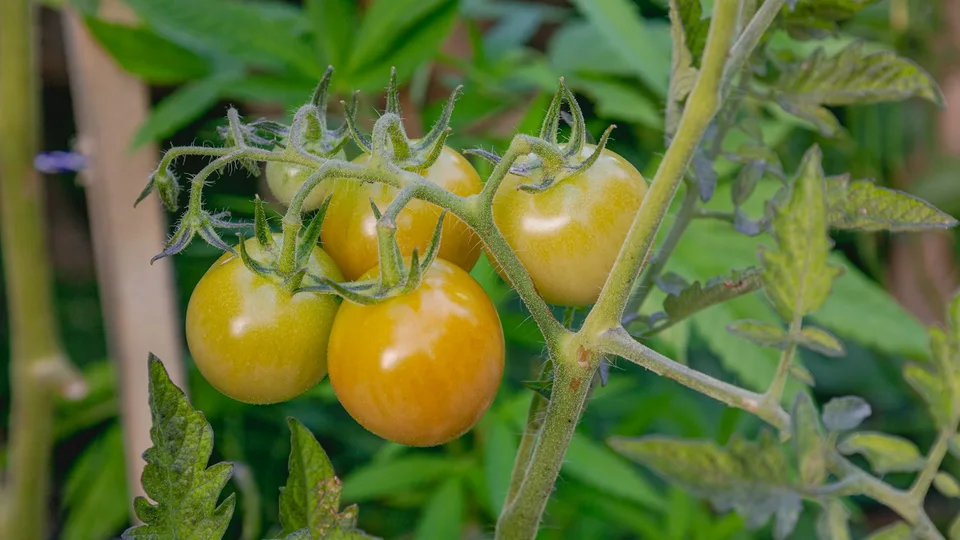
The stage that matters is the first fruit growing on the vine. Look below the flowers for small tomatoes that have set and begun to swell. An open flower is an earlier stage, and a ripe tomato is a later one. Mark the side-dressing on your garden record when you actually see the cue so you can distinguish it from anything you mixed into the bed before planting [1].
Measure the side-dressing for your row
Step 1 Measure the planted length
For its garden-row example with 46-0-0, Minnesota lists 0.5 US cup (118.3 mL) for 100 ft (30.5 m) of row. A 25 ft (7.6 m) row is one quarter of that reference length. For the same fertilizer, the scaled amount is 0.125 US cup (29.6 mL), or 2 US tablespoons. This is a worked example for that grade and row length. Use your own recommendation when it specifies a different grade or rate [1] [2].
Step 2 Distribute it beside the plants
Walk the row and spread the measured fertilizer evenly beside the plants in a 6 in (15.2 cm) wide band, as Minnesota Extension describes. Lightly work the granules into the soil surface. Think of the measured amount as the allotment for the entire planted length. Dividing it mentally into portions for each stretch helps prevent a heavy dose at the first plants and a light dose at the far end [1].
Step 3 Record what went in
Write down the grade, the quantity and the row length together. Record earlier fertilizer or compost additions on the same page. When a leaf changes color or fruit set slows, those notes give you a starting point for checking water, growth and past feeding. The amount left in the bag tells you little if that same product was used elsewhere in the garden [1] [2].
What if the fruit turns black at the tip?
Look at where the mark forms. Blossom-end rot develops at the end opposite the stem. Fluctuating soil moisture while fruit expands can contribute to this disorder. Check how deeply your watering reaches and whether the soil dries out between waterings. A surface that looks wet immediately after watering gives you less information than a check below the surface where roots are taking up water [1].
Use the soil report to decide whether the soil needs a nutrient amendment. A damaged fruit can tell you where to look, but it cannot tell you how much calcium is in the soil. Correct the watering pattern and judge the next fruit as it develops. You can use the tomato plant profile alongside these checks to review the plant's growing conditions [1] [2].
How can you avoid adding more nitrogen than you need?
Review the bed's history before treating dark green, vigorous foliage as a reason to keep feeding. Minnesota Extension associates excess nitrogen with leafy growth and slow fruiting. Walk the row and compare the plants at the ends and in the middle. If only a section looks different, check whether that section is wetter, drier or shaded before treating the entire row as if it had the same nutrient problem [1].
Use the same approach the following season. A soil test gives you a new baseline after a season of amendments, and your record lets you connect that baseline to what you added. Keep fertilizer calculations separate from decisions about when to start seeds. Feeding a plant once it is producing fruit solves a different job from getting it ready to transplant [1] [2].
Frequently asked questions
Can you use a balanced fertilizer for every tomato bed?
Choose a grade that fits the report. If phosphorus is already sufficient, pick a product with little or no phosphorus [1] [2].
Can you fertilize extra to make foliage produce more fruit?
Review nitrogen already applied first. Excess nitrogen can favor leafy growth and delay fruiting [1].
Sources
- University of Minnesota Extension, Growing tomatoes · extension.umn.edu, consulted
- University of Minnesota Extension, Soil testing · extension.umn.edu, consulted
Written by Emilio Marruso · last checked