Sheep at solar farms: 2 per hectare meant 38% more bees and beetles
A three-year Cornell study found that light sheep grazing around solar panels boosted bees and lady beetles, while heavy grazing cut honey bees. Here is the data, and what it means for mowing your own lawn.
by Emilio MarrusoPublished
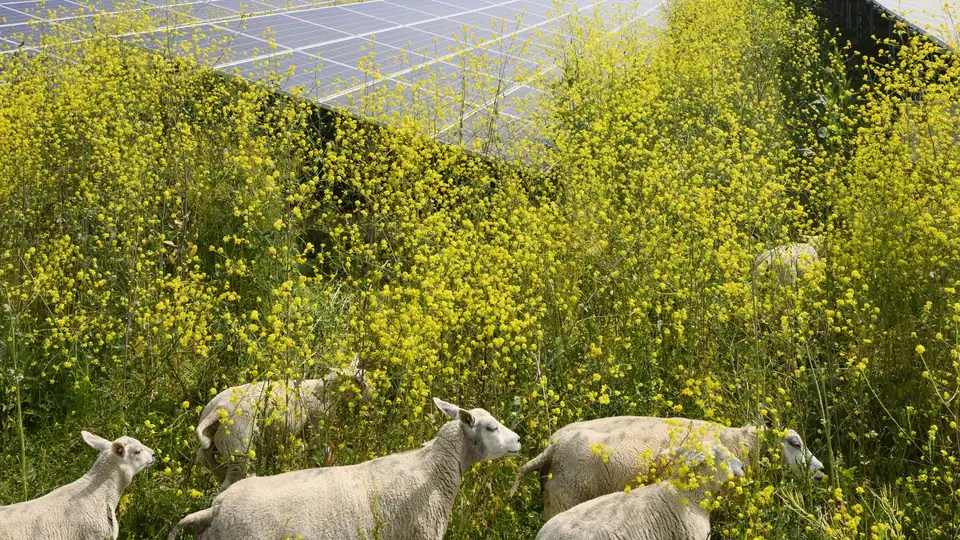
Sheep now mow many solar farms, and a Cornell team counted what that does for bees. In a three-year experiment reported in Environmental Research Letters, light grazing at 2 sheep per hectare supported 38% more beneficial insects than plots that were mowed instead [2]. As the Cornell Chronicle puts it, the right number of sheep makes all the difference [1].
In short: - At 2 sheep per hectare, bees and lady beetles were 38% more abundant than in mowed plots, driven by an 83% jump in honey bees [2]. - At 8 sheep per hectare, the sheep kept the grass in check best, but honey bees dropped by 45% [1] [2]. - Wild bees and lady beetles, counted on their own, did not respond to the number of sheep [2].
How the experiment worked
Five fenced solar arrays were each split into six paddocks, and every paddock got 0, 2, 4, 6, 8 or 10 sheep per hectare [2]. The paddocks with no sheep were mowed once a year, as standard vegetation management, and served as the control [2]. The team sampled insects with sweep nets before each grazing rotation [2]. There were no managed honey bee hives at the site [2].
What the sheep changed
The 2 sheep per hectare paddocks were the only ones with significantly more beneficial insects: 38% more than the mowed control [2]. Honey bees made the difference, with 83% more than in the control, while paddocks with 6, 8 and 10 sheep per hectare had 42%, 45% and 68% fewer honey bees [2]. At 4 sheep per hectare, insect numbers were statistically the same as in the control, and the sheep managed the vegetation better than at 2 [1] [2]. A companion study on the same site had found 8 sheep per hectare the best rate for vegetation control and flock health [2].
The authors call 2 sheep per hectare the agroecological optimum and 8 the agrotechnological one: the two do not coincide [2].
Grazing rates side by side
| Management | Sheep per acre | Beneficial insects vs mowed control | Honey bees per 100 in mowed control |
|---|---|---|---|
| Mowed once a year, no sheep | 0 | reference | 100 |
| 2 sheep per hectare | 0.809 | +38% | 183 |
| 4 sheep per hectare | 1.619 | no significant difference | no significant difference |
| 6 sheep per hectare | 2.428 | no significant difference | 58 |
| 8 sheep per hectare | 3.237 | no significant difference | 55 |
| 10 sheep per hectare | 4.047 | no significant difference | 32 |
The percentages come from the paper [2]; sheep per acre (1 hectare = 2.471 acres) and honey bees per 100 are our arithmetic on those figures. Read that way, the lightest grazing hosted 3.33 times as many honey bees as the 8-sheep rate.
What it means for your lawn
For home lawns, University of Minnesota Extension recommends a "bee lawn": turfgrass mixed with low flowers such as white clover and self-heal, often with fine fescues like creeping red fescue [3].
Mow higher
Set the mower to at least 3 inches (7.62 cm) [3].
Mow less often
Mow an established bee lawn every 2 to 3 weeks, depending on the time of year [3].
Let the flowers bloom
Hold off on mowing when the lawn flowers are in full bloom, so pollinators have time to forage [3].
Go easy on fertilizer
Too much fertilizer favors grass over flowers; established bee lawns need little or no extra feeding [3].
What the study does not say
The results come from a single solar facility in the humid northeastern United States, and the authors say that applying their 4-sheep reference rate at other facilities depends on local vegetation, array layout and region [2]. Three years is a short window: insect numbers shifted from year to year, and the team calls for longer monitoring [2]. The study counted insects, not pollination itself: the authors speak of a higher potential for pollination [2]. The paper gives no advice for home lawns: the tips above come from University of Minnesota Extension [3].
Frequently asked questions
How many sheep per hectare were best for bees?
2 sheep per hectare, with 38% more beneficial insects than mowed plots [2].
Did wild bees benefit too?
No measurable change: wild bee abundance, richness and diversity did not respond to stocking rate [2].
Sources
- Sheep grazing in solar fields offers farmers economic, ecological gains — Cornell Chronicle, 14 October 2026 · news.cornell.edu, consulted
- Zoller et al. (2026), Low solar grazing densities support beneficial insects in agrivoltaic systems — Environmental Research Letters 21 (20), 204005 · doi.org, consulted
- Planting and maintaining a bee lawn — University of Minnesota Extension · extension.umn.edu, consulted
Written by Emilio Marruso · last checked