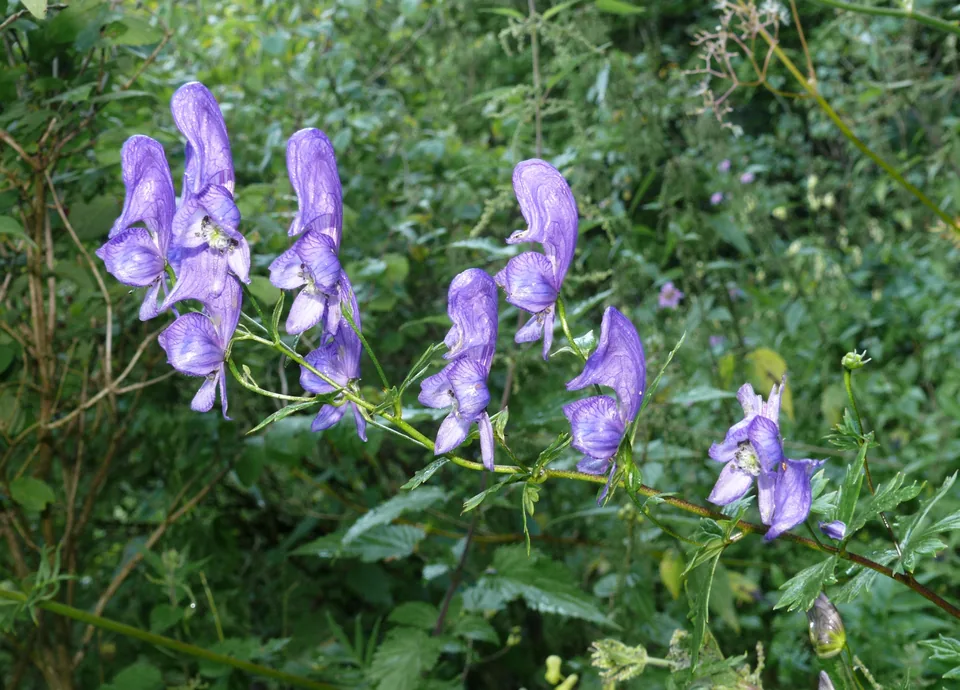
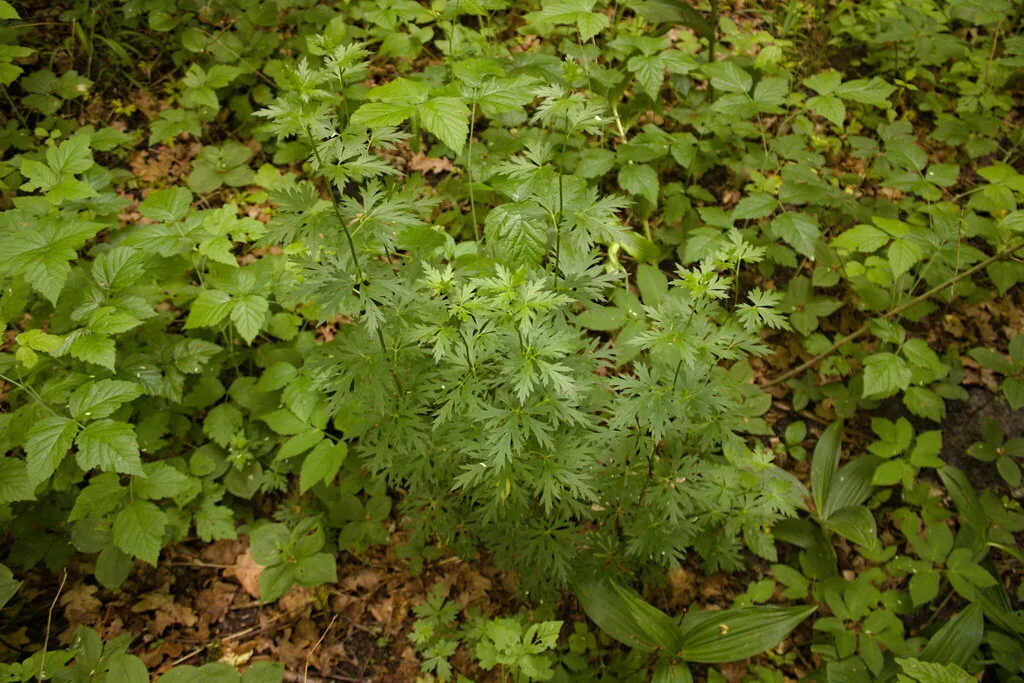

How to Grow and Care for Manchurian monkshood
Aconitum variegatum
Written by Emilio Marruso · last checked
Toxic to: People · Why
At a glance
This aconite makes a striking, tall plant for a damp corner in partial shade, reaching 6 ft when fully grown. It loves wet or evenly moist soil, and you can start it from seed in spring or autumn, or divide a clump to get new plants. Treat it with respect, though: it is one of the most toxic plants you can grow.
- Sun
Partial shade
What the sources say (1)
Light: Partial shade
| Lighting | - Half heliophobic | Spacing, cm | From 50 to 60
— Margoji kurpelė – Aconitum variegatum | FLORES [5] - Water
Likes wet or evenly moist soil; don't let it dry out
What the sources say (1)
Watering notes: Grows in wet and average-wet soils
| Soil | - wet soils - average wet soils
— Margoji kurpelė – Aconitum variegatum | FLORES [5] - Spacing
20–24 in between plants
What the sources say (1)
Spacing: 50-60 cm [20–24 in]
| Spacing, cm | From 50 to 60
— Margoji kurpelė – Aconitum variegatum | FLORES [5] - Size
Grows 6 ft tall
What the sources say (1)
Mature height: 180 cm (about 71 in)
Bis 180 cm hoch. Stängel oft in Gebüsch hin- und hergebogen.
— Aconitum variegatum L. subsp. variegatum [4] - Propagation
From seed or by dividing the clump
What the sources say (1)
Propagation: Seeds; division
Propagation methods: seeds, scrub division. 300 seeds per 1 gram.
— Margoji kurpelė – Aconitum variegatum | FLORES [5] - Sowing
Sow in spring or autumn in a cold frame
What the sources say (1)
Sowing: Spring or autumn (seeds sown in cold beds)
Seeds are sown in cold beds in Spring or Autumn.
— Margoji kurpelė – Aconitum variegatum | FLORES [5] - Safety
One of the most toxic plants: never eat any part of it
Overview
Aconitum variegatum, variegated monkshood, is a perennial herbaceous rhizomatous plant 50 to 200 cm [20–79 in] tall. [1] All parts of the plant contain highly toxic diterpene alkaloids. [3][1] It is listed on a plant database as suited to mixed borders and wet to average-wet soils, and propagated by seed or division. [5]
This record is incomplete: the sources we read do not cover every field yet.
Not yet covered by our sources: Watering, Hardiness, coldest zone, Hardiness, warmest zone, Pruning
Manchurian monkshood care
Measurements in square brackets are our conversion into the other unit system; the quoted text is unchanged.
How to water Manchurian monkshood
Watering
Not stated in the sources we read.
Watering notes
Grows in wet and average-wet soils
What the sources say (1)
| Soil |
- wet soils
- average wet soilsHow much light Manchurian monkshood needs
Partial shade
What the sources say (1)
| Lighting |
- Half heliophobic
| Spacing, cm | From 50 to 60How much cold Manchurian monkshood can take
Hardiness, coldest zone
Not stated in the sources we read.
Hardiness, warmest zone
Not stated in the sources we read.
Where to grow Manchurian monkshood
50-60 cm [20–24 in]
What the sources say (1)
| Spacing, cm | From 50 to 60How to propagate Manchurian monkshood
Seeds; division
What the sources say (1)
Propagation methods: seeds, scrub division. 300 seeds per 1 gram.How to grow Manchurian monkshood
The plant
Family
Ranunculaceae
What the sources say (1)
Ranunculaceae - Aconitum - Aconitum variegatum L. - Aconitum variegatum L. subsp. variegatumMature height
180 cm (about 71 in)
What the sources say (1)
Bis 180 cm hoch. Stängel oft in Gebüsch hin- und hergebogen.Remedies
Each remedy shows what official sources say about it; traditional remedies without an official source are marked as such. Harmful ones are listed so you know to avoid them.
First aid
First aid: not a substitute for a doctor
skin contact
rinse skin with lukewarm water and soap Official source, not independently tested
Call 1-800-222-1222 immediately for additional instructions.
— missouripoisoncenter.org [6] How: Rinse any exposed skin with lukewarm water and soap.
Rinse any exposed skin with lukewarm water and soap.
— missouripoisoncenter.org [6]
mouth contact
wipe or rinse out the mouth Official source, not independently tested
Call 1-800-222-1222 immediately for additional instructions.
— missouripoisoncenter.org [6] How: Wipe or rinse out the mouth to remove plant material, then give a serving size of water to drink.
Wipe or rinse out the mouth to remove plant material.
— missouripoisoncenter.org [6]
eye contact
rinse eyes with water Official source, not independently tested
If you suspect oral ingestion, contact a Poison Centre immediately.
— bfr.bund.de [7] How: After eye contact, rinse thoroughly with water (for approx. 5 minutes; 10 minutes if there is severe stinging).
After eye contact, rinse thoroughly with water (for approx. 5 minutes; 10 minutes if there is severe stinging).
— bfr.bund.de [7]
Treating the plant
crown rot
remove dead plants and surrounding soil Official source, not independently tested
How: Remove dead plants and the surrounding soil that contains sclerotia; plant in uninfested soil.
Removal of dead plants and the surrounding soil that contains sclerotia is otherwise indicated.
— portal.ct.gov [8]
bacterial leaf spot
remove diseased plants and avoid overhead irrigation Official source, not independently tested
How: Remove diseased plants and debris as noticed, avoid overhead irrigation especially in the evening, and increase air flow through the plants.
Remove diseased plants and debris as noticed. Avoid overhead irrigation, especially in the evening and increase air flow through the plants to speed drying of the foliage.
— portal.ct.gov [8]
downy mildew
reduce humidity and leaf wetness Official source, not independently tested
How: Cultural means of reducing humidity and leaf wetness.
Control may include cultural means of reducing humidity and leaf wetness.
— portal.ct.gov [8]
root-knot nematodes
grow resistant plants or rotate to small grains Official source, not independently tested
How: Growing resistant plants or rotating to small grains can greatly reduce or eliminate nematode populations in infested soil.
Growing resistant plants or rotating to small grains can greatly reduce or eliminate nematode populations in infested soil.
— portal.ct.gov [8]
Is Manchurian monkshood poisonous?
Reported by the source, quoted verbatim. This is not medical or veterinary advice: if a person or an animal may have eaten this plant, contact a poison control centre or a veterinarian.
Aconitum variegatum is one of the most toxic plants and this characteristic is shared by most of the species belonging to the genus.
[1]- Poisonous parts
The toxin is contained in all parts of the plant, being the highest concentration present in the rhizomes.
[1]- Toxic principle
The main toxic principle is the aconitine, a neurotoxin blocking in opening position the sodium channels on the membranes of the nervous and muscular cells.
[1]- Toxic principle
Alle Pflanzenteile des Bunten Eisenhutes enthalten hochgiftige Diterpen-Alkaloide, darunter Talatisamin.
[3]
Calendar
Sowing
Spring or autumn (seeds sown in cold beds)
What the sources say (1)
Seeds are sown in cold beds in Spring or Autumn.Pruning
Not stated in the sources we read.
Months as given by the sources, which are mostly from the United States (northern hemisphere). In the southern hemisphere they shift by about six months.
Similar plants
- Aconite Aconitum napellus
- Monkshood Aconitum uncinatum
- Black caraway Nigella sativa
- Blue Jasmine Clematis crispa
- Bugbane Actaea podocarpa
- Bugbane Actaea simplex
- Bush Clematis Clematis integrifolia
- Bush Clematis Clematis recta
Sources
Every value above is quoted from these documents. Links lead to the original publisher.
- Aconitum variegatum - Monaco Nature Encyclopedia · monaconatureencyclopedia.com, consulted
- Search for species - Gescheckter Eisenhut (Aconitum variegatum L.) · i-flora.com, consulted
- Bisherige Pflanzen der Woche - Der Bunte Eisenhut — Botanischer Garten — TU Dresden · tu-dresden.de, consulted
- Aconitum variegatum L. subsp. variegatum · infoflora.ch, consulted
- Margoji kurpelė – Aconitum variegatum | FLORES · flores.lt, consulted
- missouripoisoncenter.org · missouripoisoncenter.org
- bfr.bund.de · bfr.bund.de
- portal.ct.gov · portal.ct.gov
Written by Emilio Marruso · last checked