
How to Grow and Care for Juneberry
Amelanchier lamarckii
Written by Emilio Marruso · last checked
At a glance
Serviceberry rewards you with very tasty fruit and asks for little in return. It grows in full sun or partial shade, accepts soils from pH 4 to 8, and once settled needs no regular watering except in severe drought. Plant it any time from a container, ideally in October or November, or grow it right in a pot.
- Sun
Full sun or partial shade
What the sources say (2)
Light: Full sun or partial shade
Find a spot with full sun or partial shade, with moist soil and good
— Snowy Mespilus - How To Grow Amelanchier Lamarckii With Katherine Crouch | Horticulture.co.uk [6] Prefers moist, well-drained, acid soil in full sun or part shade. Tolerates
— Species Records | Boone County Arboretum [7] - Water
Water twice a week when newly planted; later only in severe drought
What the sources say (2)
Watering notes: Water a couple of times a week when newly planted
With a newly-planted tree, water a couple of times a week to help it get established.
— Snowy Mespilus - How To Grow Amelanchier Lamarckii With Katherine Crouch | Horticulture.co.uk [6] Watering: Once established, no regular watering needed except in severe drought
After a year or so, when your juneberry is established, you won’t need to water it anymore except during the most severe drought conditions. Deliberate watering is mainly good for
— Snowy Mespilus - How To Grow Amelanchier Lamarckii With Katherine Crouch | Horticulture.co.uk [6] - Soil
Grows in acidic to alkaline soil, pH 4–8
- Planting
Container plants any time; October or November is best
What the sources say (1)
Planting: Container plants any time (October or November preferable)
you can plant it out at any time, although October or November is preferable.
— Snowy Mespilus - How To Grow Amelanchier Lamarckii With Katherine Crouch | Horticulture.co.uk [6] - Feeding
On alkaline soil the leaves can turn yellow
What the sources say (1)
Signs of deficiency: Chlorosis on alkaline soils
It becomes chlorotic in alkaline soils and does not tolerate wind.
— Amelanchier (Common Serviceberry, Downy Serviceberry, Juneberry, Saskatoon, Serviceberry, Shadblow, Shadbush, Sugarplum) | North Carolina Extension Gardener Plant Toolbox [1] - Pruning
Prune in late winter or early spring
What the sources say (1)
Pruning: Late winter or early spring
do so in late winter or early spring.
— Snowy Mespilus - How To Grow Amelanchier Lamarckii With Katherine Crouch | Horticulture.co.uk [6] - Harvest
The fruit is edible and very tasty
- Pests
Fire blight, leaf spot, rust and powdery mildew
What the sources say (1)
Diseases: fire blight, fungal leaf spot, rust, powdery mildew
Fire blight and fungal leaf spot may affect the plant’s overall health. Rust and powdery mildew are also issues.
— Amelanchier (Common Serviceberry, Downy Serviceberry, Juneberry, Saskatoon, Serviceberry, Shadblow, Shadbush, Sugarplum) | North Carolina Extension Gardener Plant Toolbox [1] - Propagation
By seed or by dividing the suckers
- Sowing
Sow in late summer in a cold frame, right after picking the seed green
What the sources say (1)
Sowing: Late summer (cold frame); seed sown immediately when harvested green
from seed, grow in a cold frame in late summer and plant out the following spring.
— Snowy Mespilus - How To Grow Amelanchier Lamarckii With Katherine Crouch | Horticulture.co.uk [6] - Containers
Grows in containers too
What the sources say (1)
In containers: Yes
in the ground or in a container and it can also be grown as
— Snowy Mespilus - How To Grow Amelanchier Lamarckii With Katherine Crouch | Horticulture.co.uk [6]
Overview
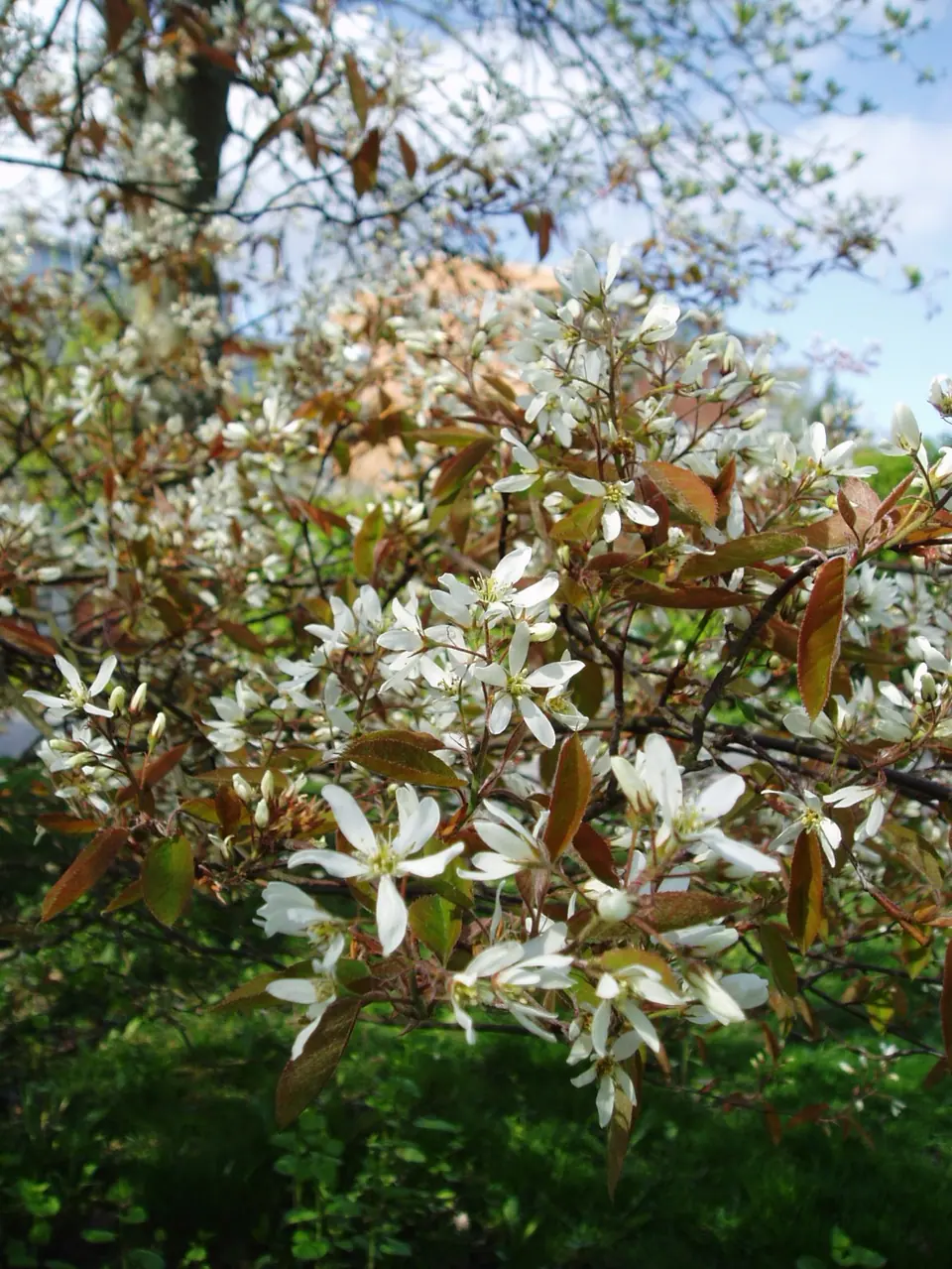
Snowy mespilus is a deciduous shrub or tree grown in gardens for its flowers, autumn colour and edible fruits. [2] It prefers full sun or partial shade with moist, well-drained soil and needs little watering once established. [6] It can be propagated by seed or by division of suckers. [2]
This record is incomplete: the sources we read do not cover every field yet.
Not yet covered by our sources: Hardiness, coldest zone, Hardiness, warmest zone
Juneberry care
How to water Juneberry
Watering
Once established, no regular watering needed except in severe drought
What the sources say (1)
After a year or so, when your juneberry is established, you won’t need to water it anymore except during the most severe drought conditions.
Deliberate watering is mainly good forWatering notes
Water a couple of times a week when newly planted
What the sources say (1)
With a newly-planted tree, water a couple of times a week to help it get established.How much light Juneberry needs
Full sun or partial shade
What the sources say (2)
Find a spot with full sun or partial shade, with moist soil and goodPrefers moist, well-drained, acid soil in full sun or part shade. ToleratesHow much cold Juneberry can take
Hardiness, coldest zone
Not stated in the sources we read.
Hardiness, warmest zone
Not stated in the sources we read.
Best soil for Juneberry
Soil pH, minimum
4
What the sources say (1)
Tolerates wet soils and pH 4-8,Soil pH, maximum
8
What the sources say (1)
Tolerates wet soils and pH 4-8,Where to grow Juneberry
Yes
What the sources say (1)
in the ground or in a container and it can also be grown asHow to propagate Juneberry
How to grow Juneberry
The plant
Family
Rosaceae
What the sources say (1)
Serviceberry is in the rose family (Rosaceae), native to Europe, Africa, North America, and temperate Asia.Pests and diseases
Diseases
fire blight, fungal leaf spot, rust, powdery mildew
What the sources say (1)
Fire blight and fungal leaf spot may affect the plant’s overall health. Rust and powdery mildew are also issues.Fertilizing
Signs of deficiency
Chlorosis on alkaline soils
What the sources say (1)
It becomes chlorotic in alkaline soils and does not tolerate wind.Remedies
Each remedy shows what official sources say about it; traditional remedies without an official source are marked as such. Harmful ones are listed so you know to avoid them.
Treating the plant
woolly aphids
hosing with a firm spray of water Official source, not independently tested
How: Knock the population down by hosing all of the tree you can reach with a firm spray; repeat as needed.
Suggest literally knocking down the population by hosing all of the tree you can reach with a firm spray. Monitor the serviceberry and spray treatments can be repeated as needed, if needed.
— ask.extension.org [8] insecticidal soap spray Works
insecticidal soap should not be applied when temperatures are greater than 90 degrees, so it would be best to apply in early morning on a cooler day
— ask.extension.org [8] How: Use insecticidal soap to reduce a significant infestation.
In the outdoors, wooly aphids are typically controlled by parasitic wasps, however since your problem is significant, it is recommended to use either horticulture oil or insecticidal soap to reduce the infestation.
— ask.extension.org [8] What the evidence says In the outdoors, wooly aphids are typically controlled by parasitic wasps, however since your problem is significant, it is recommended to use either horticulture oil or insecticidal soap to reduce the infestation.
— ask.extension.org [8]
pear slug (pear sawfly)
insecticidal soap spray Official source, not independently tested
insecticidal soap should not be applied when temperatures are greater than 90 degrees, so it would be best to apply in early morning on a cooler day
— ask.extension.org [8] How: Try insecticidal soap on the skeletonizing larvae found on the leaf undersides.
Not sure. You could try insecticidal soap, neem or spinosad.
— ask.extension.org [9] neem spray Official source, not independently tested
How: Try neem on the skeletonizing larvae found on the leaf undersides.
Not sure. You could try insecticidal soap, neem or spinosad.
— ask.extension.org [9]
spider mites
horticultural oil spray Works
How: Spray horticultural oil on infested plants.
The main symptom of mite injury is the loss of green leaf coloration. If the infestation is heavy, very fine webbing may be seen. Horticultural oil sprays help control mite infestations.
— ask.ifas.ufl.edu [10] What the evidence says The main symptom of mite injury is the loss of green leaf coloration. If the infestation is heavy, very fine webbing may be seen. Horticultural oil sprays help control mite infestations.
— ask.ifas.ufl.edu [10]
overwintering pests
dormant oil spray Works
How: Apply dormant oil in the spring, just before bud break.
Dormant oil applied in the spring, just before bud break, can help control overwintering pests.
— extension.usu.edu [11] What the evidence says Dormant oil applied in the spring, just before bud break, can help control overwintering pests.
— extension.usu.edu [11]
birds eating fruit
bird netting Works
How: Drape the branches with bird netting to protect the ripening fruit.
One of the most effective control options is to drape the branches with bird netting in order to protect ripening fruit.
— extension.usu.edu [11] What the evidence says One of the most effective control options is to drape the branches with bird netting in order to protect ripening fruit.
— extension.usu.edu [11]
entomosporium leaf spot
open canopy pruning and leaf litter removal Works
How: Keep an open canopy by pruning, remove leaf litter in the fall and avoid irrigation that wets the leaves.
Keeping an open canopy through proper pruning, removing leaf litter in the fall and avoiding irrigation techniques that would wet the leaves will help control for Entomosporium leaf and berry spot.
— extension.usu.edu [11] What the evidence says Keeping an open canopy through proper pruning, removing leaf litter in the fall and avoiding irrigation techniques that would wet the leaves will help control for Entomosporium leaf and berry spot.
— extension.usu.edu [11] pruning out diseased wood Official source, not independently tested
How: Prune out diseased wood below the infected section and sterilize the shears between each cut.
Prune out diseased wood 12 inches below the infected section and sterilize the shears between each cut.
— extension.usu.edu [11]
powdery mildew
pruning out diseased shoots Works
How: Detect early and prune out diseased shoots; plant resistant cultivars.
Early detection and pruning out of diseased shoots as well as planting resistant cultivars are the best control options.
— extension.usu.edu [11] What the evidence says Early detection and pruning out of diseased shoots as well as planting resistant cultivars are the best control options.
— extension.usu.edu [11]
juniper rust
not planting next to junipers Official source, not independently tested
How: Avoid planting serviceberry next to juniper plants.
To avoid the disease, it is best to avoid planting serviceberry next to juniper plants.
— extension.usu.edu [11]
Calendar
Late summer (cold frame); seed sown immediately when harvested green
What the sources say (1)
from seed, grow in a cold frame in late summer and plant out the following spring.Container plants any time (October or November preferable)
What the sources say (1)
you can plant it out at any time, although October or November is preferable.Late winter or early spring
What the sources say (1)
do so in late winter or early spring.Months as given by the sources, which are mostly from the United States (northern hemisphere). In the southern hemisphere they shift by about six months.
Edibility
Reported by the source, quoted verbatim. Do not eat a plant on the basis of this page alone: identification mistakes can be dangerous.
The plant has a very tasty fruit which is often
[2]
Indicative values
Values from a secondary source, not checked word for word like the rest of this page. Use them as a starting point.
- Life cycle
- PerennialIndicative value, adapt it to your climate · Secondary source
- Mature height
- 457.2-762 cm (15-25 ft)Indicative value, adapt it to your climate · Secondary source
- USDA hardiness zones
- 4-8 [winter low −34.4 to −6.7 °C (−30 to 20 °F)]Indicative value, adapt it to your climate · Secondary source
- Care level
- ModerateIndicative value, adapt it to your climate · Secondary source
- Growth rate
- LowIndicative value, adapt it to your climate · Secondary source
Similar plants
- Coastal Serviceberry Amelanchier obovalis
- Saskatoon Serviceberry Amelanchier alnifolia
- Serviceberry Amelanchier arborea
- Serviceberry Amelanchier canadensis
- Allegheny Serviceberry Amelanchier laevis
- Snowy Mespilus Amelanchier ovalis
- Afghan Cherry Prunus jacquemontii
- Alabama Snow Wreath Neviusia alabamensis
Sources
Every value above is quoted from these documents. Links lead to the original publisher.
- Amelanchier (Common Serviceberry, Downy Serviceberry, Juneberry, Saskatoon, Serviceberry, Shadblow, Shadbush, Sugarplum) | North Carolina Extension Gardener Plant Toolbox · plants.ces.ncsu.edu, consulted
- Amelanchier lamarckii - Useful Temperate Plants · temperate.theferns.info, consulted
- Amelanchier - Trees and Shrubs Online · treesandshrubsonline.org, consulted
- Bean's Trees and Shrubs · beanstreesandshrubs.org, consulted
- Plant Crib · bsbi.org, consulted
- Snowy Mespilus - How To Grow Amelanchier Lamarckii With Katherine Crouch | Horticulture.co.uk · horticulture.co.uk, consulted
- Species Records | Boone County Arboretum · bcarboretum.org, consulted
- ask.extension.org · ask.extension.org
- ask.extension.org · ask.extension.org
- ask.ifas.ufl.edu · ask.ifas.ufl.edu
- extension.usu.edu · extension.usu.edu
Written by Emilio Marruso · last checked