
How to Grow and Care for Big sagebrush
Artemisia tridentata
Written by Emilio Marruso · last checked
At a glance
This artemisia is perfect for busy gardeners: it loves full sun, shrugs off drought and needs no watering or fertilizer at all. Its leaves season food and make a tea, and its oily seeds can be eaten raw or cooked. Just keep it on the dry side, because soil that stays too wet rots its roots.
- Sun
Full sun
- Water
Very drought tolerant and needs no watering; too much water rots the roots
What the sources say (2)
Watering: Extremely drought tolerant; does not need irrigation; susceptible to root rot if too wet
Plants are extremely drought tolerant and are susceptible to root rot if too wet.
— Lady Bird Johnson Wildflower Center - The University of Texas at Austin [1] Sun. Best in well-drained soil, does not need irrigation.
— Artemisia tridentata | Landscape Plants | Oregon State University [5] - Cold
Survives winters down to −30 °F (−34.4 °C)
Very hardy · USDA 4 · RHS H7 · Z4
What the sources say (1)
Hardiness, coldest zone: 4 [winter low −34.4 to −28.9 °C (−30 to −20 °F)]
Hardy to USDA Zone 4
— Artemisia tridentata | Landscape Plants | Oregon State University [5] - Planting
Plant in late spring or early summer
What the sources say (1)
Planting: Late spring or early summer
grow them on in the greenhouse for their first winter, planting them out in late spring or early summer
— Artemisia tridentata - Useful Temperate Plants [2] - Feeding
No fertilizer needed, and it dislikes too much of it
What the sources say (3)
How often: None needed
Artemisias require no fertilizer, very little water, full sun or some light shade, and good drainage.
— [7] - Harvest
Leaves season food and make tea; the oily seeds are eaten raw or cooked
- Propagation
From seed, or from half-ripe cuttings in midsummer, which root very slowly
What the sources say (1)
Propagation: Seed; cuttings of half-ripe wood in mid summer (very slow to root)
Cuttings of half-ripe wood, mid summer in a frame. Very slow to root
— Artemisia tridentata - Useful Temperate Plants [2] - Sowing
Sow on the soil surface in a greenhouse, from late winter to early summer
What the sources say (1)
Sowing: Late winter to early summer (greenhouse, surface sown)
Seed - surface sow from late winter to early summer in a greenhouse in a very free-draining soil
— Artemisia tridentata - Useful Temperate Plants [2]
Overview
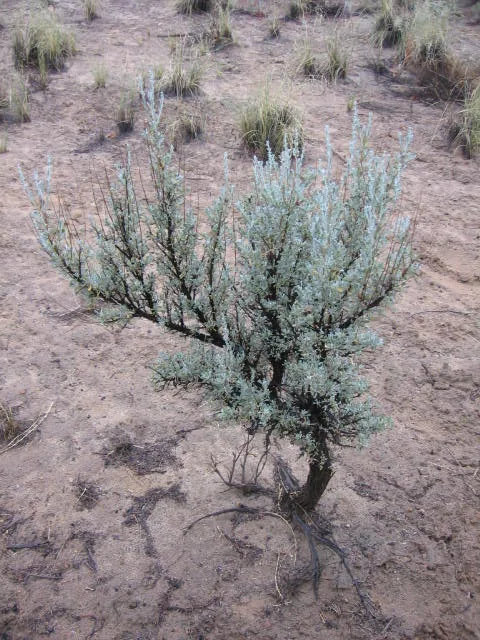
Evergreen silvery shrub of western North America, from 1.5 to 9 ft [0.5–2.7 m] tall, with an aromatic foliage. [1] It needs sun and well-drained soil and is extremely drought tolerant. [5][1]
This record is incomplete: the sources we read do not cover every field yet.
Not yet covered by our sources: Harvest
Big sagebrush care
Measurements in square brackets are our conversion into the other unit system; the quoted text is unchanged.
How to water Big sagebrush
Watering
Extremely drought tolerant; does not need irrigation; susceptible to root rot if too wet
What the sources say (2)
Plants are extremely drought tolerant and are susceptible to root rot if too wet.Sun. Best in well-drained soil, does not need irrigation.Watering notes
Grows where mean annual rainfall is 250-460 mm [9.8–18.1 in]
What the sources say (1)
The plant grows in areas where the mean annual rainfall is within the range 250 - 460mm a yearHow much light Big sagebrush needs
How much cold Big sagebrush can take
4 [winter low −34.4 to −28.9 °C (−30 to −20 °F)]
What the sources say (1)
Hardy to USDA Zone 4How to propagate Big sagebrush
Seed; cuttings of half-ripe wood in mid summer (very slow to root)
What the sources say (1)
Cuttings of half-ripe wood, mid summer in a frame. Very slow to rootHow to grow Big sagebrush
The plant
Life cycle
perennial
What the sources say (1)
Plant type: Shrub Lifecycle: Perennial Growing season: Warm, Cool Cover: HighFamily
Asteraceae
What the sources say (1)
Common name: Big Sagebrush Pronunciation: ar-te-MIZ-i-a tri-den-TAH-ta Family: Asteraceae Genus: ArtemisiaFertilizing
How often
None needed
What the sources say (1)
Artemisias require no fertilizer, very little water, full sun or some light shade, and good drainage.Avoid
Fertilizer: artemisias need none and dislike excess fertilizer
Remedies
The sources we checked give no remedies for this plant.
Calendar
Sowing
Late winter to early summer (greenhouse, surface sown)
What the sources say (1)
Seed - surface sow from late winter to early summer in a greenhouse in a very free-draining soilPlanting
Late spring or early summer
What the sources say (1)
grow them on in the greenhouse for their first winter, planting them out in late spring or early summerHarvest
Not stated in the sources we read.
Months as given by the sources, which are mostly from the United States (northern hemisphere). In the southern hemisphere they shift by about six months.
Edibility
Reported by the source, quoted verbatim. Do not eat a plant on the basis of this page alone: identification mistakes can be dangerous.
Indicative values
Values from a secondary source, not checked word for word like the rest of this page. Use them as a starting point.
- Hours of sun
- 6-8 hoursIndicative value, adapt it to your climate · Secondary source
- Drought tolerant
- yesIndicative value, adapt it to your climate · Secondary source
- Soil
- Sand, LoamIndicative value, adapt it to your climate · Secondary source
- Soil pH
- 6-8Indicative value, adapt it to your climate · Secondary source
- Care level
- LowIndicative value, adapt it to your climate · Secondary source
- Growth rate
- LowIndicative value, adapt it to your climate · Secondary source
Similar plants
- Mugwort Artemisia vulgaris
- Southernwood Artemisia abrotanum
- Wormwood Artemisia absinthium
- Dusty Miller Artemisia stelleriana
- White Sage Artemisia ludoviciana
- Sweet sagewort Artemisia annua
- Artemisia afra Artemisia afra
- Tarragon Artemisia dracunculus
Sources
Every value above is quoted from these documents. Links lead to the original publisher.
- Lady Bird Johnson Wildflower Center - The University of Texas at Austin · wildflower.org, consulted
- Artemisia tridentata - Useful Temperate Plants · temperate.theferns.info, consulted
- Artemisia tridentata | EcoRestore Portal · ecorestore.arizona.edu, consulted
- Artemisia Tridenta | Utah Valley University · uvu.edu, consulted
- Artemisia tridentata | Landscape Plants | Oregon State University · landscapeplants.oregonstate.edu, consulted
- Plant Data Sheet · depts.washington.edu, consulted
- ucanr.edu · ucanr.edu
Written by Emilio Marruso · last checked