
How to Grow and Care for Bentham's cornel
Cornus capitata
Written by Emilio Marruso · last checked
At a glance
This dogwood gives you a sweet surprise: fruit you can pick from October to November and eat raw or cooked, with a bittersweet taste like an overripe banana. It grows in full sun to partial shade and asks only for consistently moist soil and a feeding in March and July. Remove the seeds, then enjoy the fruit fresh, in desserts or in preserves.
- Sun
Full sun to partial shade
- Water
Keep the soil moist; let only the top 1–2 inches dry out, and watch it closely in summer heat
What the sources say (2)
Watering: Keep the soil consistently moist, or let only the top inch or two dry out
The soil should stay consistently moist or just the top inch or two be allowed to dry out.
— How to Grow and Care for Evergreen Dogwood | Gardener’s Path [1] Watering notes: Pay special attention during the heat of summer to keep the soil from drying out
You’ll need to pay special attention during the heat of summer to keep the soil from drying out.
— How to Grow and Care for Evergreen Dogwood | Gardener’s Path [1] - Soil
Acidic to neutral soil, pH 5.5–7.0
- Feeding
Feed twice a year, in March and July, with a general-purpose fertilizer
What the sources say (4)
When: March and again in July
A newly-planted dogwood 6 ft tall requires about ¼ cup (4 tablespoons) of a 12-4-8 or 16-4-8 fertilizer in March and again in July.
— [9] How often: Twice a year, in March and July
A newly-planted dogwood 6 ft tall requires about ¼ cup (4 tablespoons) of a 12-4-8 or 16-4-8 fertilizer in March and again in July.
— [9] Mineral fertilizers: General-purpose 12-4-8 or 16-4-8 fertilizer
newly planted trees: A newly-planted dogwood 6 ft tall requires about ¼ cup (4 tablespoons) of a 12-4-8 or 16-4-8 fertilizer in March and again in July.
— [9] A newly-planted dogwood 6 ft tall requires about ¼ cup (4 tablespoons) of a 12-4-8 or 16-4-8 fertilizer in March and again in July.
— [9] - Harvest
Pick the fruit in October–November; remove the seeds and eat it raw, cooked or in preserves
What the sources say (2)
Harvest: October to November (fruit)
According to Practical Plants: The fruit ripens in late autumn to early winter
— Bentham's Cornel (Cornus capitata) — Practical Plants [4] The flowers tend to peak in June and July and the berries are at their best in October or November.
— How to Grow and Care for Evergreen Dogwood | Gardener’s Path [1] - Propagation
From seed, cuttings or by layering
What the sources say (2)
Propagation: Seed, cuttings (half-ripe side shoots, mature wood), layering
The fruits produce seeds that you can use to propagate new evergreen dogwoods.
— How to Grow and Care for Evergreen Dogwood | Gardener’s Path [1] Cuttings of half-ripe side shoots, July/August in a frame.
— Bentham's Cornel (Cornus capitata) — Practical Plants [4] - Sowing
Sow in fall, or in spring after giving the seeds a cold period
What the sources say (2)
Sowing: Fall, or spring after cold stratification
If you sow in the fall, put them in the ground about a quarter of an inch deep
— How to Grow and Care for Evergreen Dogwood | Gardener’s Path [1] You can also sow in the spring, but to do this you’ll need to cold-stratify the seeds in the refrigerator for eight weeks.
— How to Grow and Care for Evergreen Dogwood | Gardener’s Path [1]
Overview
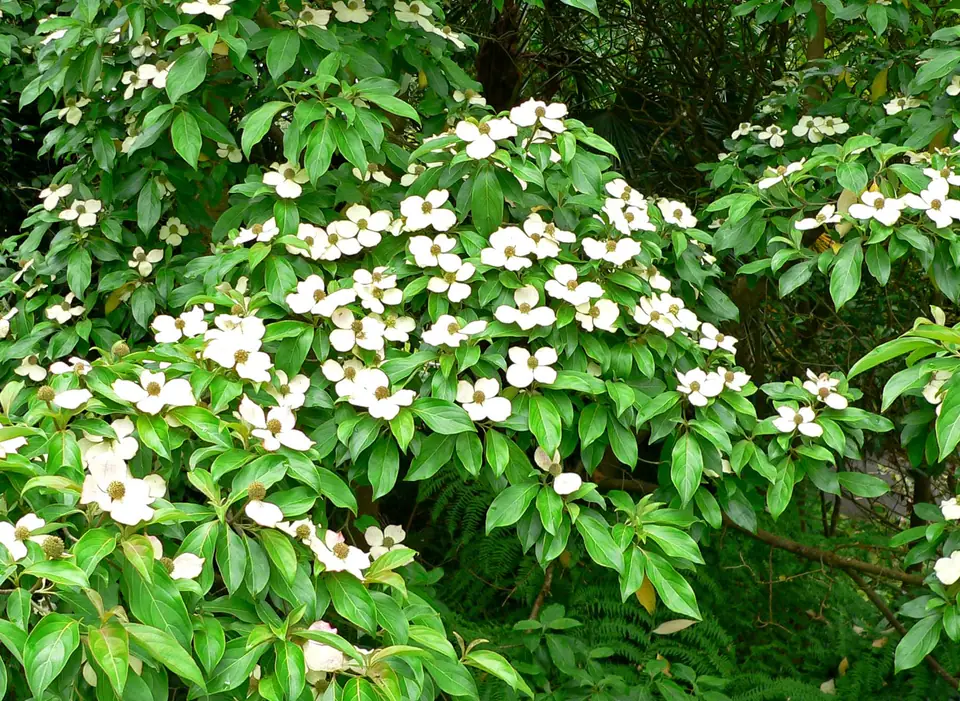
Cornus capitata is an evergreen tree or shrub native from Pakistan to southern China, grown as an ornamental that bears edible fruits. [8][1] It is grown in full sun or partial sun in organically rich, well-draining, neutral to slightly acidic soil that is kept consistently moist. [1] It is listed as an environmental weed in New Zealand. [5]
This record is incomplete: the sources we read do not cover every field yet.
Not yet covered by our sources: Hardiness, warmest zone, Pruning
Bentham's cornel care
How to water Bentham's cornel
Watering
Keep the soil consistently moist, or let only the top inch or two dry out
What the sources say (1)
The soil should stay consistently moist or just the top inch or two be allowed to dry out.Watering notes
Pay special attention during the heat of summer to keep the soil from drying out
What the sources say (1)
You’ll need to pay special attention during the heat of summer to keep the soil from drying out.How much light Bentham's cornel needs
How much cold Bentham's cornel can take
Hardiness, coldest zone
The sources give different values depending on region, zone or growing conditions.
What each source says
According to Gardening Know How: 8 [winter low −12.2 to −6.7 °C (10 to 20 °F)]
According to Practical Plants: 8 [winter low −12.2 to −6.7 °C (10 to 20 °F)]+
According to Rainy Side Gardens: 7-10 [winter low −17.8 to 4.4 °C (0 to 40 °F)]
USDA zones 6-9 (depending on variety): 6-9 [winter low −23.3 to −1.1 °C (−10 to 30 °F)]
the species: 8-9 [winter low −12.2 to −1.1 °C (10 to 30 °F)]
What the sources say (5)
According to Gardening Know How: Evergreen dogwood trees ( Cornus capitata ) are hardy down to USDA zone 8 .According to Practical Plants: Hardiness
Zone 8+According to Rainy Side Gardens: USDA zones: 7-10USDA zones 6-9 (depending on variety): Hardiness (USDA Zone): 6-9 (depending on variety)the species: C. capitata blooms later in the season than native dogwoods, and the species is hardy only in Zones 8 and 9, though some subspecies are hardier.Hardiness, warmest zone
Not stated in the sources we read.
Best soil for Bentham's cornel
Soil pH, minimum
5.5
What the sources say (1)
On the pH scale, aim for 5.5 to 7.0.Soil pH, maximum
7.0
What the sources say (1)
On the pH scale, aim for 5.5 to 7.0.How to propagate Bentham's cornel
Seed, cuttings (half-ripe side shoots, mature wood), layering
How to grow Bentham's cornel
Fertilizing
When
March and again in July
What the sources say (1)
A newly-planted dogwood 6 ft tall requires about ¼ cup (4 tablespoons) of a 12-4-8 or 16-4-8 fertilizer in March and again in July.How often
Twice a year, in March and July
What the sources say (1)
A newly-planted dogwood 6 ft tall requires about ¼ cup (4 tablespoons) of a 12-4-8 or 16-4-8 fertilizer in March and again in July.Mineral fertilizers
General-purpose 12-4-8 or 16-4-8 fertilizer
What each source says
newly planted trees: 59.3 mL of 12-4-8 or 16-4-8 for a 1.83 m [6 ft] tree, in March and again in July
What the sources say (2)
newly planted trees: A newly-planted dogwood 6 ft tall requires about ¼ cup (4 tablespoons) of a 12-4-8 or 16-4-8 fertilizer in March and again in July.A newly-planted dogwood 6 ft tall requires about ¼ cup (4 tablespoons) of a 12-4-8 or 16-4-8 fertilizer in March and again in July.Remedies
Each remedy shows what official sources say about it; traditional remedies without an official source are marked as such. Harmful ones are listed so you know to avoid them.
Treating the plant
dogwood anthracnose
pruning off symptomatic branches Not verified
Traditional remedy, not verified by an official source.
How: Prune off symptomatic branches.
Calendar
Fall, or spring after cold stratification
What the sources say (2)
If you sow in the fall, put them in the ground about a quarter of an inch deepYou can also sow in the spring, but to do this you’ll need to cold-stratify the seeds in the refrigerator for eight weeks.October to November (fruit)
What each source says
According to Practical Plants: Late autumn to early winter
What the sources say (2)
According to Practical Plants: The fruit ripens in late autumn to early winterThe flowers tend to peak in June and July and the berries are at their best in October or November.Not stated in the sources we read.
Months as given by the sources, which are mostly from the United States (northern hemisphere). In the southern hemisphere they shift by about six months.
Edibility
Reported by the source, quoted verbatim. Do not eat a plant on the basis of this page alone: identification mistakes can be dangerous.
Indicative values
Values from a secondary source, not checked word for word like the rest of this page. Use them as a starting point.
- Life cycle
- PerennialIndicative value, adapt it to your climate · Secondary source
- Mature height
- 609.6-1219.2 cm (20-40 ft)Indicative value, adapt it to your climate · Secondary source
- Hours of sun
- 4-6 hoursIndicative value, adapt it to your climate · Secondary source
- Care level
- MediumIndicative value, adapt it to your climate · Secondary source
- Growth rate
- LowIndicative value, adapt it to your climate · Secondary source
- Pruning
- March, April, December, January, FebruaryIndicative value, adapt it to your climate · Secondary source
Similar plants
- Alternate-leaf Dogwood Cornus alternifolia
- Blood-twig Dogwood Cornus sanguinea
- Bunchberry Cornus canadensis
- Cornelian Cherry Cornus mas
- Giant Dogwood Cornus controversa
- Gray Dogwood Cornus racemosa
- Japanese Cornelian Dogwood Cornus officinalis
- Pacific dogwood Cornus nuttallii
Sources
Every value above is quoted from these documents. Links lead to the original publisher.
- How to Grow and Care for Evergreen Dogwood | Gardener’s Path · gardenerspath.com, consulted
- Cornus Capitata Information: Learn About Growing Evergreen Dogwood | Gardening Know How · gardeningknowhow.com, consulted
- Cornus capitata - Trees and Shrubs Online · treesandshrubsonline.org, consulted
- Bentham's Cornel (Cornus capitata) — Practical Plants · practicalplants.org, consulted
- Cornus capitata • New Zealand Plant Conservation Network · nzpcn.org.nz, consulted
- Bracts not petals – Botanics Stories · stories.rbge.org.uk, consulted
- Cornus capitata | evergreen dogwood · rainyside.com, consulted
- Cornus capitata Wall. | Plants of the World Online | Kew Science · powo.science.kew.org, consulted
- extension.uga.edu · extension.uga.edu
Written by Emilio Marruso · last checked