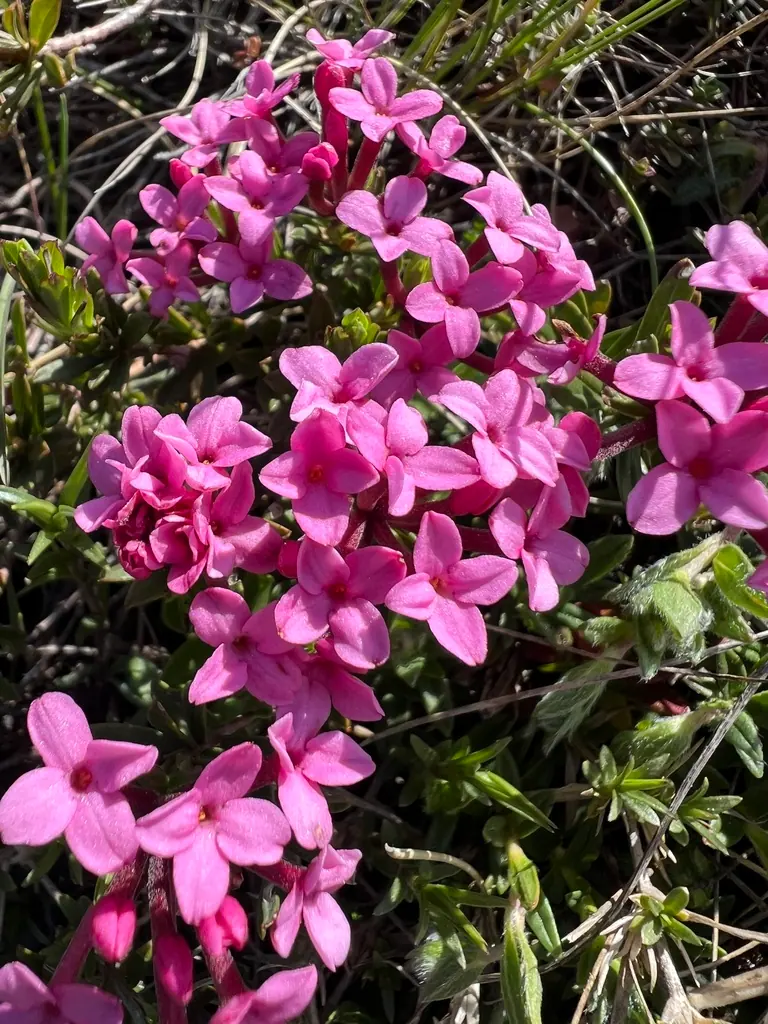
How to Grow and Care for Rose Daphne
Daphne cneorum
Written by Emilio Marruso · last checked
Toxic to: People · Why
At a glance
This little rock-garden shrub stays low, just 6–12 inches tall, while spreading up to 3 feet wide. It asks for very little: no regular feeding, only a generous layer of compost after planting, roots kept moist, and a trim after flowering. It grows happily in a container too, so even a small space can hold one.
- Water
Keep the roots moist all the time
What the sources say (1)
Watering: Permanently moist root-run
It likes a permanently moist root-run, and apparently thrives well in calcareous soil.
— Daphne cneorum - Trees and Shrubs Online [2] - Feeding
Rarely needs feeding: a thick layer of compost after planting; yellow leaves can mean alkaline soil
What the sources say (5)
How often: Generally no feeding needed: slow-growing, deep-rooted plants
in containers (alpine daphnes): With alpine daphnes in containers, you can apply a foliar feed two or three times during the growing season
— How to grow daphnes / RHS Growing Guide [3] Daphnes are generally slow growing and deep rooted, so shouldn't need feeding.
— How to grow daphnes / RHS Growing Guide [3] Natural fertilizers: A generous mulch of garden compost over the soil after planting
in containers: Top-dress containers in early spring by removing the top 5cm (2in) of compost
— How to grow daphnes / RHS Growing Guide [3] After planting, spread a generous mulch of garden compost over the soil surface. This will help to hold moisture in the soil and deter weed germination
— How to grow daphnes / RHS Growing Guide [3] Signs of deficiency: Yellowing foliage, especially on alkaline soil
nutrient deficiency leading to yellowing foliage, especially on alkaline soil
— How to grow daphnes / RHS Growing Guide [3] - Pruning
Prune right after flowering
What the sources say (1)
Pruning: After flowering
- shade - prune after flowering
— Plant Database [6] - Pests
Watch for leaf spot, crown rot and cankers
What the sources say (1)
Diseases: leaf spot, crown rots, cankers
Liabilities - leaf spot - crown rots - cankers
— Plant Database [6] - Size
6–12 in tall and 3 ft wide
What the sources say (2)
Mature height: 15.24-30.48 cm (6-12 in)
- 6" to 12" tall - width at least twice the height
— Plant Database [6] Mature width: 91.44 cm (3 ft)
Broadleaf evergreen shrub, forms a 1 x 3 ft (0.3-0.9 m) loose mat. Leaves
— Daphne cneorum | Landscape Plants | Oregon State University [1] - Sowing
Sow fresh seed in fall, right where the plants will grow
What the sources say (1)
Sowing: Fall (fresh seed, sown where the plants are to grow)
Fresh Rose Daphne seeds can be sown in the fall, directly where they are to grow in the garden.
— Daphne, How to grow and care for Rose Daphne and Winter Daphne plants - Garden Helper, Gardening Questions and Answers [7] - Containers
Grows in pots too: feed the leaves 2–3 times in the growing season, add fresh compost in early spring
What the sources say (5)
In containers: Yes
This small shrub is excellent as a ground cover , rock garden plant , growing in containers or as a foreground planting.
— Daphne, How to grow and care for Rose Daphne and Winter Daphne plants - Garden Helper, Gardening Questions and Answers [7] How often: Generally no feeding needed: slow-growing, deep-rooted plants
in containers (alpine daphnes): With alpine daphnes in containers, you can apply a foliar feed two or three times during the growing season
— How to grow daphnes / RHS Growing Guide [3] Daphnes are generally slow growing and deep rooted, so shouldn't need feeding.
— How to grow daphnes / RHS Growing Guide [3] Natural fertilizers: A generous mulch of garden compost over the soil after planting
in containers: Top-dress containers in early spring by removing the top 5cm (2in) of compost
— How to grow daphnes / RHS Growing Guide [3] After planting, spread a generous mulch of garden compost over the soil surface. This will help to hold moisture in the soil and deter weed germination
— How to grow daphnes / RHS Growing Guide [3] - Safety
Some parts are poisonous: never eat any part of it
Overview
Garland daphne is a broadleaf evergreen shrub that forms a loose mat 0.3-0.9 m [1–3 ft] wide. [1] It is grown in well-drained, moist soil and is pruned after flowering. [6] It can be propagated by softwood cuttings or tip layering. [7]
Rose Daphne care
Measurements in square brackets are our conversion into the other unit system; the quoted text is unchanged.
How to water Rose Daphne
Permanently moist root-run
What the sources say (1)
It likes a permanently moist root-run, and apparently thrives well in calcareous soil.How much light Rose Daphne needs
The sources disagree:
- prefers well-drained, moist, pH neutral soil - shade
[6]
What the sources say (2)
Exposure:
Full sun only if soil kept moist, Part sun/part shadeIt should be grown where it will receive full sun in cool summer regions, but should receive light or partial shade in warmer areas.How much cold Rose Daphne can take
Hardiness, coldest zone
The sources give different values depending on region, zone or growing conditions.
What each source says
According to Oregon State University: 6 [winter low −23.3 to −17.8 °C (−10 to 0 °F)]
According to UConn Plant Database: 4 [winter low −34.4 to −28.9 °C (−30 to −20 °F)]
According to The Garden Helper: 4 [winter low −34.4 to −28.9 °C (−30 to −20 °F)]
What the sources say (3)
According to Oregon State University: Hardy to USDA Zone 6According to UConn Plant Database: - hardy to zone 4According to The Garden Helper: Rose Daphne is hardy in USDA zones 4-8 .Hardiness, warmest zone
8 [winter low −12.2 to −6.7 °C (10 to 20 °F)]
What the sources say (1)
Rose Daphne is hardy in USDA zones 4-8 .Where to grow Rose Daphne
Yes
What the sources say (1)
This small shrub is excellent as a ground cover , rock garden plant , growing in containers or as a foreground planting.How to propagate Rose Daphne
The sources disagree:
cuttings in late summer; layering in spring
[8]
What the sources say (2)
Daphne cneorum can also be propagated with softwood cuttings taken in the spring, or by tip layering.Propagation
- by cuttings
- by seedHow to grow Rose Daphne
The plant
Family
Thymelaeaceae
What the sources say (1)
Pronunciation:
DAF-ne ne-OH-rum
Family:
Thymelaeaceae
Genus:
Daphne
Type:Mature height
15.24-30.48 cm (6-12 in)
What the sources say (1)
- 6" to 12" tall
- width at least twice the heightMature width
91.44 cm (3 ft)
What the sources say (1)
Broadleaf evergreen shrub, forms a 1 x 3 ft (0.3-0.9 m) loose mat. LeavesPests and diseases
Diseases
leaf spot, crown rots, cankers
What the sources say (1)
Liabilities
- leaf spot
- crown rots
- cankersFertilizing
When
The sources give different values depending on region, zone or growing conditions.
What each source says
in containers: Early spring (top-dressing)
What the sources say (1)
in containers: Top-dress containers in early spring by removing the top 5cm (2in) of compostHow often
Generally no feeding needed: slow-growing, deep-rooted plants
What each source says
in containers (alpine daphnes): Foliar feed two or three times during the growing season
What the sources say (2)
in containers (alpine daphnes): With alpine daphnes in containers, you can apply a foliar feed two or three times during the growing seasonDaphnes are generally slow growing and deep rooted, so shouldn't need feeding.Natural fertilizers
A generous mulch of garden compost over the soil after planting
What each source says
in containers: Early-spring top-dressing after removing the top 5 cm [2 in] of compost
What the sources say (2)
in containers: Top-dress containers in early spring by removing the top 5cm (2in) of compostAfter planting, spread a generous mulch of garden compost over the soil surface. This will help to hold moisture in the soil and deter weed germinationSigns of deficiency
Yellowing foliage, especially on alkaline soil
What the sources say (1)
nutrient deficiency leading to yellowing foliage, especially on alkaline soilRose Daphne pests and problems
Leaf spot, crown rot and canker
What the sources say (1)
Liabilities - leaf spot - crown rots - cankers
— Plant Database [6]
Remedies
Each remedy shows what official sources say about it; traditional remedies without an official source are marked as such. Harmful ones are listed so you know to avoid them.
First aid
First aid: not a substitute for a doctor
skin contact
washing the skin with soap and water Official source, not independently tested
Find out if your plants are harmful. If you know what a plant is, contact the poison center to find out more about it.
— nnepc.org [9] How: Wash the person’s skin gently with soap and water.
Wash the person’s skin gently with soap and water.
— nnepc.org [9]
swallowing
removing plant pieces and giving sips of water or milk Official source, not independently tested
Find out if your plants are harmful. If you know what a plant is, contact the poison center to find out more about it.
— nnepc.org [9] How: Take all pieces of the plant out of the person’s mouth and give a few sips of water or milk.
Take all pieces of the plant out of the person’s mouth. - Give them a few sips of water or
— nnepc.org [9]
Treating the plant
stem canker and dieback
pruning out dead and dying branches Official source, not independently tested
How: Prune dead and dying branches when conditions and plants are dry, cutting in healthy wood below any apparent canker, and dispose of the cuttings away from valued plants.
Prune dead and dying branches when conditions and plants are dry. Dispose of cuttings away from valued plants because dead leaves and wood are common sources of spores of many canker pathogens.
— ipm.ucanr.edu [10]
twig blight
keeping foliage dry and spacing plants Official source, not independently tested
How: Keep foliage as dry as possible and space plants for good air circulation.
Keep foliage as dry as possible. - Space plants for good air circulation.
— pnwhandbooks.org [11]
winter burn
removing winter-damaged stems Official source, not independently tested
How: Remove crossing or damaged stems, including stems and foliage damaged by winter burn.
Little pruning is needed, but remove crossing or damaged stems, including stems and foliage damaged by winter burn.
— extension.psu.edu [12]
Is Rose Daphne poisonous?
Reported by the source, quoted verbatim. This is not medical or veterinary advice: if a person or an animal may have eaten this plant, contact a poison control centre or a veterinarian.
Rock garden (Caution: poisonous parts)
[4]
Calendar
Sowing
Fall (fresh seed, sown where the plants are to grow)
What the sources say (1)
Fresh Rose Daphne seeds can be sown in the fall, directly where they are to grow in the garden.Months as given by the sources, which are mostly from the United States (northern hemisphere). In the southern hemisphere they shift by about six months.
Indicative values
Values from a secondary source, not checked word for word like the rest of this page. Use them as a starting point.
- Life cycle
- PerennialIndicative value, adapt it to your climate · Secondary source
- Hours of sun
- 5-6 hoursIndicative value, adapt it to your climate · Secondary source
- Soil
- Well-drainedIndicative value, adapt it to your climate · Secondary source
- Soil pH
- 6-7.5Indicative value, adapt it to your climate · Secondary source
- Growth rate
- LowIndicative value, adapt it to your climate · Secondary source
- Pests
- Canker, sap rot, Crown rot, Fungal leaf spot, Pest resistant, Deer resistant, Rabbit resistant, Drought resistantIndicative value, adapt it to your climate · Secondary source
Similar plants
- Caucasian Daphne Daphne caucasica
- Lilac Daphne Daphne genkwa
- Onishibari Daphne pseudomezereum
- Spurge Laurel Daphne mezereum
- Spurge-laurel Daphne laureola
- Tangut Daphne Daphne tangutica
- Winter Daphne Daphne odora
- Flax-Leaved Daphne Daphne gnidium
Sources
Every value above is quoted from these documents. Links lead to the original publisher.
- Daphne cneorum | Landscape Plants | Oregon State University · landscapeplants.oregonstate.edu, consulted
- Daphne cneorum - Trees and Shrubs Online · treesandshrubsonline.org, consulted
- How to grow daphnes / RHS Growing Guide · rhs.org.uk, consulted
- rose daphne - KPU Plant DB · plantdatabase.kpu.ca, consulted
- The best daphne for year-round colour and scent | Gardens Illustrated · gardensillustrated.com, consulted
- Plant Database · plantdatabase.uconn.edu, consulted
- Daphne, How to grow and care for Rose Daphne and Winter Daphne plants - Garden Helper, Gardening Questions and Answers · thegardenhelper.com, consulted
- Daphne cneorum L. · flora.kadel.cz, consulted
- nnepc.org · nnepc.org
- ipm.ucanr.edu · ipm.ucanr.edu
- pnwhandbooks.org · pnwhandbooks.org
- extension.psu.edu · extension.psu.edu
Written by Emilio Marruso · last checked