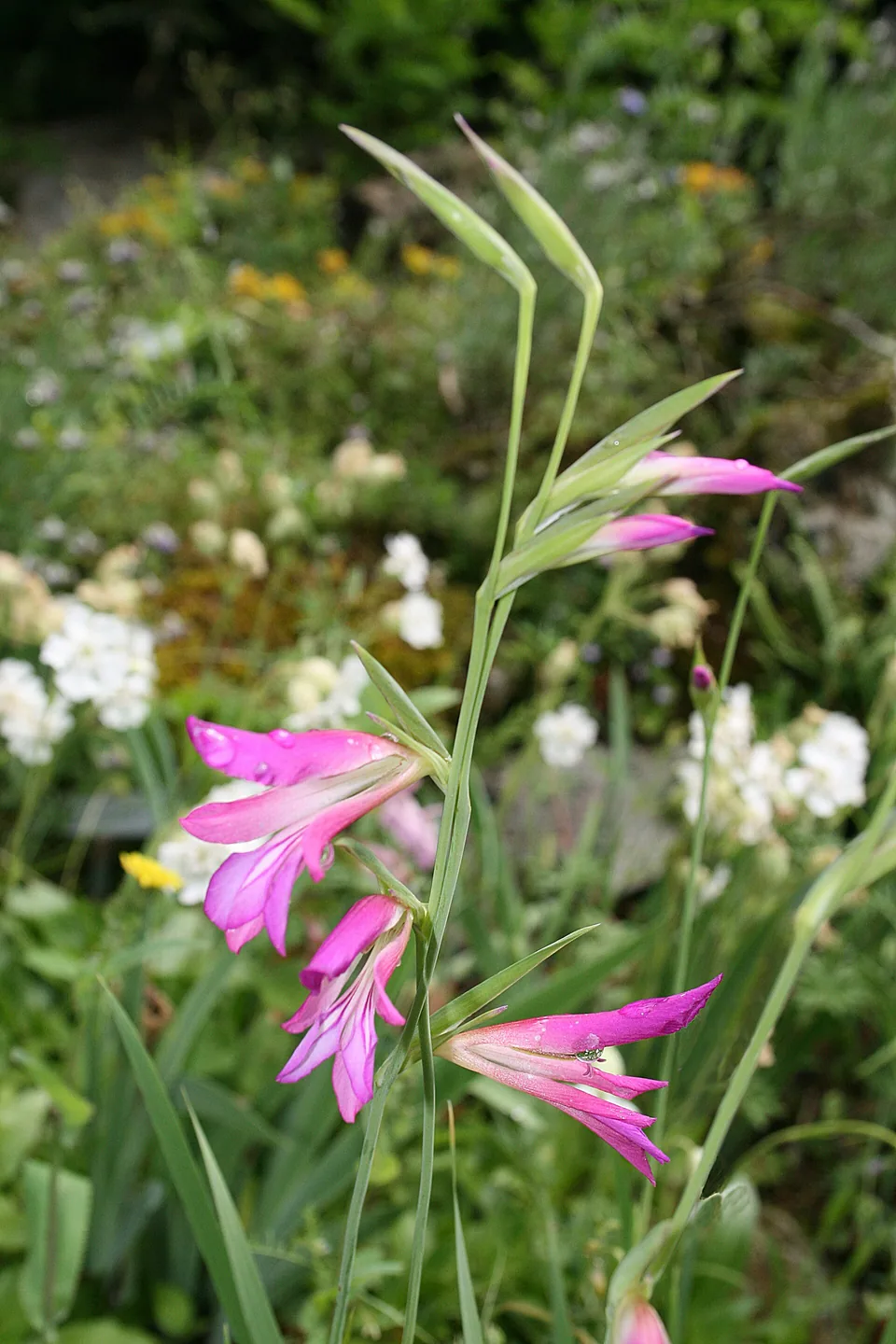

How to Grow and Care for Italian gladiolus
Gladiolus italicus
Written by Emilio Marruso · last checked
At a glance
Italian gladiolus belongs to the iris family and sends up flower stems that you can care for with a few simple habits. Keep thrips away by going easy on nitrogen fertilizer and keeping the garden free of weeds and debris. If the stems start to lean, give them thin bamboo stakes or a sunnier spot, and your flowers will stand tall.
- Pests
Thrips leave silver streaks on leaves; skip extra nitrogen and clear away weeds and debris
- Watch out
Flower stems can lean over: support them with thin bamboo stakes or move to a sunnier spot
Overview
This record is incomplete: the sources we read do not cover every field yet.
Not yet covered by our sources: Watering, Light, Hardiness, coldest zone, Hardiness, warmest zone, Pruning, Propagation
Italian gladiolus care
How to water Italian gladiolus
Not stated in the sources we read.
How much light Italian gladiolus needs
Not stated in the sources we read.
How much cold Italian gladiolus can take
Hardiness, coldest zone
Not stated in the sources we read.
Hardiness, warmest zone
Not stated in the sources we read.
How to propagate Italian gladiolus
Not stated in the sources we read.
How to grow Italian gladiolus
The plant
Family
Iridaceae
What the sources say (1)
Family:
IRIDACEAE
Genus:
Gladiolus
Catalan common name:
Espaseta. Gladiol.Fertilizing
When
The sources give different values depending on region, zone or growing conditions.
What each source says
Gladiolus in general (cut-flower crop): Half the nitrogen and all the phosphate and potash at planting
Gladiolus in general (cut-flower crop): Remaining nitrogen in two splits: foliar spray at the four-leaf stage, then to the soil at the bud stage
What the sources say (2)
Gladiolus in general (cut-flower crop): Normally 120 kg N, 150kg P O 2 5 2 and 150 Kg K O per hectare is recommended, of which 60 kg N and entire dose of P O 2 5 2 and K O is applied as basal dose.Gladiolus in general (cut-flower crop): The balance N is given in two split doses, one as foliar spray at four leaf stage while the second as soil application at the bud stage.Natural fertilizers
The sources give different values depending on region, zone or growing conditions.
What each source says
Gladiolus in general (cut-flower crop): Farmyard manure only on the preceding crop
What the sources say (1)
Gladiolus in general (cut-flower crop): Application of fertilizer leads to the formation of healthy and large sized corms, which give large-sized flowers on long spikes during the succeeding year. FYM should only be applied for a preceding crop and never before planting gladioli.Mineral fertilizers
The sources give different values depending on region, zone or growing conditions.
What each source says
Gladiolus in general (cut-flower crop): 120 kg [264.6 lb] nitrogen, 150 kg [330.7 lb] phosphate (P2O5) and 150 kg [330.7 lb] potash (K2O) per hectare, adjusted to a soil analysis
What the sources say (1)
Gladiolus in general (cut-flower crop): Application of fertilizer use should be based on soil analysis. Normally 120 kg N, 150kg P O 2 5 2 and 150 Kg K O per hectare is recommended,Avoid
The sources give different values depending on region, zone or growing conditions.
What each source says
Gladiolus in general (cut-flower crop): Farmyard manure just before planting
What the sources say (1)
Gladiolus in general (cut-flower crop): Application of fertilizer leads to the formation of healthy and large sized corms, which give large-sized flowers on long spikes during the succeeding year. FYM should only be applied for a preceding crop and never before planting gladioli.Remedies
The sources we checked give no remedies for this plant.
Calendar
Pruning
Not stated in the sources we read.
Months as given by the sources, which are mostly from the United States (northern hemisphere). In the southern hemisphere they shift by about six months.
Similar plants
- Fragrant Gladiolus Gladiolus murielae
- African lily Dietes bicolor
- Algerian Iris Iris unguicularis
- Angel's Fishing Rod Dierama pulcherrimum
- Baboon Flower Babiana nervosa
- Blackberry Lily Iris domestica
- Blood Iris Iris sanguinea
- Blue Iris Iris spuria
Sources
Every value above is quoted from these documents. Links lead to the original publisher.
- Gladiolus italicus Mill. - Herbari Virtual del Mediterrani Occidental · herbarivirtual.uib.cat, consulted
- Gladiolus italicus Mill. | Plants of the World Online | Kew Science · powo.science.kew.org, consulted
- How to Grow Gladiolus · harvesttotable.com, consulted
- nhb.gov.in · nhb.gov.in
Written by Emilio Marruso · last checked