
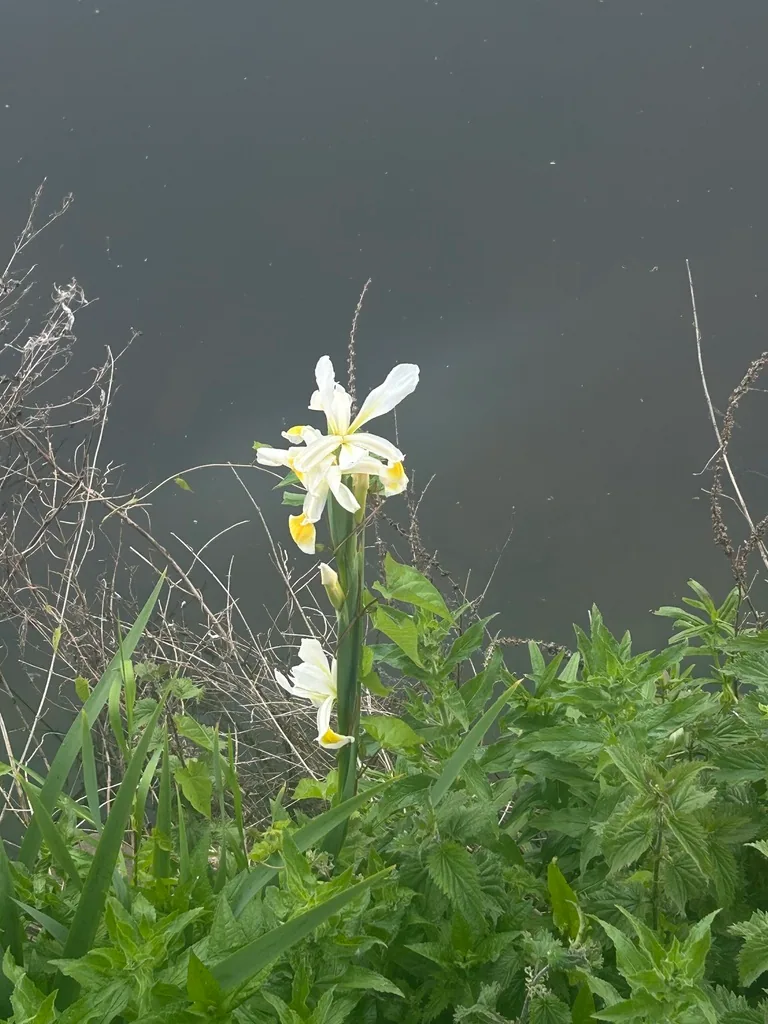

How to Grow and Care for Turkish iris
Iris orientalis
Written by Emilio Marruso · last checked
Toxic to: Cats, Dogs, Horses, People · Why
At a glance
This iris is a plant worth getting to know, and a little care keeps it a safe neighbor in your garden. Its toxicity is low, but it is not for eating: swallowing it can upset the stomach, and its seeds, roots and sap can briefly irritate the skin. Wear gloves when you handle it, and keep it away from cats, dogs and horses.
- Safety
Mildly toxic if eaten and its sap can irritate skin; keep it away from cats, dogs and horses
Overview
In North America it flowers May to July and persists after cultivation along roadsides. [1]
This record is incomplete: the sources we read do not cover every field yet.
Not yet covered by our sources: Watering, Light, Hardiness, coldest zone, Hardiness, warmest zone, Pruning, Propagation
Turkish iris care
How to water Turkish iris
Not stated in the sources we read.
How much light Turkish iris needs
Not stated in the sources we read.
How much cold Turkish iris can take
Hardiness, coldest zone
Not stated in the sources we read.
Hardiness, warmest zone
Not stated in the sources we read.
How to propagate Turkish iris
Not stated in the sources we read.
How to grow Turkish iris
Fertilizing
When
The sources give different values depending on region, zone or growing conditions.
What each source says
Iris in general, established plants: Immediately after bloom, only if the plants need it
Iris in general, poor soil: When preparing the bed before planting
What the sources say (2)
Iris in general, established plants: Plants that are growing well with good green foilage usually do not need fertilizer. If you use fertilizer, apply it immediately after plants bloom.Iris in general, poor soil: Use commercial fertilizer to enrich poor soil in the iris bed; use organic matter to improve soil structure and productivity.Natural fertilizers
The sources give different values depending on region, zone or growing conditions.
What each source says
Iris in general, heavy soil: Compost or well-rotted manure dug into the soil
What the sources say (1)
Iris in general, heavy soil: Spading organic matter—compost, well-rotted manure, or peat moss—into relatively heavy soil may improve drainage.Mineral fertilizers
The sources give different values depending on region, zone or growing conditions.
What each source says
Iris in general, established plants after bloom: 5-10-5: 118 mL for 6 small plants or 237 mL for a large clump
Iris in general, poor soil before planting: 5-10-5 at 48.8 g/m²
What the sources say (2)
Iris in general, established plants after bloom: Work it into the soil around plant bases. Use about ½ cup of 5-10-5 fertilizer for 6 small plants or about 1 cup for a large iris clump.Iris in general, poor soil before planting: For poor soil, add ½ pound of a 5-10-5 fertilizer for each 5- by 10- foot area, or ½ cup for every 6 or 7 rhizomes.Avoid
The sources give different values depending on region, zone or growing conditions.
What each source says
Iris in general: Fertilizer lumps touching the roots: mix it thoroughly into the soil
What the sources say (1)
Iris in general: Thoroughly mix fertilizer into the soil so that lumps of it do not touch iris roots.Spacing
Between plants
The sources give different values depending on region, zone or growing conditions.
What each source says
border irises (RHS guide on bearded and Siberian irises; Iris orientalis not named): 30 cm [12 in] between larger plants, 15 cm [5.9 in] between dwarf plants, planted in groups
What the sources say (1)
border irises (RHS guide on bearded and Siberian irises; Iris orientalis not named): Plant in groups, with 30cm (1ft) between larger plants and 15cm (6in) between dwarf plantsPropagation
Germination
The sources give different values depending on region, zone or growing conditions.
What each source says
border irises (RHS guide on bearded and Siberian irises; Iris orientalis not named): Sown in autumn in a cold frame, seed germinates in spring, unevenly; more may germinate in the second year
What the sources say (1)
border irises (RHS guide on bearded and Siberian irises; Iris orientalis not named): The seed should germinate in spring, but the seeds may not come up all at once. Don’t give up –more seed may germinate in the second yearScarification
The sources give different values depending on region, zone or growing conditions.
What each source says
border irises (RHS guide on bearded and Siberian irises; Iris orientalis not named): Soak the seed for 48 hours before sowing
What the sources say (1)
border irises (RHS guide on bearded and Siberian irises; Iris orientalis not named): When ripe, the pods will change colour to brown and start to split open - Soak the seed for 48 hours.Heat and drought
Drought
The sources give different values depending on region, zone or growing conditions.
What each source says
border irises (RHS guide on bearded and Siberian irises; Iris orientalis not named): Happy in dry soils once established
What the sources say (1)
border irises (RHS guide on bearded and Siberian irises; Iris orientalis not named): Hardy 3 Happy in dry soils once they are established 4 Divide every three to four years for prolific floweringRemedies
The sources we checked give no remedies for this plant.
Is Turkish iris toxic to pets?
Reported by the source, quoted verbatim. This is not medical or veterinary advice: if a person or an animal may have eaten this plant, contact a poison control centre or a veterinarian.
Animals
Problems: Contact Dermatitis Poisonous to Humans Problem for Cats Problem for Dogs Problem for Horses
[3]Genus-level warning: refers to the whole genus, not documented for this species
- Severity
This plant has low severity poison characteristics.
[3]
People
Poisonous to Humans: Poison Severity: Low Poison Symptoms: CAUSES ONLY LOW TOXICITY IF EATEN. SKIN IRRITATION MINOR, OR LASTING ONLY FOR A FEW MINUTES. Nausea, salivation, vomiting, abdominal pain, lethargy, diarrhea, elevated temperature following ingestion; skin irritation upon contact with seeds, rootstock, or cell sap.
[3]Genus-level warning: refers to the whole genus, not documented for this species
Calendar
Pruning
Not stated in the sources we read.
Months as given by the sources, which are mostly from the United States (northern hemisphere). In the southern hemisphere they shift by about six months.
Similar plants
- Algerian Iris Iris unguicularis
- Blackberry Lily Iris domestica
- Blood Iris Iris sanguinea
- Blue Iris Iris spuria
- Copper iris Iris fulva
- Dixie Iris Iris hexagona
- Dwarf Iris Iris reticulata
- Dwarf Iris Iris verna
Sources
Every value above is quoted from these documents. Links lead to the original publisher.
- Iris orientalis - FNA · floranorthamerica.org, consulted
- Iris orientalis • New Zealand Plant Conservation Network · nzpcn.org.nz, consulted
- Iris (Flag, Iris, Snake Lily, Water Flag) | North Carolina Extension Gardener Plant Toolbox · plants.ces.ncsu.edu, consulted
- extension.usu.edu · extension.usu.edu
- rhs.org.uk · rhs.org.uk
Written by Emilio Marruso · last checked