
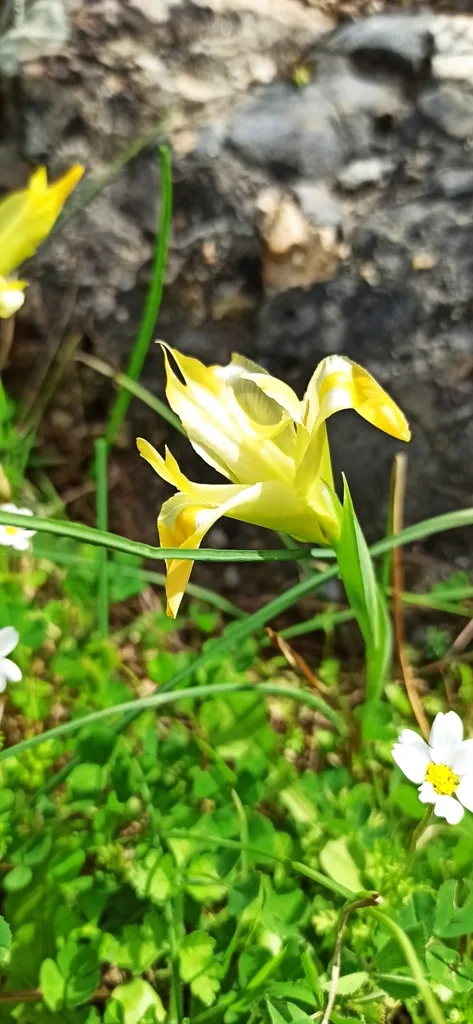

How to Grow and Care for Iris tuberosa
Iris tuberosa
Written by Emilio Marruso · last checked
At a glance
Got a sunny, dry corner? This iris could be just right for it. It loves full sun and grows particularly well in dry, chalky soil, as long as the ground drains well. At 20 inches tall, it stays compact, an easy way to bring a touch of iris charm to the driest, brightest spot in your garden.
- Sun
Full sun
What the sources say (1)
Light: Full sun
In cultivation I . tuberosa grows well given full sun and good drainage in beds and borders, and it naturalises in long grass
— Iris tuberosa - Cambridge University Botanic Garden [1] - Soil
Soil that drains well; grows particularly well in dry, chalky soil
What the sources say (1)
Watering notes: Good drainage; grows particularly well in dry, chalky soils
In cultivation I . tuberosa grows well given full sun and good drainage in beds and borders, and it naturalises in long grass, and grows particularly well in dry, chalky soils.
— Iris tuberosa - Cambridge University Botanic Garden [1] - Size
20 inches tall
What the sources say (1)
Mature height: 50 cm (approx. 20 in)
The slender, grass-like foliage grows to approximately 50cm, and is slightly taller than the flower stems.
— Iris tuberosa - Cambridge University Botanic Garden [1]
Overview
Iris tuberosa is a scented, creeping tuberous Iris with dusky green and black flowers. [1] In cultivation it grows well in full sun with good drainage in beds and borders. [1]
This record is incomplete: the sources we read do not cover every field yet.
Not yet covered by our sources: Watering, Hardiness, coldest zone, Hardiness, warmest zone, Pruning, Propagation
Iris tuberosa care
How to water Iris tuberosa
Watering
Not stated in the sources we read.
Watering notes
Good drainage; grows particularly well in dry, chalky soils
What the sources say (1)
In cultivation I . tuberosa grows well given full sun and good drainage in beds and borders, and it naturalises in long grass, and grows particularly well in dry, chalky soils.How much light Iris tuberosa needs
Full sun
What the sources say (1)
In cultivation I . tuberosa grows well given full sun and good drainage in beds and borders, and it naturalises in long grassHow much cold Iris tuberosa can take
Hardiness, coldest zone
Not stated in the sources we read.
Hardiness, warmest zone
Not stated in the sources we read.
How to propagate Iris tuberosa
Not stated in the sources we read.
How to grow Iris tuberosa
The plant
Mature height
50 cm (approx. 20 in)
What the sources say (1)
The slender, grass-like foliage grows to approximately 50cm, and is slightly taller than the flower stems.Remedies
Each remedy shows what official sources say about it; traditional remedies without an official source are marked as such. Harmful ones are listed so you know to avoid them.
Treating the plant
slugs and snails
beer traps or hand collecting Not verified
Traditional remedy, not verified by an official source.
How: Use nematodes, beer traps, or collect them by hand in the mornings and evenings.
aphids
insecticidal soap spray Works
How: If aphids are abundant, a spray of insecticidal soap will kill them.
If they are abundant, a spray of malathion or insecticidal soap, which are among the compounds registered for control of this pest in Connecticut, will kill them.
— portal.ct.gov [3] What the evidence says If they are abundant, a spray of malathion or insecticidal soap, which are among the compounds registered for control of this pest in Connecticut, will kill them.
— portal.ct.gov [3]
iris borer
remove and destroy old leaves Works
How: In fall remove and destroy old iris leaves, stems and nearby plant debris to kill eggs.
Remove and destroy (e.g. burning or burying) old iris leaves, stems and any nearby plant debris.
— extension.umn.edu [4] What the evidence says This will remove and kill eggs, and reduce the risk of iris borers next year.
— extension.umn.edu [4] beneficial nematodes Partly works
How: Apply beneficial nematodes when iris leaves are almost fully expanded but before flowering, and repeat about a week later.
Apply roundworms when iris leaves are almost fully expanded but before flowering.
— extension.umn.edu [4] What the evidence says Beneficial nematodes (roundworms) are a natural option to help control some borers.
— extension.umn.edu [4]
leaf spot
remove dead leaves in fall Works
How: Remove dead leaves from iris beds in the fall or winter.
Removal of dead leaves from iris beds in the fall or winter will reduce disease level.
— extension.okstate.edu [5] What the evidence says Removal of dead leaves from iris beds in the fall or winter will reduce disease level.
— extension.okstate.edu [5]
rhizome rot
cut back to white flesh and dust with sulphur Not verified
Traditional remedy, not verified by an official source.
How: Lift the affected piece, cut back to white flesh, discard the bad part, dust the cut end with sulphur powder and replant 24 hours later in a different place.
Calendar
Pruning
Not stated in the sources we read.
Months as given by the sources, which are mostly from the United States (northern hemisphere). In the southern hemisphere they shift by about six months.
Similar plants
- Algerian Iris Iris unguicularis
- Blackberry Lily Iris domestica
- Blood Iris Iris sanguinea
- Blue Iris Iris spuria
- Copper iris Iris fulva
- Dixie Iris Iris hexagona
- Dwarf Iris Iris reticulata
- English Iris Iris latifolia
Sources
Every value above is quoted from these documents. Links lead to the original publisher.
- Iris tuberosa - Cambridge University Botanic Garden · botanic.cam.ac.uk, consulted
- Iris tuberosa · hardy-plant.org.uk, consulted
- portal.ct.gov · portal.ct.gov
- extension.umn.edu · extension.umn.edu
- extension.okstate.edu · extension.okstate.edu
Written by Emilio Marruso · last checked