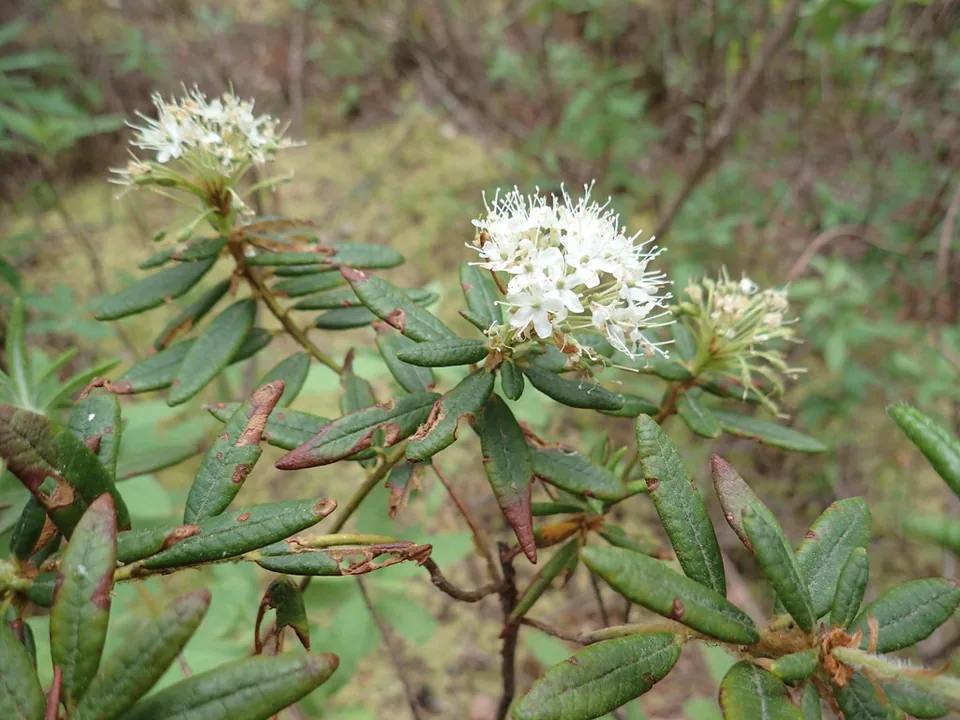
How to Grow and Care for Common Labrador tea
Rhododendron groenlandicum
Written by Emilio Marruso · last checked
Toxic to: People · Why
At a glance
Labrador tea is a natural fit for the soggy corners of your garden: it likes steady moisture and handles flooding very well. Give it acidic soil, pH 4.5–6.0, and you can start new plants from seed, layers or cuttings. Its leaves have traditionally made a fragrant tea, but the whole plant is somewhat poisonous, so enjoy it with your eyes.
- Water
Keep the soil steadily moist; it handles flooding very well
What the sources say (2)
Watering: Consistent levels of moisture
Choose a location which receives full sunlight and consistent levels of moisture in which to transplant seedlings.
— Labrador Tea Info – Labrador Tea Shrub Care And Growing Requirements | Gardening Know How [6] Watering notes: Very flood tolerant
It is a very flood tolerant plant.
— Plant Propagation Protocol for [Ledom Groenlandicium] [1] - Soil
Acidic soil, pH 4.5–6.0
What the sources say (2)
Soil pH, minimum: 4.5
Open sphagnum bogs and larch swamps, occasionally in closed coniferous forests of high humidity, in soil of pH 4.5-6.
— New York Metropolitan Flora [3] Soil pH, maximum: 6.0
Open sphagnum bogs and larch swamps, occasionally in closed coniferous forests of high humidity, in soil of pH 4.5-6.
— New York Metropolitan Flora [3] - Harvest
Collect the seeds from June through August
What the sources say (1)
Harvest: Seed harvested June through August
Seed is an eliptic capsule (fleshy fruit) and is harvested June through August.
— Plant Propagation Protocol for [Ledom Groenlandicium] [1] - Propagation
Grow new plants from seed, layers or cuttings
What the sources say (1)
Propagation: Seed; layers; cuttings
They can be propagated by seeds, treated as recommended for heaths, also by layers and cuttings.
— Rhododendron groenlandicum - Trees and Shrubs Online [2] - Safety
The whole plant is somewhat poisonous, even if its leaves are used for tea: it can cause cramps and vomiting
Overview
Rhododendron groenlandicum is an evergreen shrub grown as an ornamental in gardens. [7][2] The documents describe the plant as poisonous to some degree while noting its traditional use for tea. [1] It grows in acid, wet, nutrient-poor soils such as bogs and peatlands. [5]
This record is incomplete: the sources we read do not cover every field yet.
Not yet covered by our sources: Hardiness, coldest zone, Hardiness, warmest zone, Pruning
Common Labrador tea care
How to water Common Labrador tea
Watering
Consistent levels of moisture
What the sources say (1)
Choose a location which receives full sunlight and consistent levels of moisture in which to transplant seedlings.Watering notes
Very flood tolerant
What the sources say (1)
It is a very flood tolerant plant.How much light Common Labrador tea needs
The sources give different values depending on region, zone or growing conditions.
What each source says
According to Gardening Know How: Full sun
According to Useful Temperate Plants: Shade or semi-shade
What the sources say (2)
According to Gardening Know How: Choose a location which receives full sunlight and consistent levels of moisture in which to transplant seedlings.According to Useful Temperate Plants: Prefers a moist humus-rich acid soil in shade or semi-shadeHow much cold Common Labrador tea can take
Hardiness, coldest zone
Not stated in the sources we read.
Hardiness, warmest zone
Not stated in the sources we read.
Best soil for Common Labrador tea
Soil pH, minimum
4.5
What the sources say (1)
Open sphagnum bogs and larch swamps, occasionally in closed coniferous forests of high humidity, in soil of pH 4.5-6.Soil pH, maximum
6.0
What the sources say (1)
Open sphagnum bogs and larch swamps, occasionally in closed coniferous forests of high humidity, in soil of pH 4.5-6.How to propagate Common Labrador tea
Seed; layers; cuttings
What the sources say (1)
They can be propagated by seeds, treated as recommended for heaths, also by layers and cuttings.How to grow Common Labrador tea
Fertilizing
When
The sources give different values depending on region, zone or growing conditions.
What each source says
Rhododendron in general: Soon after flowering
Rhododendron in general: Late spring or early summer, after flowering
Rhododendron in general: In May, never after July 1
What the sources say (3)
Rhododendron in general: Fertilize soon after flowering, using products formulated for acid-loving plants such as rhododendrons, camellias and azaleas.Rhododendron in general: Apply fertilizer according to the manufacturer's instructions, typically in late spring or early summer after flowering.Rhododendron in general: Fertilizing our outdoor plants should be done in May, but not after July 1. Late summer fertilization may force out tender fall growth that will be killed by the winter.Natural fertilizers
The sources give different values depending on region, zone or growing conditions.
What each source says
Rhododendron in general: Cottonseed meal
Rhododendron in general: Slow-release organic fertilizers
Rhododendron in general: Organic mulch as the main source of nutrients
What the sources say (3)
Rhododendron in general: A fertilizer analysis similar to 6-2-1 applied at 2 pounds per 100 square feet to the soil surface is usually adequate. Cottonseed meal is also a good fertilizer.Rhododendron in general: Organic fertilizers, though costlier, release nutrients slowly and reduce the risk of root burn.Rhododendron in general: Nutrients are slowly released by any organic mulch that you use, so rely on this as the primary source of nutrients.Mineral fertilizers
The sources disagree:
Look for formulations with a balanced ratio or one slightly higher in phosphorus (the middle number), which supports root and flower bud development.
[10]Phosphate and potash do not disappear from the soil, but build up little by little with successive fertilizing. Therefore, the high phosphate formulas do not provide extra help to the plant.
[11]
What each source says
Rhododendron in general: Fertilizer formulated for acid-loving plants, preferably supplying ammonium nitrogen
Rhododendron in general: 28.3 g of granular fertilizer per 30.5 cm [12 in] of plant height or spread
What the sources say (2)
Rhododendron in general: If you do fertilize, avoid using general garden fertilizers. Use those specially formulated for acid-loving plants and follow directions. Fertilizers supplying the ammonium form of nitrogen are best.Rhododendron in general: Avoid over-fertilizing, which can damage the roots. A general guideline is about one ounce of granular fertilizer per foot of plant height or spread.Avoid
The sources give different values depending on region, zone or growing conditions.
What each source says
Rhododendron in general: Lime and alkaline fertilizers; feeding after mid-July
Rhododendron in general: Fertilizing at planting
Rhododendron in general: Granules left on the foliage
Rhododendron in general: Excess fertilizer, which injures the shallow roots
What the sources say (4)
Rhododendron in general: Avoid lime and alkaline fertilizers, and do not fertilize after mid-July, as late feeding can stimulate new growth that may not harden off before winter.Rhododendron in general: Do not fertilize at the time of planting, as this might injure the roots, but water deeply.Rhododendron in general: Be careful when broadcasting fertilizer over the top of plants, because the fertilizer granules may collect in the leaf whorls and cause foliar damage as it dissolves.Rhododendron in general: Unlike other shrubs in the landscape, azaleas are shallow rooted and can be easily injured by excess fertilizer.Signs of deficiency
The sources give different values depending on region, zone or growing conditions.
What each source says
Rhododendron in general: Pale green or dwarfed leaves (nitrogen)
Rhododendron in general: Small dark green leaves with dead tips (phosphorus)
Rhododendron in general: Pale green leaves or interveinal chlorosis
What the sources say (3)
Rhododendron in general: Pale green or dwarfed leaves may signal a nitrogen deficiency.Rhododendron in general: Small, dark green leaves with dead tips can suggest low phosphorus.Rhododendron in general: Pale green leaves or inter-veinal chlorosis are good indicators of a need for fertilizer.Signs of excess
The sources give different values depending on region, zone or growing conditions.
What each source says
Rhododendron in general: Yellow mottling along leaf margins (excess potassium)
Rhododendron in general: More lace bugs and whiteflies
What the sources say (2)
Rhododendron in general: Yellow mottling along leaf margins may indicate excess potassium.Rhododendron in general: Excess nutrients may promote larger than normal populations of azalea pests like lace bugs and azalea whiteflies.Remedies
Each remedy shows what official sources say about it; traditional remedies without an official source are marked as such. Harmful ones are listed so you know to avoid them.
First aid
First aid: not a substitute for a doctor
plant ingestion
removing plant pieces and sipping water or milk Official source, not independently tested
Give them a few sips of water or milk. - Call the poison center at 1-800-222-1222.
— nnepc.org [12] How: Take all pieces of the plant out of the person’s mouth.
Take all pieces of the plant out of the person’s mouth.
— nnepc.org [12]
skin contact
washing skin with soap and water Official source, not independently tested
Wash the person’s skin gently with soap and water. - Call the poison center at 1-800-222-1222.
— nnepc.org [12] How: Wash the person’s skin gently with soap and water.
Wash the person’s skin gently with soap and water.
— nnepc.org [12]
Is Common Labrador tea poisonous?
Reported by the source, quoted verbatim. This is not medical or veterinary advice: if a person or an animal may have eaten this plant, contact a poison control centre or a veterinarian.
Plants contain a narcotic toxin called Ledol - this is a sesquiterpene that can cause cramps, paralysis, and delirium.
[7]Entire plant is somewhat poisonous, though it has traditionally been used to make tea.
[1]- Poisonous parts
Entire plant is somewhat poisonous
[1]
Like other plants in the Heath family, it contains an andromedotoxin that can cause adverse effects including headache, cramps, indigestion, vomiting, and even death.
[5]
Calendar
The sources give different values depending on region, zone or growing conditions.
What each source says
According to Useful Temperate Plants (surface sow, shady part of the greenhouse): Late winter or early spring
According to Useful Temperate Plants (another report): Autumn, as soon as the seed is ripe
According to University of Washington ESRM 412 protocol (greenhouse): Year-round
What the sources say (3)
According to Useful Temperate Plants (surface sow, shady part of the greenhouse): Seed - surface sow in a shady part of the greenhouse in late winter or early springAccording to Useful Temperate Plants (another report): Another report says that the seed is best sown in the autumn as soon as it is ripeAccording to University of Washington ESRM 412 protocol (greenhouse): Sow year-round due to unpredictable germination.Seed harvested June through August
What the sources say (1)
Seed is an eliptic capsule (fleshy fruit) and is harvested June through August.Not stated in the sources we read.
Months as given by the sources, which are mostly from the United States (northern hemisphere). In the southern hemisphere they shift by about six months.
Edibility
Reported by the source, quoted verbatim. Do not eat a plant on the basis of this page alone: identification mistakes can be dangerous.
A fragrant and soothing tea is made from the leaves
[7]
Indicative values
Values from a secondary source, not checked word for word like the rest of this page. Use them as a starting point.
- Life cycle
- PerennialIndicative value, adapt it to your climate · Secondary source
- Hours of sun
- 4-6 hoursIndicative value, adapt it to your climate · Secondary source
- Care level
- MediumIndicative value, adapt it to your climate · Secondary source
- Growth rate
- ModerateIndicative value, adapt it to your climate · Secondary source
- Pruning
- May, May, June, December, January, FebruaryIndicative value, adapt it to your climate · Secondary source
Similar plants
- Alpenrose Rhododendron ferrugineum
- Catawba Rhododendron Rhododendron catawbiense
- Coastal Azalea Rhododendron atlanticum
- Cumberland Azalea Rhododendron cumberlandense
- Dwarf Purple Rhododendron Rhododendron impeditum
- Early Azalea Rhododendron prinophyllum
- Flame Azalea Rhododendron calendulaceum
- Florida Azalea Rhododendron austrinum
Sources
Every value above is quoted from these documents. Links lead to the original publisher.
- Plant Propagation Protocol for [Ledom Groenlandicium] · courses.washington.edu, consulted
- Rhododendron groenlandicum - Trees and Shrubs Online · treesandshrubsonline.org, consulted
- New York Metropolitan Flora · nymf.bbg.org, consulted
- Indicator Plants – Coastal Indicator Plants of BC (FRST 201) · blogs.ubc.ca, consulted
- Labrador Tea | · plantwatch.naturealberta.ca, consulted
- Labrador Tea Info – Labrador Tea Shrub Care And Growing Requirements | Gardening Know How · gardeningknowhow.com, consulted
- Rhododendron groenlandicum - Useful Temperate Plants · temperate.theferns.info, consulted
- Rhododendron groenlandicum (Labrador Tea): Minnesota Wildflowers · minnesotawildflowers.info, consulted
- extension.oregonstate.edu · extension.oregonstate.edu
- hoke.ces.ncsu.edu · hoke.ces.ncsu.edu
- s3.wp.wsu.edu · s3.wp.wsu.edu
- nnepc.org · nnepc.org
Written by Emilio Marruso · last checked