
How to Grow and Care for Thimbleberry
Rubus parviflorus
Written by Emilio Marruso · last checked
At a glance
This easygoing shrub grows in full sun, part shade or even full shade, and handles dry to moist soil. It gives red, tart berries you can eat fresh or cook into jam, and in spring its young shoots can be peeled and eaten raw or cooked. It grows fast, so a heavy yearly pruning keeps it tidy.
- Sun
Full sun, part shade or full shade
What the sources say (2)
Light: Full sun, part shade or full shade
Light Requirements: Full Sun, Part Shade, Full Shade Water Requirements: Dry, Moist
— Thimbleberry • East Multnomah Soil and Water Conservation District [6] Easily grown in a good well-drained loamy soil in sun or semi-shade
— Rubus parviflorus - Useful Temperate Plants [5] - Water
Handles dry to moist soil; keep loam or clay-loam soil moist enough
What the sources say (2)
Watering: Dry to moist conditions; adequate soil moisture on loam or clay-loam
Light Requirements: Full Sun, Part Shade, Full Shade Water Requirements: Dry, Moist
— Thimbleberry • East Multnomah Soil and Water Conservation District [6] Adequate soil moisture on loam or clay-loam, nitrogen demanding.
— Plant Data Sheet [1] - Planting
Plant seedlings in late spring of the next year; rooted cane tips in fall
What the sources say (4)
Planting: Late spring of the following year (seedlings from seed); autumn (tip layers)
seedlings from seed: Plant them out into their permanent positions in late spring of the following year.
— Rubus parviflorus - Useful Temperate Plants [5] tip layers: Tip layering in July. Plant out in autumn.
— Rubus parviflorus - Useful Temperate Plants [5] Plant them out into their permanent positions in late spring of the following year.
— Rubus parviflorus - Useful Temperate Plants [5] Tip layering in July. Plant out in autumn.
— Rubus parviflorus - Useful Temperate Plants [5] - Pruning
Cut canes that fruited right after harvest; in late winter remove damaged canes and thin
What the sources say (4)
Pruning: Immediately after fruit is harvested (remove fruited canes); late winter (remove damaged canes and thin)
fruited canes: (1) Remove canes that have fruited immediately after fruit is harvested, leaving the new vegetative (non-fruiting) canes to overwinter.
— Rubus parviflorus - Useful Temperate Plants [5] winter-damaged canes, thinning: (2) In late winter, remove any canes damaged by winter and thin the remaining canes as needed, leaving only healthy, well-spaced canes
— Rubus parviflorus - Useful Temperate Plants [5] (1) Remove canes that have fruited immediately after fruit is harvested, leaving the new vegetative (non-fruiting) canes to overwinter.
— Rubus parviflorus - Useful Temperate Plants [5] (2) In late winter, remove any canes damaged by winter and thin the remaining canes as needed, leaving only healthy, well-spaced canes
— Rubus parviflorus - Useful Temperate Plants [5] - Harvest
Tart red berries, fresh or as jam; peeled young shoots in spring, raw or cooked
What the sources say (4)
Harvest: Young shoots: spring, as they emerge; seed: late August, when fruit is bright red
young shoots: The shoots are harvested as they emerge in the spring, and whilst they are still young and tender
— Rubus parviflorus - Useful Temperate Plants [5] seed collection: Seed was collected late August when fruit bright red and easily pulled from hypantheum disk.
— Plant Propagation Protocol for Rubus parviflorus Nutt. [2] The shoots are harvested as they emerge in the spring, and whilst they are still young and tender
— Rubus parviflorus - Useful Temperate Plants [5] Seed was collected late August when fruit bright red and easily pulled from hypantheum disk.
— Plant Propagation Protocol for Rubus parviflorus Nutt. [2] - Watch out
Spreads fast by runners; a heavy pruning every year keeps it under control
- Size
Commonly up to 6 ft tall
What the sources say (1)
Mature height: commonly up to 183 cm (6 ft)
Form: An erect, spindly shrub that commonly grows to 6 feet tall, often forms thickets.
— Virginia Tech Dendrology Fact Sheet [3] - Propagation
From chilled seed, stem cuttings, root pieces, rooting cane tips or dividing the plant
What the sources say (2)
Overview
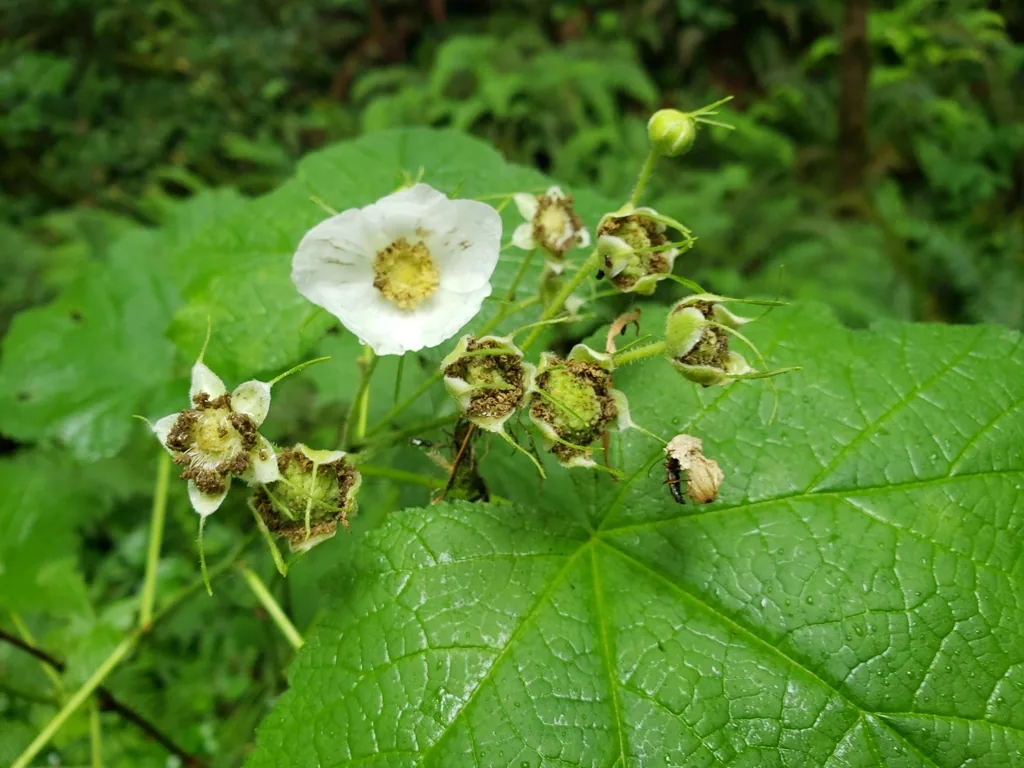
Thimbleberry is a dense, spreading, thornless deciduous shrub with large fuzzy leaves, white flowers and edible red fruit. [6] It spreads by rhizomes into thickets and tolerates heavy annual pruning. [5][6] It is native from Alaska to California and into northern Mexico. [1]
This record is incomplete: the sources we read do not cover every field yet.
Not yet covered by our sources: Spacing
Thimbleberry care
How to water Thimbleberry
Dry to moist conditions; adequate soil moisture on loam or clay-loam
How much light Thimbleberry needs
Full sun, part shade or full shade
What the sources say (2)
Light Requirements: Full Sun, Part Shade, Full Shade
Water Requirements: Dry, MoistEasily grown in a good well-drained loamy soil in sun or semi-shadeWhere to grow Thimbleberry
Not stated in the sources we read.
How to propagate Thimbleberry
How to grow Thimbleberry
The plant
Family
Rosaceae
What the sources say (1)
thimbleberry Rosaceae Rubus
parviflorus Nutt.
symbol: RUPA
Leaf: Simple, alternate, deciduous, largeMature height
commonly up to 183 cm (6 ft)
What the sources say (1)
Form: An erect, spindly shrub that commonly grows to 6 feet tall, often forms thickets.Thimbleberry pests and problems
Vigorous spreading
Symptom: Grows very large very fast and spreads by runners
What to do: Tolerates heavy annual pruning to keep it under control
What the sources say (1)
In favorable conditions, this shrub can grow very large very fast, and will try to spread by runners once established.
— Thimbleberry • East Multnomah Soil and Water Conservation District [6]
Remedies
Each remedy shows what official sources say about it; traditional remedies without an official source are marked as such. Harmful ones are listed so you know to avoid them.
Getting rid of it
wild blackberries including thimbleberry
hand-pulling young plants Works
Pulling plants when the soil is dry and hard usually will break off the stems, leaving roots that will vigorously resprout.
— ipm.ucanr.edu [8] How: It is easiest to remove plants in early spring or late fall when the soil is moist and roots can be dislodged.
Small infestations can be removed by hand-pulling or mechanical grubbing.
— ipm.ucanr.edu [8] What the evidence says The most effective way to remove blackberries is by hand-pulling young plants when the soil is moist.
— ipm.ucanr.edu [8]
Calendar
Sowing
The sources give different values depending on region, zone or growing conditions.
What each source says
According to University of Washington: February
According to Useful Temperate Plants: Early autumn, in a cold frame
What the sources say (2)
According to University of Washington: Store damp in refrigerator over winter, sow in February-low
humidity for longer storage periods.According to Useful Temperate Plants: Seed - requires stratification, is best sown in early autumn in a cold frame.Planting
Late spring of the following year (seedlings from seed); autumn (tip layers)
What each source says
seedlings from seed: Late spring of the following year
tip layers: Autumn
What the sources say (4)
seedlings from seed: Plant them out into their permanent positions in late spring of the following year.tip layers: Tip layering in July. Plant out in autumn.Plant them out into their permanent positions in late spring of the following year.Tip layering in July. Plant out in autumn.Harvest
Young shoots: spring, as they emerge; seed: late August, when fruit is bright red
What each source says
young shoots: Spring, as they emerge
seed collection: Late August
What the sources say (4)
young shoots: The shoots are harvested as they emerge in the spring, and whilst they are still young and tenderseed collection: Seed was collected late August when fruit bright red and easily pulled from hypantheum disk.The shoots are harvested as they emerge in the spring, and whilst they are still young and tenderSeed was collected late August when fruit bright red and easily pulled from hypantheum disk.Pruning
Immediately after fruit is harvested (remove fruited canes); late winter (remove damaged canes and thin)
What each source says
fruited canes: Immediately after fruit is harvested
winter-damaged canes, thinning: Late winter
What the sources say (4)
fruited canes: (1) Remove canes that have fruited immediately after fruit is harvested, leaving the new vegetative (non-fruiting) canes to overwinter.winter-damaged canes, thinning: (2) In late winter, remove any canes damaged by winter and thin the remaining canes as needed, leaving only healthy, well-spaced canes(1) Remove canes that have fruited immediately after fruit is harvested, leaving the new vegetative (non-fruiting) canes to overwinter.(2) In late winter, remove any canes damaged by winter and thin the remaining canes as needed, leaving only healthy, well-spaced canesMonths as given by the sources, which are mostly from the United States (northern hemisphere). In the southern hemisphere they shift by about six months.
Edibility
Reported by the source, quoted verbatim. Do not eat a plant on the basis of this page alone: identification mistakes can be dangerous.
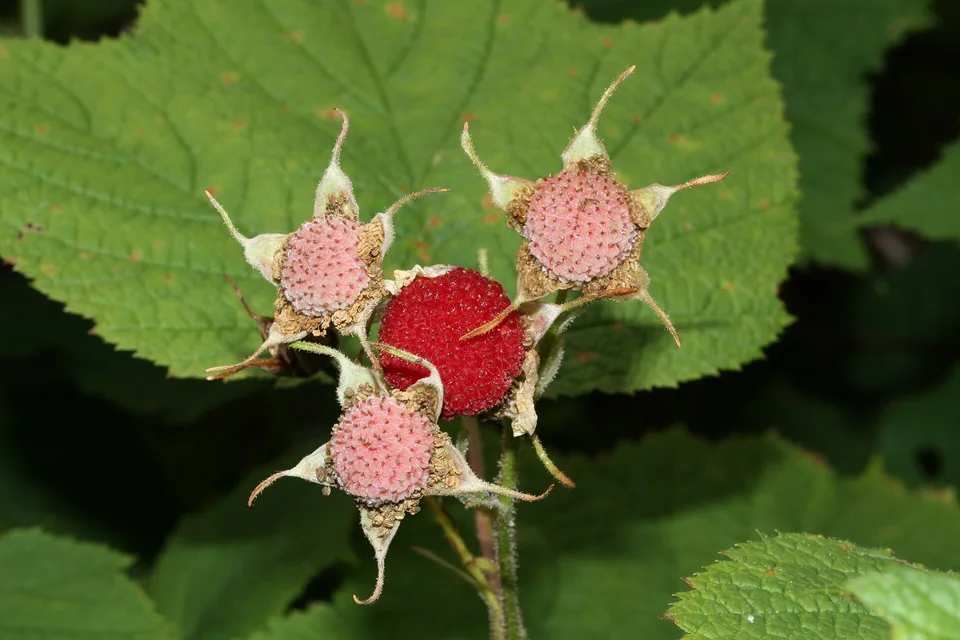
Red raspberries (aggregate of drupelets) in the shape of a flattened dome, sparse, long hairs; edible, but taste varies.
[3]These berries are tart and may be eaten raw, or cooked and made into jam or jelly and other food items such as pemmican or fruit leather.
[4]Young shoots - peeled and eaten cooked or raw
[5]
Indicative values
Values from a secondary source, not checked word for word like the rest of this page. Use them as a starting point.
- Life cycle
- PerennialIndicative value, adapt it to your climate · Secondary source
- Hours of sun
- 5-6 hoursIndicative value, adapt it to your climate · Secondary source
- Drought tolerant
- yesIndicative value, adapt it to your climate · Secondary source
- Soil
- Sandy LoamyIndicative value, adapt it to your climate · Secondary source
- Soil pH
- 5.5-7.5Indicative value, adapt it to your climate · Secondary source
- USDA hardiness zones
- 3-10 [winter low −40 to 4.4 °C (−40 to 40 °F)]Indicative value, adapt it to your climate · Secondary source
- Care level
- MediumIndicative value, adapt it to your climate · Secondary source
- Growth rate
- ModerateIndicative value, adapt it to your climate · Secondary source
- Pests
- Galls, Stem borer insects, Pest resistant, Disease resistantIndicative value, adapt it to your climate · Secondary source
Similar plants
- Blackberry Rubus allegheniensis
- Blackberry Rubus bifrons
- Blackberry Rubus canadensis
- Blackberry Rubus cuneifolius
- Blackberry Rubus laciniatus
- Blackberry Rubus pascuus
- Blackberry Rubus pensilvanicus
- Creeping Raspberry Rubus rolfei
Sources
Every value above is quoted from these documents. Links lead to the original publisher.
- Plant Data Sheet · depts.washington.edu, consulted
- Plant Propagation Protocol for Rubus parviflorus Nutt. · courses.washington.edu, consulted
- Virginia Tech Dendrology Fact Sheet · dendro.cnre.vt.edu, consulted
- Thimbleberry · fs.usda.gov, consulted
- Rubus parviflorus - Useful Temperate Plants · temperate.theferns.info, consulted
- Thimbleberry • East Multnomah Soil and Water Conservation District · emswcd.org, consulted
- Rubus parviflorus Nutt. | Plants of the World Online | Kew Science · powo.science.kew.org, consulted
- ipm.ucanr.edu · ipm.ucanr.edu
Written by Emilio Marruso · last checked