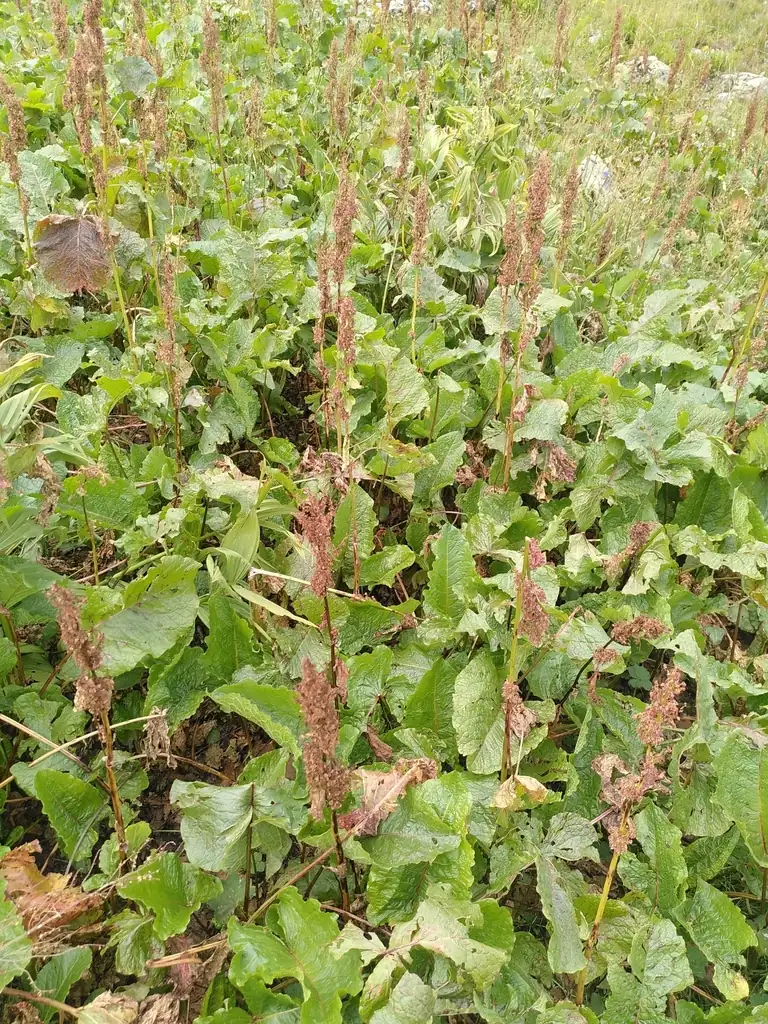
How to Grow and Care for Alpine dock
Rumex alpinus
Written by Emilio Marruso · last checked
Toxic to: People · Why
At a glance
Alpine dock is a generous leafy plant: its strong-flavored leaves can go into salads from late autumn to spring, though they are best cooked like spinach. Fresh leaves are available most months of the year. Give it full sun or light shade and soil that stays moist, since it does not like drought.
- Sun
Full sun to light shade
- Water
Moderate watering; keep the soil moist, it can't stand drought
What the sources say (2)
Watering: Moderate
Water moderate Hardiness Zone 5+ Soil textures sandy, loamy, clay
— Alpine Dock (Rumex alpinus) — Practical Plants [4] Watering notes: Prefers a moist, moderately fertile, well-drained soil; drought intolerant
it succeeds in most soils, preferring a moist moderately fertile well-drained soil in a sunny position
— Rumex alpinus - Useful Temperate Plants [3] - Cold
Survives winters down to −20 °F (−28.9 °C)
Very hardy · USDA 5 · RHS H7 · Z5
What the sources say (1)
Hardiness, coldest zone: 5 [winter low −28.9 to −23.3 °C (−20 to −10 °F)]
Hardiness Zone 5+ Soil textures sandy, loamy, clay
— Alpine Dock (Rumex alpinus) — Practical Plants [4] - Soil
Moist, well-drained, moderately rich soil
What the sources say (1)
Watering notes: Prefers a moist, moderately fertile, well-drained soil; drought intolerant
it succeeds in most soils, preferring a moist moderately fertile well-drained soil in a sunny position
— Rumex alpinus - Useful Temperate Plants [3] - Planting
Plant seedlings out in summer, after growing them on in pots
What the sources say (1)
Planting: Summer (seedlings, after pricking out into pots)
When they are large enough to handle, prick the seedlings out into individual pots and plant them out in the summer.
— Alpine Dock (Rumex alpinus) — Practical Plants [4] - Harvest
Leaves late autumn to spring, best cooked like spinach; roots in early spring
What the sources say (3)
Harvest: Leaves: late autumn to spring for salads, fresh leaves available most months of the year; root: early spring
the leaves can be used in salads in late autumn to the spring, but are better cooked like spinach
— Alpine Dock (Rumex alpinus) — Practical Plants [4] The fresh leaves can be available for most months of the year, only dying down for a short period in severe winters
— Alpine Dock (Rumex alpinus) — Practical Plants [4] The root is harvested in early spring and dried for later use
— Rumex alpinus - Useful Temperate Plants [3] - Propagation
From seed or by dividing the root clump
What the sources say (2)
Propagation: Seed; division of the rootstock
Seed - sow spring in a cold frame. The seed can also be sown as soon as it is ripe when it will germinate rapidly
— Alpine Dock (Rumex alpinus) — Practical Plants [4] Use a sharp spade or knife to divide the rootstock, ensuring that there is at least one growth bud on each section of root.
— Rumex alpinus - Useful Temperate Plants [3] - Sowing
Sow in spring in a cold frame, or as soon as the seed is ripe
What the sources say (1)
Sowing: Spring in a cold frame, or as soon as the seed is ripe
Seed - sow spring in a cold frame. The seed can also be sown as soon as it is ripe when it will germinate rapidly
— Alpine Dock (Rumex alpinus) — Practical Plants [4] - Safety
Eat with care if you have gout, arthritis, rheumatism or kidney stones
Overview
Rumex alpinus is a perennial dock that was at one time cultivated for its edible leaves. [3] The leaves are eaten raw or cooked, but their oxalic acid content means they should not be eaten in large amounts. [4] It prefers a moist, moderately fertile, well-drained soil in a sunny position. [3]
This record is incomplete: the sources we read do not cover every field yet.
Not yet covered by our sources: Spacing
Alpine dock care
How to water Alpine dock
Watering
Moderate
What the sources say (1)
Water
moderate
Hardiness
Zone 5+
Soil textures
sandy, loamy, clayWatering notes
Prefers a moist, moderately fertile, well-drained soil; drought intolerant
What the sources say (1)
it succeeds in most soils, preferring a moist moderately fertile well-drained soil in a sunny positionHow much light Alpine dock needs
How much cold Alpine dock can take
5 [winter low −28.9 to −23.3 °C (−20 to −10 °F)]
What the sources say (1)
Hardiness
Zone 5+
Soil textures
sandy, loamy, clayWhere to grow Alpine dock
Not stated in the sources we read.
How to propagate Alpine dock
Seed; division of the rootstock
What the sources say (2)
Seed - sow spring in a cold frame. The seed can also be sown as soon as it is ripe when it will germinate rapidlyUse a sharp spade or knife to divide the rootstock, ensuring that there is at least one growth bud on each section of root.Remedies
Each remedy shows what official sources say about it; traditional remedies without an official source are marked as such. Harmful ones are listed so you know to avoid them.
Getting rid of it
invasive spread
sowing native grasses after removal Not verified
Traditional remedy, not verified by an official source.
How: After removing the plant, sow seed of native grasses: the dense sward stops it regenerating from the seed bank.
Is Alpine dock poisonous?
Reported by the source, quoted verbatim. This is not medical or veterinary advice: if a person or an animal may have eaten this plant, contact a poison control centre or a veterinarian.
People with a tendency to rheumatism, arthritis, gout, kidney stones or hyperacidity should take especial caution if including this plant in their diet
[4]
Calendar
Sowing
Spring in a cold frame, or as soon as the seed is ripe
What the sources say (1)
Seed - sow spring in a cold frame. The seed can also be sown as soon as it is ripe when it will germinate rapidlyPlanting
Summer (seedlings, after pricking out into pots)
What the sources say (1)
When they are large enough to handle, prick the seedlings out into individual pots and plant them out in the summer.Harvest
Leaves: late autumn to spring for salads, fresh leaves available most months of the year; root: early spring
What the sources say (3)
the leaves can be used in salads in late autumn to the spring, but are better cooked like spinachThe fresh leaves can be available for most months of the year, only dying down for a short period in severe wintersThe root is harvested in early spring and dried for later useMonths as given by the sources, which are mostly from the United States (northern hemisphere). In the southern hemisphere they shift by about six months.
Edibility
Reported by the source, quoted verbatim. Do not eat a plant on the basis of this page alone: identification mistakes can be dangerous.
Similar plants
- Bloody Dock Rumex sanguineus
- Common Sorrel Rumex acetosa
- Curly Dock Rumex crispus
- Bitter Dock Rumex obtusifolius
- Patience Dock Rumex patientia
- Sheep Sorrel Rumex acetosella
- Sorrel Rumex hastatulus
- Sorrel Rumex scutatus
Sources
Every value above is quoted from these documents. Links lead to the original publisher.
- Ethnobotanical Plant Rumex alpinus | Dr. Duke's Phytochemical and Ethnobotanical Databases · phytochem.nal.usda.gov, consulted
- Search for species - Alpen-Ampfer (Rumex alpinus L.) · i-flora.com, consulted
- Rumex alpinus - Useful Temperate Plants · temperate.theferns.info, consulted
- Alpine Dock (Rumex alpinus) — Practical Plants · practicalplants.org, consulted
- Rumex alpinus (alpine dock): Go Botany · gobotany.nativeplanttrust.org, consulted
- Rumex alpinus — Pl@ntUse · uses.plantnet-project.org, consulted
Written by Emilio Marruso · last checked