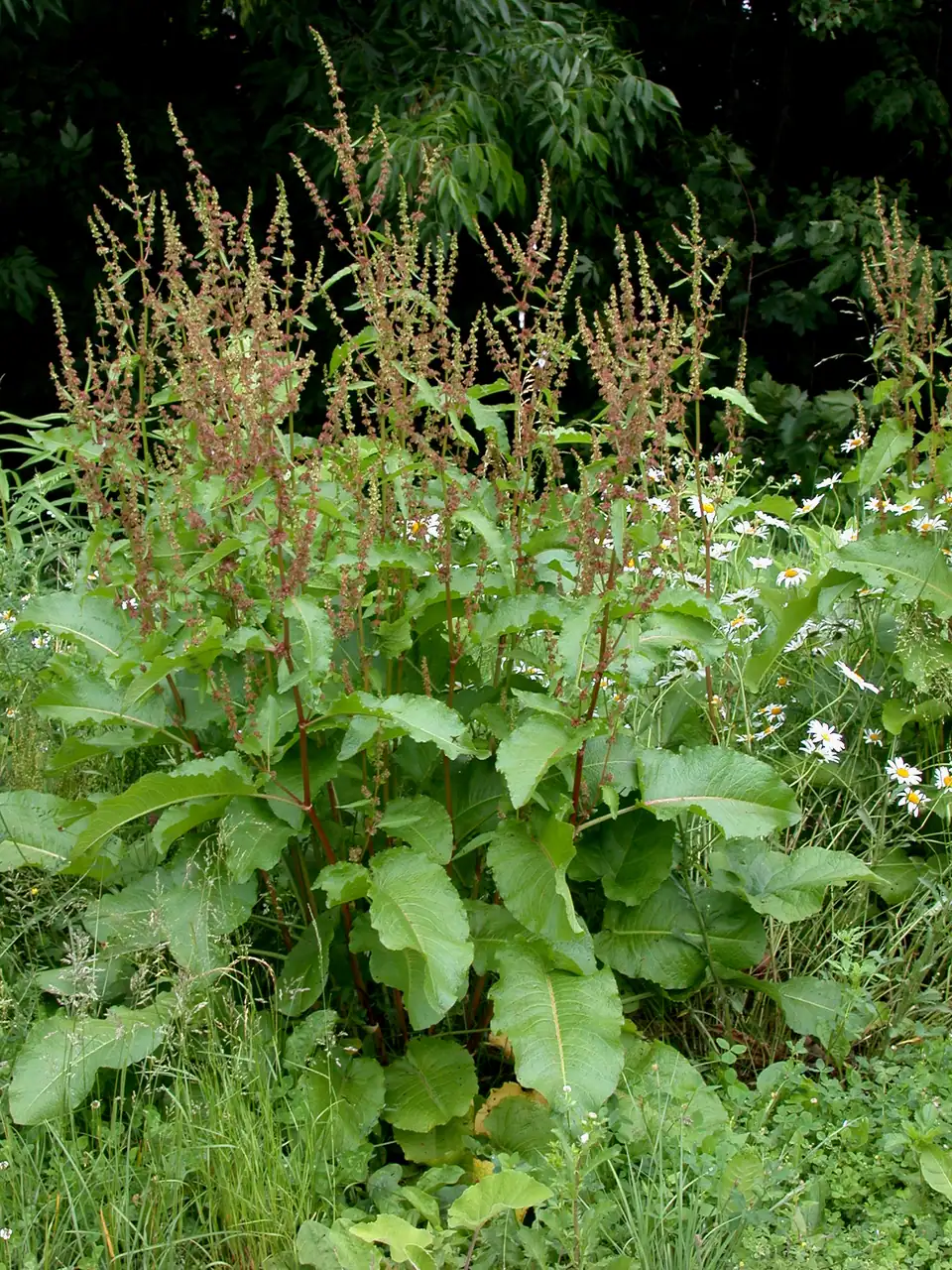
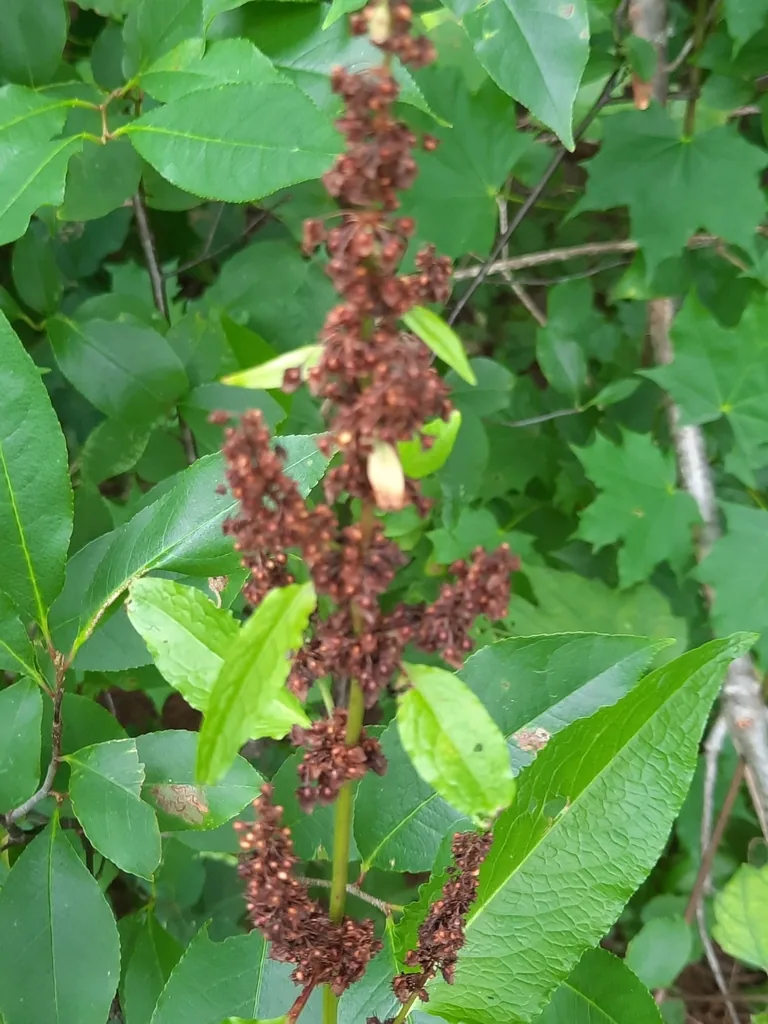

How to Grow and Care for Bitter Dock
Rumex obtusifolius
Written by Emilio Marruso · last checked
Toxic to: Animals · Why
At a glance
Broad-leaved dock is a perennial that grows in sun or part shade, and starting it is simple: sow it in spring right where it will grow. In early spring, its fresh young leaves bring a bitter, lemony taste to the kitchen, and the seeds can even be ground into flour for bread. Remove spent flowers to keep it from spreading.
- Sun
Sun to part shade
What the sources say (1)
Light: Sun to part shade
part shade, sun; moist, disturbed soils; shores, floodplains, woodland edges, roadsides, fields
— Rumex obtusifolius (Bitter Dock): Minnesota Wildflowers [5] - Harvest
Pick young leaves in early spring; they taste bitter and lemony, older leaves are more bitter
What the sources say (1)
Harvest: Early spring (young leaves)
The leaves have a much milder flavour when they are first produced in early spring
— Round-Leaved Dock (Rumex obtusifolius) — Practical Plants [2] - Watch out
Spreads by seed and regrows from root pieces; remove spent flowers and pull plants by hand
What the sources say (1)
Root system: Branching taproots grow up to 1.2 m [4 ft] deep.
Underground, branching taproots grow up to 1.2m (4ft) deep.
— Docks | RHS Advice [6] - Size
2 to 4 ft tall
What the sources say (2)
Mature height: 60.96-121.92 cm (2-4 ft); flower stems up to 120 cm (1.2 m, 4 ft)
Stems 2 to 4 feet; leaf blades 8 to 16 inches, widely ovate to oblong, base generally heart-shaped
— Rumex obtusifolius - bitter dock | Yavapai County Native and Naturalized Plants [1] Flower stems can reach a height of 1.2m (4ft) and have leaves along their length with flowers at the tips.
— Docks | RHS Advice [6] - Propagation
From seed or by dividing the plant
- Sowing
Sow in spring, right where it will grow
What the sources say (1)
Sowing: Spring, sown in situ
Seed - sow spring in situ.
— Round-Leaved Dock (Rumex obtusifolius) — Practical Plants [2] - Safety
Poisonous to animals: they can lose their appetite, stagger and even die
Overview
Rumex obtusifolius is a perennial dock that is widespread as a weed and is occasionally cultivated for its edible leaves. [7][2] Docks spread easily by seed, and deadheading prevents self-seeding and limits spread. [6] The leaves contain oxalic acid, so only small quantities should be eaten. [6]
This record is incomplete: the sources we read do not cover every field yet.
Not yet covered by our sources: Hardiness, coldest zone, Hardiness, warmest zone
Bitter Dock care
How much light Bitter Dock needs
Sun to part shade
What the sources say (1)
part shade, sun; moist, disturbed soils; shores, floodplains, woodland edges, roadsides, fieldsHow much cold Bitter Dock can take
Hardiness, coldest zone
Not stated in the sources we read.
Hardiness, warmest zone
Not stated in the sources we read.
How to propagate Bitter Dock
How to grow Bitter Dock
The plant
Life cycle
perennial
Family
Polygonaceae
What the sources say (1)
Botanical name: Rumex obtusifolius
Common family name: Buckwheat or Smartweed
Family name: PolygonaceaeMature height
60.96-121.92 cm (2-4 ft); flower stems up to 120 cm (1.2 m, 4 ft)
What the sources say (2)
Stems 2 to 4 feet; leaf blades 8 to 16 inches, widely ovate to oblong, base generally heart-shapedFlower stems can reach a height of 1.2m (4ft) and have leaves along their length with flowers at the tips.Roots
Root system
Branching taproots grow up to 1.2 m [4 ft] deep.
What the sources say (1)
Underground, branching taproots grow up to 1.2m (4ft) deep.Bitter Dock pests and problems
Dock spread in gardens
Symptom: Plants spread by seed and regrow from root sections
What to do: Deadhead to prevent self-seeding; hand-pull to eliminate weeds
Remedies
Each remedy shows what official sources say about it; traditional remedies without an official source are marked as such. Harmful ones are listed so you know to avoid them.
Getting rid of it
weed infestation
deadheading Official source, not independently tested
How: remove faded flowers in summer to prevent self-seeding
Deadhead – remove faded flowers in summer to prevent self-seeding.
— Docks | RHS Advice [6] hoeing seedlings Official source, not independently tested
How: hoe promptly while plants are very young, before they develop taproots, on a warm, dry or windy day so exposed roots dry out and die
Hoe off seedlings – do this promptly, when plants are still very young, before they develop taproots.
— Docks | RHS Advice [6] digging out roots Official source, not independently tested
docks can regenerate from root fragments, so avoid digging over or rotavating the soil where they grow, as this will chop up and spread the roots.
— Docks | RHS Advice [6] How: dig or fork out young plants, removing the top 12-15 cm (5-6in) of the root system; remove any regrowth when it appears
Aim to remove the top 12-15 cm (5-6in) of the root system; sections of root deeper than this are unlikely to regenerate.
— Docks | RHS Advice [6] regular cutting Official source, not independently tested
Mowing has little effect on established docks but will prevent seed production.
— gardenorganic.org.uk [9] How: cut back new growth regularly with a strimmer, brushcutter or mower; it is likely to take several years
Cutting back new growth regularly will weaken and eventually kill docks. This is likely to take several years but is better for soil health as it limits disturbance
— Docks | RHS Advice [6] smothering with cardboard and mulch Official source, not independently tested
How: cover with cardboard, then about 20cm (8in) of organic matter such as bark or wood chips, and keep the soil covered for a few years, topping up the mulch
Smother plants – cover with a layer of compostable material, such as cardboard, and then a layer about 20cm (8in) thick of organic matter
— Docks | RHS Advice [6]
weed seedlings
mulch layer Official source, not independently tested
How: apply a mulch of organic matter around 10cm (4in) thick in early spring, or fill gaps in borders with ground cover plants
Smother seedlings – apply a mulch of organic matter , around 10cm (4in) thick, to your soil in early spring to smother emerging seedlings.
— Docks | RHS Advice [6]
weed seeds
binning roots and seeds instead of composting Official source, not independently tested
How: put seeds and roots in the council green waste recycling bin or take them to a recycling site, not in the home compost bin
Don’t add the seed or roots of docks to your home compost bin, as it may not reach high enough temperatures to kill them.
— Docks | RHS Advice [6]
Is Bitter Dock toxic to pets?
Reported by the source, quoted verbatim. This is not medical or veterinary advice: if a person or an animal may have eaten this plant, contact a poison control centre or a veterinarian.
Poisoned animals lose their appetite, stagger, are depressed, have muscle tremors, lie down, become comatose and may die.
[8]Genus-level warning: refers to the whole genus, not documented for this species
- Toxic principle
They can accumulate oxalates and sometimes nitrates in their leaves and stems to varying degrees and if consumed in great quantity (such as in early spring or when no other forage is available), can cause oxalate poisoning.
[8]
Calendar
Sowing
Spring, sown in situ
What the sources say (1)
Seed - sow spring in situ.Harvest
Early spring (young leaves)
What the sources say (1)
The leaves have a much milder flavour when they are first produced in early springMonths as given by the sources, which are mostly from the United States (northern hemisphere). In the southern hemisphere they shift by about six months.
Edibility
Reported by the source, quoted verbatim. Do not eat a plant on the basis of this page alone: identification mistakes can be dangerous.
A bitter taste, especially if the older leaves are used
[2]Young stems - cooked
[2]The seed can also be ground into a powder and used to make a gruel or added to cereal flours when making bread etc
[2]The fresh, young leaves of broad-leaved and curled docks are edible and have a bitter, lemony taste.
[6]
Similar plants
- Bloody Dock Rumex sanguineus
- Sheep Sorrel Rumex acetosella
- Patience Dock Rumex patientia
- Sorrel Rumex hastatulus
- Sorrel Rumex scutatus
- Curly Dock Rumex crispus
- Alpine dock Rumex alpinus
- Common Sorrel Rumex acetosa
Sources
Every value above is quoted from these documents. Links lead to the original publisher.
- Rumex obtusifolius - bitter dock | Yavapai County Native and Naturalized Plants · yavapaiplants.extension.arizona.edu, consulted
- Round-Leaved Dock (Rumex obtusifolius) — Practical Plants · practicalplants.org, consulted
- Weeds: Dock | Hortsense | Washington State University · hortsense.cahnrs.wsu.edu, consulted
- Broadleaf dock | Turfgrass and Landscape Weed ID · turfweeds.cals.cornell.edu, consulted
- Rumex obtusifolius (Bitter Dock): Minnesota Wildflowers · minnesotawildflowers.info, consulted
- Docks | RHS Advice · rhs.org.uk, consulted
- Rumex obtusifolius - Useful Temperate Plants · temperate.theferns.info, consulted
- Selected Poisonous Plants of the Pacific Northwest | Animal Agriculture | Washington State University · extension.wsu.edu, consulted
- gardenorganic.org.uk · gardenorganic.org.uk
Written by Emilio Marruso · last checked