
How to Grow and Care for African tuliptree
Spathodea campanulata
Written by Emilio Marruso · last checked
At a glance
Spathodea is a big, generous tree for warm climates: it grows 50–60 ft tall and spreads 35–50 ft wide. Give it full sun and it copes with dry spells fairly well, and it accepts almost any soil, from pH 4.5 to 8.0. Plant it in a sheltered spot, because its soft wood breaks easily in strong winds.
- Sun
Full sun
What the sources say (2)
Light: Full sun
Light requirement: full sun Soil tolerances: clay; sand; loam; acidic; well-drained Drought tolerance: moderate
— ENH-758/ST600: Spathodea campanulata: African Tuliptree [2] Spathodea campanulata needs a sunny exposure and high temperatures; if it's cold (less than 8 ºC/46.4 ºF) they can lose the leaves.
— Spathodea campanulata or African tulip tree | Care and Growing [5] - Water
Handles dry spells fairly well
What the sources say (1)
Watering notes: Moderate drought tolerance
Light requirement: full sun Soil tolerances: clay; sand; loam; acidic; well-drained Drought tolerance: moderate
— ENH-758/ST600: Spathodea campanulata: African Tuliptree [2] - Cold
Survives winters down to 35 °F (1.7 °C)
Tender: needs a frost-free greenhouse · USDA 10b · RHS H2 · Z10
What the sources say (2)
Hardiness, coldest zone: 10b [winter low 1.7 to 4.4 °C (35 to 40 °F)]
Family: Bignoniaceae USDA hardiness zones: 10B through 11
— ENH-758/ST600: Spathodea campanulata: African Tuliptree [2] Hardiness, warmest zone: 11 [winter low 4.4 to 10 °C (40 to 50 °F)]
Family: Bignoniaceae USDA hardiness zones: 10B through 11
— ENH-758/ST600: Spathodea campanulata: African Tuliptree [2] - Soil
Almost any soil, pH 4.5–8.0
What the sources say (2)
Soil pH, minimum: 4.5
La textura del suelo puede variar entre arenas margosas hasta arcillas, el pH puede fluctuar entre 4.5 y 8.0
— Spathodea campanulata Beauv. Tulipán africano [3] Soil pH, maximum: 8.0
La textura del suelo puede variar entre arenas margosas hasta arcillas, el pH puede fluctuar entre 4.5 y 8.0
— Spathodea campanulata Beauv. Tulipán africano [3] - Watch out
Soft wood breaks in strong wind: plant it sheltered, where falling branches can't do harm
- Size
50–60 ft tall and 35–50 ft wide
What the sources say (2)
Mature height: 1524-1829 cm (50-60 ft)
Height: 50 to 60 feet Spread: 35 to 50 feet Crown uniformity: irregular Crown shape: upright/erect, round, spreading
— ENH-758/ST600: Spathodea campanulata: African Tuliptree [2] Mature width: 1067-1524 cm (35-50 ft)
Height: 50 to 60 feet Spread: 35 to 50 feet Crown uniformity: irregular Crown shape: upright/erect, round, spreading
— ENH-758/ST600: Spathodea campanulata: African Tuliptree [2] - Propagation
From seed, softwood cuttings or root suckers
What the sources say (2)
Propagation: Seed; softwood cuttings; root suckers
Propagation is by seed, softwood cuttings, or root suckers.
— ENH-758/ST600: Spathodea campanulata: African Tuliptree [2] Fountain tree is propagated from seeds (they germinate easily), by cuttings or from root shoots.
— Spathodea campanulata or African tulip tree | Care and Growing [5]
Overview
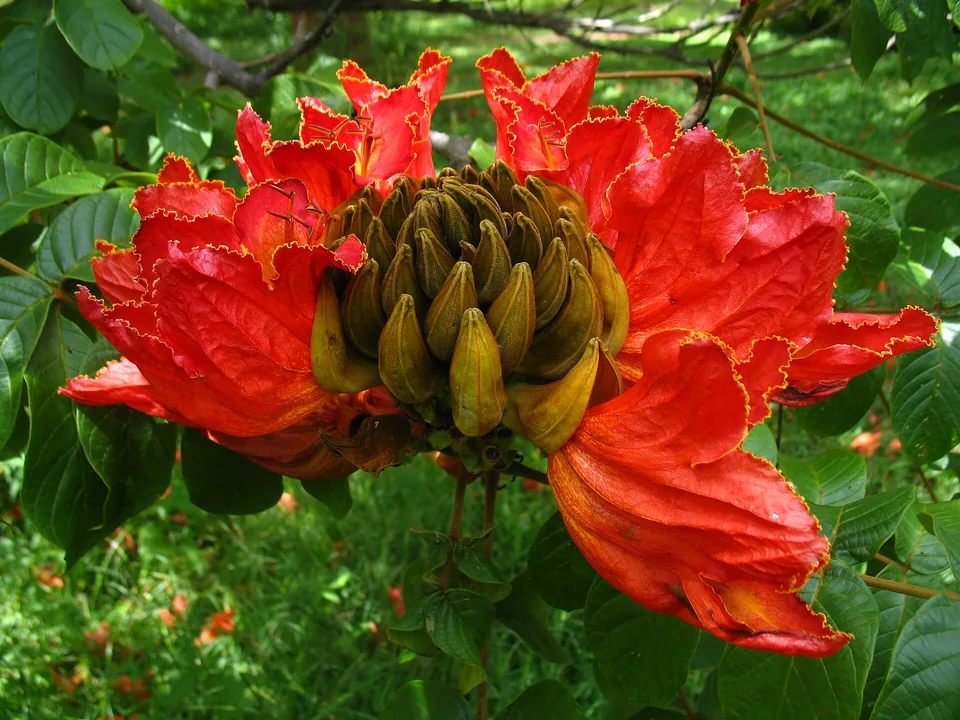
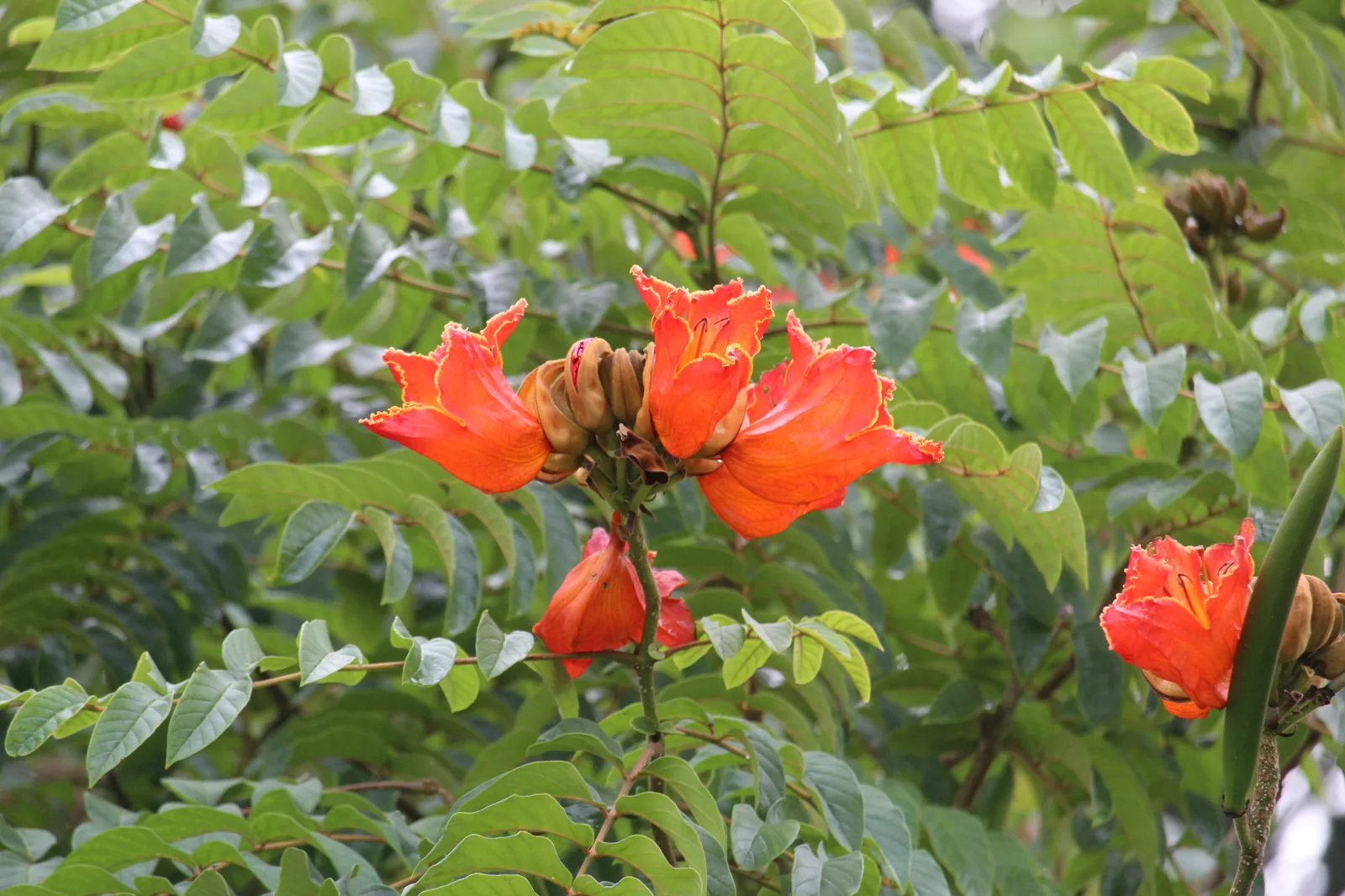
African tuliptree is a large tropical tree native to Africa, used as a shade or specimen tree in frost-free areas. [2] It grows rapidly in full sun on soil of reasonable drainage and fertility and, once established, needs little care. [2] Its soft, brittle wood is easily broken by high winds. [2]
This record is incomplete: the sources we read do not cover every field yet.
Not yet covered by our sources: Watering, Pruning
African tuliptree care
How to water African tuliptree
Watering
Not stated in the sources we read.
Watering notes
Moderate drought tolerance
What the sources say (1)
Light requirement: full sun
Soil tolerances: clay; sand; loam; acidic; well-drained
Drought tolerance: moderateHow much light African tuliptree needs
Full sun
What the sources say (2)
Light requirement: full sun
Soil tolerances: clay; sand; loam; acidic; well-drained
Drought tolerance: moderateSpathodea campanulata needs a sunny exposure and high temperatures; if it's cold (less than 8 ºC/46.4 ºF) they can lose the leaves.How much cold African tuliptree can take
Hardiness, coldest zone
10b [winter low 1.7 to 4.4 °C (35 to 40 °F)]
What the sources say (1)
Family: Bignoniaceae
USDA hardiness zones: 10B through 11Hardiness, warmest zone
11 [winter low 4.4 to 10 °C (40 to 50 °F)]
What the sources say (1)
Family: Bignoniaceae
USDA hardiness zones: 10B through 11Best soil for African tuliptree
Soil pH, minimum
4.5
What the sources say (1)
La textura del suelo puede variar entre arenas margosas hasta arcillas, el pH puede fluctuar entre 4.5 y 8.0Soil pH, maximum
8.0
What the sources say (1)
La textura del suelo puede variar entre arenas margosas hasta arcillas, el pH puede fluctuar entre 4.5 y 8.0How to propagate African tuliptree
Seed; softwood cuttings; root suckers
What the sources say (2)
Propagation is by seed, softwood cuttings, or root suckers.Fountain tree is propagated from seeds (they germinate easily), by cuttings or from root shoots.How to grow African tuliptree
The plant
Family
Bignoniaceae
What the sources say (1)
Common name(s): African tuliptree Family: Bignoniaceae USDA hardiness zones: 10B through 11Mature height
1524-1829 cm (50-60 ft)
What the sources say (1)
Height: 50 to 60 feet Spread: 35 to 50 feet Crown uniformity: irregular Crown shape: upright/erect, round, spreadingMature width
1067-1524 cm (35-50 ft)
What the sources say (1)
Height: 50 to 60 feet Spread: 35 to 50 feet Crown uniformity: irregular Crown shape: upright/erect, round, spreadingAfrican tuliptree pests and problems
Wind breakage
Symptom: Soft, brittle wood is easily broken by high winds.
What to do: Locate trees in sheltered locations or where falling branches will do no damage; eliminate major branches that will form embedded bark as early as possible.
What the sources say (2)
Also, its soft, brittle wood is easily broken by high winds, and trees should be located either in sheltered locations or where falling branches will do no damage.
— ENH-758/ST600: Spathodea campanulata: African Tuliptree [2] Eliminate major branches that will form embedded bark as early as possible.
— ENH-758/ST600: Spathodea campanulata: African Tuliptree [2] Litter
Symptom: Fruit and leaves are a litter problem.
What the sources say (1)
Fruit characteristics: does not attract wildlife; not showy; fruit/leaves a litter problem
— ENH-758/ST600: Spathodea campanulata: African Tuliptree [2]
Remedies
Each remedy shows what official sources say about it; traditional remedies without an official source are marked as such. Harmful ones are listed so you know to avoid them.
Getting rid of it
invasive spread
repeated cutting Not verified
Traditional remedy, not verified by an official source.
How: Physical removal is difficult because the tree coppices vigorously after cutting: cut mature trees and repeat as needed.
disposing of green waste Not verified
Traditional remedy, not verified by an official source.
How: Dispose of green waste to prevent vegetative reproduction.
Calendar
Pruning
Not stated in the sources we read.
Months as given by the sources, which are mostly from the United States (northern hemisphere). In the southern hemisphere they shift by about six months.
Indicative values
Values from a secondary source, not checked word for word like the rest of this page. Use them as a starting point.
- Life cycle
- PerennialIndicative value, adapt it to your climate · Secondary source
- Hours of sun
- 8-10 hoursIndicative value, adapt it to your climate · Secondary source
- Watering
- AverageIndicative value, adapt it to your climate · Secondary source
- Care level
- MediumIndicative value, adapt it to your climate · Secondary source
- Growth rate
- HighIndicative value, adapt it to your climate · Secondary source
- Pruning
- February, March, April, March, April, May, June, July, August, SeptemberIndicative value, adapt it to your climate · Secondary source
Similar plants
- Cape Honeysuckle Tecomaria capensis
- Chilean Glory Flower Eccremocarpus scaber
- Chinese catalpa Catalpa ovata
- Chinese Trumpet Creeper Campsis grandiflora
- Common calabash tree Crescentia cujete
- Cross-Vine Bignonia capreolata
- Desert Willow Chilopsis linearis
- Hardy Gloxinia Incarvillea delavayi
Sources
Every value above is quoted from these documents. Links lead to the original publisher.
- ENH-758 · edis.ifas.ufl.edu, consulted
- ENH-758/ST600: Spathodea campanulata: African Tuliptree · ask.ifas.ufl.edu, consulted
- Spathodea campanulata Beauv. Tulipán africano · npn.rngr.net, consulted
- USEFUL TREES AND SHRUBS FOR KENYA · apps.worldagroforestry.org, consulted
- Spathodea campanulata or African tulip tree | Care and Growing · consultaplantas.com, consulted
Written by Emilio Marruso · last checked