
How to Grow and Care for Scallop-leaved mullein
Verbascum sinuatum
Written by Emilio Marruso · last checked
Toxic to: Animals · Why
At a glance
This mullein is a biennial, completing its life over two growing seasons, and it belongs to the figwort family. It also comes with a curious story: wrapped around a stick and moved through water, it makes fish jump right out, because it is poisonous to them. A plant with a tale like that is a fun one to grow and talk about.
- Safety
Poisonous to fish: keep it away from fish ponds and tanks
Overview
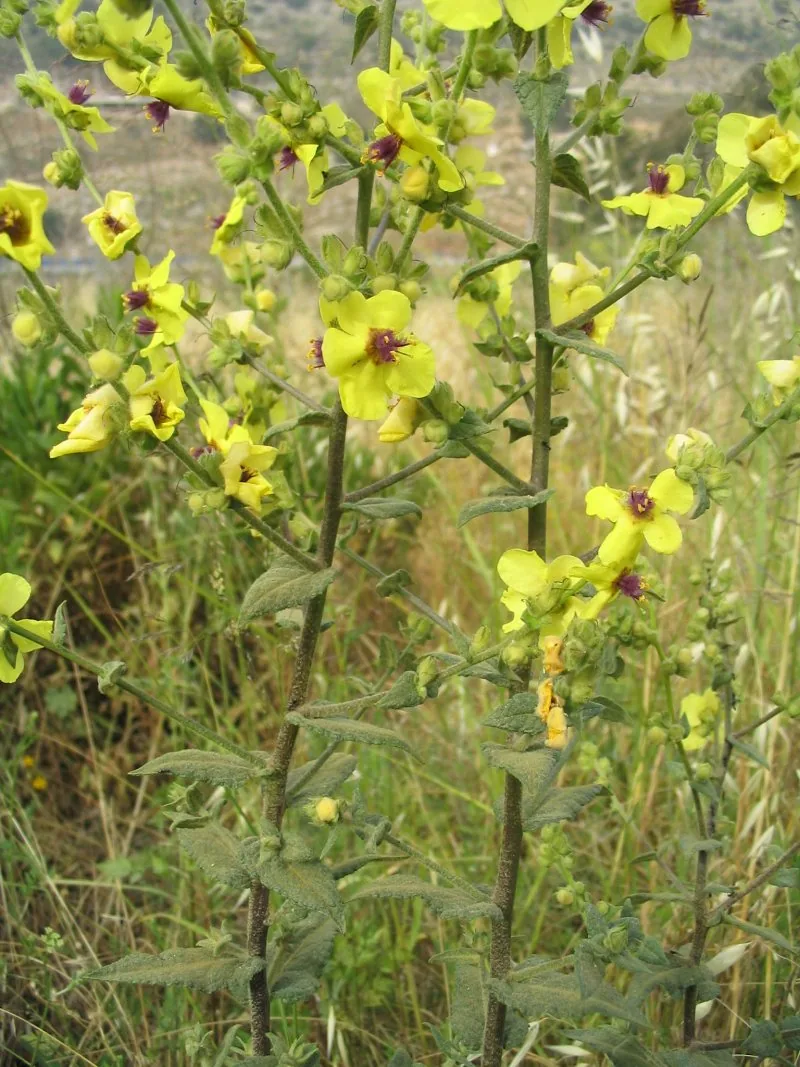
Verbascum sinuatum is a biennial native from the Mediterranean to western and southern Iran. [5] A robust Mediterranean biennial covered in dense hairs, with a basal leaf rosette and a central stem ending in an elongated panicle of large yellow flowers. [1][4] It grows in cultivated fields, path and road sides and disturbed zones. [1] The plant is poisonous to fish and was used in the ancient Mediterranean to harvest them. [4][2]
This record is incomplete: the sources we read do not cover every field yet.
Not yet covered by our sources: Watering, Light, Hardiness, coldest zone, Hardiness, warmest zone, Pruning, Propagation
Scallop-leaved mullein care
How to water Scallop-leaved mullein
Not stated in the sources we read.
How much light Scallop-leaved mullein needs
Not stated in the sources we read.
How much cold Scallop-leaved mullein can take
Hardiness, coldest zone
Not stated in the sources we read.
Hardiness, warmest zone
Not stated in the sources we read.
How to propagate Scallop-leaved mullein
Not stated in the sources we read.
How to grow Scallop-leaved mullein
The plant
Life cycle
biennial
What the sources say (1)
The native range of this species is Medit. to W. & S. Iran. It is a biennial and grows primarily in the temperate biome.Family
Scrophulariaceae
What the sources say (1)
Family: SCROPHULARIACEAE Genus: Verbascum Catalan common name: Blenera sinuada. Múria. Trepó.Remedies
The sources we checked give no remedies for this plant.
Is Scallop-leaved mullein toxic to pets?
Reported by the source, quoted verbatim. This is not medical or veterinary advice: if a person or an animal may have eaten this plant, contact a poison control centre or a veterinarian.
Wrapping Verbascum sinuatum around a stick then moving it through water, results in fish jumping out of the water, becoming an easy catch; it is poisonous to fish.
[4]- Poisonous parts
Flowers and leaves of V. sinuatum have been used for diverse purposes, for example, as an ichotoxic (poison) plant to harvest fish in rivers by the ancient Mediterranean
[2]
Calendar
Pruning
Not stated in the sources we read.
Months as given by the sources, which are mostly from the United States (northern hemisphere). In the southern hemisphere they shift by about six months.
Similar plants
- Black mullein Verbascum nigrum
- Common Mullein Verbascum thapsus
- American Butterfly Bush Buddleja americana
- Bacopa Chaenostoma cordatum
- Beardlip penstemon Penstemon barbatus
- Butterfly Bush Buddleja davidii
- Chinese Butterfly Bush Buddleja fallowiana
- Fountain Butterfly Bush Buddleja alternifolia
Sources
Every value above is quoted from these documents. Links lead to the original publisher.
- Verbascum sinuatum L. - Herbari Virtual del Mediterrani Occidental · herbarivirtual.uib.cat, consulted
- Bioactive Compounds of Verbascum sinuatum L.: Health Benefits and Potential as New Ingredients for Industrial Applications - PMC · ncbi.nlm.nih.gov, consulted
- Mullein (Verbascum sinuatum) - Garden.org · garden.org, consulted
- Verbascum sinuatum - wild in Provence · wildflowersprovence.fr, consulted
- Verbascum sinuatum L. | Plants of the World Online | Kew Science · powo.science.kew.org, consulted
Written by Emilio Marruso · last checked