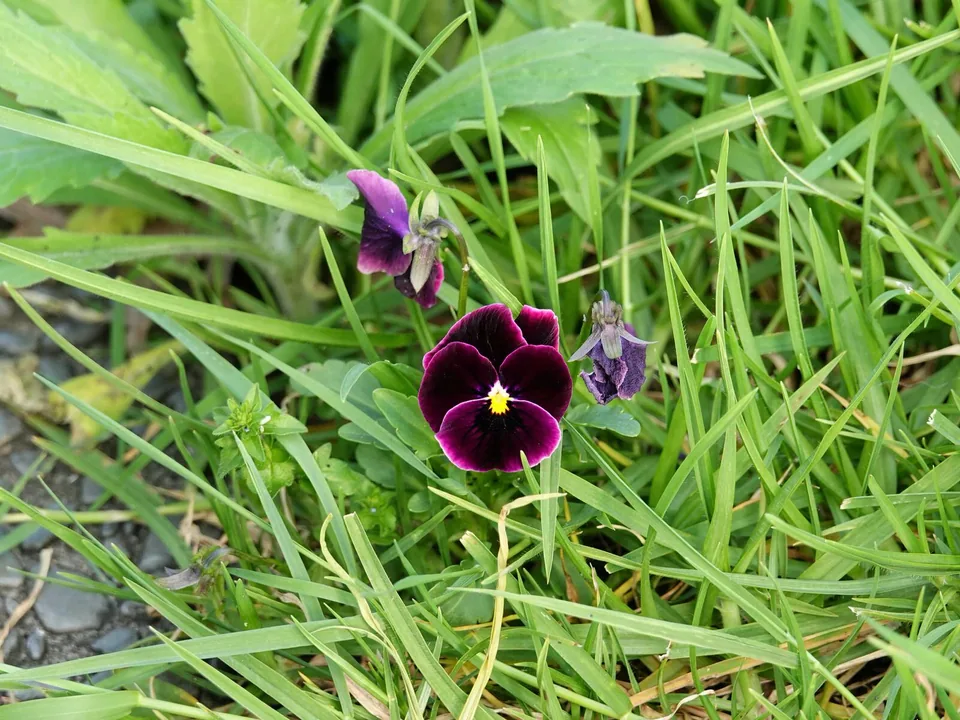
How to Grow and Care for Hybrid violet
Viola wittrockiana
Written by Emilio Marruso · last checked
At a glance
Pansies are cheerful little annuals that bloom when most gardens are resting: plant them in fall for winter and early spring flowers. They thrive in full sun to part shade, stay small at 6–9 inches tall, and grow happily in pots too. Best of all, their flowers are edible, so you can enjoy them in the garden and on the plate.
- Sun
Full sun to part shade
What the sources say (1)
Light: Full sun to part shade
Pansy prefers full sun to part shade in humus-rich soils that are consistently moist and well-drained.
— Pansy - Viola x wittrockiana | North Carolina Extension Gardener Plant Toolbox [1] - Cold
Survives winters down to −10 °F (−23.3 °C)
Very hardy · USDA 6a · RHS H7 · Z6
What the sources say (2)
Hardiness, coldest zone: 6a [winter low −23.3 to −20.6 °C (−10 to −5 °F)]
USDA Plant Hardiness Zone: 6a, 6b, 7a, 7b, 8a, 8b, 9a, 9b, 10a, 10b
— Pansy - Viola x wittrockiana | North Carolina Extension Gardener Plant Toolbox [1] Hardiness, warmest zone: 10b [winter low 1.7 to 4.4 °C (35 to 40 °F)]
USDA Plant Hardiness Zone: 6a, 6b, 7a, 7b, 8a, 8b, 9a, 9b, 10a, 10b
— Pansy - Viola x wittrockiana | North Carolina Extension Gardener Plant Toolbox [1] - Soil
Acidic soil, pH 5.4–5.8
What the sources say (2)
Soil pH, minimum: 5.4
Pansies prefer a pH in the range of 5.4 to 5.8.
— Success with Pansies in the Winter Landscape: A Guide for Landscape Professionals | CAES Field Report [2] Soil pH, maximum: 5.8
Pansies prefer a pH in the range of 5.4 to 5.8.
— Success with Pansies in the Winter Landscape: A Guide for Landscape Professionals | CAES Field Report [2] - Spacing
6–10 in between plants
What the sources say (1)
Spacing: 15.2-25.4 cm (6-10 in)
Pansy plants are usually planted at spacings of 6 inches, 8inches or 10 inches between plants (Table 3).
— Success with Pansies in the Winter Landscape: A Guide for Landscape Professionals | CAES Field Report [2] - Planting
Plant in fall for winter and early spring blooms
What the sources say (1)
Planting: Fall, for winter and early spring blooms
Plant in the fall for winter and early spring blooms.
— Pansy - Viola x wittrockiana | North Carolina Extension Gardener Plant Toolbox [1] - Feeding
Feed at planting, then liquid feed every 14 days until mid-March; too much nitrogen makes weak stems
What the sources say (11)
When: At transplanting; then a liquid feed program once soil temperature drops below 15.6 °C [60 °F], through mid-March; ammoniacal nitrogen only from mid-March as soils warm
Generally, a thorough drenching of the soil at transplant with 150 parts per million of a soluble greenhouse fertilizer, such as 15-2-20, will get the plants off to a good start.
— Success with Pansies in the Winter Landscape: A Guide for Landscape Professionals | CAES Field Report [2] When the weather cools and soil temperatures drop below 60° F, begin a liquid feed program using a fertilizer containing at least 50 percent of its nitrogen in nitrate form.
— Success with Pansies in the Winter Landscape: A Guide for Landscape Professionals | CAES Field Report [2] Soil temperatures usually are on the rise by March 15, so fertilizers containing ammoniacal nitrogen can be used at that time.
— Success with Pansies in the Winter Landscape: A Guide for Landscape Professionals | CAES Field Report [2] How often: Every 14 days through mid-March, adjusted to the vigor of the planting
A standard 15-2-20, high-nitrate pansy formula fertilizer applied at 14-day intervals through March 15 provides excellent results.
— Success with Pansies in the Winter Landscape: A Guide for Landscape Professionals | CAES Field Report [2] Fertilization frequency depends on the vigor and performance of the planting.
— Success with Pansies in the Winter Landscape: A Guide for Landscape Professionals | CAES Field Report [2] Avoid: High slow-release ammoniacal nitrogen in the cold months; high nitrogen in September and in late April–May; liming without a soil test; more than two boron drenches per season; organic matter above 25% by volume
Avoid using fertilizers containing high amounts of slow-release ammoniacal nitrogen. These fertilizers are commonly used on summer annuals but are not recommended for pansies.
— Success with Pansies in the Winter Landscape: A Guide for Landscape Professionals | CAES Field Report [2] Avoid high rates of nitrogen during September and later in April and May, because the plants grow quickly and can stretch in warm weather under high nutrition.
— Success with Pansies in the Winter Landscape: A Guide for Landscape Professionals | CAES Field Report [2] A soil pH above 5.8 can result in boron and iron deficiencies; therefore, avoid liming pansy beds out of habit, unless the soil test indicates a need for lime.
— Success with Pansies in the Winter Landscape: A Guide for Landscape Professionals | CAES Field Report [2] Do not apply more than two boron drenches during the growing season because excess boron can cause other problems.
— Success with Pansies in the Winter Landscape: A Guide for Landscape Professionals | CAES Field Report [2] Avoid high amounts of organic matter (more than 25 percent by volume); the humic acids and organic salts it releases can cause plant problems.
— Success with Pansies in the Winter Landscape: A Guide for Landscape Professionals | CAES Field Report [2] Signs of excess: Stretched, succulent stems that weaken the plant and make it more prone to winter injury
High rates of ammoniacal nitrogen can cause pansy stems to stretch and become succulent during warm fall weather, which weakens plants and makes them more susceptible to winter injury.
— Success with Pansies in the Winter Landscape: A Guide for Landscape Professionals | CAES Field Report [2] - Harvest
The flowers are edible, but store-bought plants may have been treated with pesticides
- Pests
Slugs, snails and red spider mites; leaf spot and powdery mildew
What the sources say (2)
Pests: slugs, snails, glasshouse red spider mites
Slugs, snails and glasshouse red spider mites are common pests.
— Pansy - Viola x wittrockiana | North Carolina Extension Gardener Plant Toolbox [1] Diseases: fungal leaf disease, pansy leaf spot, powdery mildew
Fungal leaf disease, pansy leaf spot and powdery mildew may affect this plant.
— Pansy - Viola x wittrockiana | North Carolina Extension Gardener Plant Toolbox [1] - Size
6–9 in tall and 9–12 in wide
What the sources say (2)
Mature height: 15.24-22.86 cm (6-9 in)
It grows 6 to 9 inches in height and 9 to 12 inches in width.
— Pansy - Viola x wittrockiana | North Carolina Extension Gardener Plant Toolbox [1] Mature width: 22.86-30.48 cm (9-12 in)
It grows 6 to 9 inches in height and 9 to 12 inches in width.
— Pansy - Viola x wittrockiana | North Carolina Extension Gardener Plant Toolbox [1] - Containers
Grows in containers too
What the sources say (1)
In containers: Yes
This plant can bloom for up to 4 to 6 months, making it an excellent plant for bedding, containers and hanging baskets.
— Pansy - Viola x wittrockiana | North Carolina Extension Gardener Plant Toolbox [1]
Overview
Pansy is a semi-evergreen annual bedding plant for cooler weather that prefers full sun to part shade in consistently moist, well-drained soil. [1] It is suited to bedding, containers and hanging baskets, and flowers are edible. [1] Plants are usually spaced 6 to 10 inches [15–25 cm] apart, and wider spacing improves air circulation. [2]
This record is incomplete: the sources we read do not cover every field yet.
Not yet covered by our sources: Pruning, Propagation
Hybrid violet care
Measurements in square brackets are our conversion into the other unit system; the quoted text is unchanged.
How to water Hybrid violet
The sources give different values depending on region, zone or growing conditions.
What each source says
According to NC State Extension: Consistently moist, well-drained soil
before cold weather (UGA Extension, Georgia): Slightly on the dry side
What the sources say (3)
According to NC State Extension: Pansy prefers full sun to part shade in humus-rich soils that are consistently moist and well-drained.before cold weather (UGA Extension, Georgia): Carefully monitor irrigation and try to keep pansies slightly on the dry side to “harden” growth prior to cold weather.Pansy prefers full sun to part shade in humus-rich soils that are consistently moist and well-drained.How much light Hybrid violet needs
Full sun to part shade
What the sources say (1)
Pansy prefers full sun to part shade in humus-rich soils that are consistently moist and well-drained.How much cold Hybrid violet can take
Hardiness, coldest zone
6a [winter low −23.3 to −20.6 °C (−10 to −5 °F)]
What the sources say (1)
USDA Plant Hardiness Zone:
6a, 6b, 7a, 7b, 8a, 8b, 9a, 9b, 10a, 10b Hardiness, warmest zone
10b [winter low 1.7 to 4.4 °C (35 to 40 °F)]
What the sources say (1)
USDA Plant Hardiness Zone:
6a, 6b, 7a, 7b, 8a, 8b, 9a, 9b, 10a, 10b Best soil for Hybrid violet
Soil pH, minimum
5.4
What the sources say (1)
Pansies prefer a pH in the range of 5.4 to 5.8.Soil pH, maximum
5.8
What the sources say (1)
Pansies prefer a pH in the range of 5.4 to 5.8.Where to grow Hybrid violet
In containers
Yes
What the sources say (1)
This plant can bloom for up to 4 to 6 months, making it an excellent plant for bedding, containers and hanging baskets.Spacing
15.2-25.4 cm (6-10 in)
What the sources say (1)
Pansy plants are usually planted at spacings of 6 inches, 8inches or 10 inches between plants (Table 3).How to propagate Hybrid violet
Not stated in the sources we read.
How to grow Hybrid violet
The plant
Life cycle
annual
What the sources say (1)
Pansy is a semi-evergreen annual in the violet family (Violaceae) and native to Europe and Asia.Family
Violaceae
What the sources say (1)
Pansy is a semi-evergreen annual in the violet family (Violaceae) and native to Europe and Asia.Mature height
15.24-22.86 cm (6-9 in)
What the sources say (1)
It grows 6 to 9 inches in height and 9 to 12 inches in width.Mature width
22.86-30.48 cm (9-12 in)
What the sources say (1)
It grows 6 to 9 inches in height and 9 to 12 inches in width.Pests and diseases
Pests
slugs, snails, glasshouse red spider mites
What the sources say (1)
Slugs, snails and glasshouse red spider mites are common pests.Diseases
fungal leaf disease, pansy leaf spot, powdery mildew
What the sources say (1)
Fungal leaf disease, pansy leaf spot and powdery mildew may affect this plant.Fertilizing
When
At transplanting; then a liquid feed program once soil temperature drops below 15.6 °C [60 °F], through mid-March; ammoniacal nitrogen only from mid-March as soils warm
What the sources say (3)
Generally, a thorough drenching of the soil at transplant with 150 parts per million of a soluble greenhouse fertilizer, such as 15-2-20, will get the plants off to a good start.When the weather cools and soil temperatures drop below 60° F, begin a liquid feed program using a fertilizer containing at least 50 percent of its nitrogen in nitrate form.Soil temperatures usually are on the rise by March 15, so fertilizers containing ammoniacal nitrogen can be used at that time.How often
Every 14 days through mid-March, adjusted to the vigor of the planting
What the sources say (2)
A standard 15-2-20, high-nitrate pansy formula fertilizer applied at 14-day intervals through March 15 provides excellent results.Fertilization frequency depends on the vigor and performance of the planting.Natural fertilizers
Compost or composted animal manure as a bed amendment, 25% by volume: 7.62 cm [3 in] worked into the top 30.5 cm [12 in] of soil
What the sources say (1)
Compost and composted animal manure are frequently used as amendments. A 25 percent by volume quantity of amendment is recommended for best results; this equals 3 inches of organic matter incorporated into the top 12 inches of soil.Mineral fertilizers
Soluble 15-2-20 at 150 ppm at transplant; then a high-nitrate 15-2-20 liquid feed with at least 50% of the nitrogen as nitrate (potassium, calcium or magnesium nitrate); from mid-March 20-20-20 at 200 ppm or a slow-release/granular fertilizer
What the sources say (4)
Generally, a thorough drenching of the soil at transplant with 150 parts per million of a soluble greenhouse fertilizer, such as 15-2-20, will get the plants off to a good start.A standard 15-2-20, high-nitrate pansy formula fertilizer applied at 14-day intervals through March 15 provides excellent results.Formulations with nitrogen derived from potassium nitrate (KNO 3 ), calcium nitrate [Ca(NO 3 ) 2 ] or magnesium nitrate [Mg(NO 3 ) 2 ] are recommended.The standard fertility program used on summer annuals — 200 ppm 20-20-20 or a slow release/granular fertilizer — should work well for pansies during the remainder of the growing season.Micronutrients
Boron: borax drench at 3.74 g per 100 L [26.4 gal] when deficient; magnesium: Epsom salts drench at 240 g per 100 L [26.4 gal] if the Ca:Mg ratio exceeds 5:2, no more than once every four weeks; iron: iron sulfate drench at 120–360 g per 100 L [26.4 gal], then if needed a foliar spray of 10% iron chelate
What the sources say (4)
In addition, a soil drench of borax at a rate of ½ ounce per 100 gallonsIf it is greater than 5:2, apply a soil drench of epsom salts (2 pounds per 100 gallons of water). Do not make applications more than once every four weeks.If the pH is too high, lower it with a soil drench of iron sulfate (1 to 3 pounds per 100 gallons). Not only will this treatment lower soil pH, it also will increase iron levels in the soil solution.If further treatment is needed, use a foliar spray of 10 percent iron chelateAvoid
High slow-release ammoniacal nitrogen in the cold months; high nitrogen in September and in late April–May; liming without a soil test; more than two boron drenches per season; organic matter above 25% by volume
What the sources say (5)
Avoid using fertilizers containing high amounts of slow-release ammoniacal nitrogen. These fertilizers are commonly used on summer annuals but are not recommended for pansies.Avoid high rates of nitrogen during September and later in April and May, because the plants grow quickly and can stretch in warm weather under high nutrition.A soil pH above 5.8 can result in boron and iron deficiencies; therefore, avoid liming pansy beds out of habit, unless the soil test indicates a need for lime.Do not apply more than two boron drenches during the growing season because excess boron can cause other problems.Avoid high amounts of organic matter (more than 25 percent by volume); the humic acids and organic salts it releases can cause plant problems.Signs of deficiency
Boron: main shoot stops growing, young leaves small, thickened and puckered; iron: yellowing between the veins of the youngest leaves, then marginal burn; magnesium: yellowing between the veins of newly matured leaves, then general yellowing from the margins; nitrogen: pale, hungry-looking plants
What the sources say (4)
Boron deficiency symptoms are very specific: the main shoot stops growing and the young, developing leaves become small, thickened and puckered.Iron deficiency symptoms begin with interveinal chlorosis (yellowing) of primarily the youngest leaves, followed by marginal burning in severe cases.Magnesium deficiency symptoms begin with interveinal chlorosis of the newly matured (not the youngest, still expanding) leaves, followed by a general yellowing of the leaves beginning at the margins.As a result, nitrogen levels in the soil may be depleted, causing plants to appear anemic and hungry.Signs of excess
Stretched, succulent stems that weaken the plant and make it more prone to winter injury
What the sources say (1)
High rates of ammoniacal nitrogen can cause pansy stems to stretch and become succulent during warm fall weather, which weakens plants and makes them more susceptible to winter injury.Hybrid violet pests and problems
Pansy leaf spot, powdery mildew, slugs, snails, glasshouse red spider mites
What the sources say (1)
Slugs, snails and glasshouse red spider mites are common pests.
— Pansy - Viola x wittrockiana | North Carolina Extension Gardener Plant Toolbox [1]
Remedies
Each remedy shows what official sources say about it; traditional remedies without an official source are marked as such. Harmful ones are listed so you know to avoid them.
Treating the plant
slugs and snails
handpicking at night Official source, not independently tested
How: Handpick slugs and snails during the evening using a flashlight. Water the area before evening inspections to encourage slug and snail activity.
Handpick slugs and snails during the evening using a flashlight.
— hgic.clemson.edu [3] beer trap Official source, not independently tested
How: Fill shallow containers with beer and place them in the soil with rims level to the soil surface.
Slugs and snails are attracted to the yeasty odor and may drown in the liquid.
— hgic.clemson.edu [3] board trap Official source, not independently tested
How: Place a board approximately one inch above the soil surface; slugs and snails hide beneath it during the day. Lift the board regularly to remove and dispose of them.
Slugs and snails will hide beneath the board during the day.
— hgic.clemson.edu [3] diatomaceous earth barrier Partly works
How: Sprinkle diatomaceous earth around pansies. Reapply after rainfall or irrigation.
Sprinkle diatomaceous earth around pansies to reduce slug and snail activity.
— hgic.clemson.edu [3] What the evidence says Diatomaceous earth damages the soft bodies of these pests, leading to dehydration. Reapply after rainfall or irrigation.
— hgic.clemson.edu [3] removing mulch and leaf litter Official source, not independently tested
How: Remove mulch and leaf litter near plants to reduce the moist hiding areas.
Remove mulch and leaf litter near plants to reduce the moist hiding areas.
— hgic.clemson.edu [3]
spider mites
insecticidal soap Official source, not independently tested
As with all pesticides, read and follow all label instructions and precautions.
— hgic.clemson.edu [3] How: Begin applications of insecticidal soap weekly as needed.
When spider mite infestations occur, begin applications of insecticidal soap weekly as needed.
— hgic.clemson.edu [3]
aphids
ladybugs and lacewings Official source, not independently tested
How: Allow natural predators to reduce aphid populations; small-flowered nectar plants such as Queen Anne’s lace attract them.
As much as possible, these predators should be allowed to reduce aphid populations.
— hgic.clemson.edu [3]
Calendar
Planting
Fall, for winter and early spring blooms
What the sources say (1)
Plant in the fall for winter and early spring blooms.Pruning
Not stated in the sources we read.
Months as given by the sources, which are mostly from the United States (northern hemisphere). In the southern hemisphere they shift by about six months.
Edibility
Reported by the source, quoted verbatim. Do not eat a plant on the basis of this page alone: identification mistakes can be dangerous.
Pansy flowers are edible, but be advised that plants purchased from nurseries or garden centers may have been treated with systemic pesticides.
[1]
Indicative values
Values from a secondary source, not checked word for word like the rest of this page. Use them as a starting point.
- Hours of sun
- 5-6 hoursIndicative value, adapt it to your climate · Secondary source
- Care level
- MediumIndicative value, adapt it to your climate · Secondary source
- Growth rate
- LowIndicative value, adapt it to your climate · Secondary source
- Pruning
- February, March, AprilIndicative value, adapt it to your climate · Secondary source
- Propagation
- Seed Propagation, Division, Cutting, Layering PropagationIndicative value, adapt it to your climate · Secondary source
Similar plants
- Bird-Foot Violet Viola pedata
- Bog White Viola Viola lanceolata
- Canadian Violet Viola canadensis
- Common Blue Violet Viola sororia
- Field Pansy Viola arvensis
- Field Pansy Viola rafinesquei
- Hairy Yellow Violet Viola pubescens
- Kidneyleaf Violet Viola renifolia
Sources
Every value above is quoted from these documents. Links lead to the original publisher.
- Pansy - Viola x wittrockiana | North Carolina Extension Gardener Plant Toolbox · plants.ces.ncsu.edu, consulted
- Success with Pansies in the Winter Landscape: A Guide for Landscape Professionals | CAES Field Report · fieldreport.caes.uga.edu, consulted
- hgic.clemson.edu · hgic.clemson.edu
Written by Emilio Marruso · last checked