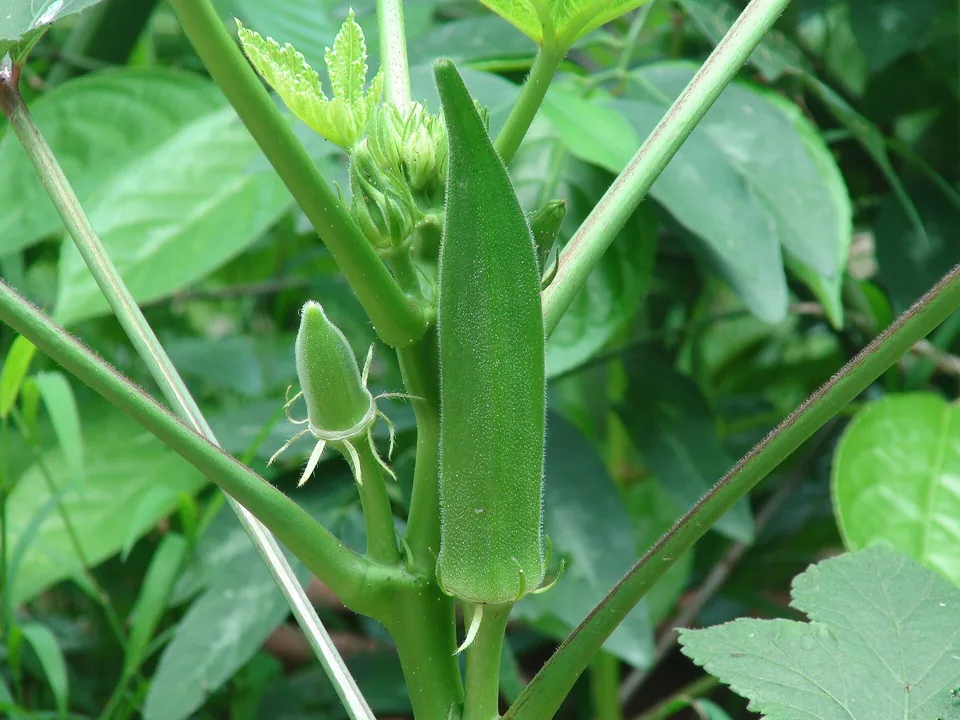


Cómo cultivar y cuidar Okra
Abelmoschus esculentus
Escrito por Emilio Marruso · última revisión
Tóxica para: Personas · Por qué
De un vistazo
La okra es una planta anual amante del sol cuyas vainas jóvenes y tiernas puedes cocinar, encurtir o incluso comer crudas, y sus bonitas flores también se comen. Dale sol pleno y un riego profundo cada 7 a 10 días, y recoge las vainas de 5 a 13 cm cada uno o dos días. Usa guantes: sus pelos pueden irritar, pero se quitan fácilmente al lavarlos.
- Sol
Sol pleno: 6 o más horas al día
Qué dicen las fuentes (1)
Luz: Pleno sol (6 o más horas de luz solar directa al día)
Full sun (6 or more hours of direct sunlight a day)
— Abelmoschus esculentus (Common Ivy, Gobbo, Gumbo, Ivy Gum Plant, Ladies' Fingers, Ochro, Okra, Okro) | North Carolina Extension Gardener Plant Toolbox [1] - Riego
4–5 cm de agua cada 7–10 días; riega por la mañana para que las hojas se sequen antes de la noche
Qué dicen las fuentes (6)
Riego: Tolera condiciones relativamente secas, pero un riego adecuado aumenta el crecimiento y el rendimiento; para obtener rendimientos máximos aplica 1.5 a 2 pulgadas [3,8–5,1 cm] de agua cada 7 a 10 días; riega para humedecer el suelo hasta una profundidad de 6 pulgadas [15 cm].
Okra tolerates relatively dry conditions, but adequate water will increase growth and yield.
— Okra in the Garden | USU [3] For maximum yields apply 1.5 to 2 inches of water every 7 to 10 days.
— Okra in the Garden | USU [3] Water the garden sufficiently to moisten the soil to a depth of 6 inches.
— How to Grow Okra in South Carolina | Home & Garden Information Center [2] Notas sobre el riego: Riega por la mañana para que el follaje se seque antes del anochecer; el riego por goteo es una alternativa a la manguera o el aspersor; el período crítico para la humedad del suelo es durante la formación y el desarrollo de las vainas; la okra no tolera condiciones de suelo húmedo
Water in the morning, allowing the foliage to dry before dark.
— How to Grow Okra in South Carolina | Home & Garden Information Center [2] The critical period for soil moisture is during pod set and pod development.
— How to Grow Okra in South Carolina | Home & Garden Information Center [2] Almost all soils are suitable for okra production, provided they are well-drained. Okra does not tolerate wet soil conditions.
— Okra in the Garden | USU [3] - Frío
Trasplanta en primavera solo cuando ya no haya riesgo de heladas
Qué dicen las fuentes (2)
Plantación: Trasplantes en primavera después de que haya pasado el riesgo de heladas; en áreas de temporada corta, comienza las semillas en interiores 4 a 5 semanas antes de trasplantar al exterior
Sow seeds or plant transplants in spring after the chance of frost has passed.
— Abelmoschus esculentus (Common Ivy, Gobbo, Gumbo, Ivy Gum Plant, Ladies' Fingers, Ochro, Okra, Okro) | North Carolina Extension Gardener Plant Toolbox [1] In areas with a short growing season, start seeds indoors 4 to 5 weeks before they are to be transplanted outdoors.
— Okra in the Garden | USU [3] - Distancia
90–180 cm entre hileras
Qué dicen las fuentes (2)
Distancia entre hileras: 91-183 cm (3 a 6 pies)
Okra should be planted in rows 3 to 6 feet apart with 9 to 12 inches between seeds in the row at a depth of ¾ inch.
— How to Grow Okra in South Carolina | Home & Garden Information Center [2] Plant seeds 1 inch deep and 2 inches apart, thin to 1 to 2 feet apart depending on plant size after plants develop their first true leaves. Space rows 3 feet apart.
— Okra in the Garden | USU [3] - Siembra
Donde el verano es corto, siembra en interior 4–5 semanas antes del trasplante
Qué dicen las fuentes (2)
Plantación: Trasplantes en primavera después de que haya pasado el riesgo de heladas; en áreas de temporada corta, comienza las semillas en interiores 4 a 5 semanas antes de trasplantar al exterior
Sow seeds or plant transplants in spring after the chance of frost has passed.
— Abelmoschus esculentus (Common Ivy, Gobbo, Gumbo, Ivy Gum Plant, Ladies' Fingers, Ochro, Okra, Okro) | North Carolina Extension Gardener Plant Toolbox [1] In areas with a short growing season, start seeds indoors 4 to 5 weeks before they are to be transplanted outdoors.
— Okra in the Garden | USU [3] - Abonado
Abona antes de plantar y luego añade nitrógeno; con demasiado nitrógeno temprano da hojas, no vainas
Qué dicen las fuentes (7)
Cuándo: Antes de plantar, se incorpora al suelo; luego abonos nitrogenados de cobertera mientras las plantas están produciendo
abono de cobertera (Carolina del Sur): Sidedressing should occur at 3 to 4 weeks and again at 6 to 8 weeks after planting.
— How to Grow Okra in South Carolina | Home & Garden Information Center [2] abono de cobertera (Utah): Side dress okra with ¼ pound of 21-0-0 fertilizer per 100 sq ft when pods begin to size and repeat 4 weeks later.
— Okra in the Garden | USU [3] final de temporada: It is important to supply additional nitrogen late in the season when the blooms are concentrated at the top of the plant.
— How to Grow Okra in South Carolina | Home & Garden Information Center [2] Fertilizer or compost should be incorporated 3 to 6 inches into the soil before planting.
— Okra in the Garden | USU [3] Sidedressing should occur at 3 to 4 weeks and again at 6 to 8 weeks after planting.
— How to Grow Okra in South Carolina | Home & Garden Information Center [2] Evitar: Exceso de nitrógeno al inicio de la temporada y mientras las plantas son pequeñas: produce hojas en lugar de vainas
Excess nitrogen when plants are small will cause increased vegetative (leaf) growth and decreases yield and pod set.
— Okra in the Garden | USU [3] The use of additional nitrogen should be avoided on vigorous plantings until fruiting begins to manage plant growth and ensure pod production.
— How to Grow Okra in South Carolina | Home & Garden Information Center [2] - Poda
De mediados de julio a mediados de agosto, si produce menos, poda a 15–30 cm del suelo
Qué dicen las fuentes (2)
Poda: Mediados de julio a mediados de agosto, cuando la producción de okra disminuye o la producción de flores cesa (rebrote o «ratooning»: corta o poda a 6 a 12 pulgadas [15–30 cm] por encima de la línea del suelo).
If okra production slows or flower production ceases, gardeners can ratoon okra (mid-July to mid-August).
— How to Grow Okra in South Carolina | Home & Garden Information Center [2] Mow or prune to 6 to 12 inches above the soil line.
— How to Grow Okra in South Carolina | Home & Garden Information Center [2] - Cosecha
Recoge vainas de 5–13 cm cada 1–2 días; guárdalas sin lavar en la nevera
Qué dicen las fuentes (9)
Cómo cosechar: Recoge las vainas cuando estén inmaduras y tiernas, de 5-7,6 cm (2 a 3 pulgadas) a 7,6-12,7 cm (3 a 5 pulgadas) de largo; corta el tallo dejando un pedúnculo de 0,6 cm (1/4 de pulgada) en la vaina, o tira de la vaina hacia abajo para romper el tallo cerca de su base; cosecha cada uno o dos días y no dejes que las vainas maduren en la planta; usa guantes porque los pelos de las vainas pueden irritar.
Pods are harvested when they are 3 to 5 inches long, immature and tender.
— Okra in the Garden | USU [3] Harvest about 60 to 70 days after planting, when pods are 2 to 3 inches long.
— How to Grow Okra in South Carolina | Home & Garden Information Center [2] Harvest pods by cutting the stem leaving a ¼ inch stalk on the pod or by pulling the pod downward, thus breaking the stem near its base.
— Okra in the Garden | USU [3] Okra grows very quickly; therefore, it must be harvested at least every two days.
— How to Grow Okra in South Carolina | Home & Garden Information Center [2] The hairs on the seed pods can be an irritant, gloves should be used when handling.
— Abelmoschus esculentus (Common Ivy, Gobbo, Gumbo, Ivy Gum Plant, Ladies' Fingers, Ochro, Okra, Okro) | North Carolina Extension Gardener Plant Toolbox [1] Conservación: No laves las vainas antes de almacenarlas; mantenlas en una bolsa de plástico en el refrigerador en un ambiente húmedo a 7-10 °C (45 a 50 °F), donde las vainas de buena calidad duran hasta unos siete días.
Do not wash okra before storing it in the refrigerator, as this can speed up decay.
— How to Grow Okra in South Carolina | Home & Garden Information Center [2] If properly harvested, handled, and stored, good-quality pods can last up to seven days in the refrigerator.
— How to Grow Okra in South Carolina | Home & Garden Information Center [2] Okra should be stored in a plastic bag and can be refrigerated for about seven days.
— Okra in the Garden | USU [3] The optimum conditions for storing fresh okra are a moist environment and temperatures of 45 °F to 50 °F.
— How to Grow Okra in South Carolina | Home & Garden Information Center [2] - Plagas
Pulgones, gusanos de la mazorca, babosas, moscas blancas; raíces podridas en suelo encharcado
Qué dicen las fuentes (5)
Plagas: pulgones, gusanos del choclo, babosas, moscas blancas, arañitas rojas, chinches apestosas, chinches de patas laminadas, nematodos agalladores
Insects include aphids, corn earworms, slugs, whiteflies, and spider mites.
— Abelmoschus esculentus (Common Ivy, Gobbo, Gumbo, Ivy Gum Plant, Ladies' Fingers, Ochro, Okra, Okro) | North Carolina Extension Gardener Plant Toolbox [1] Stink bugs and leaf-footed bugs will cause the pods to be twisted and distorted.
— How to Grow Okra in South Carolina | Home & Garden Information Center [2] Root-knot nematodes can be a serious problem with okra.
— How to Grow Okra in South Carolina | Home & Garden Information Center [2] Enfermedades: podredumbre de raíz, enfermedades de pudrición de raíces de plántulas, oídio
Poorly drained soil can lead to root rot. Powdery mildew can be an issue.
— Abelmoschus esculentus (Common Ivy, Gobbo, Gumbo, Ivy Gum Plant, Ladies' Fingers, Ochro, Okra, Okro) | North Carolina Extension Gardener Plant Toolbox [1] Root-decay diseases, causing young seedling death, are the most serious okra disease problems.
— How to Grow Okra in South Carolina | Home & Garden Information Center [2] - Tamaño
90–150 cm de alto
Qué dicen las fuentes (1)
Altura adulta: 91-152 cm (3 a 5 pies)
Dimensions: Height: 3 ft. 0 in. - 5 ft. 0 in. Width: 3 ft. 0 in. - 5 ft. 0 in.
— Abelmoschus esculentus (Common Ivy, Gobbo, Gumbo, Ivy Gum Plant, Ladies' Fingers, Ochro, Okra, Okro) | North Carolina Extension Gardener Plant Toolbox [1] - Seguridad
Los pelos de las vainas pueden irritar la piel; usa guantes
Resumen
El okra es una hortaliza anual de temporada cálida que se cultiva a pleno sol por sus vainas de semillas inmaduras. [1][2] Se siembra o trasplanta en primavera después de que haya pasado el riesgo de heladas, y tolera condiciones relativamente secas aunque un riego adecuado aumenta el crecimiento y el rendimiento. [1][3] Los pelos de las vainas de semillas pueden ser irritantes, por lo que se deben usar guantes al manipularlas. [1]
Citado en inglés, como en la fuente.
Cuidados
Las medidas entre corchetes son nuestra conversión al otro sistema de unidades; el texto citado no cambia.
Riego
Riego
Tolera condiciones relativamente secas, pero un riego adecuado aumenta el crecimiento y el rendimiento; para obtener rendimientos máximos aplica 1.5 a 2 pulgadas [3,8–5,1 cm] de agua cada 7 a 10 días; riega para humedecer el suelo hasta una profundidad de 6 pulgadas [15 cm].
Qué dicen las fuentes (3)
Okra tolerates relatively dry conditions, but adequate water will increase growth and yield.For maximum yields apply 1.5 to 2 inches of water every 7 to 10 days.Water the garden sufficiently to moisten the soil to a depth of 6 inches.Notas sobre el riego
Riega por la mañana para que el follaje se seque antes del anochecer; el riego por goteo es una alternativa a la manguera o el aspersor; el período crítico para la humedad del suelo es durante la formación y el desarrollo de las vainas; la okra no tolera condiciones de suelo húmedo
Qué dicen las fuentes (3)
Water in the morning, allowing the foliage to dry before dark.The critical period for soil moisture is during pod set and pod development.Almost all soils are suitable for okra production, provided they are well-drained. Okra does not tolerate wet soil conditions.Luz
Pleno sol (6 o más horas de luz solar directa al día)
Qué dicen las fuentes (1)
Full sun (6 or more hours of direct sunlight a day)Suelo
pH del suelo, mínimo
Las fuentes dan valores distintos según la región, la zona o las condiciones de cultivo.
Lo que dice cada fuente
Según Clemson Cooperative Extension HGIC: 5.8
Según Utah State University Extension: 6.0
Qué dicen las fuentes (2)
Según Clemson Cooperative Extension HGIC: Follow the results of a soil test to maintain a soil pH between 5.8 and 6.5 and optimal fertility levels.Según Utah State University Extension: Fertile, sandy loam soils with a pH of 6.0 to 7.0 are ideal for growing okra.pH del suelo, máximo
Las fuentes dan valores distintos según la región, la zona o las condiciones de cultivo.
Lo que dice cada fuente
Según Clemson Cooperative Extension HGIC: 6.5
Según Utah State University Extension: 7.0
Qué dicen las fuentes (2)
Según Clemson Cooperative Extension HGIC: Follow the results of a soil test to maintain a soil pH between 5.8 and 6.5 and optimal fertility levels.Según Utah State University Extension: Fertile, sandy loam soils with a pH of 6.0 to 7.0 are ideal for growing okra.Dónde cultivarla
En maceta
Sí
Qué dicen las fuentes (1)
#warm season vegetable #edible flowers #edible fruits #yellow flowers #contact dermatitis #container plantDistancia de plantación
Las fuentes dan valores distintos según la región, la zona o las condiciones de cultivo.
Lo que dice cada fuente
Según Clemson Cooperative Extension HGIC: 22.9-30.5 cm (9-12 pulgadas) entre plantas; hileras separadas 91.4-182.9 cm (3 a 6 pies)
Según Utah State University Extension: 30.5-61.0 cm (1-2 pies) de separación después del raleo; hileras separadas 91.4 cm (3 pies)
Qué dicen las fuentes (2)
Según Clemson Cooperative Extension HGIC: Okra should be planted in rows 3 to 6 feet apart with 9 to 12 inches between seeds in the row at a depth of ¾ inch.Según Utah State University Extension: Plant seeds 1 inch deep and 2 inches apart, thin to 1 to 2 feet apart depending on plant size after plants develop their first true leaves.Propagación
Semilla (siembra directa, o iniciada en interiores y trasplantada)
Qué dicen las fuentes (2)
Sow seeds or plant transplants in spring after the chance of frost has passed.To enhance germination soak seeds overnight before sowing.Cultivo
La planta
Ciclo de vida
anual
Qué dicen las fuentes (1)
Life Cycle: Annual Recommended Propagation Strategy: Seed Country Or Region Of Origin: Tropical Africa and AsiaFamilia
Malvaceae
Qué dicen las fuentes (1)
Okra is a warm-season vegetable in the mallow family (Malvaceae). It is native to tropical areas of Africa and AsiaAltura adulta
91-152 cm (3 a 5 pies)
Qué dicen las fuentes (1)
Dimensions: Height: 3 ft. 0 in. - 5 ft. 0 in. Width: 3 ft. 0 in. - 5 ft. 0 in.Siembra y crecimiento
Profundidad de siembra
Distancia entre hileras
91-183 cm (3 a 6 pies)
Qué dicen las fuentes (2)
Okra should be planted in rows 3 to 6 feet apart with 9 to 12 inches between seeds in the row at a depth of ¾ inch.Plant seeds 1 inch deep and 2 inches apart, thin to 1 to 2 feet apart depending on plant size after plants develop their first true leaves. Space rows 3 feet apart.Días hasta la madurez
Las fuentes no coinciden:
Cosecha y conservación
Cómo cosechar
Recoge las vainas cuando estén inmaduras y tiernas, de 5-7,6 cm (2 a 3 pulgadas) a 7,6-12,7 cm (3 a 5 pulgadas) de largo; corta el tallo dejando un pedúnculo de 0,6 cm (1/4 de pulgada) en la vaina, o tira de la vaina hacia abajo para romper el tallo cerca de su base; cosecha cada uno o dos días y no dejes que las vainas maduren en la planta; usa guantes porque los pelos de las vainas pueden irritar.
Qué dicen las fuentes (5)
Pods are harvested when they are 3 to 5 inches long, immature and tender.Harvest about 60 to 70 days after planting, when pods are 2 to 3 inches long.Harvest pods by cutting the stem leaving a ¼ inch stalk on the pod or by pulling the pod downward, thus breaking the stem near its base.Okra grows very quickly; therefore, it must be harvested at least every two days.The hairs on the seed pods can be an irritant, gloves should be used when handling.Conservación
No laves las vainas antes de almacenarlas; mantenlas en una bolsa de plástico en el refrigerador en un ambiente húmedo a 7-10 °C (45 a 50 °F), donde las vainas de buena calidad duran hasta unos siete días.
Qué dicen las fuentes (4)
Do not wash okra before storing it in the refrigerator, as this can speed up decay.If properly harvested, handled, and stored, good-quality pods can last up to seven days in the refrigerator.Okra should be stored in a plastic bag and can be refrigerated for about seven days.The optimum conditions for storing fresh okra are a moist environment and temperatures of 45 °F to 50 °F.Guardar semillas
Deja las vainas en la planta para que se sequen y guarda la semilla para el próximo año.
Qué dicen las fuentes (1)
Leave okra pods on the plant to dry after harvest to save seed for next year.Plagas y enfermedades
Plagas
pulgones, gusanos del choclo, babosas, moscas blancas, arañitas rojas, chinches apestosas, chinches de patas laminadas, nematodos agalladores
Qué dicen las fuentes (3)
Insects include aphids, corn earworms, slugs, whiteflies, and spider mites.Stink bugs and leaf-footed bugs will cause the pods to be twisted and distorted.Root-knot nematodes can be a serious problem with okra.Enfermedades
podredumbre de raíz, enfermedades de pudrición de raíces de plántulas, oídio
Qué dicen las fuentes (2)
Poorly drained soil can lead to root rot. Powdery mildew can be an issue.Root-decay diseases, causing young seedling death, are the most serious okra disease problems.Abonado
Cuándo
Antes de plantar, se incorpora al suelo; luego abonos nitrogenados de cobertera mientras las plantas están produciendo
Lo que dice cada fuente
abono de cobertera (Carolina del Sur): 3 a 4 semanas y nuevamente 6 a 8 semanas después de la siembra
abono de cobertera (Utah): Cuando las vainas comiencen a tomar tamaño, repite 4 semanas después.
final de temporada: Nitrógeno adicional cuando las flores se concentran en la parte superior de la planta
Qué dicen las fuentes (5)
abono de cobertera (Carolina del Sur): Sidedressing should occur at 3 to 4 weeks and again at 6 to 8 weeks after planting.abono de cobertera (Utah): Side dress okra with ¼ pound of 21-0-0 fertilizer per 100 sq ft when pods begin to size and repeat 4 weeks later.final de temporada: It is important to supply additional nitrogen late in the season when the blooms are concentrated at the top of the plant.Fertilizer or compost should be incorporated 3 to 6 inches into the soil before planting.Sidedressing should occur at 3 to 4 weeks and again at 6 to 8 weeks after planting.Frecuencia
Dos aplicaciones de nitrógeno en cobertera durante la temporada, con más si la producción dura mucho
Qué dicen las fuentes (3)
Sidedressing should occur at 3 to 4 weeks and again at 6 to 8 weeks after planting.Additional applications of calcium nitrate may be needed later, depending on rainfall and the duration of okra production.Side dress okra with ¼ pound of 21-0-0 fertilizer per 100 sq ft when pods begin to size and repeat 4 weeks later.Abonos naturales
Compost a base de estiércol, una capa de 1.27–2.54 cm [0,5–1 in] de profundidad, trabajada 7.62–15.2 cm [3–6 in] en el suelo antes de plantar
Qué dicen las fuentes (2)
For most gardens, 2 to 3 pounds of 10-10-10 fertilizer per 100 sq ft or 0.5 to 1 inch of manure-based compost provides sufficient nutrients.Fertilizer or compost should be incorporated 3 to 6 inches into the soil before planting.Abonos minerales
10-10-10 trabajado antes de plantar, luego aplicaciones de nitrógeno en cobertera como nitrato de calcio (15.5-0-0) o 21-0-0
Lo que dice cada fuente
antes de plantar: 97.6–146 g/m² de 10-10-10
abono de cobertera (Carolina del Sur): 14.6–29.3 g/m² de nitrato de calcio (15.5-0-0)
abono de cobertera (Utah): 12.2 g/m² de 21-0-0
después del resguardo: Un fertilizante con relación 1:2 de nitrógeno a potasio (4-0-8, 5-0-10 o 10-0-20), 907 g–1.36 kg [3 lb] por 30.5 m [100 ft] de hilera
Qué dicen las fuentes (7)
antes de plantar: For most gardens, 2 to 3 pounds of 10-10-10 fertilizer per 100 sq ft or 0.5 to 1 inch of manure-based compost provides sufficient nutrients.abono de cobertera (Carolina del Sur): Apply 3 to 6 pounds of calcium nitrate (15.5-0-0) per 1,000 square feet.abono de cobertera (Utah): Side dress okra with ¼ pound of 21-0-0 fertilizer per 100 sq ft when pods begin to size and repeat 4 weeks later.después del resguardo: Fertilize with a 1:2 nitrogen to potassium ratio fertilizer (4-0-8, 5-0-10, or 10-0-20). - Apply 2 to 3 pounds per 100 feet of row.For most gardens, 2 to 3 pounds of 10-10-10 fertilizer per 100 sq ft or 0.5 to 1 inch of manure-based compost provides sufficient nutrients.Apply 3 to 6 pounds of calcium nitrate (15.5-0-0) per 1,000 square feet.Side dress okra with ¼ pound of 21-0-0 fertilizer per 100 sq ft when pods begin to size and repeat 4 weeks later.Evitar
Exceso de nitrógeno al inicio de la temporada y mientras las plantas son pequeñas: produce hojas en lugar de vainas
Qué dicen las fuentes (2)
Excess nitrogen when plants are small will cause increased vegetative (leaf) growth and decreases yield and pod set.The use of additional nitrogen should be avoided on vigorous plantings until fruiting begins to manage plant growth and ensure pod production.Signos de exceso
Crecimiento frondoso con menos vainas y menor rendimiento
Qué dicen las fuentes (1)
Excess nitrogen when plants are small will cause increased vegetative (leaf) growth and decreases yield and pod set.Problemas
Pudriciones de raíz y mal de los almácigos
Qué hacer: Evita plantar en suelos fríos, húmedos y con mal drenaje; inicia los trasplantes en tierra de calidad para macetas en un área brillante y cálida.
Qué dicen las fuentes (1)
Plants are stunted, have yellow leaves, and brown, rotting roots. Plants die after emergence.
— Okra in the Garden | USU [3] Pulgones
Qué hacer: Usa jabones insecticidas o una corriente de agua fuerte para desprender los pulgones.
Qué dicen las fuentes (1)
Use insecticidal soaps or a strong water stream to dislodge aphids from the plants.
— Okra in the Garden | USU [3] Nematodos de nudo de raíz
Qué hacer: Practica rotaciones de cultivos y retira y destruye las plantas dañadas.
Qué dicen las fuentes (1)
Infected plants have stunted growth and have galls on their roots.
— Okra in the Garden | USU [3] Mildiu polvoriento y otros insectos
Qué hacer: Un suelo con mal drenaje puede provocar pudrición de raíces, así que planta en un suelo bien drenado
Qué dicen las fuentes (1)
Poorly drained soil can lead to root rot. Powdery mildew can be an issue. Insects include aphids, corn earworms, slugs, whiteflies, and spider mites.
— Abelmoschus esculentus (Common Ivy, Gobbo, Gumbo, Ivy Gum Plant, Ladies' Fingers, Ochro, Okra, Okro) | North Carolina Extension Gardener Plant Toolbox [1]
Remedios
Cada remedio indica qué dicen las fuentes oficiales; los remedios tradicionales sin fuente oficial aparecen marcados. Los perjudiciales están para que sepas evitarlos.
Primeros auxilios
Primeros auxilios: no sustituyen al médico
pelillos irritantes de las vainas
lavado de los pelillos Fuente oficial, sin prueba independiente
Cómo: Los pelillos se lavan fácilmente; usa guantes al manipularlas.
The hairs on the seed pods can be an irritant, gloves should be used when handling. The hairs easily wash off.
— Abelmoschus esculentus (Common Ivy, Gobbo, Gumbo, Ivy Gum Plant, Ladies' Fingers, Ochro, Okra, Okro) | North Carolina Extension Gardener Plant Toolbox [1]
Cuidar la planta
pulgones
chorro de agua fuerte No verificado
Remedio tradicional, no verificado por una fuente oficial.
Cómo: Derriba los pulgones con un chorro de agua fuerte y constante.
spray de jabón insecticida Funciona
Cómo: Aplica jabón insecticida.
knock off with water spray; apply insecticidal soap; put banana or orange peels around plants
— almanac.com [4] Qué dicen las pruebas For example, insecticidal soap is a safe, effective organic insecticide with minimal environmental impact.
— extension.psu.edu [5] cáscaras de plátano o naranja No verificado
Remedio tradicional, no verificado por una fuente oficial.
Cómo: Coloca cáscaras de plátano o naranja alrededor de las plantas.
limpieza con solución de jabón para platos Perjudicial
Home remedies often lack specific mix or use rates or identify how often to use them. Not using enough may not control the pest, while using too much may be harmful to the environment.
— extension.psu.edu [6] Cómo: Limpia las hojas con una solución de 1 a 2 por ciento de jabón para platos (sin aditivos) y agua cada 2 a 3 días durante 2 semanas.
wipe leaves with a 1 to 2 percent solution of dish soap (no additives) and water every 2 to 3 days for 2 weeks
— almanac.com [4] Qué dicen las pruebas For example, spraying home remedies that contain dish detergent on plants on a sunny day can injure the plant, essentially burning it.
— extension.psu.edu [6] tierra de diatomeas No verificado
Remedio tradicional, no verificado por una fuente oficial.
Cómo: Espolvorea tierra de diatomeas alrededor de las plantas.
cultivo trampa de capuchina No verificado
Remedio tradicional, no verificado por una fuente oficial.
Cómo: Planta repollo temprano y capuchinas cerca del jardín para atraer pulgones.
escarabajos de la pulga
chorro de agua fuerte No verificado
Remedio tradicional, no verificado por una fuente oficial.
Cómo: Saca los escarabajos de la pulga con un chorro de agua fuerte y constante.
tierra de diatomeas No verificado
Remedio tradicional, no verificado por una fuente oficial.
Cómo: Espolvorea tierra de diatomeas alrededor de las plantas.
cultivos trampa de bok choy y rábano No verificado
Remedio tradicional, no verificado por una fuente oficial.
Cómo: Planta bok choy y rábanos como cultivos trampa cerca del jardín.
plagas de insectos
spray de aceite de neem Funciona
Cómo: El aceite de neem es una alternativa fácilmente disponible al jabón insecticida.
Insecticidal soap is a natural insecticide that will kill many of the pests on your okra. You can buy insecticidal soaps and horticultural oils at garden centers. Neem oil is another choice that is readily available.
— weekand.com [7] Qué dicen las pruebas Neem oil is found in the seeds of the neem tree. The active component found in this biological pesticide reduces insect feeding, interferes with hormones
— extension.illinois.edu [8] spray casero de jabón de castilla No verificado
Remedio tradicional, no verificado por una fuente oficial.
Home remedies often lack specific mix or use rates or identify how often to use them. Not using enough may not control the pest, while using too much may be harmful to the environment.
— extension.psu.edu [6] Cómo: Mezcla 2 cucharadas de jabón líquido vegetal sin colorantes ni fragancias, como jabón de castilla, con 1 galón de agua y rocía el quingombó.
chinches apestosas
recolección manual No verificado
Remedio tradicional, no verificado por una fuente oficial.
Cómo: Recoge los insectos a mano (huelen mal, usa guantes).
spray de jabón insecticida Funciona
Cómo: Destruye los huevos y rocía las ninfas con jabón insecticida.
handpick (bugs emit odor, wear gloves); destroy eggs, spray nymphs with insecticidal soap; use row covers
— almanac.com [4] Qué dicen las pruebas For example, insecticidal soap is a safe, effective organic insecticide with minimal environmental impact.
— extension.psu.edu [5]
moscas blancas
aspiradora de mano No verificado
Remedio tradicional, no verificado por una fuente oficial.
Cómo: Usa una aspiradora de mano para eliminar las plagas.
chorro de agua en el envés de las hojas No verificado
Remedio tradicional, no verificado por una fuente oficial.
Cómo: Rocía con agua el envés de las hojas por la mañana o por la tarde para desprender las plagas.
spray de jabón insecticida Funciona
Cómo: Rocía con jabón insecticida.
monitor adults with yellow sticky traps; spray with insecticidal soap; invite beneficial insects and hummingbirds with native plants
— almanac.com [4] Qué dicen las pruebas For example, insecticidal soap is a safe, effective organic insecticide with minimal environmental impact.
— extension.psu.edu [5]
mildiu polvoriento
rociado con bicarbonato de sodio No verificado
Remedio tradicional, no verificado por una fuente oficial.
Cómo: Rocía las plantas con 1 cucharadita de bicarbonato de sodio disuelta en 1 cuarto de galón de agua.
Toxicidad
Según la fuente, citada textualmente. No es un consejo médico ni veterinario: si una persona o un animal pudo haber ingerido esta planta, contacta con un centro de toxicología o con un veterinario.
Calendario
Siembra
Las fuentes dan valores distintos según la región, la zona o las condiciones de cultivo.
Lo que dice cada fuente
Según NC State Extension: Las temperaturas permanecen por encima de los 55 grados F [13 °C]; siembra en primavera después de que haya pasado el riesgo de heladas.
Según Clemson Cooperative Extension HGIC: Temperatura óptima del suelo 70-95 F; espera a plantar si la temperatura es inferior a 65 F a una profundidad de 4 pulgadas [10 cm].
Según Utah State University Extension: 2 a 3 semanas después de la fecha de la última helada o cuando la temperatura del suelo sea de al menos 75 F
Qué dicen las fuentes (6)
Según NC State Extension: Sow seeds or plant transplants in spring after the chance of frost has passed. If grown from seed, ensure the temperatures remain above 55 degrees F or start indoors.Según Clemson Cooperative Extension HGIC: If soil temperatures are less than 65 °F, at a soil depth of 4 inches, gardeners should hold off on planting until soil temperatures are warmer.Según Utah State University Extension: Plant seeds 2 to 3 weeks after the last frost date or when soil temperatures are at least 75˚F.Sow seeds or plant transplants in spring after the chance of frost has passed.If grown from seed, ensure the temperatures remain above 55 degrees F or start indoors.Plant seeds 2 to 3 weeks after the last frost date or when soil temperatures are at least 75˚F.Plantación
Trasplantes en primavera después de que haya pasado el riesgo de heladas; en áreas de temporada corta, comienza las semillas en interiores 4 a 5 semanas antes de trasplantar al exterior
Qué dicen las fuentes (2)
Sow seeds or plant transplants in spring after the chance of frost has passed.In areas with a short growing season, start seeds indoors 4 to 5 weeks before they are to be transplanted outdoors.Cosecha
Las fuentes dan valores distintos según la región, la zona o las condiciones de cultivo.
Lo que dice cada fuente
Según Clemson Cooperative Extension HGIC: 60 a 70 días después de la siembra, vainas de 2 a 3 pulgadas [5,1–7,6 cm] de largo
Según Utah State University Extension: 90 días después de sembrar las semillas, vainas de 3 a 5 pulgadas [8–13 cm] de largo
Según NC State Extension: aproximadamente 4 meses después de la siembra, vainas de 3 pulgadas [7,6 cm] de largo
Qué dicen las fuentes (3)
Según Clemson Cooperative Extension HGIC: Harvest about 60 to 70 days after planting, when pods are 2 to 3 inches long.Según Utah State University Extension: Okra is a warm season vegetable that requires 90 days to mature harvestable pods once seeds are planted.Según NC State Extension: The pods can be harvested when they reach a length of 3 inches, approximately 4 months after sowing.Poda
Mediados de julio a mediados de agosto, cuando la producción de okra disminuye o la producción de flores cesa (rebrote o «ratooning»: corta o poda a 6 a 12 pulgadas [15–30 cm] por encima de la línea del suelo).
Qué dicen las fuentes (2)
If okra production slows or flower production ceases, gardeners can ratoon okra (mid-July to mid-August).Mow or prune to 6 to 12 inches above the soil line.Meses tal como los dan las fuentes, en su mayoría de Estados Unidos (hemisferio norte). En el hemisferio sur se desplazan unos seis meses.
Respecto a las heladas
Estimación menos precisa: no hay ninguna estación meteorológica a menos de 300 km.
Busca las fechas de heladas por código postal o ciudad
Siembra al aire libre: hacia la última helada
Sow seeds or plant transplants in spring after the chance of frost has passed.
— Abelmoschus esculentus (Common Ivy, Gobbo, Gumbo, Ivy Gum Plant, Ladies' Fingers, Ochro, Okra, Okro) | North Carolina Extension Gardener Plant Toolbox [1] Trasplante: hacia la última helada
Sow seeds or plant transplants in spring after the chance of frost has passed.
— Abelmoschus esculentus (Common Ivy, Gobbo, Gumbo, Ivy Gum Plant, Ladies' Fingers, Ochro, Okra, Okro) | North Carolina Extension Gardener Plant Toolbox [1] Siembra al aire libre: de 2 a 3 semanas después de la última helada
Plant seeds 2 to 3 weeks after the last frost date
— Okra in the Garden | USU [3]
Cuenta desde las fechas medias de las heladas de tu zona.
Comestibilidad
Según la fuente, citada textualmente. No comas una planta basándote solo en esta página: los errores de identificación pueden ser peligrosos.
Valores orientativos
Valores de una fuente secundaria, no comprobados palabra por palabra como el resto de esta página. Úselos como punto de partida.
- Horas de sol
- 6-8 horasValor orientativo, adáptalo a tu clima · Fuente secundaria
- Zonas de rusticidad USDA
- 2-11 [mínima invernal de −45,6 a 10 °C (de −50 a 50 °F)]Valor orientativo, adáptalo a tu clima · Fuente secundaria
- Crecimiento
- AltaValor orientativo, adáptalo a tu clima · Fuente secundaria
Plantas similares
- Sunset Huskmallow Abelmoschus manihot
- Abelmosco Abelmoschus moschatus
- Baobab africano Adansonia digitata
- Guasmo Guazuma ulmifolia
- Tilo de hoja ancha Tilia platyphyllos
- Brazilian Bellflower Callianthe megapotamica
- Cape Mallow Anisodontea capensis
- Rosa de China Hibiscus × rosa-sinensis
Fuentes
Cada valor anterior se cita de estos documentos. Los enlaces llevan al editor original.
- Abelmoschus esculentus (Common Ivy, Gobbo, Gumbo, Ivy Gum Plant, Ladies' Fingers, Ochro, Okra, Okro) | North Carolina Extension Gardener Plant Toolbox · plants.ces.ncsu.edu, consultado
- How to Grow Okra in South Carolina | Home & Garden Information Center · hgic.clemson.edu, consultado
- Okra in the Garden | USU · extension.usu.edu, consultado
- almanac.com · almanac.com
- extension.psu.edu · extension.psu.edu
- extension.psu.edu · extension.psu.edu
- weekand.com · weekand.com
- extension.illinois.edu · extension.illinois.edu
Escrito por Emilio Marruso · última revisión