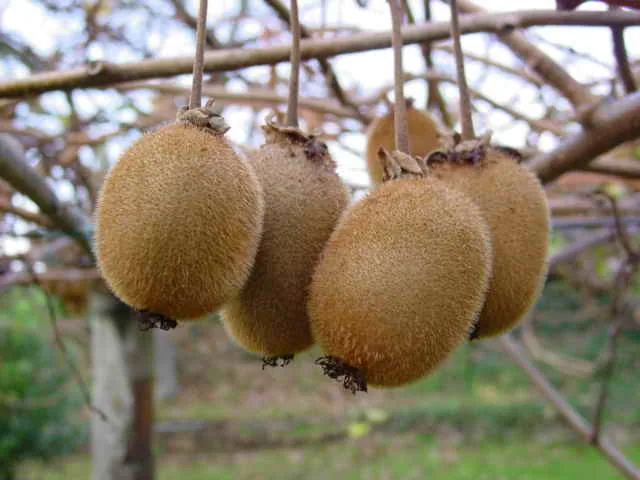

Cómo cultivar y cuidar Kiwi
Actinidia deliciosa
Escrito por Emilio Marruso · última revisión
Tóxica para: Personas · Por qué
De un vistazo
El kiwi premia la paciencia con frutos peludos que puedes comer crudos o añadir a tus ensaladas. Dale sol pleno, tierra siempre húmeda y mucho calor, y planta un ejemplar macho cerca de las hembras para que den fruto. Cosecha de octubre a principios de noviembre, cuando el fruto esté algo blando y las semillas se hayan vuelto negras.
- Sol
Sol pleno; tolera algo de sombra
Qué dicen las fuentes (1)
Luz: Pleno sol; tolera algo de sombra
It is best if planted in full sun in well-drained soil but it will tolerate some shade which may cause less volume of fruit.
— Actinidia chinensis var. deliciosa (Chinese Gooseberry, Kiwifruit, Kiwi Fruit, Smooth-Skinned Kiwifruit, Yangtao) | North Carolina Extension Gardener Plant Toolbox [1] - Riego
5 cm de agua a la semana en temporada de crecimiento; tierra siempre húmeda, sin encharcar
Qué dicen las fuentes (5)
Riego: Tierra constantemente húmeda, sin agua estancada
Mature plants require consistently moist soil, but standing water can lead to root rot.
— Did you know you can grow: Kiwi | CAES Field Report [4] Soil must be well drained but kept moist at all times.
— Growing Temperate Tree Fruit and Nut Crops [6] Notas sobre el riego: Riega varias veces a la semana cuando la planta sea joven, e inmediatamente si las hojas empiezan a doblarse o marchitarse; unos 2 pulgadas [5,1 cm] de agua a la semana durante la temporada de crecimiento
Water multiple times a week when the plant is young, and immediately if the leaves start to fold or wilt.
— Did you know you can grow: Kiwi | CAES Field Report [4] Provide about 2 inches of water a week during the growing season.
— Grow kiwifruit at home with the right support and frost protection | OSU Extension Service [7] Sequía: Sensible a la sequía y necesita mucha agua; las plantas jóvenes necesitan riego varias veces a la semana, y de inmediato si las hojas se doblan o se marchitan.
Kiwi is drought-sensitive and needs plenty of water. Water multiple times a week when the plant is young, and immediately if the leaves start to fold or wilt.
— Did you know you can grow: Kiwi | CAES Field Report [4] - Frío
Aguanta inviernos de hasta −17,8 °C (0 °F)
Rústica en inviernos muy fríos · USDA 7 · RHS H6 · Z7
Qué dicen las fuentes (4)
Rusticidad, zona más fría: 7 [mínima invernal de −17,8 a −12,2 °C (de 0 a 10 °F)]
Fuzzy kiwi, Actinidia chinensis or A. deliciosa , is the type you find in the grocery store and the most common. Cold hardy to winter temperatures of 10 degrees Fahrenheit, kiwi usually grow well in Plant Hardiness Zones 7-9 .
— Did you know you can grow: Kiwi | CAES Field Report [4] Table 1. Types and cultivars of kiwifruit adapted to Oregon regions and suited for fruit production: - ## Fuzzy kiwifruit ( Actinidia deliciosa ), Zones 7-9
— Growing kiwifruit in your home garden | OSU Extension Service [3] Rusticidad, zona más cálida: 9 [mínima invernal de −6,7 a −1,1 °C (de 20 a 30 °F)]
Fuzzy kiwi, Actinidia chinensis or A. deliciosa , is the type you find in the grocery store and the most common. Cold hardy to winter temperatures of 10 degrees Fahrenheit, kiwi usually grow well in Plant Hardiness Zones 7-9 .
— Did you know you can grow: Kiwi | CAES Field Report [4] Table 1. Types and cultivars of kiwifruit adapted to Oregon regions and suited for fruit production: - ## Fuzzy kiwifruit ( Actinidia deliciosa ), Zones 7-9
— Growing kiwifruit in your home garden | OSU Extension Service [3] - Suelo
Suelo ligeramente ácido, pH 5,6–6,5
Qué dicen las fuentes (2)
pH del suelo, mínimo: 5.6
Kiwifruit plants require a soil pH of 5.6 to 6.5.
— Growing kiwifruit in your home garden | OSU Extension Service [3] pH del suelo, máximo: 6.5
Kiwifruit plants require a soil pH of 5.6 to 6.5.
— Growing kiwifruit in your home garden | OSU Extension Service [3] - Distancia
3–6 m entre plantas, normalmente 4,5 m
Qué dicen las fuentes (4)
Entre plantas: 3.05-6.1 m [10–20 ft] entre vides, con mayor frecuencia 4.57 m [15 ft]; deja 1.83 m [6 ft] en cada extremo del soporte.
Plant two vines 15 feet apart and leave about 6 feet on each end.
— Growing kiwifruit in your home garden | OSU Extension Service [3] Space kiwi plants and their trellises about 15 feet apart.
— Did you know you can grow: Kiwi | CAES Field Report [4] Plant kiwis about 15 to 20 ft apart.
— Growing Temperate Tree Fruit and Nut Crops [6] Plant in spring, 10 to 15 feet apart, in deep, well-drained soil and full sun with wind protection.
— Grow kiwifruit at home with the right support and frost protection | OSU Extension Service [7] - Plantación
A principios de primavera, en cuanto se pueda trabajar la tierra
Qué dicen las fuentes (1)
Plantación: A principios de primavera, tan pronto como se pueda trabajar el suelo
Plant as early as you can work the soil in spring.
— Growing kiwifruit in your home garden | OSU Extension Service [3] - Abonado
Abona de primavera a mediados de verano, nunca después de julio en plantas jóvenes; nada de abono en el hoyo
Qué dicen las fuentes (9)
Cuándo: Desde primavera hasta mediados del verano; en vides jóvenes, nunca después de julio
año de plantación: Divide the total required N into three equal portions (0.4 ounces each), the first starting two weeks after planting, the next one month later, and the last one a month after that
— Growing kiwifruit in your home garden | OSU Extension Service [3] vides maduras: Use higher rates for vines with more vigor. Apply two-thirds of the total N in March; apply the last third in May or June
— Growing kiwifruit in your home garden | OSU Extension Service [3] fertilizantes orgánicos granulares (harina de plumas, soja o semilla de algodón): Therefore, it’s best to apply granular organic fertilizers about a month before inorganic fertilizers would be applied.
— Growing kiwifruit in your home garden | OSU Extension Service [3] Kiwi plants require 10-10-10 fertilizer. Apply 4 ounces during March, May and July in the first year of growth.
— Did you know you can grow: Kiwi | CAES Field Report [4] Do not fertilize young plants after July; this will force late growth and increase the potential for frost injury in the fall.
— Growing kiwifruit in your home garden | OSU Extension Service [3] Evitar: Fertilizante o estiércol en el hoyo de plantación (quema las raíces); fertilizar vides jóvenes después de julio; fertilizante sobre el tronco; compostas con alto contenido de sal, como estiércol animal fresco
Do not add fertilizers or manures to the planting hole because they will burn the roots.
— Growing kiwifruit in your home garden | OSU Extension Service [3] Do not fertilize young plants after July; this will force late growth and increase the potential for frost injury in the fall.
— Growing kiwifruit in your home garden | OSU Extension Service [3] Spread the fertilizer around the base of the trunk in a 12-inch-diameter circle but avoid getting any on the trunk.
— Growing kiwifruit in your home garden | OSU Extension Service [3] You can also use high-pH composts to add organic matter and increase soil pH. However, avoid composts with a high salt content (electrical conductivity or EC), such as fresh animal manures.
— Growing kiwifruit in your home garden | OSU Extension Service [3] - Poda
Poda las hembras en invierno y los machos tras la floración; deja los sarmientos del año pasado, que dan fruto
Qué dicen las fuentes (9)
Poda: Vides femeninas: de diciembre a enero; vides masculinas: en verano, inmediatamente después de la floración
Prune female vines every winter. In the Willamette Valley and southwestern Oregon, prune female fuzzy and kiwiberry vines from December through January.
— Growing kiwifruit in your home garden | OSU Extension Service [3] Figure 29. A gardener prunes a male fuzzy kiwifruit vine in summer immediately after bloom.
— Growing kiwifruit in your home garden | OSU Extension Service [3] Cuándo podar: Poda las enredaderas femeninas cada invierno mientras estén en reposo, mucho antes de que empiecen a crecer (los cortes tardíos pierden savia). Poda las enredaderas masculinas justo después de la floración, no en invierno. Poda también en verano. Conserva los tallos de 1 año, porque las flores salen en los brotes que nacen del crecimiento del año anterior.
Prune female vines every winter. In the Willamette Valley and southwestern Oregon, prune female fuzzy and kiwiberry vines from December through January.
— Growing kiwifruit in your home garden | OSU Extension Service [3] Pruning should be done well before growth starts in the spring to prevent vine bleeding.
— Kiwifruit and Hardy Kiwi (Kiwiberries) | CFAES Knowledge Hub [2] Do not prune male vines in winter (Figure 27). Instead, prune male vines immediately after bloom (in late June in the Willamette Valley).
— Growing kiwifruit in your home garden | OSU Extension Service [3] They need twice yearly pruning, in summer and winter, to keep them in check and fruiting well
— [8] In all kiwifruit, flowers are produced on shoots that grow from 1-year-old canes (last year’s growth).
— Growing kiwifruit in your home garden | OSU Extension Service [3] Madera que florece: Flores en los brotes de este año que crecen a partir de madera de un año
In all kiwifruit, flowers are produced on shoots that grow from 1-year-old canes (last year’s growth).
— Growing kiwifruit in your home garden | OSU Extension Service [3] Flowers and fruit are produced on new shoots that sprout from the base of the previous year’s growth, rather than from older stems.
— [8] - Cosecha
De octubre a principios de noviembre, con el fruto algo blando y las semillas negras
Qué dicen las fuentes (5)
Cosecha: De octubre a principios de noviembre
California: Vines leaf out in March, bloom occurs in May, and fruits are harvested in October and November.
— Growing Temperate Tree Fruit and Nut Crops [6] Oeste de Oregón: pick ‘Hayward’ and other fuzzy kiwifruit cultivars as late as possible (late October/early November, or before the first hard frost)
— Growing kiwifruit in your home garden | OSU Extension Service [3] Georgia: Kiwi typically matures to full size in August but will not be fully ripe until around October.
— Did you know you can grow: Kiwi | CAES Field Report [4] Vines leaf out in March, bloom occurs in May, and fruits are harvested in October and November.
— Growing Temperate Tree Fruit and Nut Crops [6] Cómo cosechar: Cosecha cuando el fruto esté ligeramente blando y sus semillas estén negras.
The fruit is ready to harvest when it is slightly soft and its seeds are black.
— Did you know you can grow: Kiwi | CAES Field Report [4] - Polinización
Solo las hembras dan fruto: planta un macho por cada 6–8 hembras
Qué dicen las fuentes (7)
Cuajado: Dioicas: flores masculinas y femeninas en plantas separadas.
cultivar 'Jenny': If you only have space for one plant, choose self-fertile ‘Jenny’ , which produces smaller, well-flavoured fruits.
— [8] Kiwifruit plants are dioecious, meaning there are separate male and female plants.
— Growing kiwifruit in your home garden | OSU Extension Service [3] The plants are dioecious, which means that male and female flowers are found on different plants.
— Kiwifruit and Hardy Kiwi (Kiwiberries) | CFAES Knowledge Hub [2] Qué necesita: Planta una vid macho de la misma especie con las vides hembra (proporción sugerida un macho por cada seis a ocho hembras), con los machos a favor del viento de las hembras y floreciendo al mismo tiempo; solo las vides hembra producen fruta.
It is best to plant a male and female vine of the same species.
— Growing kiwifruit in your home garden | OSU Extension Service [3] The suggested ratio is one male to six to eight female plants. Only female plants will produce fruit.
— Kiwifruit and Hardy Kiwi (Kiwiberries) | CFAES Knowledge Hub [2] Hence, it is also important to know the direction of the prevailing wind, and plant male plants upwind from the female plants.
— Kiwifruit and Hardy Kiwi (Kiwiberries) | CFAES Knowledge Hub [2] Generally, with a male and female vine blooming at the same time and good weather for pollinator activity, pollination and fruit set will be good.
— Growing kiwifruit in your home garden | OSU Extension Service [3] - Plagas
Vigila la podredumbre de raíz y la verticilosis
Qué dicen las fuentes (2)
Enfermedades: pudrición de raíz por Phytophthora, marchitez por verticillium
Phytophthora root rot, a soilborne disease, is aggravated in wet, heavy soil.
— Growing kiwifruit in your home garden | OSU Extension Service [3] Kiwifruit vines are susceptible to verticillium wilt, a soilborne fungus.
— Growing kiwifruit in your home garden | OSU Extension Service [3] - Atención
Sensible a las heladas; necesita mucho calor para madurar bien la fruta
Qué dicen las fuentes (1)
Calor: Vid sensible a las heladas que necesita mucho calor para madurar la fruta adecuadamente.
Kiwifruit is a large, frost-sensitive, temperate zone vine that requires plenty of heat to mature the fruit properly.
— Growing Temperate Tree Fruit and Nut Crops [6] - Multiplicación
Esquejes leñosos tomados en invierno, o semilla
Qué dicen las fuentes (8)
Propagación: Esquejes de madera dura; semilla
Kiwifruit are relatively easy to propagate using hardwood cuttings.
— Growing kiwifruit in your home garden | OSU Extension Service [3] Seedling - Extracted seed from ripe kiwifruit.
— Growing Temperate Tree Fruit and Nut Crops [6] Esquejes: Esquejes de madera dura de poda, tomados en invierno antes de que la savia comience a fluir, de cinco a seis nudos de largo; uno por maceta de 3.79 L [1 gal] de mezcla para macetas con uno o dos nudos por debajo del nivel del suelo. La hormona de enraizamiento es opcional. Las plantas con raíces propias también pueden provenir de madera de mediados de verano de 1.27 cm [0,5 in] de grosor o de madera en reposo.
Kiwifruit are easy to propagate from hardwood cuttings if you know someone who has a good male and female vine.
— Growing kiwifruit in your home garden | OSU Extension Service [3] Make cuttings about five to six nodes long (Figure 8).
— Growing kiwifruit in your home garden | OSU Extension Service [3] Take cuttings in winter before sap starts to flow (in early to mid- January in the Willamette Valley).
— Growing kiwifruit in your home garden | OSU Extension Service [3] Fill 1-gallon containers with potting mix. Insert one cutting per pot with one or two nodes below the level of the soil.
— Growing kiwifruit in your home garden | OSU Extension Service [3] You can dip the base of cuttings in a rooting hormone, but it is not necessary.
— Growing kiwifruit in your home garden | OSU Extension Service [3] Cutting - Own rooted. From 1/2 inch mid-summer wood or dormant wood.
— Growing Temperate Tree Fruit and Nut Crops [6] - Seguridad
Los pelos del fruto y una enzima que contiene pueden irritar la garganta
Resumen
El kiwi es una vid leñosa dioica originaria de China, cultivada por su fruto y sus hojas. [1] Se necesitan tanto una planta masculina como una femenina para obtener fruto. [1]
Citado en inglés, como en la fuente.
Cuidados
Las medidas entre corchetes son nuestra conversión al otro sistema de unidades; el texto citado no cambia.
Riego
Riego
Tierra constantemente húmeda, sin agua estancada
Notas sobre el riego
Riega varias veces a la semana cuando la planta sea joven, e inmediatamente si las hojas empiezan a doblarse o marchitarse; unos 2 pulgadas [5,1 cm] de agua a la semana durante la temporada de crecimiento
Qué dicen las fuentes (2)
Water multiple times a week when the plant is young, and immediately if the leaves start to fold or wilt.Provide about 2 inches of water a week during the growing season.Luz
Pleno sol; tolera algo de sombra
Qué dicen las fuentes (1)
It is best if planted in full sun in well-drained soil but it will tolerate some shade which may cause less volume of fruit.Clima y frío
Rusticidad, zona más fría
7 [mínima invernal de −17,8 a −12,2 °C (de 0 a 10 °F)]
Qué dicen las fuentes (2)
Fuzzy kiwi, Actinidia chinensis or A. deliciosa , is the type you find in the grocery store and the most common. Cold hardy to winter temperatures of 10 degrees Fahrenheit, kiwi usually grow well in Plant Hardiness Zones 7-9 .Table 1. Types and cultivars of kiwifruit adapted to Oregon regions and suited for fruit production:
-
## Fuzzy kiwifruit ( Actinidia deliciosa ), Zones 7-9Rusticidad, zona más cálida
9 [mínima invernal de −6,7 a −1,1 °C (de 20 a 30 °F)]
Qué dicen las fuentes (2)
Fuzzy kiwi, Actinidia chinensis or A. deliciosa , is the type you find in the grocery store and the most common. Cold hardy to winter temperatures of 10 degrees Fahrenheit, kiwi usually grow well in Plant Hardiness Zones 7-9 .Table 1. Types and cultivars of kiwifruit adapted to Oregon regions and suited for fruit production:
-
## Fuzzy kiwifruit ( Actinidia deliciosa ), Zones 7-9Suelo
pH del suelo, mínimo
5.6
Qué dicen las fuentes (1)
Kiwifruit plants require a soil pH of 5.6 to 6.5.pH del suelo, máximo
6.5
Qué dicen las fuentes (1)
Kiwifruit plants require a soil pH of 5.6 to 6.5.Dónde cultivarla
Las fuentes dan valores distintos según la región, la zona o las condiciones de cultivo.
Lo que dice cada fuente
Oregon (guía de Extensión de OSU): 457 cm (15 pies)
Georgia: 457 cm (15 pies)
California: 457-610 cm (15 a 20 pies)
Qué dicen las fuentes (5)
Oregon (guía de Extensión de OSU): One plant needs about 15 feet of space. Plant two vines 15 feet apart and leave about 6 feet on each end.Georgia: Space kiwi plants and their trellises about 15 feet apart.California: Plant kiwis about 15 to 20 ft apart.One plant needs about 15 feet of space. Plant two vines 15 feet apart and leave about 6 feet on each end.Space kiwi plants and their trellises about 15 feet apart.Propagación
Cultivo
La planta
Familia
Actinidiaceae
Qué dicen las fuentes (1)
Kiwi fruit is a dioecious, woody vine in the Actinidiaceae family native to ChinaCosecha y conservación
Cómo cosechar
Cosecha cuando el fruto esté ligeramente blando y sus semillas estén negras.
Qué dicen las fuentes (1)
The fruit is ready to harvest when it is slightly soft and its seeds are black.Plagas y enfermedades
Enfermedades
pudrición de raíz por Phytophthora, marchitez por verticillium
Qué dicen las fuentes (2)
Phytophthora root rot, a soilborne disease, is aggravated in wet, heavy soil.Kiwifruit vines are susceptible to verticillium wilt, a soilborne fungus.Abonado
Cuándo
Desde primavera hasta mediados del verano; en vides jóvenes, nunca después de julio
Lo que dice cada fuente
año de plantación: Dos semanas después de la plantación, y luego uno y dos meses más tarde
vides maduras: Dos tercios del nitrógeno a principios de primavera (marzo), el último tercio en mayo o junio
fertilizantes orgánicos granulares (harina de plumas, soja o semilla de algodón): Un mes antes de aplicar los fertilizantes minerales.
Qué dicen las fuentes (5)
año de plantación: Divide the total required N into three equal portions (0.4 ounces each), the first starting two weeks after planting, the next one month later, and the last one a month after thatvides maduras: Use higher rates for vines with more vigor. Apply two-thirds of the total N in March; apply the last third in May or Junefertilizantes orgánicos granulares (harina de plumas, soja o semilla de algodón): Therefore, it’s best to apply granular organic fertilizers about a month before inorganic fertilizers would be applied.Kiwi plants require 10-10-10 fertilizer. Apply 4 ounces during March, May and July in the first year of growth.Do not fertilize young plants after July; this will force late growth and increase the potential for frost injury in the fall.Frecuencia
Las fuentes dan valores distintos según la región, la zona o las condiciones de cultivo.
Lo que dice cada fuente
año de plantación: Tres partes iguales, con un mes de diferencia
segundo año: Cuatro partes iguales aplicadas mensualmente
tercer y cuarto año: Tres aplicaciones, cada dos meses
vides maduras: Dos aplicaciones al año
fertilizantes líquidos: Aplicaciones más pequeñas y frecuentes, como semanales
Qué dicen las fuentes (5)
año de plantación: Divide the total required N into three equal portions (0.4 ounces each), the first starting two weeks after planting, the next one month later, and the last one a month after thatsegundo año: The year after planting, apply a total of 3.2 ounces of N per plant, dividing into four equal portions applied monthlytercer y cuarto año: Fertilize third- and fourth-year plants with 6 to 9 ounces of N, divided into three applications (every other month from March through July in the Willamette Valley).vides maduras: Apply two-thirds of the total N in March; apply the last third in May or June (Table 3). Spread fertilizer so that it is equally distributed under the plant canopy.fertilizantes líquidos: In general, liquid fertilizers are available relatively quickly to plants but may also move out of the root zone quickly. So, for liquid fertilizers, divide the total amount of N into smaller, more frequent applications, such as weekly.Abonos naturales
Compost incorporado al suelo antes de la plantación, una capa de 2.5–5.1 cm [1–2 in] de profundidad; durante la temporada, fuentes de nitrógeno orgánico lento como harina de plumas, harina de soja o harina de semilla de algodón, aplicadas antes que los fertilizantes minerales
Qué dicen las fuentes (4)
In Central Oregon, amend native soil with compost to increase water-holding capacity.It is important that whatever material you apply is free of pest insects and weed seeds. Apply organic matter at a rate of 1–2 inches deep for each area being planted.Granular organic fertilizers such as feather, soybean or cottonseed meals require longer periods of time for N to be available.When using organic fertilizer sources, apply the product relatively earlier as described above.Abonos minerales
Nitrógeno sobre todo, con un fertilizante granular completo como 10-10-10; la dosis aumenta cada año a medida que la vid crece
Lo que dice cada fuente
año de plantación: 34 g de nitrógeno por planta para el año, en tres porciones de 11.3 g
año de plantación: 113.2 g de 10-10-10 por planta en marzo, mayo y julio
segundo año: 90.6 g de nitrógeno por planta para el año
tercer y cuarto año: 169.8–254.7 g de nitrógeno por planta para el año
vides maduras: 227–454 g de nitrógeno por vid al año, la tasa más alta para vides más vigorosas
Qué dicen las fuentes (8)
año de plantación: In the planting year, fertilize each plant with 1.2 ounces of N per plant. Divide the total required N into three equal portions (0.4 ounces each)año de plantación: Kiwi plants require 10-10-10 fertilizer. Apply 4 ounces during March, May and July in the first year of growth.segundo año: The year after planting, apply a total of 3.2 ounces of N per plant, dividing into four equal portions applied monthlytercer y cuarto año: Fertilize third- and fourth-year plants with 6 to 9 ounces of N, divided into three applications (every other month from March through July in the Willamette Valley).vides maduras: Fertilize with 0.5 to 1 pound of N per vine per year, depending on the cultivar or vine vigor. Use higher rates for vines with more vigor.Kiwi plants require 10-10-10 fertilizer. Apply 4 ounces during March, May and July in the first year of growth.The most important nutrient needed by kiwifruit plants after planting in all home garden soils is N.Kiwifruit plants are vigorous, and as they get older plants need more nitrogen (N) to support the growth.Microelementos
Boro, calcio y magnesio: verifícalos con un análisis de suelo antes de plantar (deficiente por debajo de 0.5–1.0 ppm de boro, 1,000 ppm de calcio, 120 ppm de magnesio)
Qué dicen las fuentes (2)
Also test for organic matter and boron (B), especially in the Willamette Valley where B deficiency is common.Calcium (Ca): deficient at less than 1,000ppm - Magnesium (Mg): deficient at less than 120ppm - Boron (B): deficient at less then 0.5–1.0ppmEvitar
Fertilizante o estiércol en el hoyo de plantación (quema las raíces); fertilizar vides jóvenes después de julio; fertilizante sobre el tronco; compostas con alto contenido de sal, como estiércol animal fresco
Qué dicen las fuentes (4)
Do not add fertilizers or manures to the planting hole because they will burn the roots.Do not fertilize young plants after July; this will force late growth and increase the potential for frost injury in the fall.Spread the fertilizer around the base of the trunk in a 12-inch-diameter circle but avoid getting any on the trunk.You can also use high-pH composts to add organic matter and increase soil pH. However, avoid composts with a high salt content (electrical conductivity or EC), such as fresh animal manures.Signos de carencia
Nitrógeno: crecimiento deficiente y hojas viejas de color verde pálido o amarillo en comparación con las más jóvenes
Qué dicen las fuentes (2)
Plants deficient in N will have poor growth and older leaves that are pale green or yellow compared to younger leaves.Healthy kiwifruit plants with sufficient fertilizer nutrients have medium to dark green leaves. Pale green or yellow leaves indicate a problem with nutrients, insects or disease.Distancias
Entre plantas
3.05-6.1 m [10–20 ft] entre vides, con mayor frecuencia 4.57 m [15 ft]; deja 1.83 m [6 ft] en cada extremo del soporte.
Qué dicen las fuentes (4)
Plant two vines 15 feet apart and leave about 6 feet on each end.Space kiwi plants and their trellises about 15 feet apart.Plant kiwis about 15 to 20 ft apart.Plant in spring, 10 to 15 feet apart, in deep, well-drained soil and full sun with wind protection.Propagación
Esquejes
Esquejes de madera dura de poda, tomados en invierno antes de que la savia comience a fluir, de cinco a seis nudos de largo; uno por maceta de 3.79 L [1 gal] de mezcla para macetas con uno o dos nudos por debajo del nivel del suelo. La hormona de enraizamiento es opcional. Las plantas con raíces propias también pueden provenir de madera de mediados de verano de 1.27 cm [0,5 in] de grosor o de madera en reposo.
Qué dicen las fuentes (6)
Kiwifruit are easy to propagate from hardwood cuttings if you know someone who has a good male and female vine.Make cuttings about five to six nodes long (Figure 8).Take cuttings in winter before sap starts to flow (in early to mid- January in the Willamette Valley).Fill 1-gallon containers with potting mix. Insert one cutting per pot with one or two nodes below the level of the soil.You can dip the base of cuttings in a rooting hormone, but it is not necessary.Cutting - Own rooted. From 1/2 inch mid-summer wood or dormant wood.Tras la cosecha
Conservación
El kiwi velloso cosechado firme con semillas negras se conserva varios meses a 0-4.4 °C [32–40 °F]: guarda la fruta seca en bolsas de papel o cajas en el refrigerador o en una cámara fría, luego madúrala a temperatura ambiente.
Lo que dice cada fuente
cultivar 'Hayward': Cosechado duro, conservado en frío a 0 °C [32 °F], luego madurado a temperatura ambiente; se conserva hasta 6 meses
Qué dicen las fuentes (4)
cultivar 'Hayward': Will ripen on the vine but can be picked when still hard, placed in cold storage (32oF), and removed to room temperature for final ripening. Will keep for up to 6 months.Fuzzy kiwifruit — In warmer parts of Oregon, harvest in late October to early November while fruit are still firm and seeds are black. Store at 32–40°F for several months.Store dry fruit in paper bags or boxes in the refrigerator or a cold room.If fruit were picked at the proper stage and kept in a cold room, they can be stored for several months.Calor y sequía
Calor
Vid sensible a las heladas que necesita mucho calor para madurar la fruta adecuadamente.
Qué dicen las fuentes (1)
Kiwifruit is a large, frost-sensitive, temperate zone vine that requires plenty of heat to mature the fruit properly.Sequía
Sensible a la sequía y necesita mucha agua; las plantas jóvenes necesitan riego varias veces a la semana, y de inmediato si las hojas se doblan o se marchitan.
Qué dicen las fuentes (1)
Kiwi is drought-sensitive and needs plenty of water. Water multiple times a week when the plant is young, and immediately if the leaves start to fold or wilt.Polinización
Cuajado
Dioicas: flores masculinas y femeninas en plantas separadas.
Lo que dice cada fuente
cultivar 'Jenny': Autofértil: produce fruto con su propio polen
Qué dicen las fuentes (3)
cultivar 'Jenny': If you only have space for one plant, choose self-fertile ‘Jenny’ , which produces smaller, well-flavoured fruits.Kiwifruit plants are dioecious, meaning there are separate male and female plants.The plants are dioecious, which means that male and female flowers are found on different plants.Qué necesita
Planta una vid macho de la misma especie con las vides hembra (proporción sugerida un macho por cada seis a ocho hembras), con los machos a favor del viento de las hembras y floreciendo al mismo tiempo; solo las vides hembra producen fruta.
Qué dicen las fuentes (4)
It is best to plant a male and female vine of the same species.The suggested ratio is one male to six to eight female plants. Only female plants will produce fruit.Hence, it is also important to know the direction of the prevailing wind, and plant male plants upwind from the female plants.Generally, with a male and female vine blooming at the same time and good weather for pollinator activity, pollination and fruit set will be good.Lo transportan
Insectos y viento
Qué dicen las fuentes (1)
Kiwifruit and hardy kiwis are primarily pollinated by bees and other pollinators. However, wind can play a role in pollinating them.Polinizadores
abejas
Qué dicen las fuentes (1)
Kiwifruit and hardy kiwis are primarily pollinated by bees and other pollinators. However, wind can play a role in pollinating them.Poda
Madera que florece
Flores en los brotes de este año que crecen a partir de madera de un año
Qué dicen las fuentes (2)
In all kiwifruit, flowers are produced on shoots that grow from 1-year-old canes (last year’s growth).Flowers and fruit are produced on new shoots that sprout from the base of the previous year’s growth, rather than from older stems.Cuándo podar
Poda las enredaderas femeninas cada invierno mientras estén en reposo, mucho antes de que empiecen a crecer (los cortes tardíos pierden savia). Poda las enredaderas masculinas justo después de la floración, no en invierno. Poda también en verano. Conserva los tallos de 1 año, porque las flores salen en los brotes que nacen del crecimiento del año anterior.
Qué dicen las fuentes (5)
Prune female vines every winter. In the Willamette Valley and southwestern Oregon, prune female fuzzy and kiwiberry vines from December through January.Pruning should be done well before growth starts in the spring to prevent vine bleeding.Do not prune male vines in winter (Figure 27). Instead, prune male vines immediately after bloom (in late June in the Willamette Valley).They need twice yearly pruning, in summer and winter, to keep them in check and fruiting wellIn all kiwifruit, flowers are produced on shoots that grow from 1-year-old canes (last year’s growth).Poda drástica
Las plantas descuidadas se pueden renovar podando muy severamente en invierno; no habrá flores ni frutos el año siguiente a menos que se conserven algunos sarmientos de 1 año.
Qué dicen las fuentes (2)
If there are no good shoots to prune back to near the cordon, you can renovate or prune the vine extremely hard in the winter.After renovating a vine, there will be no flowers or fruit the following year, unless some 1-year-old canes remained.Despunte
En verano, pellizca los brotes fructíferos hasta cuatro o cinco hojas más allá del fruto maduro, y cualquier rebrote hasta una hoja más allá del último corte.
Frío invernal
Horas de frío
50–850 horas entre 0 y 7,2 °C [32–45 °F]
Lo que dice cada fuente
cultivo «Kiwi»: 50–850 horas
grupo 'variedades de bajo requerimiento (sur de California)': 50–250 horas
cultivar 'Hayward': 800 horas
cultivar 'Hayward': 660 horas
cultivar 'Hayward': 940 horas
Qué dicen las fuentes (7)
cultivo «Kiwi»: Kiwi Chill hours: 50 to 850 Kiwi is frost sensitive, especially when young.grupo 'variedades de bajo requerimiento (sur de California)': These kiwi varieties are adapted to the low latitudes of Southern CA because they have low winter chilling requirements (50-250 hr).cultivar 'Hayward': La linea verde tratteggiata indica il fabbisogno medio stimato, pari a 800 ore di freddo (Cristos Xiloyannis. Giornata Tecnica MACFRUT 2022 Friut & Veg Professional show - Rimini 06/05/2022), necessario per una corretta maturazione e sviluppo del kiwi.cultivar 'Hayward': La linea verde tratteggiata rappresenta la soglia minima per la germogliazione (660 CU), mentre la linea nera continua indica il fabbisogno stimato per una fioritura ottimale (940 CU).cultivar 'Hayward': La linea verde tratteggiata rappresenta la soglia minima per la germogliazione (660 CU), mentre la linea nera continua indica il fabbisogno stimato per una fioritura ottimale (940 CU).Kiwi Chill hours: 50 to 850 Kiwi is frost sensitive, especially when young.Chill hours are accumulated from November through February when temperatures are between 32° and 45°F.Remedios
Cada remedio indica qué dicen las fuentes oficiales; los remedios tradicionales sin fuente oficial aparecen marcados. Los perjudiciales están para que sepas evitarlos.
Cuidar la planta
Enrolladores de hoja
Bacillus thuringiensis (Bt) No verificado
Remedio tradicional, no verificado por una fuente oficial.
Cómo: El Bt es un tratamiento seguro y no tóxico para las orugas de la hoja; las trampas de feromonas también son un método eficaz de control.
ácaros araña
spray de jabón insecticida Funciona
Cómo: Rocía con jabón insecticida.
They are usually fairly easy to control with insecticidal soap spray or neem oil
— gardeningknowhow.com [11] Qué dicen las pruebas For example, insecticidal soap is a safe, effective organic insecticide with minimal environmental impact.
— extension.psu.edu [12] aceite de neem Funciona en parte
Cómo: Rocía con aceite de neem.
They are usually fairly easy to control with insecticidal soap spray or neem oil
— gardeningknowhow.com [11] Qué dicen las pruebas However, neem oil is not effective against every insect and disease, and often must be frequently reapplied to reach the desired outcome.
— extension.unh.edu [13]
trips
chorro fuerte de agua No verificado
Remedio tradicional, no verificado por una fuente oficial.
Cómo: Aplica un chorro fuerte de agua sobre las zonas afectadas.
spray de jabón insecticida Funciona
Cómo: Los rociados con jabón insecticida suelen ser efectivos, pero deben repetirse con regularidad.
Insecticidal soap sprays are usually effective but must be repeated regularly.
— gardeningknowhow.com [11] Qué dicen las pruebas For example, insecticidal soap is a safe, effective organic insecticide with minimal environmental impact.
— extension.psu.edu [12]
Toxicidad
Según la fuente, citada textualmente. No es un consejo médico ni veterinario: si una persona o un animal pudo haber ingerido esta planta, contacta con un centro de toxicología o con un veterinario.
Calendario
A principios de primavera, tan pronto como se pueda trabajar el suelo
Qué dicen las fuentes (1)
Plant as early as you can work the soil in spring.De octubre a principios de noviembre
Lo que dice cada fuente
California: Octubre y noviembre
Oeste de Oregón: Desde fines de octubre hasta principios de noviembre, o antes de la primera helada fuerte
Georgia: Totalmente maduro alrededor de octubre
Qué dicen las fuentes (4)
California: Vines leaf out in March, bloom occurs in May, and fruits are harvested in October and November.Oeste de Oregón: pick ‘Hayward’ and other fuzzy kiwifruit cultivars as late as possible (late October/early November, or before the first hard frost)Georgia: Kiwi typically matures to full size in August but will not be fully ripe until around October.Vines leaf out in March, bloom occurs in May, and fruits are harvested in October and November.Vides femeninas: de diciembre a enero; vides masculinas: en verano, inmediatamente después de la floración
Qué dicen las fuentes (2)
Prune female vines every winter. In the Willamette Valley and southwestern Oregon, prune female fuzzy and kiwiberry vines from December through January.Figure 29. A gardener prunes a male fuzzy kiwifruit vine in summer immediately after bloom.Meses tal como los dan las fuentes, en su mayoría de Estados Unidos (hemisferio norte). En el hemisferio sur se desplazan unos seis meses.
Comestibilidad
Según la fuente, citada textualmente. No comas una planta basándote solo en esta página: los errores de identificación pueden ser peligrosos.
It can be eaten raw and is added to salads.
[1]
Valores orientativos
Valores de una fuente secundaria, no comprobados palabra por palabra como el resto de esta página. Úselos como punto de partida.
- Ciclo de vida
- PerenneValor orientativo, adáptalo a tu clima · Fuente secundaria
- Altura adulta
- 457.2-914.4 cm (15-30 pies)Valor orientativo, adáptalo a tu clima · Fuente secundaria
- Horas de sol
- 6-8 horasValor orientativo, adáptalo a tu clima · Fuente secundaria
- Crecimiento
- AltaValor orientativo, adáptalo a tu clima · Fuente secundaria
- Plagas
- Tizón, quemazón de agujas, mancha foliar fúngica, saltahojas, espumita, ácaros, nematodos, pudrición de raíz, moscas de sierra, avispas de cola de cuerno, hormigas, tripsValor orientativo, adáptalo a tu clima · Fuente secundaria
Plantas similares
- Hardy kiwi Actinidia arguta
- Kiwi Actinidia chinensis
- Kiwi Actinidia kolomikta
- Kiwi Actinidia melanandra
- Afghan Cherry Prunus jacquemontii
- Castaño estadounidense Castanea dentata
- Ciruelo Americano Prunus americana
- Manzano silvestre Malus sylvestris
Fuentes
Cada valor anterior se cita de estos documentos. Los enlaces llevan al editor original.
- Actinidia chinensis var. deliciosa (Chinese Gooseberry, Kiwifruit, Kiwi Fruit, Smooth-Skinned Kiwifruit, Yangtao) | North Carolina Extension Gardener Plant Toolbox · plants.ces.ncsu.edu, consultado
- Kiwifruit and Hardy Kiwi (Kiwiberries) | CFAES Knowledge Hub · ohioline.osu.edu, consultado
- Growing kiwifruit in your home garden | OSU Extension Service · extension.oregonstate.edu, consultado
- Did you know you can grow: Kiwi | CAES Field Report · fieldreport.caes.uga.edu, consultado
- Kiwifruit, Actinidia spp. – Wisconsin Horticulture · hort.extension.wisc.edu, consultado
- Growing Temperate Tree Fruit and Nut Crops · ccfruitandnuts.ucanr.edu, consultado
- Grow kiwifruit at home with the right support and frost protection | OSU Extension Service · extension.oregonstate.edu, consultado
- rhs.org.uk · rhs.org.uk
- escholarship.org · escholarship.org
- arsacweb.it · arsacweb.it
- gardeningknowhow.com · gardeningknowhow.com
- extension.psu.edu · extension.psu.edu
- extension.unh.edu · extension.unh.edu
Escrito por Emilio Marruso · última revisión