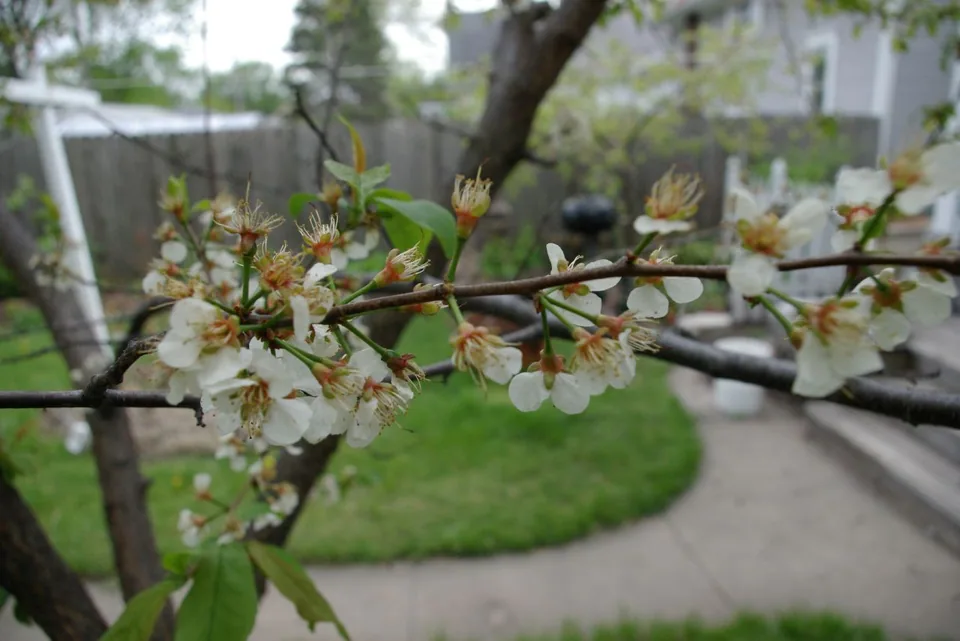
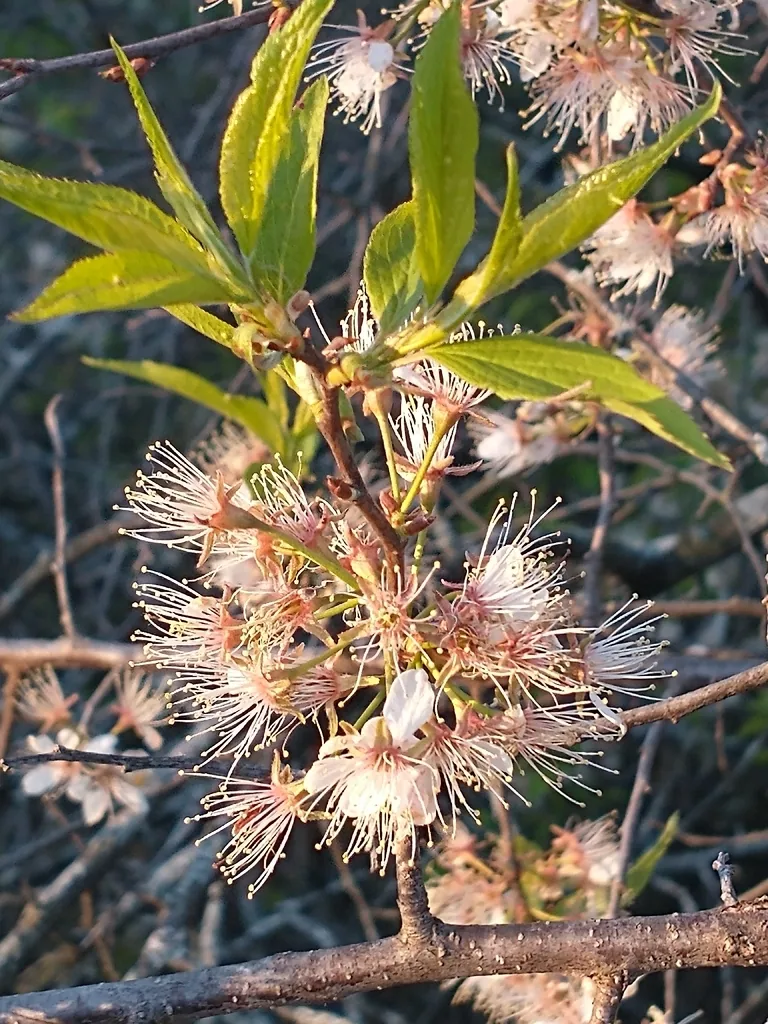

Cómo cultivar y cuidar Ciruelo Americano
Prunus americana
Escrito por Emilio Marruso · última revisión
Tóxica para: Gatos, Perros, Caballos, Personas · Por qué
De un vistazo
El ciruelo americano es un frutal agradecido que crece a pleno sol o en semisombra y aguanta bastante bien la sequía. Con sol pleno y riego regular crece más rápido y da más fruta. En julio y agosto maduran sus ciruelas, ideales para mermeladas, jaleas y conservas, o para secarlas como ciruelas pasas.
- Sol
Sol pleno o semisombra; con sol pleno da más fruta
Qué dicen las fuentes (3)
Luz: Pleno sol a semisombra
The American plum is easily grown in average, dry to medium, well-drained soils in full sun to part shade.
— Prunus americana (American Plum, American Wild Plum, Wild Plum) | North Carolina Extension Gardener Plant Toolbox [1] Light : Full sun to partial shade. Water : Fair to good drought tolerance.
— American Plum | NDSU Agriculture [2] Notas sobre el riego: Se logran mejores rendimientos y un crecimiento más rápido a pleno sol con acceso regular al agua
However, better yields and faster growth will be achieved in full sun environments with regular access to water.
— Native Fruits: Wild Plums - Alabama Cooperative Extension System [4] - Riego
Aguanta bastante bien la sequía, pero con riego regular crece más rápido y da más fruta
Qué dicen las fuentes (3)
Riego: Tolerancia a la sequía de regular a buena
Light : Full sun to partial shade. Water : Fair to good drought tolerance.
— American Plum | NDSU Agriculture [2] Particularly Resistant To (Insects/Diseases/Other Problems): fire in the landscape. Heat and drought tolerant.
— Prunus americana (American Plum, American Wild Plum, Wild Plum) | North Carolina Extension Gardener Plant Toolbox [1] Notas sobre el riego: Se logran mejores rendimientos y un crecimiento más rápido a pleno sol con acceso regular al agua
However, better yields and faster growth will be achieved in full sun environments with regular access to water.
— Native Fruits: Wild Plums - Alabama Cooperative Extension System [4] - Frío
Aguanta inviernos de hasta −40 °C (−40 °F)
Muy rústica · USDA 3a · RHS H7 · Z3
Qué dicen las fuentes (3)
Rusticidad, zona más fría: 3a [mínima invernal de −40 a −37,2 °C (de −40 a −35 °F)]
USDA Plant Hardiness Zone: 3a, 3b, 4a, 4b, 5a, 5b, 6a, 6b, 7a, 7b, 8a, 8b, 9a, 9b
— Prunus americana (American Plum, American Wild Plum, Wild Plum) | North Carolina Extension Gardener Plant Toolbox [1] Rusticidad, zona más cálida:
Según NC State Extension: USDA Plant Hardiness Zone: 3a, 3b, 4a, 4b, 5a, 5b, 6a, 6b, 7a, 7b, 8a, 8b, 9a, 9b
— Prunus americana (American Plum, American Wild Plum, Wild Plum) | North Carolina Extension Gardener Plant Toolbox [1] Iowa: Hardiness: Zones 3 through 10 Growth Rate: Moderate to Fast
— Wild Plum | Natural Resources [3] - Abonado
Compost o abono equilibrado a principios de primavera; con demasiado nitrógeno da hojas y no fruta
Qué dicen las fuentes (5)
Cuándo: Principios de primavera
Soil test: Conduct a soil test to determine nutrient deficiencies. Based on the results, apply a balanced fertilizer (10-10-10) in early spring.
— [5] Fertilizing: Apply compost or a balanced fertilizer in early spring.
— [5] Abonos naturales: Compost, a principios de primavera
Fertilizing: Apply compost or a balanced fertilizer in early spring.
— [5] Abonos minerales: Fertilizante equilibrado (10-10-10), según un análisis del suelo
Soil test: Conduct a soil test to determine nutrient deficiencies. Based on the results, apply a balanced fertilizer (10-10-10) in early spring.
— [5] Evitar: Exceso de nitrógeno.
Avoid excessive nitrogen: Too much nitrogen can lead to excessive vegetative growth at the expense of fruit production.
— [5] - Poda
Poda en invierno
Qué dicen las fuentes (2)
Poda: Invierno
Alabama: Prune in winter and follow Alabama Extension’s pruning guides for best practices.
— Native Fruits: Wild Plums - Alabama Cooperative Extension System [4] Prune the trees to a shorter height for better access and to maintain good growth form if fruit for human consumption is the primary goal. Prune in winter
— Native Fruits: Wild Plums - Alabama Cooperative Extension System [4] - Cosecha
Las ciruelas maduran en julio y agosto; mejores en mermeladas, jaleas o secas
Qué dicen las fuentes (5)
Cosecha: Madura en julio y agosto
Según NC State Extension: with bright yellow pulp which ripen in July and August.
— Prunus americana (American Plum, American Wild Plum, Wild Plum) | North Carolina Extension Gardener Plant Toolbox [1] Iowa: It is red to yellowish red when mature in late August.
— Wild Plum | Natural Resources [3] Alabama: The fruits range from yellow to red or deep purple at ripeness and are ready by mid to late summer.
— Native Fruits: Wild Plums - Alabama Cooperative Extension System [4] Flowers are followed by 1 inch, thick-skin, edible, round, red-purple plums (1 inch in diameter) with bright yellow pulp which ripen in July and August.
— Prunus americana (American Plum, American Wild Plum, Wild Plum) | North Carolina Extension Gardener Plant Toolbox [1] Años hasta el primer fruto: 4 (edad de producción de semillas)
Seed Bearing Age: 4 years Seed Bearing Frequency: Every 1 to 2 years Seed Stratification: Prechill for 3 to 5 months
— Wild Plum | Natural Resources [3] - Plagas
Gorgojo del ciruelo, pulgón, cochinillas y barrenadores; podredumbre parda y nudo negro; los ciervos se la comen
Qué dicen las fuentes (4)
Plagas: picudo del ciruelo, pulgones, cochinillas, barrenadores, orugas de tienda, mosca de la pera, barrenador del melocotonero, barrenador menor del melocotonero
Plum curculio and brown rot can affect the fruit.
— Prunus americana (American Plum, American Wild Plum, Wild Plum) | North Carolina Extension Gardener Plant Toolbox [1] Other potential insect problems include aphids, scale, borers and tent caterpillars.
— Prunus americana (American Plum, American Wild Plum, Wild Plum) | North Carolina Extension Gardener Plant Toolbox [1] Insects that Can Affect Wild Plum - Pear Sawfly or Pearslug - Eastern Tent Caterpillar - Peachtree Borer - Lesser Peachtree Borer
— Wild Plum | Natural Resources [3] Enfermedades: podredumbre parda, mancha foliar, cancro, nudo negro
Plum curculio and brown rot can affect the fruit. Other potential disease problems include leaf spot, canker and black knot.
— Prunus americana (American Plum, American Wild Plum, Wild Plum) | North Carolina Extension Gardener Plant Toolbox [1] - Atención
Echa muchos chupones y puede formar matorrales: quítalos para mantenerlo como árbol pequeño
- Tamaño
De 4,6 a 7,6 m de ancho
Qué dicen las fuentes (2)
Anchura adulta: 457-762 cm (15-25 pies)
Height: 15 ft. 0 in. - 25 ft. 0 in. Width: 15 ft. 0 in. - 25 ft. 0 in.
— Prunus americana (American Plum, American Wild Plum, Wild Plum) | North Carolina Extension Gardener Plant Toolbox [1] Height: 20-30 feet Width: 15-25 feet Site Requirements: Adaptable but prefers moist, well-drained soils.
— Wild Plum | Natural Resources [3] - Multiplicación
Por semilla, esquejes de tallo o esquejes de raíz
Qué dicen las fuentes (2)
Propagación: Esqueje de raíz, semilla, esqueje de tallo
Recommended Propagation Strategy: Root Cutting Seed Stem Cutting
— Prunus americana (American Plum, American Wild Plum, Wild Plum) | North Carolina Extension Gardener Plant Toolbox [1] Wild plums grow readily from seed. Planting the pits from local patches is a good way to further establish locally adapted plums.
— Native Fruits: Wild Plums - Alabama Cooperative Extension System [4] - Seguridad
Los huesos son venenosos; es dañino para gatos, perros y caballos
Resumen
El ciruelo americano es un pequeño árbol o arbusto de floración caducifolia que produce retoños libremente y puede formar grandes colonias o matorrales. [1] Crece en suelos promedio, secos a medianamente húmedos, bien drenados, a pleno sol o semisombra. [1] Su fruto es comestible pero de calidad cruda algo pobre y es mejor utilizarlo para conservas, jaleas o secado. [1]
Citado en inglés, como en la fuente.
Cuidados
Riego
Riego
Tolerancia a la sequía de regular a buena
Qué dicen las fuentes (2)
Light : Full sun to partial shade.
Water : Fair to good drought tolerance.Particularly Resistant To (Insects/Diseases/Other Problems):
fire in the landscape. Heat and drought tolerant.Notas sobre el riego
Se logran mejores rendimientos y un crecimiento más rápido a pleno sol con acceso regular al agua
Qué dicen las fuentes (1)
However, better yields and faster growth will be achieved in full sun environments with regular access to water.Luz
Pleno sol a semisombra
Qué dicen las fuentes (2)
The American plum is easily grown in average, dry to medium, well-drained soils in full sun to part shade.Light : Full sun to partial shade.
Water : Fair to good drought tolerance.Clima y frío
Rusticidad, zona más fría
3a [mínima invernal de −40 a −37,2 °C (de −40 a −35 °F)]
Qué dicen las fuentes (1)
USDA Plant Hardiness Zone:
3a, 3b, 4a, 4b, 5a, 5b, 6a, 6b, 7a, 7b, 8a, 8b, 9a, 9bRusticidad, zona más cálida
Las fuentes dan valores distintos según la región, la zona o las condiciones de cultivo.
Lo que dice cada fuente
Según NC State Extension: 9b [mínima invernal de −3,9 a −1,1 °C (de 25 a 30 °F)]
Iowa: 10 [mínima invernal de −1,1 a 4,4 °C (de 30 a 40 °F)]
Qué dicen las fuentes (2)
Según NC State Extension: USDA Plant Hardiness Zone:
3a, 3b, 4a, 4b, 5a, 5b, 6a, 6b, 7a, 7b, 8a, 8b, 9a, 9bIowa: Hardiness: Zones 3 through 10
Growth Rate: Moderate to FastPropagación
Esqueje de raíz, semilla, esqueje de tallo
Qué dicen las fuentes (2)
Recommended Propagation Strategy:
Root Cutting
Seed
Stem CuttingWild plums grow readily from seed. Planting the pits from local patches is a good way to further establish locally adapted plums.Cultivo
La planta
Ciclo de vida
perenne
Qué dicen las fuentes (1)
The American plum is a small, deciduous, flowering tree or shrub with a short, stout trunk and ascending branches in the rose family.Familia
Rosáceas
Qué dicen las fuentes (1)
Scientific Name: Prunus americana
Family: Rosaceae (Rose)
Hardiness: Zone 3
Leaves: Deciduous
Plant Type: ShrubAltura adulta
Anchura adulta
457-762 cm (15-25 pies)
Qué dicen las fuentes (2)
Height: 15 ft. 0 in. - 25 ft. 0 in.
Width: 15 ft. 0 in. - 25 ft. 0 in.Height: 20-30 feet
Width: 15-25 feet
Site Requirements: Adaptable but prefers moist, well-drained soils.Años hasta el primer fruto
4 (edad de producción de semillas)
Qué dicen las fuentes (1)
Seed Bearing Age: 4 years
Seed Bearing Frequency: Every 1 to 2 years
Seed Stratification: Prechill for 3 to 5 monthsPlagas y enfermedades
Plagas
picudo del ciruelo, pulgones, cochinillas, barrenadores, orugas de tienda, mosca de la pera, barrenador del melocotonero, barrenador menor del melocotonero
Qué dicen las fuentes (3)
Plum curculio and brown rot can affect the fruit.Other potential insect problems include aphids, scale, borers and tent caterpillars.Insects that Can Affect Wild Plum
- Pear Sawfly or Pearslug
- Eastern Tent Caterpillar
- Peachtree Borer
- Lesser Peachtree BorerEnfermedades
podredumbre parda, mancha foliar, cancro, nudo negro
Qué dicen las fuentes (1)
Plum curculio and brown rot can affect the fruit. Other potential disease problems include leaf spot, canker and black knot.Abonado
Cuándo
Principios de primavera
Abonos naturales
Compost, a principios de primavera
Qué dicen las fuentes (1)
Fertilizing: Apply compost or a balanced fertilizer in early spring.Abonos minerales
Fertilizante equilibrado (10-10-10), según un análisis del suelo
Qué dicen las fuentes (1)
Soil test: Conduct a soil test to determine nutrient deficiencies. Based on the results, apply a balanced fertilizer (10-10-10) in early spring.Evitar
Exceso de nitrógeno.
Qué dicen las fuentes (1)
Avoid excessive nitrogen: Too much nitrogen can lead to excessive vegetative growth at the expense of fruit production.Signos de exceso
Crecimiento vegetativo excesivo a costa de la producción de frutos
Qué dicen las fuentes (1)
Avoid excessive nitrogen: Too much nitrogen can lead to excessive vegetative growth at the expense of fruit production.Problemas
Formación de chupones y matorrales
Síntoma: Produce chupones libremente y puede formar grandes colonias o matorrales.
Qué hacer: Elimina los chupones para evitar la propagación no deseada o para entrenar la planta como árbol pequeño.
Qué dicen las fuentes (2)
As a shrub, it suckers freely and can form large colonies or thickets.
— Prunus americana (American Plum, American Wild Plum, Wild Plum) | North Carolina Extension Gardener Plant Toolbox [1] You can remove suckers to prevent unwanted spread or to train the plant into a small tree.
— Prunus americana (American Plum, American Wild Plum, Wild Plum) | North Carolina Extension Gardener Plant Toolbox [1] Picudo del ciruelo y podredumbre parda
Síntoma: Las hojas y los frutos se desfiguran ocasionalmente por insectos y enfermedades; el picudo del ciruelo y la podredumbre parda pueden afectar el fruto.
Qué hacer: No se indica en las fuentes.
Qué dicen las fuentes (1)
Plum curculio and brown rot can affect the fruit. Other potential disease problems include leaf spot, canker and black knot.
— Prunus americana (American Plum, American Wild Plum, Wild Plum) | North Carolina Extension Gardener Plant Toolbox [1] Daño por ciervos
Síntoma: Esta planta es susceptible al daño causado por los ciervos.
Qué hacer: No se indica en las fuentes.
Qué dicen las fuentes (1)
Other potential insect problems include aphids, scale, borers and tent caterpillars. This plant is susceptible to damage from deer.
— Prunus americana (American Plum, American Wild Plum, Wild Plum) | North Carolina Extension Gardener Plant Toolbox [1]
Remedios
Cada remedio indica qué dicen las fuentes oficiales; los remedios tradicionales sin fuente oficial aparecen marcados. Los perjudiciales están para que sepas evitarlos.
Primeros auxilios
Primeros auxilios: no sustituyen al médico
hueso tragado
hueso entero tragado: no se necesita acción Fuente oficial, sin prueba independiente
If the seed is chewed or if someone ingests several seeds and/or the person is symptomatic, contact the poison center or a health care professional.
— poison.org [6] Cómo: Si se traga una semilla entera accidentalmente, no necesitas hacer nada; debería atravesar el tracto digestivo.
If someone accidentally swallows an apricot seed/pit while eating the apricot, you do not need to do anything. The whole seed should traverse the digestive tract and be eliminated in the stool.
— poison.org [6]
Cuidar la planta
pulgones
spray casero de aceite y jabón de castilla No verificado
Remedio tradicional, no verificado por una fuente oficial.
Some plants are sensitive to soap sprays and in full sun, this can cause the leaves to wither and brown.
— joybileefarm.com [7] Do not substitute dish soap or laundry soap for the liquid castile soap. These are not the same chemically and could damage your plants.
— joybileefarm.com [7] Cómo: Aplica generosamente en todos los lados de las hojas y ramas donde veas daño de insectos; vuelve a rociar 4 o 5 días después de la primera aplicación. Receta en la fuente: aceite de canola o de semillas de uva, kéfir, yogur o suero de leche, jabón líquido de castilla, aceites esenciales, agua.
nudo negro
poda de madera infectada Fuente oficial, sin prueba independiente
Cómo: Poda y quema o entierra toda la madera infectada a fines del invierno o principios de la primavera, cortando de cuatro a ocho pulgadas detrás de las hinchazones.
prune out and burn (or bury) all infected wood in late winter or early spring before growth starts and as soon as new knots appear. Make cuts four to eight inches behind any obvious, black-knot swellings.
— purduelandscapereport.org [8]
Cómo eliminarla
matorrales de renuevos
excavación y eliminación manual No verificado
Remedio tradicional, no verificado por una fuente oficial.
Cómo: Excava y elimina manualmente, asegurándote de que se retire todo el sistema de raíces; usa ropa protectora contra las espinas.
Venenosa para los animales
Según la fuente, citada textualmente. No es un consejo médico ni veterinario: si una persona o un animal pudo haber ingerido esta planta, contacta con un centro de toxicología o con un veterinario.
Animales
Problems: Problem for Cats Problem for Dogs Problem for Horses
[1]La fuente señala el riesgo para este animal pero no explica por qué.
Personas
The pits contain cyanide compounds, which are poisonous. If a couple of pits are accidentally swallowed, it will not cause poisoning.
[1]- Partes venenosas
Causes Contact Dermatitis: No Poison Part: Leaves Seeds Stems Download Print-Friendly
[1]- Principio tóxico
Poison Toxic Principle: Cyanogenic glycosides Causes Contact Dermatitis: No
[1]- Síntomas
Symptoms include Gasping, weakness, excitement, pupil dilation, spasms, convulsions, coma, respiratory failure.
[1]- Gravedad
Poisonous to Humans: Poison Severity: Medium Poison Symptoms: The pits contain cyanide compounds
[1]
Calendario
Madura en julio y agosto
Lo que dice cada fuente
Según NC State Extension: Madura en julio y agosto
Iowa: Madura a fines de agosto
Alabama: Listo a mediados o fines del verano
Qué dicen las fuentes (4)
Según NC State Extension: with bright yellow pulp which ripen in July and August.Iowa: It is red to yellowish red when mature in late August.Alabama: The fruits range from yellow to red or deep purple at ripeness and are ready by mid to late summer.Flowers are followed by 1 inch, thick-skin, edible, round, red-purple plums (1 inch in diameter) with bright yellow pulp which ripen in July and August.Invierno
Lo que dice cada fuente
Alabama: Invierno
Qué dicen las fuentes (2)
Alabama: Prune in winter and follow Alabama Extension’s pruning guides for best practices.Prune the trees to a shorter height for better access and to maintain good growth form if fruit for human consumption is the primary goal. Prune in winterMeses tal como los dan las fuentes, en su mayoría de Estados Unidos (hemisferio norte). En el hemisferio sur se desplazan unos seis meses.
Comestibilidad
Según la fuente, citada textualmente. No comas una planta basándote solo en esta página: los errores de identificación pueden ser peligrosos.
Valores orientativos
Valores de una fuente secundaria, no comprobados palabra por palabra como el resto de esta página. Úselos como punto de partida.
- Horas de sol
- 4-6 horasValor orientativo, adáptalo a tu clima · Fuente secundaria
- Suelo
- FrancoValor orientativo, adáptalo a tu clima · Fuente secundaria
- pH del suelo
- 5.5-6.5Valor orientativo, adáptalo a tu clima · Fuente secundaria
- Nivel de cuidado
- MedioValor orientativo, adáptalo a tu clima · Fuente secundaria
- Crecimiento
- ModeradoValor orientativo, adáptalo a tu clima · Fuente secundaria
Plantas similares
- Afghan Cherry Prunus jacquemontii
- Amur chokecherry Prunus maackii
- Albaricoque Prunus armeniaca
- Cerezo criollo Prunus serotina
- Carolina Cherry Laurel Prunus caroliniana
- Lauroceraso Prunus laurocerasus
- Chickasaw Plum Prunus angustifolia
- Chinese Plum Prunus glandulosa
Fuentes
Cada valor anterior se cita de estos documentos. Los enlaces llevan al editor original.
- Prunus americana (American Plum, American Wild Plum, Wild Plum) | North Carolina Extension Gardener Plant Toolbox · plants.ces.ncsu.edu, consultado
- American Plum | NDSU Agriculture · ndsu.edu, consultado
- Wild Plum | Natural Resources · naturalresources.extension.iastate.edu, consultado
- Native Fruits: Wild Plums - Alabama Cooperative Extension System · aces.edu, consultado
- ask.extension.org · ask.extension.org
- poison.org · poison.org
- joybileefarm.com · joybileefarm.com
- purduelandscapereport.org · purduelandscapereport.org
Escrito por Emilio Marruso · última revisión