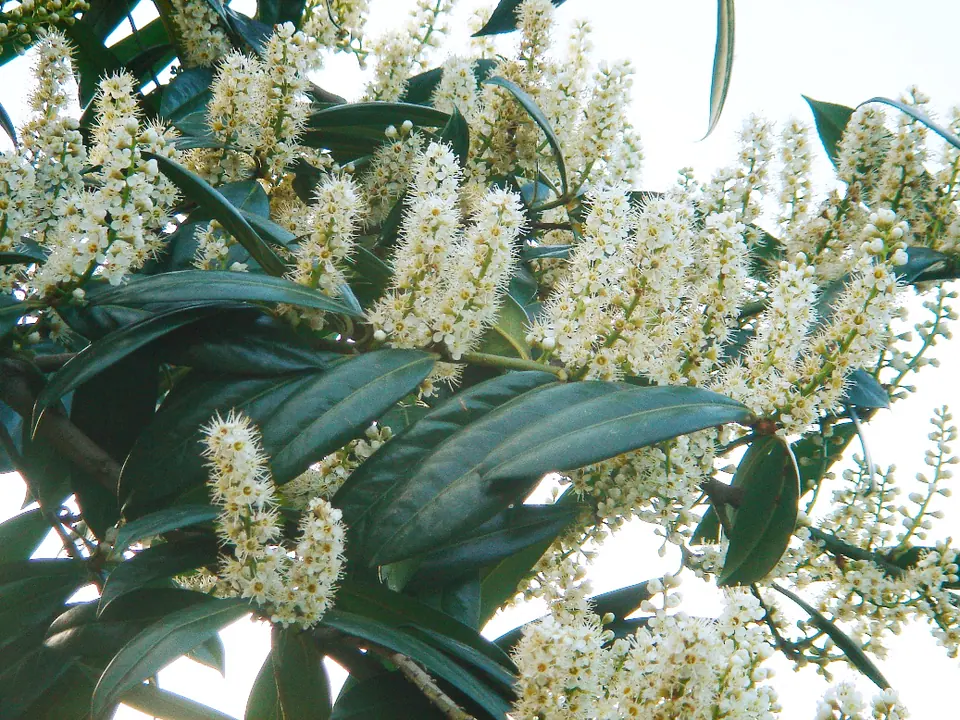


Cómo cultivar y cuidar Lauroceraso
Prunus laurocerasus
Escrito por Emilio Marruso · última revisión
Tóxica para: Gatos, Perros, Caballos, Personas · Por qué
De un vistazo
El laurel cerezo es un arbusto o arbolito de hoja perenne que conserva sus hojas todo el año. Crece a pleno sol, pero también tolera la semisombra y la sombra, y con compost al plantar casi nunca necesita más abono. Dale un suelo que drene bien y riego profundo durante sus dos primeros años, y se asentará sin problemas.
- Sol
Sol pleno, pero también tolera la semisombra y la sombra
Qué dicen las fuentes (1)
Luz: Pleno sol; tolera semisombra a sombra completa.
Best grown in full sun, but also very tolerant of partial to full shade.
— Cherry Laurel: Identify and Manage Problems | University of Maryland Extension [3] - Riego
Los dos primeros años: riega a fondo en la base cuando la tierra se seque varios centímetros
Qué dicen las fuentes (4)
Notas sobre el riego: Para plantas nuevas, vigila la humedad del suelo y riega profundamente si se seca varios centímetros por debajo de la superficie; es importante en los primeros dos años; riega en la base en lugar de por encima; no tolera suelos arcillosos compactados con mal drenaje.
Monitor the soil moisture of new plants regularly, and water deeply if it begins to dry out several inches below the surface.
— Cherry Laurel: Identify and Manage Problems | University of Maryland Extension [3] This is important for plants in their first two years of establishment.
— Cherry Laurel: Identify and Manage Problems | University of Maryland Extension [3] Water at the base of the plants rather than overhead to minimize leaf wetness as much as possible
— Cherry Laurel: Identify and Manage Problems | University of Maryland Extension [3] Cherry laurel does not tolerate compacted clay soil that drains poorly.
— Cherry Laurel: Identify and Manage Problems | University of Maryland Extension [3] - Frío
Aguanta inviernos de hasta −23,3 °C (−10 °F)
Muy rústica · USDA 6a · RHS H7 · Z6
Qué dicen las fuentes (5)
Rusticidad, zona más fría: 6a [mínima invernal de −23,3 a −20,6 °C (de −10 a −5 °F)]
USDA Plant Hardiness Zone: 6a, 6b, 7a, 7b, 8a, 8b
— Prunus laurocerasus (Cherry Laurel, English Laurel) | North Carolina Extension Gardener Plant Toolbox [1] Rusticidad, zona más cálida:
Según NC State Extension: USDA Plant Hardiness Zone: 6a, 6b, 7a, 7b, 8a, 8b
— Prunus laurocerasus (Cherry Laurel, English Laurel) | North Carolina Extension Gardener Plant Toolbox [1] Según Virginia Cooperative Extension: Zone : 6b (6a) to 9 Light :
— Cherrylaurel (Prunus laurocerasus `Otto Luyken') | VCE Publications | Virginia Tech [4] Según University of Maryland Extension: Cold-hardy in USDA zones 6 to 8. Performs
— Cherry Laurel: Identify and Manage Problems | University of Maryland Extension [3] USDA Plant Hardiness Zone: 6a, 6b, 7a, 7b, 8a, 8b
— Prunus laurocerasus (Cherry Laurel, English Laurel) | North Carolina Extension Gardener Plant Toolbox [1] - Suelo
Necesita un suelo que drene bien; evita la arcilla compacta y encharcada
Qué dicen las fuentes (4)
Notas sobre el riego: Para plantas nuevas, vigila la humedad del suelo y riega profundamente si se seca varios centímetros por debajo de la superficie; es importante en los primeros dos años; riega en la base en lugar de por encima; no tolera suelos arcillosos compactados con mal drenaje.
Monitor the soil moisture of new plants regularly, and water deeply if it begins to dry out several inches below the surface.
— Cherry Laurel: Identify and Manage Problems | University of Maryland Extension [3] This is important for plants in their first two years of establishment.
— Cherry Laurel: Identify and Manage Problems | University of Maryland Extension [3] Water at the base of the plants rather than overhead to minimize leaf wetness as much as possible
— Cherry Laurel: Identify and Manage Problems | University of Maryland Extension [3] Cherry laurel does not tolerate compacted clay soil that drains poorly.
— Cherry Laurel: Identify and Manage Problems | University of Maryland Extension [3] - Abonado
Suele bastar con compost al plantar o un acolchado de corteza; no abones de más
Qué dicen las fuentes (4)
Abonos naturales: Composta como enmienda del suelo al plantar, o un mantillo orgánico (corteza, astillas de madera, agujas de pino): la mayoría de las plantas entonces no necesitan fertilizante adicional.
If planted with an organic soil amendment (such as compost) or with an organic mulch (bark, wood chips, pine needles), most plants should not need additional nutrients from fertilizer.
— Cherry Laurel: Identify and Manage Problems | University of Maryland Extension [3] Evitar: Fertilización excesiva o pesada; fertilizar sin un análisis de suelo que muestre una deficiencia de nutrientes.
It is moderately tolerant to salt but is intolerant of heavy fertilization.
— Prunus laurocerasus (Cherry Laurel, English Laurel) | North Carolina Extension Gardener Plant Toolbox [1] This plant tolerates salt spray and heavy shearing. Avoid excessive fertilization.
— Laurel | Home & Garden Information Center [2] Fertilize cherry laurel if a laboratory soil test indicates a nutrient deficiency.
— Cherry Laurel: Identify and Manage Problems | University of Maryland Extension [3] - Poda
Poda a principios de primavera (marzo); recorta los brotes nuevos tras la floración, en junio
Qué dicen las fuentes (2)
Poda: Principios de primavera (alrededor de marzo); el nuevo crecimiento después de la floración se puede podar alrededor de junio.
Según University of Maryland Extension: prune and shape the shrubs by using hand pruners in early spring (around March). New growth emerging after flowering can be pruned as needed to control size around June.
— Cherry Laurel: Identify and Manage Problems | University of Maryland Extension [3] prune and shape the shrubs by using hand pruners in early spring (around March). New growth emerging after flowering can be pruned as needed to control size around June.
— Cherry Laurel: Identify and Manage Problems | University of Maryland Extension [3] - Cosecha
Sus frutos pequeños y negruzcos no merecen la pena para comer
- Plagas
Barrenador del melocotonero y cochinillas; cribado, oídio y podredumbre de raíz
Qué dicen las fuentes (8)
Plagas: barrenador del duraznero, cochinilla blanca del ciruelo, cochinilla blanca del duraznero, grillo arborícola nevado, topillo de pradera
Peachtree borer , the larva of a moth, is primarily a pest of cherry, peach, plum, and other related plants (all belonging to the genus Prunus ). Cherry laurel is commonly affected, primarily when under stress.
— Cherry Laurel: Identify and Manage Problems | University of Maryland Extension [3] White prunicola scale ( Pseudaulacaspis prunicola ) is a type of armored scale insect that feeds on the contents of plant cells.
— Cherry Laurel: Identify and Manage Problems | University of Maryland Extension [3] Another scale that can feed on cherry laurel is white peach scale ( Pseudaulacaspis pentagona ).
— Cherry Laurel: Identify and Manage Problems | University of Maryland Extension [3] Snowy tree crickets ( Oecanthus fultoni ) commonly feed on cherry laurel and rhododendron leaves.
— Cherry Laurel: Identify and Manage Problems | University of Maryland Extension [3] Voles injure stems by chewing into and girdling the base of the shrub, by feeding on roots, and by tunneling through the root system.
— Cherry Laurel: Identify and Manage Problems | University of Maryland Extension [3] Enfermedades: enfermedad del agujero de bala (agujero de bala del cerezo), mildiu polvoriento, pudrición de raíces, muerte regresiva de ramas (Botryosphaeria)
Insects, Diseases, and Other Plant Problems: Better resistance than most other species in the genus Prunus . Susceptible to shot-hole disease, powdery mildew, and root rot.
— Prunus laurocerasus (Cherry Laurel, English Laurel) | North Carolina Extension Gardener Plant Toolbox [1] The two pathogens that produce these leaf spot symptoms are the bacterium Xanthomonas pruni and the fungus Blumeriella jaapii .
— Cherry Laurel: Identify and Manage Problems | University of Maryland Extension [3] Mild, wet summer weather promotes this leaf spot. Avoid overhead watering. The fungus Botryosphaeria causes limb dieback.
— Laurel | Home & Garden Information Center [2] - Atención
El viento invernal quema los bordes de las hojas: plántalo en un lugar resguardado
- Seguridad
Hojas, tallos y semillas son tóxicos para personas, gatos, perros y caballos
Resumen
El laurel cerezo es un arbusto o árbol pequeño de hoja perenne que se utiliza como pantalla o seto alto. [1] Le va mejor a pleno sol y tolera semisombra a sombra completa, y las plantas establecidas aún necesitan riego profundo en períodos secos. [3] Los tallos, las hojas y las semillas se enumeran como que contienen cianuro. [1]
Citado en inglés, como en la fuente.
Esta ficha está incompleta: las fuentes consultadas aún no cubren todos los campos.
Aún no cubierto por nuestras fuentes: Propagación
Cuidados
Riego
Riego
Las fuentes dan valores distintos según la región, la zona o las condiciones de cultivo.
Lo que dice cada fuente
Según University of Maryland Extension: Riega abundantemente las plantas establecidas durante los períodos secos.
Según Clemson HGIC: Suelo húmedo y bien drenado
Según Virginia Cooperative Extension: Húmedo a seco
Según University of Arkansas Extension: Crecimiento rápido y tolerante a la sequía una vez establecido.
Qué dicen las fuentes (6)
Según University of Maryland Extension: Well-established plants should still be watered thoroughly during dry periods.Según Clemson HGIC: Cherry laurels perform best in moist, well-drained soil supplemented with organic matter.Según Virginia Cooperative Extension: Moisture : Moist to dry
Soil Type :Según University of Arkansas Extension: it's fast growing and drought-tolerant
once established. ItWell-established plants should still be watered thoroughly during dry periods.If there is less than 1 inch of rainfall per week, water thoroughly to maintain even soil moisture during dry periods.Notas sobre el riego
Para plantas nuevas, vigila la humedad del suelo y riega profundamente si se seca varios centímetros por debajo de la superficie; es importante en los primeros dos años; riega en la base en lugar de por encima; no tolera suelos arcillosos compactados con mal drenaje.
Qué dicen las fuentes (4)
Monitor the soil moisture of new plants regularly, and water deeply if it begins to dry out several inches below the surface.This is important for plants in their first two years of establishment.Water at the base of the plants rather than overhead to minimize leaf wetness as much as possibleCherry laurel does not tolerate compacted clay soil that drains poorly.Luz
Pleno sol; tolera semisombra a sombra completa.
Qué dicen las fuentes (1)
Best grown in full sun, but also very tolerant of partial to full shade.Clima y frío
Rusticidad, zona más fría
6a [mínima invernal de −23,3 a −20,6 °C (de −10 a −5 °F)]
Qué dicen las fuentes (1)
USDA Plant Hardiness Zone:
6a, 6b, 7a, 7b, 8a, 8bRusticidad, zona más cálida
Las fuentes dan valores distintos según la región, la zona o las condiciones de cultivo.
Lo que dice cada fuente
Según NC State Extension: 8b [mínima invernal de −9,4 a −6,7 °C (de 15 a 20 °F)]
Según Virginia Cooperative Extension: 9 [mínima invernal de −6,7 a −1,1 °C (de 20 a 30 °F)]
Según University of Maryland Extension: 8 [mínima invernal de −12,2 a −6,7 °C (de 10 a 20 °F)]
Qué dicen las fuentes (4)
Según NC State Extension: USDA Plant Hardiness Zone:
6a, 6b, 7a, 7b, 8a, 8bSegún Virginia Cooperative Extension: Zone : 6b (6a) to 9
Light :Según University of Maryland Extension: Cold-hardy in USDA zones 6 to 8. PerformsUSDA Plant Hardiness Zone:
6a, 6b, 7a, 7b, 8a, 8bSuelo
pH del suelo, mínimo
Las fuentes dan valores distintos según la región, la zona o las condiciones de cultivo.
Lo que dice cada fuente
cultivar 'Otto Luyken' (Virginia Cooperative Extension): 3.7
Qué dicen las fuentes (1)
cultivar 'Otto Luyken' (Virginia Cooperative Extension): pH Range : 3.7 to 7.3
## FunctionspH del suelo, máximo
Las fuentes dan valores distintos según la región, la zona o las condiciones de cultivo.
Lo que dice cada fuente
cultivar 'Otto Luyken' (Virginia Cooperative Extension): 7.3
Qué dicen las fuentes (1)
cultivar 'Otto Luyken' (Virginia Cooperative Extension): pH Range : 3.7 to 7.3
## FunctionsPropagación
No figura en las fuentes consultadas.
Cultivo
La planta
Ciclo de vida
perenne (arbusto leñoso o árbol pequeño siempreverde)
Qué dicen las fuentes (1)
Whole Plant Traits: Plant Type: Perennial Poisonous Shrub Tree Woody Plant Leaf Characteristics: Broadleaf EvergreenFamilia
Rosáceas
Qué dicen las fuentes (1)
Genus: Prunus Species: laurocerasus Family: Rosaceae Life Cycle: WoodyAltura adulta
Las fuentes no coinciden:
Dimensions: Height: 10 ft. 0 in. - 20 ft. 0 in. Width: 8 ft. 0 in. - 10 ft. 0 in.
[1]Mature size generally ranges from 10 to 15 feet high and about 6 to 12 feet wide, but will vary with the cultivar .
[3]In gardens, dwarf forms have been selected so it's usually seen as a large, evergreen shrub 4- to 8-foot tall and wide.
[5]
Lo que dice cada fuente
cultivar 'Otto Luyken':
cultivar 'Otto Luyken':
Qué dicen las fuentes (2)
cultivar 'Otto Luyken': Foliage : Evergreen broadleaf Height: 4 feet Spread : 8 feet Shape : Spreadingcultivar 'Otto Luyken': ‘Otto Luyken’ grows 3 to 4 feet high and 5 to 7 feet wide.Anchura adulta
Las fuentes no coinciden:
Dimensions: Height: 10 ft. 0 in. - 20 ft. 0 in. Width: 8 ft. 0 in. - 10 ft. 0 in.
[1]Mature size generally ranges from 10 to 15 feet high and about 6 to 12 feet wide, but will vary with the cultivar .
[3]Mature Height/Spread: This evergreen, broadleaf shrub can grow to 20 feet but is generally kept smaller in the home landscape. The spread is 6 to 10 feet.
[2]
Lo que dice cada fuente
cultivar 'Otto Luyken':
cultivar 'Otto Luyken':
Qué dicen las fuentes (2)
cultivar 'Otto Luyken': Foliage : Evergreen broadleaf Height: 4 feet Spread : 8 feet Shape : Spreadingcultivar 'Otto Luyken': ‘Otto Luyken’ grows 3 to 4 feet high and 5 to 7 feet wide.Plagas y enfermedades
Plagas
barrenador del duraznero, cochinilla blanca del ciruelo, cochinilla blanca del duraznero, grillo arborícola nevado, topillo de pradera
Qué dicen las fuentes (5)
Peachtree borer , the larva of a moth, is primarily a pest of cherry, peach, plum, and other related plants (all belonging to the genus Prunus ). Cherry laurel is commonly affected, primarily when under stress.White prunicola scale ( Pseudaulacaspis prunicola ) is a type of armored scale insect that feeds on the contents of plant cells.Another scale that can feed on cherry laurel is white peach scale ( Pseudaulacaspis pentagona ).Snowy tree crickets ( Oecanthus fultoni ) commonly feed on cherry laurel and rhododendron leaves.Voles injure stems by chewing into and girdling the base of the shrub, by feeding on roots, and by tunneling through the root system.Enfermedades
enfermedad del agujero de bala (agujero de bala del cerezo), mildiu polvoriento, pudrición de raíces, muerte regresiva de ramas (Botryosphaeria)
Qué dicen las fuentes (3)
Insects, Diseases, and Other Plant Problems: Better resistance than most other species in the genus Prunus . Susceptible to shot-hole disease, powdery mildew, and root rot.The two pathogens that produce these leaf spot symptoms are the bacterium Xanthomonas pruni and the fungus Blumeriella jaapii .Mild, wet summer weather promotes this leaf spot. Avoid overhead watering. The fungus Botryosphaeria causes limb dieback.Abonado
Abonos naturales
Composta como enmienda del suelo al plantar, o un mantillo orgánico (corteza, astillas de madera, agujas de pino): la mayoría de las plantas entonces no necesitan fertilizante adicional.
Qué dicen las fuentes (1)
If planted with an organic soil amendment (such as compost) or with an organic mulch (bark, wood chips, pine needles), most plants should not need additional nutrients from fertilizer.Evitar
Fertilización excesiva o pesada; fertilizar sin un análisis de suelo que muestre una deficiencia de nutrientes.
Qué dicen las fuentes (3)
It is moderately tolerant to salt but is intolerant of heavy fertilization.This plant tolerates salt spray and heavy shearing. Avoid excessive fertilization.Fertilize cherry laurel if a laboratory soil test indicates a nutrient deficiency.Signos de exceso
Amarillamiento o pardeamiento de las hojas, muerte regresiva de ramas o decaimiento de todo el arbusto cuando el suelo está contaminado con exceso de fertilizante.
Qué dicen las fuentes (2)
Symptoms from stressful site conditions include leaf yellowing or browning, branch dieback, or an entire shrub declining and dying.Poor soil conditions can include compaction, limited root space, too little organic matter, and contamination with excess fertilizer or ice-melt.Problemas
Podredumbre de la raíz
Síntoma: Las hojas se vuelven marrones y las ramas mueren; ocurre en sitios húmedos o con mal drenaje.
Qué hacer: Evita arcilla compactada con mal drenaje; redirige las bajantes o elige otro lugar de plantación.
Qué dicen las fuentes (2)
Susceptible to shot-hole disease, powdery mildew, and root rot.
— Prunus laurocerasus (Cherry Laurel, English Laurel) | North Carolina Extension Gardener Plant Toolbox [1] Cherry laurel does not tolerate compacted clay soil that drains poorly.
— Cherry Laurel: Identify and Manage Problems | University of Maryland Extension [3] Quemadura invernal
Síntoma: Pardeamiento a lo largo del borde o la superficie de la hoja
Qué hacer: Planta en lugares menos expuestos a los vientos invernales.
Qué dicen las fuentes (1)
The risk of winter burn can be reduced by planting in locations less exposed to winter winds.
— Cherry Laurel: Identify and Manage Problems | University of Maryland Extension [3] Barrenador del durazno
Síntoma: Amarillamiento de las hojas, marchitez irregular y muerte de ramas
Qué hacer: Poda y destruye las ramas infestadas.
Qué dicen las fuentes (1)
The best control option for home gardeners with only a few plants is to prune out and destroy infested branches.
— Cherry Laurel: Identify and Manage Problems | University of Maryland Extension [3] Enfermedad de los agujeros de perdigón y mildiu polvoriento
Síntoma: Enumeradas como enfermedades del laurel cerezo
Qué hacer: No indicado en las fuentes
Qué dicen las fuentes (1)
Susceptible to shot-hole disease, powdery mildew, and root rot.
— Prunus laurocerasus (Cherry Laurel, English Laurel) | North Carolina Extension Gardener Plant Toolbox [1]
Remedios
Cada remedio indica qué dicen las fuentes oficiales; los remedios tradicionales sin fuente oficial aparecen marcados. Los perjudiciales están para que sepas evitarlos.
Cuidar la planta
cochinilla
cepillo suave Funciona en parte
Cómo: Si la infestación no es intensa, usa un cepillo suave para quitar de las ramas las cubiertas blancas de las cochinillas; esto expone a los insectos a los depredadores y los seca.
If the infestation is not heavy, use a soft brush to remove the white scale covers from the branches, which will expose the insects to predators and dry them out.
— Cherry Laurel: Identify and Manage Problems | University of Maryland Extension [3] Qué dicen las pruebas If the infestation is not heavy, use a soft brush to remove the white scale covers from the branches, which will expose the insects to predators and dry them out.
— Cherry Laurel: Identify and Manage Problems | University of Maryland Extension [3]
barrenador del duraznero
Poda y destruye las ramas infestadas. Funciona
Cómo: Poda y destruye las ramas infestadas; los arbustos pueden recuperar gradualmente el crecimiento perdido si permanecen sanos.
The best control option for home gardeners with only a few plants is to prune out and destroy infested branches.
— Cherry Laurel: Identify and Manage Problems | University of Maryland Extension [3] Qué dicen las pruebas The best control option for home gardeners with only a few plants is to prune out and destroy infested branches.
— Cherry Laurel: Identify and Manage Problems | University of Maryland Extension [3]
agujero de bala
poda de ramas dañadas y recogida de hojas caídas Fuente oficial, sin prueba independiente
Cómo: Poda las ramas muy dañadas y recoge el follaje caído; desecha los restos infectados para evitar que el patógeno se propague.
If too unsightly, you can prune out heavily-damaged branches and rake-up any fallen foliage. Discard any infected debris to keep the pathogen from spreading.
— Cherry Laurel: Identify and Manage Problems | University of Maryland Extension [3] rociado con bicarbonato de sodio No verificado
Remedio tradicional, no verificado por una fuente oficial.
Cómo: Una mezcla de 1 cucharadita de bicarbonato de sodio y 1 cuarto de galón de agua puede ayudar en casos leves; rocíala sobre las hojas afectadas semanalmente.
Cómo eliminarla
laurel cerezo (planta no deseada)
Desentierra las raíces Funciona en parte
Cómo: Desentierra las plantas individuales y los parches pequeños y retira las raíces; el laurel cerezo puede volver a crecer si no se eliminan todas las raíces. Arranca o excava cuando el suelo esté húmedo.
Dig out individual plants and small patches. Remove the roots. Cherry laurel may regrow if all the roots are not removed.
— solvepestproblems.oregonstate.edu [6] Qué dicen las pruebas Dig out individual plants and small patches. Remove the roots. Cherry laurel may regrow if all the roots are not removed.
— solvepestproblems.oregonstate.edu [6] montón de ramas sobre los tocones cortados No verificado
Remedio tradicional, no verificado por una fuente oficial.
Cómo: Construye balsas y montones de ramas de laurel cortado justo encima de los tocones recién cortados: esto bloquea la luz y desalienta el nuevo crecimiento; los tocones sin montón de cobertura pronto produjeron brotes nuevos y vigorosos.
Venenosa para los animales
Según la fuente, citada textualmente. No es un consejo médico ni veterinario: si una persona o un animal pudo haber ingerido esta planta, contacta con un centro de toxicología o con un veterinario.
Animales
Malodorous Problem for Cats Problem for Dogs Problem for Horses
[1]- Partes venenosas
Poison Part: Leaves Seeds Stems Download Print-Friendly QR
[1]- Principio tóxico
Poison Toxic Principle: Cyanogenic glycosides (amygdalin, prunasin, prulaurasin)
[1]- Síntomas
Stems, leaves, seeds contain cyanide, particularly toxic in the process of wilting: brick red mucous membranes, panting, shock.
[1]- Gravedad
Poison Severity: High Poison Symptoms: Gasping, weakness, excitement,
[1]
Personas
Stems, leaves, seeds contain cyanide, particularly toxic in the process of wilting: brick red mucous membranes, panting, shock.
[1]- Partes venenosas
Poison Part: Leaves Seeds Stems Download Print-Friendly QR
[1]- Principio tóxico
Poison Toxic Principle: Cyanogenic glycosides (amygdalin, prunasin, prulaurasin)
[1]- Síntomas
Stems, leaves, seeds contain cyanide, particularly toxic in the process of wilting: brick red mucous membranes, panting, shock.
[1]- Gravedad
Poison Severity: High Poison Symptoms: Gasping, weakness, excitement,
[1]
Gasping, weakness, excitement, pupil dilation, spasms, convulsions, coma, respiratory failure
[1]- Partes venenosas
Poison Part: Leaves Seeds Stems Download Print-Friendly QR
[1]- Principio tóxico
Poison Toxic Principle: Cyanogenic glycosides (amygdalin, prunasin, prulaurasin)
[1]- Síntomas
Stems, leaves, seeds contain cyanide, particularly toxic in the process of wilting: brick red mucous membranes, panting, shock.
[1]- Gravedad
Poison Severity: High Poison Symptoms: Gasping, weakness, excitement,
[1]
Calendario
Poda
Principios de primavera (alrededor de marzo); el nuevo crecimiento después de la floración se puede podar alrededor de junio.
Lo que dice cada fuente
Según University of Maryland Extension: Principios de primavera (alrededor de marzo); nuevo crecimiento después de la floración alrededor de junio.
Qué dicen las fuentes (2)
Según University of Maryland Extension: prune and shape the shrubs by using hand pruners in early spring (around March). New growth emerging after flowering can be pruned as needed to control size around June.prune and shape the shrubs by using hand pruners in early spring (around March). New growth emerging after flowering can be pruned as needed to control size around June.Meses tal como los dan las fuentes, en su mayoría de Estados Unidos (hemisferio norte). En el hemisferio sur se desplazan unos seis meses.
Comestibilidad
Según la fuente, citada textualmente. No comas una planta basándote solo en esta página: los errores de identificación pueden ser peligrosos.
Small, marble-sized, blackish fruit are produced but have little to recommend them for eating.
[5]
Valores orientativos
Valores de una fuente secundaria, no comprobados palabra por palabra como el resto de esta página. Úselos como punto de partida.
- Suelo
- Ácido, Bien drenadoValor orientativo, adáptalo a tu clima · Fuente secundaria
- Nivel de cuidado
- MedioValor orientativo, adáptalo a tu clima · Fuente secundaria
- Crecimiento
- ModeradoValor orientativo, adáptalo a tu clima · Fuente secundaria
- Propagación
- Esquejes de madera verdeValor orientativo, adáptalo a tu clima · Fuente secundaria
Plantas similares
- Afghan Cherry Prunus jacquemontii
- Ciruelo Americano Prunus americana
- Amur chokecherry Prunus maackii
- Albaricoque Prunus armeniaca
- Cerezo criollo Prunus serotina
- Carolina Cherry Laurel Prunus caroliniana
- Chickasaw Plum Prunus angustifolia
- Chinese Plum Prunus glandulosa
Fuentes
Cada valor anterior se cita de estos documentos. Los enlaces llevan al editor original.
- Prunus laurocerasus (Cherry Laurel, English Laurel) | North Carolina Extension Gardener Plant Toolbox · plants.ces.ncsu.edu, consultado
- Laurel | Home & Garden Information Center · hgic.clemson.edu, consultado
- Cherry Laurel: Identify and Manage Problems | University of Maryland Extension · extension.umd.edu, consultado
- Cherrylaurel (Prunus laurocerasus `Otto Luyken') | VCE Publications | Virginia Tech · pubs.ext.vt.edu, consultado
- Laurel, Cherry · uaex.uada.edu, consultado
- solvepestproblems.oregonstate.edu · solvepestproblems.oregonstate.edu
Escrito por Emilio Marruso · última revisión