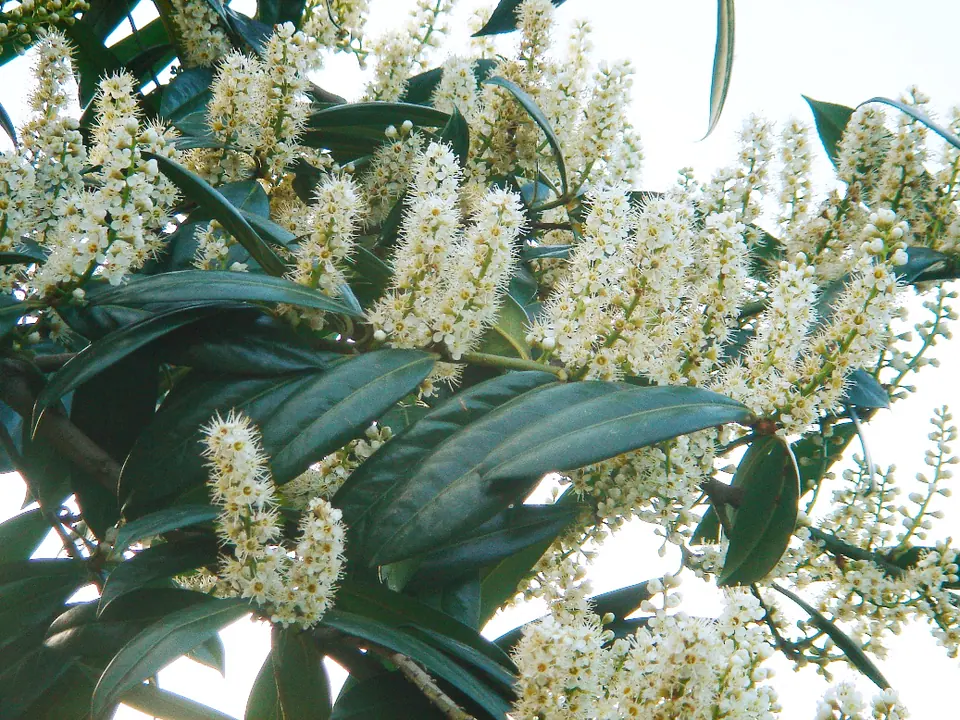


How to Grow and Care for Cherry Laurel
Prunus laurocerasus
Written by Emilio Marruso · last checked
Toxic to: Cats, Dogs, Horses, People · Why
At a glance
Cherry laurel is an evergreen shrub or small tree that keeps its leaves all year round. It grows in full sun but also handles partial to full shade, and with compost at planting most plants need no extra fertilizer. Give it soil that drains well and deep watering during its first two years, and it will settle in happily.
- Sun
Full sun, but also handles partial to full shade
What the sources say (1)
Light: Full sun; tolerates partial to full shade
Best grown in full sun, but also very tolerant of partial to full shade.
— Cherry Laurel: Identify and Manage Problems | University of Maryland Extension [3] - Water
First two years: water deeply at the base when the soil dries several inches down
What the sources say (4)
Watering notes: For new plants, monitor soil moisture and water deeply if it dries out several inches below the surface; important in the first two years; water at the base rather than overhead; does not tolerate poorly draining compacted clay soil
Monitor the soil moisture of new plants regularly, and water deeply if it begins to dry out several inches below the surface.
— Cherry Laurel: Identify and Manage Problems | University of Maryland Extension [3] This is important for plants in their first two years of establishment.
— Cherry Laurel: Identify and Manage Problems | University of Maryland Extension [3] Water at the base of the plants rather than overhead to minimize leaf wetness as much as possible
— Cherry Laurel: Identify and Manage Problems | University of Maryland Extension [3] Cherry laurel does not tolerate compacted clay soil that drains poorly.
— Cherry Laurel: Identify and Manage Problems | University of Maryland Extension [3] - Cold
Survives winters down to −10 °F (−23.3 °C)
Very hardy · USDA 6a · RHS H7 · Z6
What the sources say (5)
Hardiness, coldest zone: 6a [winter low −23.3 to −20.6 °C (−10 to −5 °F)]
USDA Plant Hardiness Zone: 6a, 6b, 7a, 7b, 8a, 8b
— Prunus laurocerasus (Cherry Laurel, English Laurel) | North Carolina Extension Gardener Plant Toolbox [1] Hardiness, warmest zone:
According to NC State Extension: USDA Plant Hardiness Zone: 6a, 6b, 7a, 7b, 8a, 8b
— Prunus laurocerasus (Cherry Laurel, English Laurel) | North Carolina Extension Gardener Plant Toolbox [1] According to Virginia Cooperative Extension: Zone : 6b (6a) to 9 Light :
— Cherrylaurel (Prunus laurocerasus `Otto Luyken') | VCE Publications | Virginia Tech [4] According to University of Maryland Extension: Cold-hardy in USDA zones 6 to 8. Performs
— Cherry Laurel: Identify and Manage Problems | University of Maryland Extension [3] USDA Plant Hardiness Zone: 6a, 6b, 7a, 7b, 8a, 8b
— Prunus laurocerasus (Cherry Laurel, English Laurel) | North Carolina Extension Gardener Plant Toolbox [1] - Soil
Needs soil that drains well; avoid compacted, soggy clay
What the sources say (4)
Watering notes: For new plants, monitor soil moisture and water deeply if it dries out several inches below the surface; important in the first two years; water at the base rather than overhead; does not tolerate poorly draining compacted clay soil
Monitor the soil moisture of new plants regularly, and water deeply if it begins to dry out several inches below the surface.
— Cherry Laurel: Identify and Manage Problems | University of Maryland Extension [3] This is important for plants in their first two years of establishment.
— Cherry Laurel: Identify and Manage Problems | University of Maryland Extension [3] Water at the base of the plants rather than overhead to minimize leaf wetness as much as possible
— Cherry Laurel: Identify and Manage Problems | University of Maryland Extension [3] Cherry laurel does not tolerate compacted clay soil that drains poorly.
— Cherry Laurel: Identify and Manage Problems | University of Maryland Extension [3] - Feeding
Compost at planting or a bark mulch is usually enough; don't overfeed
What the sources say (4)
Natural fertilizers: Compost as a soil amendment at planting, or an organic mulch (bark, wood chips, pine needles): most plants then need no extra fertilizer
If planted with an organic soil amendment (such as compost) or with an organic mulch (bark, wood chips, pine needles), most plants should not need additional nutrients from fertilizer.
— Cherry Laurel: Identify and Manage Problems | University of Maryland Extension [3] Avoid: Heavy or excessive fertilization; fertilizing without a soil test showing a nutrient deficiency
It is moderately tolerant to salt but is intolerant of heavy fertilization.
— Prunus laurocerasus (Cherry Laurel, English Laurel) | North Carolina Extension Gardener Plant Toolbox [1] This plant tolerates salt spray and heavy shearing. Avoid excessive fertilization.
— Laurel | Home & Garden Information Center [2] Fertilize cherry laurel if a laboratory soil test indicates a nutrient deficiency.
— Cherry Laurel: Identify and Manage Problems | University of Maryland Extension [3] - Pruning
Prune in early spring (March); trim new growth after flowering in June
What the sources say (2)
Pruning: Early spring (around March); new growth after flowering can be pruned around June
According to University of Maryland Extension: prune and shape the shrubs by using hand pruners in early spring (around March). New growth emerging after flowering can be pruned as needed to control size around June.
— Cherry Laurel: Identify and Manage Problems | University of Maryland Extension [3] prune and shape the shrubs by using hand pruners in early spring (around March). New growth emerging after flowering can be pruned as needed to control size around June.
— Cherry Laurel: Identify and Manage Problems | University of Maryland Extension [3] - Harvest
Its small blackish fruit are not worth eating
- Pests
Peachtree borers and scale insects; shot-hole disease, powdery mildew and root rot
What the sources say (8)
Pests: peachtree borer, white prunicola scale, white peach scale, snowy tree cricket, meadow vole
Peachtree borer , the larva of a moth, is primarily a pest of cherry, peach, plum, and other related plants (all belonging to the genus Prunus ). Cherry laurel is commonly affected, primarily when under stress.
— Cherry Laurel: Identify and Manage Problems | University of Maryland Extension [3] White prunicola scale ( Pseudaulacaspis prunicola ) is a type of armored scale insect that feeds on the contents of plant cells.
— Cherry Laurel: Identify and Manage Problems | University of Maryland Extension [3] Another scale that can feed on cherry laurel is white peach scale ( Pseudaulacaspis pentagona ).
— Cherry Laurel: Identify and Manage Problems | University of Maryland Extension [3] Snowy tree crickets ( Oecanthus fultoni ) commonly feed on cherry laurel and rhododendron leaves.
— Cherry Laurel: Identify and Manage Problems | University of Maryland Extension [3] Voles injure stems by chewing into and girdling the base of the shrub, by feeding on roots, and by tunneling through the root system.
— Cherry Laurel: Identify and Manage Problems | University of Maryland Extension [3] Diseases: shot-hole disease (cherry shot hole), powdery mildew, root rot, limb dieback (Botryosphaeria)
Insects, Diseases, and Other Plant Problems: Better resistance than most other species in the genus Prunus . Susceptible to shot-hole disease, powdery mildew, and root rot.
— Prunus laurocerasus (Cherry Laurel, English Laurel) | North Carolina Extension Gardener Plant Toolbox [1] The two pathogens that produce these leaf spot symptoms are the bacterium Xanthomonas pruni and the fungus Blumeriella jaapii .
— Cherry Laurel: Identify and Manage Problems | University of Maryland Extension [3] Mild, wet summer weather promotes this leaf spot. Avoid overhead watering. The fungus Botryosphaeria causes limb dieback.
— Laurel | Home & Garden Information Center [2] - Watch out
Winter winds brown the leaf edges: plant it in a sheltered spot
- Safety
Leaves, stems and seeds are poisonous to people, cats, dogs and horses
Overview
Cherry laurel is an evergreen shrub or small tree used as a screen or tall hedge. [1] It does best in full sun and tolerates partial to full shade, and established plants still need thorough watering in dry periods. [3] Stems, leaves and seeds are listed as containing cyanide. [1]
This record is incomplete: the sources we read do not cover every field yet.
Not yet covered by our sources: Propagation
Cherry Laurel care
How to water Cherry Laurel
Watering
The sources give different values depending on region, zone or growing conditions.
What each source says
According to University of Maryland Extension: Water established plants thoroughly during dry periods
According to Clemson HGIC: Moist, well-drained soil
According to Virginia Cooperative Extension: Moist to dry
According to University of Arkansas Extension: Fast growing and drought-tolerant once established
What the sources say (6)
According to University of Maryland Extension: Well-established plants should still be watered thoroughly during dry periods.According to Clemson HGIC: Cherry laurels perform best in moist, well-drained soil supplemented with organic matter.According to Virginia Cooperative Extension: Moisture : Moist to dry
Soil Type :According to University of Arkansas Extension: it's fast growing and drought-tolerant
once established. ItWell-established plants should still be watered thoroughly during dry periods.If there is less than 1 inch of rainfall per week, water thoroughly to maintain even soil moisture during dry periods.Watering notes
For new plants, monitor soil moisture and water deeply if it dries out several inches below the surface; important in the first two years; water at the base rather than overhead; does not tolerate poorly draining compacted clay soil
What the sources say (4)
Monitor the soil moisture of new plants regularly, and water deeply if it begins to dry out several inches below the surface.This is important for plants in their first two years of establishment.Water at the base of the plants rather than overhead to minimize leaf wetness as much as possibleCherry laurel does not tolerate compacted clay soil that drains poorly.How much light Cherry Laurel needs
Full sun; tolerates partial to full shade
What the sources say (1)
Best grown in full sun, but also very tolerant of partial to full shade.How much cold Cherry Laurel can take
Hardiness, coldest zone
6a [winter low −23.3 to −20.6 °C (−10 to −5 °F)]
What the sources say (1)
USDA Plant Hardiness Zone:
6a, 6b, 7a, 7b, 8a, 8bHardiness, warmest zone
The sources give different values depending on region, zone or growing conditions.
What each source says
According to NC State Extension: 8b [winter low −9.4 to −6.7 °C (15 to 20 °F)]
According to Virginia Cooperative Extension: 9 [winter low −6.7 to −1.1 °C (20 to 30 °F)]
According to University of Maryland Extension: 8 [winter low −12.2 to −6.7 °C (10 to 20 °F)]
What the sources say (4)
According to NC State Extension: USDA Plant Hardiness Zone:
6a, 6b, 7a, 7b, 8a, 8bAccording to Virginia Cooperative Extension: Zone : 6b (6a) to 9
Light :According to University of Maryland Extension: Cold-hardy in USDA zones 6 to 8. PerformsUSDA Plant Hardiness Zone:
6a, 6b, 7a, 7b, 8a, 8bBest soil for Cherry Laurel
Soil pH, minimum
The sources give different values depending on region, zone or growing conditions.
What each source says
cultivar 'Otto Luyken' (Virginia Cooperative Extension): 3.7
What the sources say (1)
cultivar 'Otto Luyken' (Virginia Cooperative Extension): pH Range : 3.7 to 7.3
## FunctionsSoil pH, maximum
The sources give different values depending on region, zone or growing conditions.
What each source says
cultivar 'Otto Luyken' (Virginia Cooperative Extension): 7.3
What the sources say (1)
cultivar 'Otto Luyken' (Virginia Cooperative Extension): pH Range : 3.7 to 7.3
## FunctionsHow to propagate Cherry Laurel
Not stated in the sources we read.
How to grow Cherry Laurel
The plant
Life cycle
perennial (evergreen woody shrub or small tree)
What the sources say (1)
Whole Plant Traits: Plant Type: Perennial Poisonous Shrub Tree Woody Plant Leaf Characteristics: Broadleaf EvergreenFamily
Rosaceae
What the sources say (1)
Genus: Prunus Species: laurocerasus Family: Rosaceae Life Cycle: WoodyMature height
The sources disagree:
Dimensions: Height: 10 ft. 0 in. - 20 ft. 0 in. Width: 8 ft. 0 in. - 10 ft. 0 in.
[1]Mature size generally ranges from 10 to 15 feet high and about 6 to 12 feet wide, but will vary with the cultivar .
[3]In gardens, dwarf forms have been selected so it's usually seen as a large, evergreen shrub 4- to 8-foot tall and wide.
[5]
What each source says
cultivar 'Otto Luyken':
cultivar 'Otto Luyken':
What the sources say (2)
cultivar 'Otto Luyken': Foliage : Evergreen broadleaf Height: 4 feet Spread : 8 feet Shape : Spreadingcultivar 'Otto Luyken': ‘Otto Luyken’ grows 3 to 4 feet high and 5 to 7 feet wide.Mature width
The sources disagree:
Dimensions: Height: 10 ft. 0 in. - 20 ft. 0 in. Width: 8 ft. 0 in. - 10 ft. 0 in.
[1]Mature size generally ranges from 10 to 15 feet high and about 6 to 12 feet wide, but will vary with the cultivar .
[3]Mature Height/Spread: This evergreen, broadleaf shrub can grow to 20 feet but is generally kept smaller in the home landscape. The spread is 6 to 10 feet.
[2]
What each source says
cultivar 'Otto Luyken':
cultivar 'Otto Luyken':
What the sources say (2)
cultivar 'Otto Luyken': Foliage : Evergreen broadleaf Height: 4 feet Spread : 8 feet Shape : Spreadingcultivar 'Otto Luyken': ‘Otto Luyken’ grows 3 to 4 feet high and 5 to 7 feet wide.Pests and diseases
Pests
peachtree borer, white prunicola scale, white peach scale, snowy tree cricket, meadow vole
What the sources say (5)
Peachtree borer , the larva of a moth, is primarily a pest of cherry, peach, plum, and other related plants (all belonging to the genus Prunus ). Cherry laurel is commonly affected, primarily when under stress.White prunicola scale ( Pseudaulacaspis prunicola ) is a type of armored scale insect that feeds on the contents of plant cells.Another scale that can feed on cherry laurel is white peach scale ( Pseudaulacaspis pentagona ).Snowy tree crickets ( Oecanthus fultoni ) commonly feed on cherry laurel and rhododendron leaves.Voles injure stems by chewing into and girdling the base of the shrub, by feeding on roots, and by tunneling through the root system.Diseases
shot-hole disease (cherry shot hole), powdery mildew, root rot, limb dieback (Botryosphaeria)
What the sources say (3)
Insects, Diseases, and Other Plant Problems: Better resistance than most other species in the genus Prunus . Susceptible to shot-hole disease, powdery mildew, and root rot.The two pathogens that produce these leaf spot symptoms are the bacterium Xanthomonas pruni and the fungus Blumeriella jaapii .Mild, wet summer weather promotes this leaf spot. Avoid overhead watering. The fungus Botryosphaeria causes limb dieback.Fertilizing
Natural fertilizers
Compost as a soil amendment at planting, or an organic mulch (bark, wood chips, pine needles): most plants then need no extra fertilizer
What the sources say (1)
If planted with an organic soil amendment (such as compost) or with an organic mulch (bark, wood chips, pine needles), most plants should not need additional nutrients from fertilizer.Avoid
Heavy or excessive fertilization; fertilizing without a soil test showing a nutrient deficiency
What the sources say (3)
It is moderately tolerant to salt but is intolerant of heavy fertilization.This plant tolerates salt spray and heavy shearing. Avoid excessive fertilization.Fertilize cherry laurel if a laboratory soil test indicates a nutrient deficiency.Signs of excess
Leaf yellowing or browning, branch dieback or decline of the whole shrub when the soil is contaminated with excess fertilizer
What the sources say (2)
Symptoms from stressful site conditions include leaf yellowing or browning, branch dieback, or an entire shrub declining and dying.Poor soil conditions can include compaction, limited root space, too little organic matter, and contamination with excess fertilizer or ice-melt.Cherry Laurel pests and problems
Root rot
Symptom: Leaves turn brown and branches die back; occurs in wet or poorly drained sites
What to do: Avoid compacted, poorly draining clay; redirect downspouts or choose another planting site
What the sources say (2)
Susceptible to shot-hole disease, powdery mildew, and root rot.
— Prunus laurocerasus (Cherry Laurel, English Laurel) | North Carolina Extension Gardener Plant Toolbox [1] Cherry laurel does not tolerate compacted clay soil that drains poorly.
— Cherry Laurel: Identify and Manage Problems | University of Maryland Extension [3] Winter burn
Symptom: Browning along the leaf edge or surface
What to do: Plant in locations less exposed to winter winds
What the sources say (1)
The risk of winter burn can be reduced by planting in locations less exposed to winter winds.
— Cherry Laurel: Identify and Manage Problems | University of Maryland Extension [3] Peachtree borer
Symptom: Leaf yellowing, uneven wilting and branch dieback
What to do: Prune out and destroy infested branches
What the sources say (1)
The best control option for home gardeners with only a few plants is to prune out and destroy infested branches.
— Cherry Laurel: Identify and Manage Problems | University of Maryland Extension [3] Shot-hole disease and powdery mildew
Symptom: Listed as diseases of cherry laurel
What to do: Not stated in sources
What the sources say (1)
Susceptible to shot-hole disease, powdery mildew, and root rot.
— Prunus laurocerasus (Cherry Laurel, English Laurel) | North Carolina Extension Gardener Plant Toolbox [1]
Remedies
Each remedy shows what official sources say about it; traditional remedies without an official source are marked as such. Harmful ones are listed so you know to avoid them.
Treating the plant
scale
soft brush Partly works
How: If the infestation is not heavy, use a soft brush to remove the white scale covers from the branches; this exposes the insects to predators and dries them out.
If the infestation is not heavy, use a soft brush to remove the white scale covers from the branches, which will expose the insects to predators and dry them out.
— Cherry Laurel: Identify and Manage Problems | University of Maryland Extension [3] What the evidence says If the infestation is not heavy, use a soft brush to remove the white scale covers from the branches, which will expose the insects to predators and dry them out.
— Cherry Laurel: Identify and Manage Problems | University of Maryland Extension [3]
peachtree-borer
pruning out and destroying infested branches Works
How: Prune out and destroy infested branches; shrubs can gradually replace lost growth if they remain otherwise healthy.
The best control option for home gardeners with only a few plants is to prune out and destroy infested branches.
— Cherry Laurel: Identify and Manage Problems | University of Maryland Extension [3] What the evidence says The best control option for home gardeners with only a few plants is to prune out and destroy infested branches.
— Cherry Laurel: Identify and Manage Problems | University of Maryland Extension [3]
shot-hole
pruning damaged branches and raking up fallen leaves Official source, not independently tested
How: Prune out heavily-damaged branches and rake up any fallen foliage; discard infected debris to keep the pathogen from spreading.
If too unsightly, you can prune out heavily-damaged branches and rake-up any fallen foliage. Discard any infected debris to keep the pathogen from spreading.
— Cherry Laurel: Identify and Manage Problems | University of Maryland Extension [3] baking soda spray Not verified
Traditional remedy, not verified by an official source.
How: A mixture of 1 teaspoon baking soda and 1 quart water can help mild cases; spray it on affected leaves weekly.
Getting rid of it
cherry laurel (unwanted plant)
dig out roots Partly works
How: Dig out individual plants and small patches and remove the roots; cherry laurel may regrow if all the roots are not removed. Pull or dig when the soil is moist.
Dig out individual plants and small patches. Remove the roots. Cherry laurel may regrow if all the roots are not removed.
— solvepestproblems.oregonstate.edu [6] What the evidence says Dig out individual plants and small patches. Remove the roots. Cherry laurel may regrow if all the roots are not removed.
— solvepestproblems.oregonstate.edu [6] brash heap over cut stools Not verified
Traditional remedy, not verified by an official source.
How: Build rafts and brash heaps of cut laurel right on top of newly cut stools: this excludes the light and discourages new growth; stools without a covering heap soon produced fresh strong growth.
Is Cherry Laurel toxic to pets?
Reported by the source, quoted verbatim. This is not medical or veterinary advice: if a person or an animal may have eaten this plant, contact a poison control centre or a veterinarian.
Animals
Malodorous Problem for Cats Problem for Dogs Problem for Horses
[1]- Poisonous parts
Poison Part: Leaves Seeds Stems Download Print-Friendly QR
[1]- Toxic principle
Poison Toxic Principle: Cyanogenic glycosides (amygdalin, prunasin, prulaurasin)
[1]- Symptoms
Stems, leaves, seeds contain cyanide, particularly toxic in the process of wilting: brick red mucous membranes, panting, shock.
[1]- Severity
Poison Severity: High Poison Symptoms: Gasping, weakness, excitement,
[1]
People
Stems, leaves, seeds contain cyanide, particularly toxic in the process of wilting: brick red mucous membranes, panting, shock.
[1]- Poisonous parts
Poison Part: Leaves Seeds Stems Download Print-Friendly QR
[1]- Toxic principle
Poison Toxic Principle: Cyanogenic glycosides (amygdalin, prunasin, prulaurasin)
[1]- Symptoms
Stems, leaves, seeds contain cyanide, particularly toxic in the process of wilting: brick red mucous membranes, panting, shock.
[1]- Severity
Poison Severity: High Poison Symptoms: Gasping, weakness, excitement,
[1]
Gasping, weakness, excitement, pupil dilation, spasms, convulsions, coma, respiratory failure
[1]- Poisonous parts
Poison Part: Leaves Seeds Stems Download Print-Friendly QR
[1]- Toxic principle
Poison Toxic Principle: Cyanogenic glycosides (amygdalin, prunasin, prulaurasin)
[1]- Symptoms
Stems, leaves, seeds contain cyanide, particularly toxic in the process of wilting: brick red mucous membranes, panting, shock.
[1]- Severity
Poison Severity: High Poison Symptoms: Gasping, weakness, excitement,
[1]
Calendar
Pruning
Early spring (around March); new growth after flowering can be pruned around June
What each source says
According to University of Maryland Extension: Early spring (around March); new growth after flowering around June
What the sources say (2)
According to University of Maryland Extension: prune and shape the shrubs by using hand pruners in early spring (around March). New growth emerging after flowering can be pruned as needed to control size around June.prune and shape the shrubs by using hand pruners in early spring (around March). New growth emerging after flowering can be pruned as needed to control size around June.Months as given by the sources, which are mostly from the United States (northern hemisphere). In the southern hemisphere they shift by about six months.
Edibility
Reported by the source, quoted verbatim. Do not eat a plant on the basis of this page alone: identification mistakes can be dangerous.
Small, marble-sized, blackish fruit are produced but have little to recommend them for eating.
[5]
Indicative values
Values from a secondary source, not checked word for word like the rest of this page. Use them as a starting point.
- Soil
- Acidic, Well-drainedIndicative value, adapt it to your climate · Secondary source
- Care level
- MediumIndicative value, adapt it to your climate · Secondary source
- Growth rate
- ModerateIndicative value, adapt it to your climate · Secondary source
- Propagation
- Greenwood CuttingsIndicative value, adapt it to your climate · Secondary source
Similar plants
- Afghan Cherry Prunus jacquemontii
- American Plum Prunus americana
- Amur chokecherry Prunus maackii
- Apricot Prunus armeniaca
- Black Cherry Prunus serotina
- Carolina Cherry Laurel Prunus caroliniana
- Chickasaw Plum Prunus angustifolia
- Chinese Plum Prunus glandulosa
Sources
Every value above is quoted from these documents. Links lead to the original publisher.
- Prunus laurocerasus (Cherry Laurel, English Laurel) | North Carolina Extension Gardener Plant Toolbox · plants.ces.ncsu.edu, consulted
- Laurel | Home & Garden Information Center · hgic.clemson.edu, consulted
- Cherry Laurel: Identify and Manage Problems | University of Maryland Extension · extension.umd.edu, consulted
- Cherrylaurel (Prunus laurocerasus `Otto Luyken') | VCE Publications | Virginia Tech · pubs.ext.vt.edu, consulted
- Laurel, Cherry · uaex.uada.edu, consulted
- solvepestproblems.oregonstate.edu · solvepestproblems.oregonstate.edu
Written by Emilio Marruso · last checked