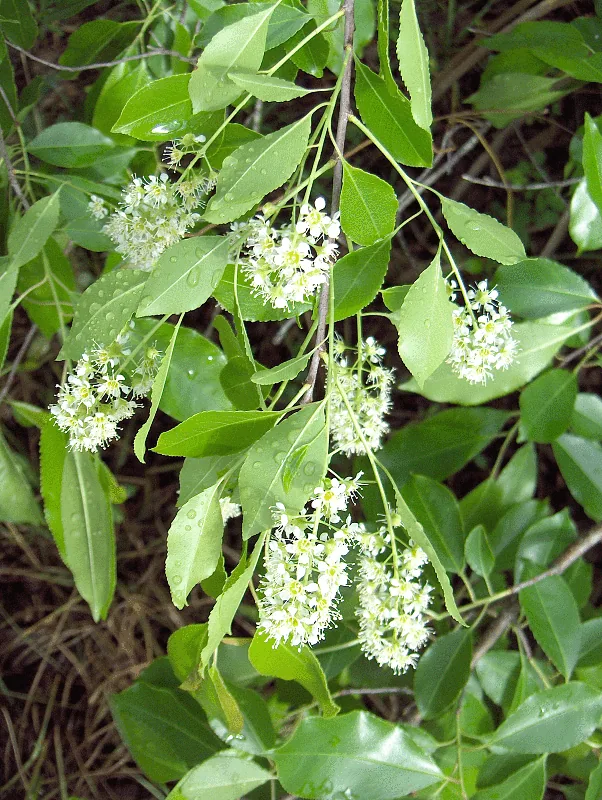


How to Grow and Care for Carolina Cherry Laurel
Prunus caroliniana
Written by Emilio Marruso · last checked
Toxic to: Cats, Dogs, Horses, Livestock, People · Why
At a glance
Carolina cherry laurel is a tough tree that grows 15 to 35 feet tall and loves full sun, though it happily accepts partial shade. Once settled in, it handles dry spells well, and its fruit feeds songbirds, wild turkeys, quail and small mammals. Just remember that its leaves, seeds and berries are poisonous to people and pets.
- Sun
Full sun is best; it also takes partial shade
What the sources say (1)
Light: Full sun preferred; tolerates partial shade
Full sun is preferred but it is tolerant of partial shade as long as the soil is moist and well-drained.
— Prunus caroliniana (Carolina Cherry Laurel, Carolina Cherry-Laurel, Carolina Laurel Cherry) | North Carolina Extension Gardener Plant Toolbox [1] - Water
Once established, it handles drought well; in partial shade keep the soil moist
What the sources say (2)
Watering: Established plants have good drought tolerance
Established plants have good drought tolerance. It is easy to transplant, can withstand heavy pruning, and is moderately salt tolerant.
— Prunus caroliniana (Carolina Cherry Laurel, Carolina Cherry-Laurel, Carolina Laurel Cherry) | North Carolina Extension Gardener Plant Toolbox [1] Watering notes: Partial shade is tolerated as long as the soil is moist and well-drained
Full sun is preferred but it is tolerant of partial shade as long as the soil is moist and well-drained.
— Prunus caroliniana (Carolina Cherry Laurel, Carolina Cherry-Laurel, Carolina Laurel Cherry) | North Carolina Extension Gardener Plant Toolbox [1] - Cold
Survives winters down to 0 °F (−17.8 °C)
Hardy in very cold winters · USDA 7a · RHS H6 · Z7
What the sources say (2)
Hardiness, coldest zone: 7a [winter low −17.8 to −15 °C (0 to 5 °F)]
7a, 7b, 8a, 8b, 9a, 9b, 10a, 10b
— Prunus caroliniana (Carolina Cherry Laurel, Carolina Cherry-Laurel, Carolina Laurel Cherry) | North Carolina Extension Gardener Plant Toolbox [1] Hardiness, warmest zone: 10b [winter low 1.7 to 4.4 °C (35 to 40 °F)]
7a, 7b, 8a, 8b, 9a, 9b, 10a, 10b
— Prunus caroliniana (Carolina Cherry Laurel, Carolina Cherry-Laurel, Carolina Laurel Cherry) | North Carolina Extension Gardener Plant Toolbox [1] - Soil
Moist soil that drains well
What the sources say (1)
Watering notes: Partial shade is tolerated as long as the soil is moist and well-drained
Full sun is preferred but it is tolerant of partial shade as long as the soil is moist and well-drained.
— Prunus caroliniana (Carolina Cherry Laurel, Carolina Cherry-Laurel, Carolina Laurel Cherry) | North Carolina Extension Gardener Plant Toolbox [1] - Pests
Borers, mites, scale and plum curculio; borers hit stressed trees most. Fungal and viral diseases too
What the sources say (2)
Pests: borers, mites, scale, plum curculio (weevils)
Borers can be a problem, particularly with trees under stress. Mites and scale and plum curculio (weevils) can also be a problem.
— Prunus caroliniana (Carolina Cherry Laurel, Carolina Cherry-Laurel, Carolina Laurel Cherry) | North Carolina Extension Gardener Plant Toolbox [1] Diseases: fungal and viral issues (unspecified)
Mites and scale and plum curculio (weevils) can also be a problem. Fungal and viral issues are occasional problems.
— Prunus caroliniana (Carolina Cherry Laurel, Carolina Cherry-Laurel, Carolina Laurel Cherry) | North Carolina Extension Gardener Plant Toolbox [1] - Watch out
It can spread in the garden through suckers and self-sown seedlings
- Size
15 to 35 ft tall and 15 to 20 ft wide
What the sources say (2)
Mature height: 457-1067 cm (15 to 35 feet)
Dimensions: Height: 15 ft. 0 in. - 35 ft. 0 in. Width: 15 ft. 0 in. - 20 ft. 0 in.
— Prunus caroliniana (Carolina Cherry Laurel, Carolina Cherry-Laurel, Carolina Laurel Cherry) | North Carolina Extension Gardener Plant Toolbox [1] Mature width: 457-610 cm (15 to 20 feet)
Dimensions: Height: 15 ft. 0 in. - 35 ft. 0 in. Width: 15 ft. 0 in. - 20 ft. 0 in.
— Prunus caroliniana (Carolina Cherry Laurel, Carolina Cherry-Laurel, Carolina Laurel Cherry) | North Carolina Extension Gardener Plant Toolbox [1] - Propagation
Grow new plants from seed or stem cuttings
What the sources say (1)
Propagation: Seed or stem cutting
Established plants have good drought tolerance. It is easy to transplant, can withstand heavy pruning, and is moderately salt tolerant. Propagate it by seed or stem cutting.
— Prunus caroliniana (Carolina Cherry Laurel, Carolina Cherry-Laurel, Carolina Laurel Cherry) | North Carolina Extension Gardener Plant Toolbox [1] - Safety
Leaves, seeds and berries are poisonous to people, cats, dogs and horses
Overview
Carolina cherry laurel is a broadleaf evergreen woody shrub to small tree native to the southern United States. [1] It prefers full sun, tolerates partial shade in moist, well-drained soil, and established plants are drought tolerant. [1] Stems, leaves and seeds contain cyanide and the plant is rated as having high poison severity. [1]
This record is incomplete: the sources we read do not cover every field yet.
Not yet covered by our sources: Pruning
Carolina Cherry Laurel care
How to water Carolina Cherry Laurel
Watering
Established plants have good drought tolerance
What the sources say (1)
Established plants have good drought tolerance. It is easy to transplant, can withstand heavy pruning, and is moderately salt tolerant.Watering notes
Partial shade is tolerated as long as the soil is moist and well-drained
What the sources say (1)
Full sun is preferred but it is tolerant of partial shade as long as the soil is moist and well-drained.How much light Carolina Cherry Laurel needs
Full sun preferred; tolerates partial shade
What the sources say (1)
Full sun is preferred but it is tolerant of partial shade as long as the soil is moist and well-drained.How much cold Carolina Cherry Laurel can take
Hardiness, coldest zone
7a [winter low −17.8 to −15 °C (0 to 5 °F)]
What the sources say (1)
7a, 7b, 8a, 8b, 9a, 9b, 10a, 10bHardiness, warmest zone
10b [winter low 1.7 to 4.4 °C (35 to 40 °F)]
What the sources say (1)
7a, 7b, 8a, 8b, 9a, 9b, 10a, 10bHow to propagate Carolina Cherry Laurel
Seed or stem cutting
What the sources say (1)
Established plants have good drought tolerance. It is easy to transplant, can withstand heavy pruning, and is moderately salt tolerant. Propagate it by seed or stem cutting.How to grow Carolina Cherry Laurel
The plant
Life cycle
perennial
What the sources say (1)
Plant Type: Native Plant Perennial Poisonous Shrub Tree Woody Plant Leaf Characteristics: Broadleaf EvergreenFamily
Rosaceae
What the sources say (1)
Carolina cherry laurel is a broadleaf evergreen, woody shrub to small tree and a member of the rose family (Rosaceae).Mature height
457-1067 cm (15 to 35 feet)
What the sources say (1)
Dimensions: Height: 15 ft. 0 in. - 35 ft. 0 in. Width: 15 ft. 0 in. - 20 ft. 0 in.Mature width
457-610 cm (15 to 20 feet)
What the sources say (1)
Dimensions: Height: 15 ft. 0 in. - 35 ft. 0 in. Width: 15 ft. 0 in. - 20 ft. 0 in.Pests and diseases
Pests
borers, mites, scale, plum curculio (weevils)
What the sources say (1)
Borers can be a problem, particularly with trees under stress. Mites and scale and plum curculio (weevils) can also be a problem.Diseases
fungal and viral issues (unspecified)
What the sources say (1)
Mites and scale and plum curculio (weevils) can also be a problem. Fungal and viral issues are occasional problems.Carolina Cherry Laurel pests and problems
Borers, mites, scale and plum curculio
Symptom: Borers can be a problem, particularly with trees under stress; mites, scale and plum curculio (weevils) can also be a problem.
What to do: No management given in the source.
What the sources say (1)
Borers can be a problem, particularly with trees under stress. Mites and scale and plum curculio (weevils) can also be a problem.
— Prunus caroliniana (Carolina Cherry Laurel, Carolina Cherry-Laurel, Carolina Laurel Cherry) | North Carolina Extension Gardener Plant Toolbox [1] Weediness
Symptom: Can become weedy in the landscape due to suckering and self-seeding.
What to do: No management given in the source.
What the sources say (1)
It can become weedy in the landscape due to suckering and self-seeding.
— Prunus caroliniana (Carolina Cherry Laurel, Carolina Cherry-Laurel, Carolina Laurel Cherry) | North Carolina Extension Gardener Plant Toolbox [1]
Remedies
Each remedy shows what official sources say about it; traditional remedies without an official source are marked as such. Harmful ones are listed so you know to avoid them.
Treating the plant
scale insects
removing scale covers with a soft brush Partly works
How: If the infestation is not heavy, use a soft brush to remove the white scale covers from the branches, which will expose the insects to predators and dry them out.
If the infestation is not heavy, use a soft brush to remove the white scale covers from the branches, which will expose the insects to predators and dry them out.
— extension.umd.edu [6] What the evidence says If the infestation is not heavy, use a soft brush to remove the white scale covers from the branches, which will expose the insects to predators and dry them out.
— extension.umd.edu [6] soapy water scrub Not verified
Traditional remedy, not verified by an official source.
Most dish soaps are not naturally occurring substances nor are they biodegradable. They can contain detergents and degreasers that are harmful to groundwater and aquatic and soil organisms.
— ucanr.edu [7] How: Use a soft brush or cloth dipped in soapy water to remove visible scale.
borers
pruning out and destroying infested branches Works
How: The best control option for home gardeners with only a few plants is to prune out and destroy infested branches.
The best control option for home gardeners with only a few plants is to prune out and destroy infested branches.
— extension.umd.edu [6] What the evidence says The best control option for home gardeners with only a few plants is to prune out and destroy infested branches.
— extension.umd.edu [6]
leaf spot
baking soda spray Not verified
Traditional remedy, not verified by an official source.
How: A mixture of 1 teaspoon baking soda and 1 quart water can help mild cases. Spray it on affected leaves weekly.
Getting rid of it
cherry laurel plants
digging out the roots Official source, not independently tested
How: Dig out individual plants and small patches. Remove the roots. Cherry laurel may regrow if all the roots are not removed.
Dig out individual plants and small patches. Remove the roots. Cherry laurel may regrow if all the roots are not removed.
— solvepestproblems.oregonstate.edu [8]
cherry laurel stumps regrowth
covering cut stumps with brash heaps Not verified
Traditional remedy, not verified by an official source.
How: Where possible, build the rafts and brash heaps right on top of newly cut laurel stools. This excludes the light from them and discourages new growth from the stool
Is Carolina Cherry Laurel toxic to pets?
Reported by the source, quoted verbatim. This is not medical or veterinary advice: if a person or an animal may have eaten this plant, contact a poison control centre or a veterinarian.
Animals
While the fruit is poisonous to humans and livestock, many birds such as cedar waxwings and robins
[4]- Toxic principle
its fruit , twigs, and leaves contain hydrocyanic acid that can be toxic to humans
[4]
#problem for cats #problem for dogs #problem for horses
[1]The source flags the risk for this animal but does not explain why.
People
Calendar
Pruning
Not stated in the sources we read.
Months as given by the sources, which are mostly from the United States (northern hemisphere). In the southern hemisphere they shift by about six months.
Edibility
Reported by the source, quoted verbatim. Do not eat a plant on the basis of this page alone: identification mistakes can be dangerous.
Fruits are eaten by songbirds, wild turkeys, quail, raccoons, foxes, and small mammals.
[1]
Indicative values
Values from a secondary source, not checked word for word like the rest of this page. Use them as a starting point.
- Hours of sun
- 6-8 hoursIndicative value, adapt it to your climate · Secondary source
- Soil pH
- 6-7.5Indicative value, adapt it to your climate · Secondary source
- Care level
- MediumIndicative value, adapt it to your climate · Secondary source
- Growth rate
- HighIndicative value, adapt it to your climate · Secondary source
- Pruning
- March, April, May, June, July, AugustIndicative value, adapt it to your climate · Secondary source
Similar plants
- Afghan Cherry Prunus jacquemontii
- American Plum Prunus americana
- Amur chokecherry Prunus maackii
- Apricot Prunus armeniaca
- Black Cherry Prunus serotina
- Cherry Laurel Prunus laurocerasus
- Chickasaw Plum Prunus angustifolia
- Chinese Plum Prunus glandulosa
Sources
Every value above is quoted from these documents. Links lead to the original publisher.
- Prunus caroliniana (Carolina Cherry Laurel, Carolina Cherry-Laurel, Carolina Laurel Cherry) | North Carolina Extension Gardener Plant Toolbox · plants.ces.ncsu.edu, consulted
- Carolina Cherry Laurel - Prunus caroliniana | North Carolina Extension Gardener Plant Toolbox · plants.ces.ncsu.edu, consulted
- Carolina Laurel Cherry - Prunus caroliniana | North Carolina Extension Gardener Plant Toolbox · plants.ces.ncsu.edu, consulted
- Carolina Laurelcherry - School of Forest, Fisheries, & Geomatics Sciences - Institute of Food and Agricultural Sciences - University of Florida, Institute of Food and Agricultural Sciences - UF/IFAS · ffgs.ifas.ufl.edu, consulted
- Laurel | Home & Garden Information Center · hgic.clemson.edu, consulted
- extension.umd.edu · extension.umd.edu
- ucanr.edu · ucanr.edu
- solvepestproblems.oregonstate.edu · solvepestproblems.oregonstate.edu
Written by Emilio Marruso · last checked