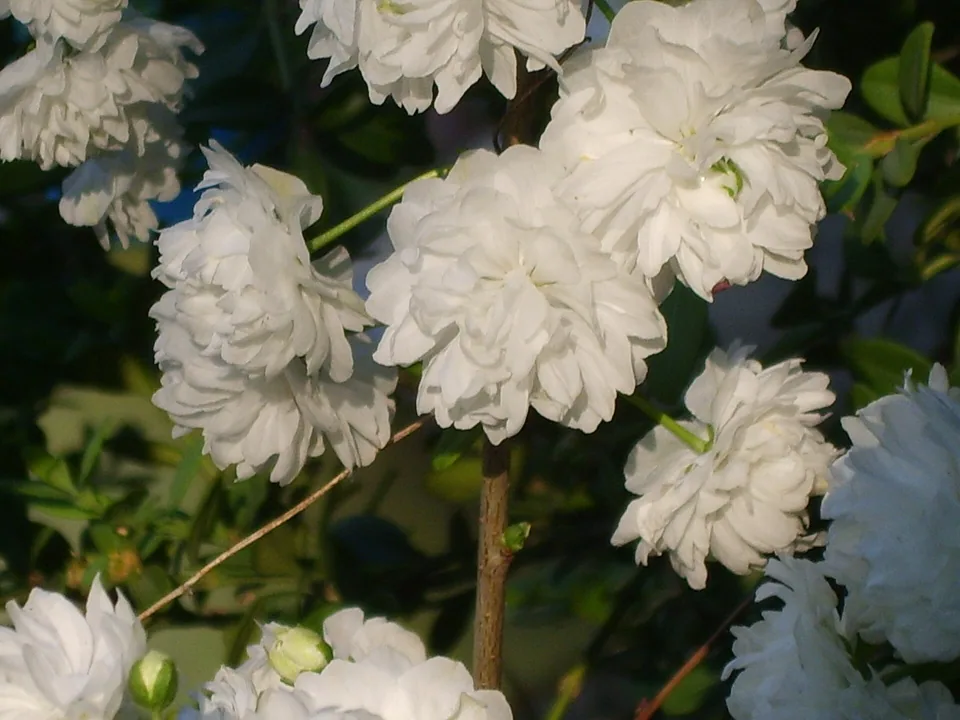


How to Grow and Care for Chinese Plum
Prunus glandulosa
Written by Emilio Marruso · last checked
Toxic to: Cats, Dogs, Horses, People · Why
At a glance
This deciduous shrub of the rose family blooms in spring and grows happily in full sun or partial shade. Give it moist soil and regular watering for its first two years; after that, it tolerates some drought. Prune it right after flowering, and in July and August it rewards you with edible fruit.
- Sun
Full sun to partial shade
What the sources say (2)
Light: Full sun to partial shade
Chinese Plum does best planted in moist, organic, well-drained soil in full sun or partial shade.
— Prunus glandulosa (Chinese Plum, Dwarf Flowering Almond, Flowering Almond, Korean Cherry) | North Carolina Extension Gardener Plant Toolbox [1] The plant will do best in full sun.
— Dwarf Flowering Almond (Prunus glandulosa) [3] - Water
Likes moist soil; water regularly the first two years, then it handles some drought
What the sources say (4)
Watering: Moist soil is best; tolerates some drought
- Soil: fairly tolerant - Watering: moist best - When to prune: after flowering
— Dwarf Flowering Almond (Prunus glandulosa) [3] It will tolerate a range of soil types, urban conditions, and some drought. However, it does not do well with wet soil and good drainage is required.
— Prunus glandulosa (Chinese Plum, Dwarf Flowering Almond, Flowering Almond, Korean Cherry) | North Carolina Extension Gardener Plant Toolbox [1] Watering notes: Needs more moisture during establishment than some other spring-blooming shrubs; water regularly during the first two years
it seems to need more moisture during establishment than some of the other spring blooming shrubs.
— Flowering Almond [5] make sure it is watered regularly during the first two years of establishment.
— Flowering Almond [5] - Pruning
Prune right after it flowers
What the sources say (2)
Pruning: After flowering
It can be severely pruned after flowering to promote new stem growth and flowering for the following year.
— Prunus glandulosa (Chinese Plum, Dwarf Flowering Almond, Flowering Almond, Korean Cherry) | North Carolina Extension Gardener Plant Toolbox [1] When to prune: after flowering - Suggested use: mixed shrub bed
— Dwarf Flowering Almond (Prunus glandulosa) [3] - Harvest
Edible fruit ripens in July and August; never eat the leaves or seeds
What the sources say (1)
Harvest: Summer; fruit ripens in July and August
Display/Harvest Time: Summer Fruit Type: Drupe Fruit Width: < 1 inch Fruit Description: Dark red fruits 3/8 of an inch in diameter. Ripens in July and August.
— Prunus glandulosa (Chinese Plum, Dwarf Flowering Almond, Flowering Almond, Korean Cherry) | North Carolina Extension Gardener Plant Toolbox [1] - Pests
Borers are the worst problem; also aphids, Japanese beetles, powdery mildew and leaf spot
What the sources say (2)
Pests: cankers, borers, Japanese beetles, aphids, scale, leaf hoppers, caterpillars, spider mites
Cankers, borers, Japanese beetles, aphids, scale, leaf hoppers, caterpillars, and spider mites can appear.
— Prunus glandulosa (Chinese Plum, Dwarf Flowering Almond, Flowering Almond, Korean Cherry) | North Carolina Extension Gardener Plant Toolbox [1] Diseases: fire blight, leaf spot, die back, leaf curl, powdery mildew, root rot, honey fungus
Chinese Plum is susceptible to a number of diseases and insect pests including fire blight, leaf spot, die back, leaf curl, powdery mildew, root rot, and honey fungus.
— Prunus glandulosa (Chinese Plum, Dwarf Flowering Almond, Flowering Almond, Korean Cherry) | North Carolina Extension Gardener Plant Toolbox [1] - Watch out
Spreads by root suckers: pull them out to keep it in its place
- Propagation
From seed or stem cuttings
What the sources say (1)
Propagation: Seed, stem cutting
Recommended Propagation Strategy: Seed Stem Cutting Country Or Region Of Origin:
— Prunus glandulosa (Chinese Plum, Dwarf Flowering Almond, Flowering Almond, Korean Cherry) | North Carolina Extension Gardener Plant Toolbox [1] - Safety
Stems, leaves and seeds contain cyanide; harmful to cats, dogs and horses
Overview
Chinese plum is a small, multi-stemmed, deciduous flowering shrub with pink or white blossoms in early spring. [1] It prefers moist, well-drained soil in full sun or partial shade and can be pruned hard after flowering. [1] Stems, leaves and seeds contain cyanogenic glycosides and the plant is flagged as a problem for cats, dogs and horses. [1]
Chinese Plum care
How to water Chinese Plum
Watering
Moist soil is best; tolerates some drought
What the sources say (2)
- Soil: fairly tolerant
- Watering: moist best
- When to prune: after floweringIt will tolerate a range of soil types, urban conditions, and some drought. However, it does not do well with wet soil and good drainage is required.Watering notes
Needs more moisture during establishment than some other spring-blooming shrubs; water regularly during the first two years
How much light Chinese Plum needs
Full sun to partial shade
What the sources say (2)
Chinese Plum does best planted in moist, organic, well-drained soil in full sun or partial shade.The plant will do best in full sun.How much cold Chinese Plum can take
Hardiness, coldest zone
The sources give different values depending on region, zone or growing conditions.
What each source says
According to NC State Extension: 4a [winter low −34.4 to −31.7 °C (−30 to −25 °F)]
According to University of Illinois Extension: 5 [winter low −28.9 to −23.3 °C (−20 to −10 °F)]
What the sources say (2)
According to NC State Extension: USDA Plant Hardiness Zone:
4a, 4b, 5a, 5b, 6a, 6b, 7a, 7b, 8a, 8bAccording to University of Illinois Extension: | Hardiness Zone:
|
5 - 9
| Mature Height:
|
4-5 FeetHardiness, warmest zone
The sources give different values depending on region, zone or growing conditions.
What each source says
According to NC State Extension: 8b [winter low −9.4 to −6.7 °C (15 to 20 °F)]
According to University of Illinois Extension: 9 [winter low −6.7 to −1.1 °C (20 to 30 °F)]
What the sources say (2)
According to NC State Extension: USDA Plant Hardiness Zone:
4a, 4b, 5a, 5b, 6a, 6b, 7a, 7b, 8a, 8bAccording to University of Illinois Extension: | Hardiness Zone:
|
5 - 9
| Mature Height:
|
4-5 FeetHow to propagate Chinese Plum
Seed, stem cutting
What the sources say (1)
Recommended Propagation Strategy:
Seed
Stem Cutting
Country Or Region Of Origin:How to grow Chinese Plum
The plant
Life cycle
woody (deciduous shrub)
What the sources say (1)
Genus: Prunus Species: glandulosa Family: Rosaceae Life Cycle: WoodyFamily
Rosaceae
What the sources say (1)
Genus: Prunus Species: glandulosa Family: Rosaceae Life Cycle: WoodyMature height
Pests and diseases
Pests
cankers, borers, Japanese beetles, aphids, scale, leaf hoppers, caterpillars, spider mites
What the sources say (1)
Cankers, borers, Japanese beetles, aphids, scale, leaf hoppers, caterpillars, and spider mites can appear.Diseases
fire blight, leaf spot, die back, leaf curl, powdery mildew, root rot, honey fungus
What the sources say (1)
Chinese Plum is susceptible to a number of diseases and insect pests including fire blight, leaf spot, die back, leaf curl, powdery mildew, root rot, and honey fungus.Chinese Plum pests and problems
Disease and insect pests
Symptom: Fire blight, leaf spot, die back, leaf curl, powdery mildew, root rot, honey fungus, cankers, borers, Japanese beetles, aphids, scale and other pests; the volume of problems tends to shorten the lifespan to less than 10 years
What the sources say (1)
The volume of problems tends to shorten the lifespan of the shrub to less than 10 years.
— Prunus glandulosa (Chinese Plum, Dwarf Flowering Almond, Flowering Almond, Korean Cherry) | North Carolina Extension Gardener Plant Toolbox [1] Borers
Symptom: The most serious problems of this species are borers
What the sources say (1)
The most serious problems of this species are borers.
— Dwarf Flowering Almond (Prunus glandulosa)-Hort Answers - University of Illinois Extension [4] Root suckers
Symptom: Spreads by root suckers
What to do: Remove root suckers to control unwanted spread
What the sources say (1)
Without pruning, the shrub can begin to appear unkempt. To control unwanted spread, remove root suckers.
— Prunus glandulosa (Chinese Plum, Dwarf Flowering Almond, Flowering Almond, Korean Cherry) | North Carolina Extension Gardener Plant Toolbox [1]
Remedies
Each remedy shows what official sources say about it; traditional remedies without an official source are marked as such. Harmful ones are listed so you know to avoid them.
First aid
First aid: not a substitute for a doctor
plant ingestion
wipe out the mouth and rinse with water Official source, not independently tested
If the person is awake and alert, call the Missouri Poison Center at 1-800-222-1222 for further treatment advice.
— missouripoisoncenter.org [7] Call 911 if the person is unconscious, having seizures, or has trouble breathing.
— missouripoisoncenter.org [7] Do not induce vomiting and do not give them anything to drink.
— missouripoisoncenter.org [7] How: Wipe out the mouth with a damp cloth and/or let the person rinse their mouth out with water.
Wipe out their mouth with a damp cloth and or let them rinse their mouth out with water.
— missouripoisoncenter.org [7]
Treating the plant
peachtree borer
keep mulch away from the trunk Official source, not independently tested
How: Do not pile mulch around the base of the trunks; piled mulch makes the host plant more attractive to egg-laying females.
do not pile mulch around the base of the trunks of these trees. This practice makes the host plant more attractive to egg-laying females.
— extension.psu.edu [8] avoid damaging the bark at the trunk base Official source, not independently tested
How: Avoid damaging the bark on the trunk at the base of host trees.
Another nonchemical management tactic for this key pest is to avoid damaging the bark on the trunk at the base of host trees.
— extension.psu.edu [8]
black knot
pruning out the galls Partly works
How: Prune in the dormant season when galls are easy to see; remove all knots and burn, bury, or remove them from the site; cut 4 to 8 inches behind the swellings.
Remove all knots from the tree and burn, bury, or remove them from the site. The fungus can release spores from the dead knots. Make cuts 4 to 8 inches behind any obvious black knot swellings.
— hyg.ipm.illinois.edu [9] What the evidence says take steps to get it under control using a combination of pruning and fungicide applications.
— hyg.ipm.illinois.edu [9] dormant oil at bud swell Official source, not independently tested
How: Apply a dormant oil at bud swell.
Apply a dormant oil at bud swell. You could still prune now, but sap will flow freely from the cut surfaces, attracting many insects.
— hyg.ipm.illinois.edu [9]
aphids
insecticidal soap spray Works
Some plants are sensitive to soap sprays and may be seriously injured by them. Read the label to make sure your plant is not one of them
— caswell.ces.ncsu.edu [10] To test for plant sensitivity, spray a small area and wait 24 hours to see if any damage occurs
— caswell.ces.ncsu.edu [10] Do not apply the soap in full sun or at temperatures above 90 ºF as this may damage the plants
— caswell.ces.ncsu.edu [10] Sensitive plants include portulaca, hawthorn, cherries, plum, horse chestnut
— caswell.ces.ncsu.edu [10] How: Insecticidal soaps are usually used as a 1 to 2% solution (2½ to 5 tablespoons per gallon); follow the product label; do not apply in full sun or above 90 °F.
Insecticidal soaps are usually used as a 1 to 2% solution (2½ to 5 tablespoons per gallon). Always follow the label for the product you are using
— caswell.ces.ncsu.edu [10] What the evidence says Small, soft-bodied insects such as aphids, mealybugs, thrips, scale crawlers, and spider mites are most susceptible to the soaps
— caswell.ces.ncsu.edu [10]
Is Chinese Plum toxic to pets?
Reported by the source, quoted verbatim. This is not medical or veterinary advice: if a person or an animal may have eaten this plant, contact a poison control centre or a veterinarian.
Animals
Problems: Frequent Disease Problems Frequent Insect Problems Problem for Cats Problem for Dogs Problem for Horses
[1]- Poisonous parts
Poison Toxic Principle: Cyanogenic glycosides Causes Contact Dermatitis: No Poison Part: Leaves Seeds Stems
[1]- Toxic principle
Poison Toxic Principle: Cyanogenic glycosides Causes Contact Dermatitis: No Poison Part: Leaves Seeds Stems
[1]- Symptoms
Poison Symptoms: Stems, leaves, seeds contain cyanide, particularly toxic when in the process of wilting. Can cause brick red mucous membranes, dilated pupils, difficulty breathing, panting, shock.
[1]
People
Poison Severity: Low Poison Symptoms: Stems, leaves, seeds contain cyanide, particularly toxic when in the process of wilting.
[1]- Poisonous parts
Poison Toxic Principle: Cyanogenic glycosides Causes Contact Dermatitis: No Poison Part: Leaves Seeds Stems
[1]- Toxic principle
Poison Toxic Principle: Cyanogenic glycosides Causes Contact Dermatitis: No Poison Part: Leaves Seeds Stems
[1]- Symptoms
Poison Symptoms: Stems, leaves, seeds contain cyanide, particularly toxic when in the process of wilting. Can cause brick red mucous membranes, dilated pupils, difficulty breathing, panting, shock.
[1]- Severity
Poisonous to Humans: Poison Severity: Low Poison Symptoms:
[1]
Calendar
Harvest
Summer; fruit ripens in July and August
What the sources say (1)
Display/Harvest Time:
Summer
Fruit Type:
Drupe
Fruit Width:
< 1 inch
Fruit Description:
Dark red fruits 3/8 of an inch in diameter. Ripens in July and August.Pruning
After flowering
What the sources say (2)
It can be severely pruned after flowering to promote new stem growth and flowering for the following year.When to prune: after flowering
- Suggested use: mixed shrub bedMonths as given by the sources, which are mostly from the United States (northern hemisphere). In the southern hemisphere they shift by about six months.
Edibility
Reported by the source, quoted verbatim. Do not eat a plant on the basis of this page alone: identification mistakes can be dangerous.
The fruit is edible. However, leaves and seeds contain hydrogen cyanide, a poison that gives almonds their characteristic flavor.
[1]
Indicative values
Values from a secondary source, not checked word for word like the rest of this page. Use them as a starting point.
- Drought tolerant
- yesIndicative value, adapt it to your climate · Secondary source
- Soil pH
- 6-7.5Indicative value, adapt it to your climate · Secondary source
- Care level
- MediumIndicative value, adapt it to your climate · Secondary source
- Growth rate
- LowIndicative value, adapt it to your climate · Secondary source
Similar plants
- Afghan Cherry Prunus jacquemontii
- American Plum Prunus americana
- Amur chokecherry Prunus maackii
- Apricot Prunus armeniaca
- Black Cherry Prunus serotina
- Carolina Cherry Laurel Prunus caroliniana
- Cherry Laurel Prunus laurocerasus
- Chickasaw Plum Prunus angustifolia
Sources
Every value above is quoted from these documents. Links lead to the original publisher.
- Prunus glandulosa (Chinese Plum, Dwarf Flowering Almond, Flowering Almond, Korean Cherry) | North Carolina Extension Gardener Plant Toolbox · plants.ces.ncsu.edu, consulted
- Dwarf Flowering Almond (Prunus glandulosa) - Selecting Shrubs for Your Home - University of Illinois Extension · web.extension.illinois.edu, consulted
- Dwarf Flowering Almond (Prunus glandulosa) · uaex.uada.edu, consulted
- Dwarf Flowering Almond (Prunus glandulosa)-Hort Answers - University of Illinois Extension · web.extension.illinois.edu, consulted
- Flowering Almond · uaex.uada.edu, consulted
- Prunus (Almond, Apricot, Cherries, Nectarines, peach, Plum, Stone Fruits) | North Carolina Extension Gardener Plant Toolbox · plants.ces.ncsu.edu, consulted
- missouripoisoncenter.org · missouripoisoncenter.org
- extension.psu.edu · extension.psu.edu
- hyg.ipm.illinois.edu · hyg.ipm.illinois.edu
- caswell.ces.ncsu.edu · caswell.ces.ncsu.edu
Written by Emilio Marruso · last checked