

How to Grow and Care for Chickasaw Plum
Prunus angustifolia
Written by Emilio Marruso · last checked
Toxic to: Cats, Dogs, Horses, People · Why
At a glance
Chickasaw plum is easygoing: it grows in full sun or part shade and tolerates a wide range of soils. In early to mid summer it ripens tart little plums that shine in homemade preserves and jellies. Just pull out the root suckers promptly, and it will stay a tidy plant instead of spreading into a thicket.
- Sun
Full sun or part shade
What the sources say (1)
Light: Full sun or part shade
The Chickasaw plum grows best in average, medium, well-drained soils in full sun or part shade, but it will tolerate a wide range of soil types and growing conditions.
— Prunus angustifolia (Chickasaw Plum) | North Carolina Extension Gardener Plant Toolbox [1] - Cold
Survives winters down to −20 °F (−28.9 °C)
Very hardy · USDA 5a · RHS H7 · Z5
What the sources say (2)
Hardiness, coldest zone: 5a [winter low −28.9 to −26.1 °C (−20 to −15 °F)]
5a, 5b, 6a, 6b, 7a, 7b, 8a, 8b, 9a, 9b
— Prunus angustifolia (Chickasaw Plum) | North Carolina Extension Gardener Plant Toolbox [1] Hardiness, warmest zone: 9b [winter low −3.9 to −1.1 °C (25 to 30 °F)]
5a, 5b, 6a, 6b, 7a, 7b, 8a, 8b, 9a, 9b
— Prunus angustifolia (Chickasaw Plum) | North Carolina Extension Gardener Plant Toolbox [1] - Soil
Best in average, well-drained soil, but it handles many soil types
What the sources say (1)
Watering notes: Grows best in average, medium, well-drained soils; tolerates a wide range of soil types and growing conditions
The Chickasaw plum grows best in average, medium, well-drained soils in full sun or part shade, but it will tolerate a wide range of soil types and growing conditions.
— Prunus angustifolia (Chickasaw Plum) | North Carolina Extension Gardener Plant Toolbox [1] - Harvest
Plums ripen in early to mid summer; tart, best for preserves and jellies
What the sources say (1)
Harvest: Early to mid summer (fruit ripens)
Small, cherry-like, edible, red to yellow 1/2 inch plums ripen in early to mid summer.
— Prunus angustifolia (Chickasaw Plum) | North Carolina Extension Gardener Plant Toolbox [1] - Pests
Plum curculio and brown rot hit the fruit; also aphids, scale, borers and black knot
What the sources say (2)
Pests: plum curculio, aphids, scale, borers, tent caterpillars
Plum curculio and brown rot can affect the fruit of the Chickasaw plum. Watch for leaf spot, canker and black knot. Insect problems include aphids, scale, borers and tent caterpillars.
— Prunus angustifolia (Chickasaw Plum) | North Carolina Extension Gardener Plant Toolbox [1] Diseases: brown rot, leaf spot, canker, black knot
Plum curculio and brown rot can affect the fruit of the Chickasaw plum. Watch for leaf spot, canker and black knot. Insect problems include aphids, scale, borers and tent caterpillars.
— Prunus angustifolia (Chickasaw Plum) | North Carolina Extension Gardener Plant Toolbox [1] - Watch out
Root suckers spread it into thickets: pull them out promptly
- Size
4 to 20 ft tall and just as wide
What the sources say (2)
Mature height: 122-610 cm (4-20 ft)
Height: 4 ft. 0 in. - 20 ft. 0 in. Width: 4 ft. 0 in. - 20 ft. 0 in.
— Prunus angustifolia (Chickasaw Plum) | North Carolina Extension Gardener Plant Toolbox [1] Mature width: 122-610 cm (4-20 ft)
Height: 4 ft. 0 in. - 20 ft. 0 in. Width: 4 ft. 0 in. - 20 ft. 0 in.
— Prunus angustifolia (Chickasaw Plum) | North Carolina Extension Gardener Plant Toolbox [1] - Safety
Eat only the fruit: pits, leaves and stems are poisonous to people, cats, dogs and horses
Overview
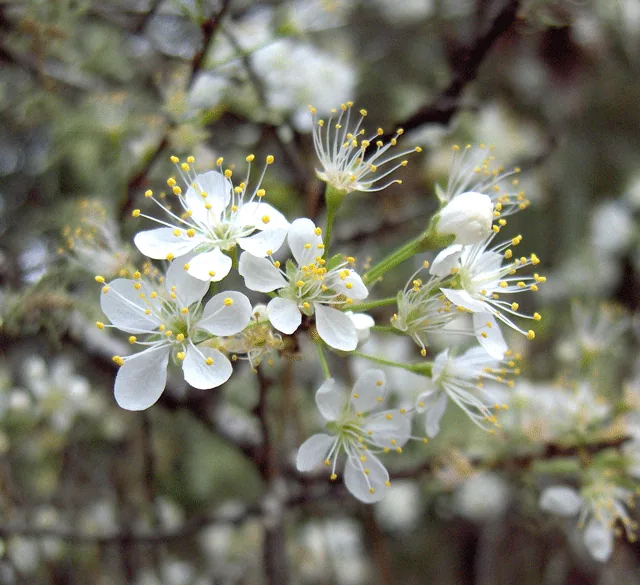
Chickasaw plum is a deciduous, multi-stemmed small tree or shrub native to the southern United States that bears fragrant white flowers in early spring and small plums in summer. [1] It grows best in average, medium, well-drained soils in full sun or part shade, and forms thickets through root suckers unless they are removed. [1] The fruit is safe to eat but the pits, foliage and stems are not, since the pits contain cyanide compounds. [1]
This record is incomplete: the sources we read do not cover every field yet.
Not yet covered by our sources: Watering, Pruning, Propagation
Chickasaw Plum care
How to water Chickasaw Plum
Watering
Not stated in the sources we read.
Watering notes
Grows best in average, medium, well-drained soils; tolerates a wide range of soil types and growing conditions
What the sources say (1)
The Chickasaw plum grows best in average, medium, well-drained soils in full sun or part shade, but it will tolerate a wide range of soil types and growing conditions.How much light Chickasaw Plum needs
Full sun or part shade
What the sources say (1)
The Chickasaw plum grows best in average, medium, well-drained soils in full sun or part shade, but it will tolerate a wide range of soil types and growing conditions.How much cold Chickasaw Plum can take
Hardiness, coldest zone
5a [winter low −28.9 to −26.1 °C (−20 to −15 °F)]
What the sources say (1)
5a, 5b, 6a, 6b, 7a, 7b, 8a, 8b, 9a, 9bHardiness, warmest zone
9b [winter low −3.9 to −1.1 °C (25 to 30 °F)]
What the sources say (1)
5a, 5b, 6a, 6b, 7a, 7b, 8a, 8b, 9a, 9bHow to propagate Chickasaw Plum
Not stated in the sources we read.
How to grow Chickasaw Plum
The plant
Family
Rosaceae
What the sources say (1)
Chickasaw Plum is a flowering, deciduous, multi-stemmed small tree or shrub in the rose family and native to the southern United States.Mature height
122-610 cm (4-20 ft)
What the sources say (1)
Height: 4 ft. 0 in. - 20 ft. 0 in.
Width: 4 ft. 0 in. - 20 ft. 0 in.Mature width
122-610 cm (4-20 ft)
What the sources say (1)
Height: 4 ft. 0 in. - 20 ft. 0 in.
Width: 4 ft. 0 in. - 20 ft. 0 in.Pests and diseases
Pests
plum curculio, aphids, scale, borers, tent caterpillars
What the sources say (1)
Plum curculio and brown rot can affect the fruit of the Chickasaw plum. Watch for leaf spot, canker and black knot. Insect problems include aphids, scale, borers and tent caterpillars.Diseases
brown rot, leaf spot, canker, black knot
What the sources say (1)
Plum curculio and brown rot can affect the fruit of the Chickasaw plum. Watch for leaf spot, canker and black knot. Insect problems include aphids, scale, borers and tent caterpillars.Chickasaw Plum pests and problems
Fruit and foliage pests and diseases
Symptom: Plum curculio and brown rot can affect the fruit; leaf spot, canker and black knot; aphids, scale, borers and tent caterpillars.
What the sources say (1)
Plum curculio and brown rot can affect the fruit of the Chickasaw plum. Watch for leaf spot, canker and black knot. Insect problems include aphids, scale, borers and tent caterpillars.
— Prunus angustifolia (Chickasaw Plum) | North Carolina Extension Gardener Plant Toolbox [1] Thicket-forming root suckers
Symptom: Left alone it forms thickets with suckers that make large colonies.
What to do: Prevent unwanted spread by promptly removing the root suckers.
What the sources say (2)
In nature and left to its own devices, it is typically a thicket-forming shrub with suckers that form large colonies.
— Prunus angustifolia (Chickasaw Plum) | North Carolina Extension Gardener Plant Toolbox [1] You can, however, prevent unwanted spread by promptly removing the root suckers.
— Prunus angustifolia (Chickasaw Plum) | North Carolina Extension Gardener Plant Toolbox [1]
Remedies
Each remedy shows what official sources say about it; traditional remedies without an official source are marked as such. Harmful ones are listed so you know to avoid them.
Treating the plant
black knot
pruning out infected branches Official source, not independently tested
How: Prune out all infected branches in late winter and destroy them by burning, burying, or throwing them away; remove at least 3-4 inches of healthy tissue below each knot.
Prune out all infected branches in late winter (late February through the end of March) and destroy them by burning, burying, or throwing them away.
— extension.unh.edu [3]
root suckers
root barrier Not verified
Traditional remedy, not verified by an official source.
How: Plant it inside an impenetrable barrier; for a shrub, a large plastic bucket with the bottom cut off is suitable.
Getting rid of it
unwanted plants
digging up the plant Not verified
Traditional remedy, not verified by an official source.
How: Dig up the plant; in the case of smaller shrubs this prevents further fruiting that will spread the plant.
Is Chickasaw Plum toxic to pets?
Reported by the source, quoted verbatim. This is not medical or veterinary advice: if a person or an animal may have eaten this plant, contact a poison control centre or a veterinarian.
Animals
#larval host plant #problem for cats #problem for dogs #problem for horses
[1]The source flags the risk for this animal but does not explain why.
People
Calendar
Harvest
Early to mid summer (fruit ripens)
What the sources say (1)
Small, cherry-like, edible, red to yellow 1/2 inch plums ripen in early to mid summer.Pruning
Not stated in the sources we read.
Months as given by the sources, which are mostly from the United States (northern hemisphere). In the southern hemisphere they shift by about six months.
Edibility
Reported by the source, quoted verbatim. Do not eat a plant on the basis of this page alone: identification mistakes can be dangerous.
The fruit is safe to eat. The pits, foliage, and stems are not. Although the plums may be eaten raw, they are somewhat tart and acidic, and are perhaps best used in preserves and jellies, rather than consumed raw.
[1]
Indicative values
Values from a secondary source, not checked word for word like the rest of this page. Use them as a starting point.
- Life cycle
- PerennialIndicative value, adapt it to your climate · Secondary source
- Watering
- AverageIndicative value, adapt it to your climate · Secondary source
- Drought tolerant
- yesIndicative value, adapt it to your climate · Secondary source
- Soil pH
- 5.5-6.5Indicative value, adapt it to your climate · Secondary source
- Care level
- MediumIndicative value, adapt it to your climate · Secondary source
- Growth rate
- LowIndicative value, adapt it to your climate · Secondary source
- Pruning
- February, March, AprilIndicative value, adapt it to your climate · Secondary source
- Propagation
- Seed Propagation, Grafting Propagation, Layering Propagation, Cutting, BuddingIndicative value, adapt it to your climate · Secondary source
Similar plants
- Afghan Cherry Prunus jacquemontii
- American Plum Prunus americana
- Amur chokecherry Prunus maackii
- Apricot Prunus armeniaca
- Black Cherry Prunus serotina
- Carolina Cherry Laurel Prunus caroliniana
- Cherry Laurel Prunus laurocerasus
- Chinese Plum Prunus glandulosa
Sources
Every value above is quoted from these documents. Links lead to the original publisher.
- Prunus angustifolia (Chickasaw Plum) | North Carolina Extension Gardener Plant Toolbox · plants.ces.ncsu.edu, consulted
- Prunus (Almond, Apricot, Cherries, Nectarines, peach, Plum, Stone Fruits) | North Carolina Extension Gardener Plant Toolbox · plants.ces.ncsu.edu, consulted
- extension.unh.edu · extension.unh.edu
Written by Emilio Marruso · last checked