
How to Grow and Care for Amur chokecherry
Prunus maackii
Written by Emilio Marruso · last checked
At a glance
This adaptable plant grows happily in full sun or partial shade and accepts a wide range of soils, from pH 5.0 to 8.0. In mid- to late summer it carries small, long-lasting black fruit that birds love. You can also turn the fruit into jams and jellies, a bitter treat with a deep violet juice.
- Sun
Full sun to partial shade
- Water
Keep the soil moist but well drained; short dry spells are fine, soggy soil is not
What the sources say (3)
Watering: Medium water; moist, well-drained soil
Light: Full sun. Water: Medium. Soil: Average well drained soils.
— Amur Chokecherry | NDSU Agriculture [2] It does best in moist, well-drained soil high in organic matter
— Amur Cherry, Prunus maackii – Wisconsin Horticulture [1] Watering notes: Consistently moist, well-drained soil with occasional periods of dry soil; low tolerance of poor drainage
Moisture Tolerance: Consistently moist, well-drained soil; Occasional periods of dry soil
— Woody Plants Database [7] - Soil
Well-drained soil, pH 5.0–8.0
What the sources say (3)
Soil pH, minimum: 5.0
Soil Ph: Can tolerate acid to alkaline soil (pH 5.0 to 8.0)
— Woody Plants Database [7] Soil pH, maximum: 8.0
Soil Ph: Can tolerate acid to alkaline soil (pH 5.0 to 8.0)
— Woody Plants Database [7] Watering notes: Consistently moist, well-drained soil with occasional periods of dry soil; low tolerance of poor drainage
Moisture Tolerance: Consistently moist, well-drained soil; Occasional periods of dry soil
— Woody Plants Database [7] - Harvest
Small black fruit in mid- to late summer; bitter, good raw, cooked or in jams and jellies
- Pests
Watch for aphids, scale, borers and black knot
What the sources say (2)
Pests: aphids, scale, borers
## Insect Disease aphids, scale, borers ## Bare Root Transplanting ## Other Native to Manchuria and Korea
— Woody Plants Database [7] Diseases: black knot
It is somewhat prone to black knot , a fungal disease that produces grotesque blackish swellings on branches but otherwise has few pest problems
— Amur Cherry, Prunus maackii – Wisconsin Horticulture [1]
Overview
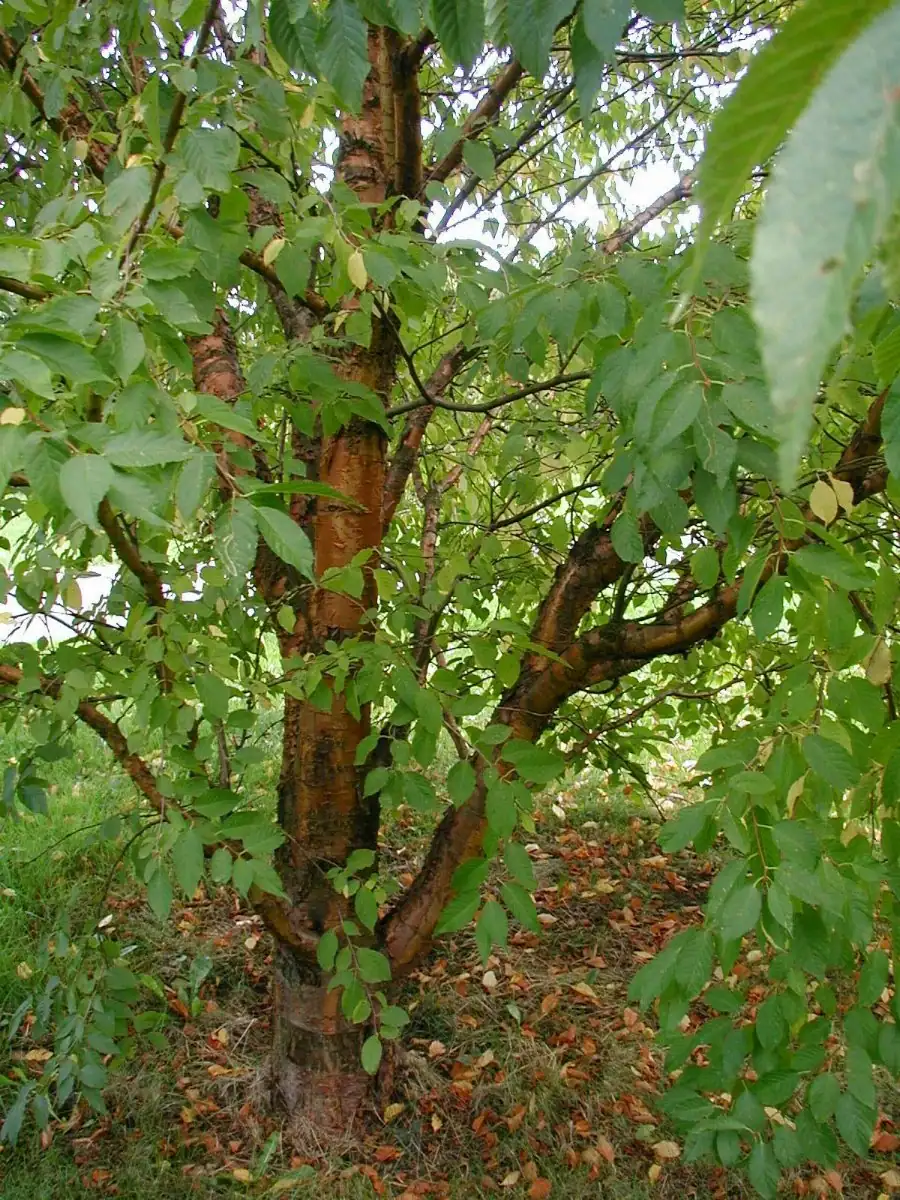
Prunus maackii is a deciduous ornamental tree valued for its exfoliating golden brown to russet bark. [2] It is planted in full sun or partial shade and does best in moist, well-drained soil. [1] Its small black fruit attract birds and can be used to make jams and jellies. [1]
This record is incomplete: the sources we read do not cover every field yet.
Not yet covered by our sources: Pruning
Amur chokecherry care
How to water Amur chokecherry
Watering
Medium water; moist, well-drained soil
Watering notes
Consistently moist, well-drained soil with occasional periods of dry soil; low tolerance of poor drainage
What the sources say (1)
Moisture Tolerance:
Consistently moist, well-drained soil; Occasional periods of dry soilHow much light Amur chokecherry needs
How much cold Amur chokecherry can take
Hardiness, coldest zone
The sources give different values depending on region, zone or growing conditions.
What each source says
According to University of Wisconsin Extension: 2 [winter low −45.6 to −40 °C (−50 to −40 °F)]
According to NDSU Extension: 3 [winter low −40 to −34.4 °C (−40 to −30 °F)]
According to Utah State University Extension: 3 [winter low −40 to −34.4 °C (−40 to −30 °F)]
According to Oregon State University: 2 [winter low −45.6 to −40 °C (−50 to −40 °F)]
According to University of Connecticut: 3 [winter low −40 to −34.4 °C (−40 to −30 °F)]
According to Cornell University: 3a [winter low −40 to −37.2 °C (−40 to −35 °F)]
What the sources say (6)
According to University of Wisconsin Extension: Native to Korea, Siberia and Manchuria, it is hardy in zones 2-9, making this a valuable addition to the landscape for northern gardeners.According to NDSU Extension: Hardiness: Zone 3
Leaves: Deciduous
Plant Type: According to Utah State University Extension: Limited cultivars available. Zones 3-6.According to Oregon State University: Hardy to USDA Zone 2 Native to Korea and Manchuria.According to University of Connecticut: - hardy to zone 3, and warmer parts of 2According to Cornell University: Light:
Full sun
Hardy To Zone:
3aHardiness, warmest zone
The sources give different values depending on region, zone or growing conditions.
What each source says
According to University of Wisconsin Extension: 9 [winter low −6.7 to −1.1 °C (20 to 30 °F)]
According to Utah State University Extension: 6 [winter low −23.3 to −17.8 °C (−10 to 0 °F)]
What the sources say (2)
According to University of Wisconsin Extension: Native to Korea, Siberia and Manchuria, it is hardy in zones 2-9, making this a valuable addition to the landscape for northern gardeners.According to Utah State University Extension: Limited cultivars available. Zones 3-6.Best soil for Amur chokecherry
Soil pH, minimum
5.0
What the sources say (1)
Soil Ph:
Can tolerate acid to alkaline soil (pH 5.0 to 8.0)Soil pH, maximum
8.0
What the sources say (1)
Soil Ph:
Can tolerate acid to alkaline soil (pH 5.0 to 8.0)How to propagate Amur chokecherry
How to grow Amur chokecherry
The plant
Family
Rosaceae
What the sources say (1)
Scientific Name: Prunus maackii
Family: Rosaceae (Rose)
Hardiness: Zone 3
Leaves: DeciduousPests and diseases
Pests
aphids, scale, borers
What the sources say (1)
## Insect Disease
aphids, scale, borers
## Bare Root Transplanting
## Other
Native to Manchuria and KoreaDiseases
black knot
What the sources say (1)
It is somewhat prone to black knot , a fungal disease that produces grotesque blackish swellings on branches but otherwise has few pest problemsRemedies
The sources we checked give no remedies for this plant.
Calendar
Pruning
Not stated in the sources we read.
Months as given by the sources, which are mostly from the United States (northern hemisphere). In the southern hemisphere they shift by about six months.
Edibility
Reported by the source, quoted verbatim. Do not eat a plant on the basis of this page alone: identification mistakes can be dangerous.
Indicative values
Values from a secondary source, not checked word for word like the rest of this page. Use them as a starting point.
- Life cycle
- PerennialIndicative value, adapt it to your climate · Secondary source
- Hours of sun
- 8-10 hoursIndicative value, adapt it to your climate · Secondary source
- Drought tolerant
- yesIndicative value, adapt it to your climate · Secondary source
- Care level
- MediumIndicative value, adapt it to your climate · Secondary source
- Growth rate
- HighIndicative value, adapt it to your climate · Secondary source
- Pruning
- March, April, August, March, April, AugustIndicative value, adapt it to your climate · Secondary source
Similar plants
- Afghan Cherry Prunus jacquemontii
- American Plum Prunus americana
- Apricot Prunus armeniaca
- Black Cherry Prunus serotina
- Carolina Cherry Laurel Prunus caroliniana
- Cherry Laurel Prunus laurocerasus
- Chickasaw Plum Prunus angustifolia
- Chinese Plum Prunus glandulosa
Sources
Every value above is quoted from these documents. Links lead to the original publisher.
- Amur Cherry, Prunus maackii – Wisconsin Horticulture · hort.extension.wisc.edu, consulted
- Amur Chokecherry | NDSU Agriculture · ndsu.edu, consulted
- Amur Chokecherry | Drush Site-Install · selectors.extension.illinois.edu, consulted
- Chokecherry, Amur | TreeBrowser | USU · extension.usu.edu, consulted
- Prunus maackii | Landscape Plants | Oregon State University · landscapeplants.oregonstate.edu, consulted
- Plant Database · plantdatabase.uconn.edu, consulted
- Woody Plants Database · woodyplants.cals.cornell.edu, consulted
- Prunus maackii - Useful Temperate Plants · temperate.theferns.info, consulted
Written by Emilio Marruso · last checked