How to Grow and Care for Black Cherry
Prunus serotina
Written by Emilio Marruso · last checked
Toxic to: Cats, Dogs, Horses, Cattle, Livestock, Animals, People · Why
At a glance
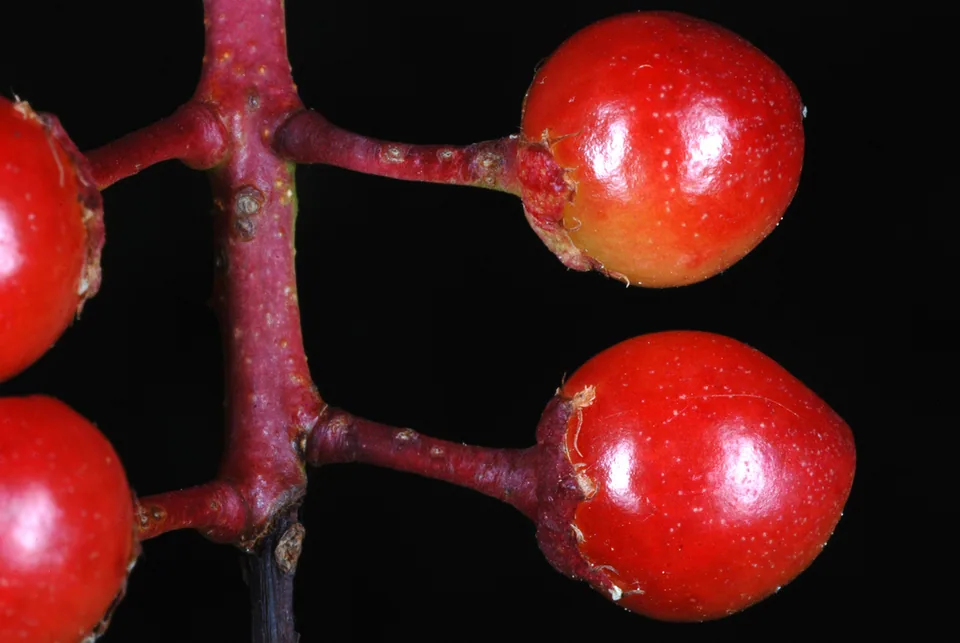
One of the largest cherry trees, black cherry fills with clusters of dark red to black fruit that many songbirds love. It grows happily in full sun or partial shade, and after 5 years its bitter fruit can be cooked into jams, jellies and even wine. Give it 1 inch of water a week while it settles in, then simply enjoy the birds.
- Sun
Full sun to partial shade
What the sources say (3)
Light: Full sun to partial shade
Site Requirements: Adaptable but prefers moist, well-drained soils. In the right conditions, it will grow like a weed. Withstands heavy pruning and prefers full sun to partial shade.
— Black Cherry | Natural Resources [5] Black cherry requires full sun, soil high in organic matter and good drainage.
— Prunus serotina (Black Cherry, Eastern Wild Black Cherry, Wild Cherry, Wild Rum Cherry) | North Carolina Extension Gardener Plant Toolbox [1] Light: Part shade. Water: Medium to high water use. Soil: Best grown in moist, fertile loam soils.
— Black Cherry | NDSU Agriculture [6] - Water
1 inch of water a week while it settles in; later only in severe drought
What the sources say (4)
Watering: Medium to high water use; after the establishment period, supplemental irrigation during periods of severe drought
Light: Part shade. Water: Medium to high water use. Soil: Best grown in moist, fertile loam soils.
— Black Cherry | NDSU Agriculture [6] After the establishment period, provide supplemental irrigation during periods of severe drought.
— Bulletin #2575, Native Trees and Shrubs for Maine Landscapes: Black Cherry (Prunus serotina) - Cooperative Extension Publications - University of Maine Cooperative Extension [4] Watering notes: During establishment (one year per inch of trunk diameter at planting), water regularly in the growing season, giving the root zone 1 inch [2.5 cm] of water per week
During the establishment period, defined as one year after planting for each inch of trunk diameter at planting time, water your trees regularly during the growing season.
— Bulletin #2575, Native Trees and Shrubs for Maine Landscapes: Black Cherry (Prunus serotina) - Cooperative Extension Publications - University of Maine Cooperative Extension [4] Give the root zone of each tree 1 inch of water per week; in general, a tree’s root zone extends twice as wide as its canopy.
— Bulletin #2575, Native Trees and Shrubs for Maine Landscapes: Black Cherry (Prunus serotina) - Cooperative Extension Publications - University of Maine Cooperative Extension [4] - Feeding
No nitrogen at planting or the first season; feed only if a soil test shows a need
What the sources say (2)
Avoid: Nitrogen fertilizer at planting or during the first growing season; fertilizing without a soil test showing a need
Landscape trees and shrubs should not be fertilized unless a soil test indicates a need.
— Bulletin #2575, Native Trees and Shrubs for Maine Landscapes: Black Cherry (Prunus serotina) - Cooperative Extension Publications - University of Maine Cooperative Extension [4] No nitrogen fertilizer should be added at planting or during the first growing season.
— Bulletin #2575, Native Trees and Shrubs for Maine Landscapes: Black Cherry (Prunus serotina) - Cooperative Extension Publications - University of Maine Cooperative Extension [4] - Harvest
Fruit from year 5: bitter raw, but good for jams, jellies and wine
What the sources say (1)
Years to first fruit: 5
Seed Bearing Age: 5 years
— Black Cherry | Natural Resources [5] - Pests
Tent caterpillars, Japanese beetles, aphids; black knot and powdery mildew
What the sources say (11)
Pests: eastern tent caterpillar, Japanese beetle, leafrollers, borers, cherry lace bug, aphids, scale, leafhoppers, spider mites, pear sawfly (pearslug)
Potential insects include cherry lace bug, aphids, scale, borers, leafhoppers, caterpillars, tent caterpillars and Japanese beetles. Spider mites may also be trouble.
— Prunus serotina (Black Cherry, Eastern Wild Black Cherry, Wild Cherry, Wild Rum Cherry) | North Carolina Extension Gardener Plant Toolbox [1] Eastern Tent Caterpillar ( Malacosoma americanum )
— Black Cherry, Wild Cherry (Prunus serotina)-Hort Answers - University of Illinois Extension [3] Japanese Beetle ( Popilla japonica )
— Black Cherry, Wild Cherry (Prunus serotina)-Hort Answers - University of Illinois Extension [3] Leafrollers ( Tortricidae )
— Black Cherry, Wild Cherry (Prunus serotina)-Hort Answers - University of Illinois Extension [3] Pear Sawfly or Pearslug
— Black Cherry | Natural Resources [5] Diseases: leaf spot, die back, leaf curl, powdery mildew, root rot, fireblight, black knot, gray mold, Verticillium wilt, wood rots, black rot canker
Potential diseases include leaf spot, die back, leaf curl, powdery mildew, root rot and fireblight.
— Prunus serotina (Black Cherry, Eastern Wild Black Cherry, Wild Cherry, Wild Rum Cherry) | North Carolina Extension Gardener Plant Toolbox [1] Black Knot ( Apiosporina morbosa [syn. Dibotryon morbosum] )
— Black Cherry, Wild Cherry (Prunus serotina)-Hort Answers - University of Illinois Extension [3] Gray Mold [Trees and Shrubs] ( Botrytis cinerea and other species )
— Black Cherry, Wild Cherry (Prunus serotina)-Hort Answers - University of Illinois Extension [3] Verticillium Wilt [Shrubs and Trees] ( Verticillium albo-atrum and V. dahliae )
— Black Cherry, Wild Cherry (Prunus serotina)-Hort Answers - University of Illinois Extension [3] Wood Rots and Decays ( Many genus and species involved )
— Black Cherry, Wild Cherry (Prunus serotina)-Hort Answers - University of Illinois Extension [3] Potentially susceptible to black rot canker.
— Black Cherry | NDSU Agriculture [6] - Watch out
Often troubled by pests and diseases; skip it if caterpillar webs and black branch knots bother you
- Propagation
From seed or stem cuttings
What the sources say (1)
Propagation: Seed; stem cutting
It can be pruned and kept at shrub size by cutting it to the ground every two to three years. Propagate it by seed or stem cutting.
— Prunus serotina (Black Cherry, Eastern Wild Black Cherry, Wild Cherry, Wild Rum Cherry) | North Carolina Extension Gardener Plant Toolbox [1] - Safety
All parts can be toxic: dangerous for children, dogs, cats, horses and livestock
Overview
Black cherry is a deciduous tree in the rose family that is native to North America. [1] It prefers full sun to partial shade and moist, well-drained soil. [5] The leaves, fruits and seeds contain cyanide compounds and are poisonous. [1]
This record is incomplete: the sources we read do not cover every field yet.
Not yet covered by our sources: Pruning
Black Cherry care
Measurements in square brackets are our conversion into the other unit system; the quoted text is unchanged.
How to water Black Cherry
Watering
Medium to high water use; after the establishment period, supplemental irrigation during periods of severe drought
What the sources say (2)
Light: Part shade.
Water: Medium to high water use.
Soil: Best grown in moist, fertile loam soils.After the establishment period, provide supplemental irrigation during periods of severe drought.Watering notes
During establishment (one year per inch of trunk diameter at planting), water regularly in the growing season, giving the root zone 1 inch [2.5 cm] of water per week
What the sources say (2)
During the establishment period, defined as one year after planting for each inch of trunk diameter at planting time, water your trees regularly during the growing season.Give the root zone of each tree 1 inch of water per week; in general, a tree’s root zone extends twice as wide as its canopy.How much light Black Cherry needs
Full sun to partial shade
What the sources say (3)
Site Requirements: Adaptable but prefers moist, well-drained soils. In the right conditions, it will grow like a weed. Withstands heavy pruning and prefers full sun to partial shade.Black cherry requires full sun, soil high in organic matter and good drainage.Light: Part shade.
Water: Medium to high water use.
Soil: Best grown in moist, fertile loam soils.How much cold Black Cherry can take
Hardiness, coldest zone
The sources give different values depending on region, zone or growing conditions.
What each source says
According to NC State Extension: 2a [winter low −45.6 to −42.8 °C (−50 to −45 °F)]
According to University of Illinois Extension: 4 [winter low −34.4 to −28.9 °C (−30 to −20 °F)]
According to University of Maine Cooperative Extension: 3b [winter low −37.2 to −34.4 °C (−35 to −30 °F)]
According to Iowa State University Extension: 3 [winter low −40 to −34.4 °C (−40 to −30 °F)]
According to NDSU Extension: 3 [winter low −40 to −34.4 °C (−40 to −30 °F)]
What the sources say (5)
According to NC State Extension: USDA Plant Hardiness Zone: 2a, 2b, 3a, 3b, 4a, 4b, 5a, 5b, 6a, 6b, 7a, 7b, 8a, 8bAccording to University of Illinois Extension: USDA Hardiness Zone 4 - 8According to University of Maine Cooperative Extension: Hardiness: USDA zone 3bAccording to Iowa State University Extension: Hardiness: Zones 3 through 10According to NDSU Extension: Hardiness: Zone 3Hardiness, warmest zone
The sources give different values depending on region, zone or growing conditions.
What each source says
According to NC State Extension: 8b [winter low −9.4 to −6.7 °C (15 to 20 °F)]
According to University of Illinois Extension: 8 [winter low −12.2 to −6.7 °C (10 to 20 °F)]
According to Iowa State University Extension: 10 [winter low −1.1 to 4.4 °C (30 to 40 °F)]
What the sources say (3)
According to NC State Extension: USDA Plant Hardiness Zone: 2a, 2b, 3a, 3b, 4a, 4b, 5a, 5b, 6a, 6b, 7a, 7b, 8a, 8bAccording to University of Illinois Extension: USDA Hardiness Zone 4 - 8According to Iowa State University Extension: Hardiness: Zones 3 through 10How to propagate Black Cherry
Seed; stem cutting
What the sources say (1)
It can be pruned and kept at shrub size by cutting it to the ground every two to three years. Propagate it by seed or stem cutting.How to grow Black Cherry
The plant
Family
Rosaceae
Mature height
Mature width
Years to first fruit
5
What the sources say (1)
Seed Bearing Age: 5 yearsPests and diseases
Pests
eastern tent caterpillar, Japanese beetle, leafrollers, borers, cherry lace bug, aphids, scale, leafhoppers, spider mites, pear sawfly (pearslug)
What the sources say (5)
Potential insects include cherry lace bug, aphids, scale, borers, leafhoppers, caterpillars, tent caterpillars and Japanese beetles. Spider mites may also be trouble.Eastern Tent Caterpillar ( Malacosoma americanum )Japanese Beetle ( Popilla japonica )Leafrollers ( Tortricidae )Pear Sawfly or PearslugDiseases
leaf spot, die back, leaf curl, powdery mildew, root rot, fireblight, black knot, gray mold, Verticillium wilt, wood rots, black rot canker
What the sources say (6)
Potential diseases include leaf spot, die back, leaf curl, powdery mildew, root rot and fireblight.Black Knot ( Apiosporina morbosa [syn. Dibotryon morbosum] )Gray Mold [Trees and Shrubs] ( Botrytis cinerea and other species )Verticillium Wilt [Shrubs and Trees] ( Verticillium albo-atrum and V. dahliae )Wood Rots and Decays ( Many genus and species involved )Potentially susceptible to black rot canker.Fertilizing
Avoid
Nitrogen fertilizer at planting or during the first growing season; fertilizing without a soil test showing a need
What the sources say (2)
Landscape trees and shrubs should not be fertilized unless a soil test indicates a need.No nitrogen fertilizer should be added at planting or during the first growing season.Black Cherry pests and problems
Diseases and insect pests
Symptom: Susceptible to leaf spot, die back, leaf curl, powdery mildew, root rot, fireblight and many insects
What to do: Frequent disease and insect problems
What the sources say (1)
Potential diseases include leaf spot, die back, leaf curl, powdery mildew, root rot and fireblight.
— Prunus serotina (Black Cherry, Eastern Wild Black Cherry, Wild Cherry, Wild Rum Cherry) | North Carolina Extension Gardener Plant Toolbox [1] Eastern tent caterpillar and black knot
Symptom: Caterpillar webs and defoliation; black knobby fungus growths on branches
What to do: Avoid using the species if these are not tolerated
What the sources say (1)
Over the years, any black cherry will serve as host to eastern tent caterpillars and possibly black knot disease.
— Bulletin #2575, Native Trees and Shrubs for Maine Landscapes: Black Cherry (Prunus serotina) - Cooperative Extension Publications - University of Maine Cooperative Extension [4]
Remedies
Each remedy shows what official sources say about it; traditional remedies without an official source are marked as such. Harmful ones are listed so you know to avoid them.
First aid
First aid: not a substitute for a doctor
cyanide poisoning from crushed or chewed pits and seeds
call the poison center Official source, not independently tested
Whether online or by phone, expert guidance is always free, confidential, and available 24 hours a day.
— poison.org [7] Crushing or chewing pits before swallowing can result in the release of cyanide.
— poison.org [7] How: If someone swallows a stone fruit pit, use the online poison control tool or call the poison center.
If someone swallows a stone fruit pit or if you have a question about stone fruit pit safety, use the web POISON CONTROL online tool to get help, or call your poison center at 1-800-222-1222
— poison.org [7]
Treating the plant
spider mites
insecticidal soap spray Works
Avoid applying soaps or oils during the hot part of the day as leaf burn may result.
— extension.usu.edu [8] How: Apply insecticidal soap every 5-7 days until mite densities decline.
Applying insecticidal soap or 1% horticultural mineral oil every 5-7 days until mite densities decline can be effective.
— extension.usu.edu [8] What the evidence says Applying insecticidal soap or 1% horticultural mineral oil every 5-7 days until mite densities decline can be effective.
— extension.usu.edu [8]
eastern tent caterpillar
pulling out tents by hand Works
How: Pull out young tents by hand or with a stick on a cool or wet day, when the caterpillars are inside, and squash or bin them.
Pull out young tents by hand or with a stick on a cool or wet day, when the caterpillars are inside, and squash or bin them.
— leaftide.com [9] What the evidence says Many insect and disease issues can be solved in the home garden by hand-picking insects or clipping and disposing of diseased plant parts.
— extension.unh.edu [10] scraping off winter egg bands Not verified
Traditional remedy, not verified by an official source.
How: In winter, cut off or scrape away the egg bands on twigs you can reach.
cherry leaf spot
raking up and removing fallen leaves Not verified
Traditional remedy, not verified by an official source.
How: Rake up and remove fallen leaves in autumn, since the fungus overwinters on them.
deer browsing
hanging deodorant soap cakes Partly works
How: Hang small cakes of deodorant soap from branches.
Hanging small cakes of deodorant soap from branches may also be helpful.
— extension.umd.edu [11] What the evidence says Hanging small cakes of deodorant soap from branches may also be helpful.
— extension.umd.edu [11]
pruning wounds
pruning paint on cuts Harmful
How: Cover the pruning cut with pruning paint.
Covering a tree's pruning cut with pruning paint helps to protect the wound.
— extension.psu.edu [12] What the evidence says While products are still sold for painting over pruning cuts, this practice should not be used. It can do more harm than good in creating an environment prone to rot.
— extension.psu.edu [12]
Is Black Cherry toxic to pets?
Reported by the source, quoted verbatim. This is not medical or veterinary advice: if a person or an animal may have eaten this plant, contact a poison control centre or a veterinarian.
Animals
#problem for cats #larval host plant #problem for children #problem for dogs #problem for horses
[1]- Poisonous parts
Poison Part: Fruits Leaves Seeds
[1]- Toxic principle
Poison Toxic Principle: Cyanogenic glycosides (amygdalin & prunasin)
[1]- Symptoms
Gasping, weakness, excitement, pupil dilation, spasms, convulsions, coma, respiratory failure.
[1]- Severity
This plant has medium severity poison characteristics.
[1]
All parts are potentially toxic. If ingested, it is likely to cause death in livestock and pets.
[1]- Poisonous parts
Poison Part: Fruits Leaves Seeds
[1]- Toxic principle
Poison Toxic Principle: Cyanogenic glycosides (amygdalin & prunasin)
[1]- Symptoms
Gasping, weakness, excitement, pupil dilation, spasms, convulsions, coma, respiratory failure.
[1]- Severity
This plant has medium severity poison characteristics.
[1]
Twigs and leaves contain high levels of hydrocyanic acid (also called prussic acid), which is poisonous to cattle and humans.
[4]The cyanic acid in wilted twigs and leaves may be dangerous to deer and cattle when consumed in large quantities in the fall, although deer can eat the fresh green leaves without ill effect.
[5]- Poisonous parts
The cyanic acid in wilted twigs and leaves may be dangerous to deer and cattle when consumed in large quantities in the fall
[5]
People
Cedar Waxwings can digest the fruits without releasing the cyanide, but humans are advised not to consume the fruits.
[1]- Poisonous parts
Poison Part: Fruits Leaves Seeds
[1]- Toxic principle
Poison Toxic Principle: Cyanogenic glycosides (amygdalin & prunasin)
[1]- Symptoms
Gasping, weakness, excitement, pupil dilation, spasms, convulsions, coma, respiratory failure.
[1]- Severity
This plant has medium severity poison characteristics.
[1]
Calendar
Pruning
Not stated in the sources we read.
Months as given by the sources, which are mostly from the United States (northern hemisphere). In the southern hemisphere they shift by about six months.
Edibility
Reported by the source, quoted verbatim. Do not eat a plant on the basis of this page alone: identification mistakes can be dangerous.
Fruits are bitter but can be used to make jellies and jams.
[1]One of the largest of the cherry trees, the fruits are inedible straight off the tree, but can be used to make jams and jellies.
[6]The clusters of dark red to black fruits taste bitter, but are used for jams and wines and utilized by many species of songbirds.
[5]
Indicative values
Values from a secondary source, not checked word for word like the rest of this page. Use them as a starting point.
- Life cycle
- PerennialIndicative value, adapt it to your climate · Secondary source
- Hours of sun
- 6-8 hoursIndicative value, adapt it to your climate · Secondary source
- Soil
- Sandy Loamy ClayIndicative value, adapt it to your climate · Secondary source
- Soil pH
- 5.5-7Indicative value, adapt it to your climate · Secondary source
- Care level
- MediumIndicative value, adapt it to your climate · Secondary source
- Growth rate
- HighIndicative value, adapt it to your climate · Secondary source
- Pruning
- February, March, AprilIndicative value, adapt it to your climate · Secondary source
Similar plants
- Afghan Cherry Prunus jacquemontii
- American Plum Prunus americana
- Amur chokecherry Prunus maackii
- Apricot Prunus armeniaca
- Carolina Cherry Laurel Prunus caroliniana
- Cherry Laurel Prunus laurocerasus
- Chickasaw Plum Prunus angustifolia
- Chinese Plum Prunus glandulosa
Sources
Every value above is quoted from these documents. Links lead to the original publisher.
- Prunus serotina (Black Cherry, Eastern Wild Black Cherry, Wild Cherry, Wild Rum Cherry) | North Carolina Extension Gardener Plant Toolbox · plants.ces.ncsu.edu, consulted
- Selecting Trees for Your Home - Black Cherry, Wild Cherry (Prunus serotina) · web.extension.illinois.edu, consulted
- Black Cherry, Wild Cherry (Prunus serotina)-Hort Answers - University of Illinois Extension · web.extension.illinois.edu, consulted
- Bulletin #2575, Native Trees and Shrubs for Maine Landscapes: Black Cherry (Prunus serotina) - Cooperative Extension Publications - University of Maine Cooperative Extension · extension.umaine.edu, consulted
- Black Cherry | Natural Resources · naturalresources.extension.iastate.edu, consulted
- Black Cherry | NDSU Agriculture · ndsu.edu, consulted
- poison.org · poison.org
- extension.usu.edu · extension.usu.edu
- leaftide.com · leaftide.com
- extension.unh.edu · extension.unh.edu
- extension.umd.edu · extension.umd.edu
- extension.psu.edu · extension.psu.edu
Written by Emilio Marruso · last checked