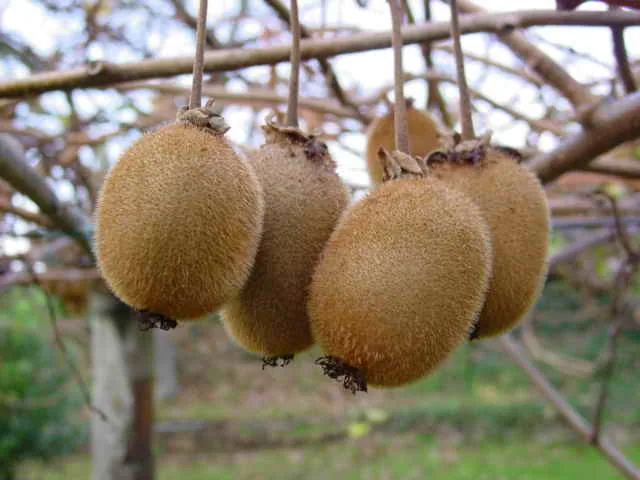

How to Grow and Care for Kiwifruit
Actinidia deliciosa
Written by Emilio Marruso · last checked
Toxic to: People · Why
At a glance
Kiwi vines reward patience with fuzzy fruit you can eat raw or toss into salads. Give them full sun, consistently moist soil and plenty of warmth, and plant a male vine near the females so they set fruit. Harvest from October to early November, when the fruit is slightly soft and the seeds have turned black.
- Sun
Full sun; tolerates some shade
What the sources say (1)
Light: Full sun; tolerates some shade
It is best if planted in full sun in well-drained soil but it will tolerate some shade which may cause less volume of fruit.
— Actinidia chinensis var. deliciosa (Chinese Gooseberry, Kiwifruit, Kiwi Fruit, Smooth-Skinned Kiwifruit, Yangtao) | North Carolina Extension Gardener Plant Toolbox [1] - Water
2 inches of water a week while growing; keep the soil always moist, never soggy
What the sources say (5)
Watering: Consistently moist soil, without standing water
Mature plants require consistently moist soil, but standing water can lead to root rot.
— Did you know you can grow: Kiwi | CAES Field Report [4] Soil must be well drained but kept moist at all times.
— Growing Temperate Tree Fruit and Nut Crops [6] Watering notes: Water multiple times a week when the plant is young, and immediately if the leaves start to fold or wilt; about 2 inches [5.1 cm] of water a week during the growing season
Water multiple times a week when the plant is young, and immediately if the leaves start to fold or wilt.
— Did you know you can grow: Kiwi | CAES Field Report [4] Provide about 2 inches of water a week during the growing season.
— Grow kiwifruit at home with the right support and frost protection | OSU Extension Service [7] Drought: Drought-sensitive and needs plenty of water; young plants need watering several times a week, and at once if the leaves fold or wilt.
Kiwi is drought-sensitive and needs plenty of water. Water multiple times a week when the plant is young, and immediately if the leaves start to fold or wilt.
— Did you know you can grow: Kiwi | CAES Field Report [4] - Cold
Survives winters down to 0 °F (−17.8 °C)
Hardy in very cold winters · USDA 7 · RHS H6 · Z7
What the sources say (4)
Hardiness, coldest zone: 7 [winter low −17.8 to −12.2 °C (0 to 10 °F)]
Fuzzy kiwi, Actinidia chinensis or A. deliciosa , is the type you find in the grocery store and the most common. Cold hardy to winter temperatures of 10 degrees Fahrenheit, kiwi usually grow well in Plant Hardiness Zones 7-9 .
— Did you know you can grow: Kiwi | CAES Field Report [4] Table 1. Types and cultivars of kiwifruit adapted to Oregon regions and suited for fruit production: - ## Fuzzy kiwifruit ( Actinidia deliciosa ), Zones 7-9
— Growing kiwifruit in your home garden | OSU Extension Service [3] Hardiness, warmest zone: 9 [winter low −6.7 to −1.1 °C (20 to 30 °F)]
Fuzzy kiwi, Actinidia chinensis or A. deliciosa , is the type you find in the grocery store and the most common. Cold hardy to winter temperatures of 10 degrees Fahrenheit, kiwi usually grow well in Plant Hardiness Zones 7-9 .
— Did you know you can grow: Kiwi | CAES Field Report [4] Table 1. Types and cultivars of kiwifruit adapted to Oregon regions and suited for fruit production: - ## Fuzzy kiwifruit ( Actinidia deliciosa ), Zones 7-9
— Growing kiwifruit in your home garden | OSU Extension Service [3] - Soil
Slightly acidic soil, pH 5.6–6.5
- Spacing
10–20 ft between vines, most often 15 ft
What the sources say (4)
Between plants: 3.05-6.1 m [10–20 ft] between vines, most often 4.57 m [15 ft]; leave 1.83 m [6 ft] at each end of the support.
Plant two vines 15 feet apart and leave about 6 feet on each end.
— Growing kiwifruit in your home garden | OSU Extension Service [3] Space kiwi plants and their trellises about 15 feet apart.
— Did you know you can grow: Kiwi | CAES Field Report [4] Plant kiwis about 15 to 20 ft apart.
— Growing Temperate Tree Fruit and Nut Crops [6] Plant in spring, 10 to 15 feet apart, in deep, well-drained soil and full sun with wind protection.
— Grow kiwifruit at home with the right support and frost protection | OSU Extension Service [7] - Planting
Early spring, as soon as the soil can be worked
What the sources say (1)
Planting: Early spring, as soon as the soil can be worked
Plant as early as you can work the soil in spring.
— Growing kiwifruit in your home garden | OSU Extension Service [3] - Feeding
Feed from spring to midsummer, never after July on young vines; no fertilizer in the planting hole
What the sources say (9)
When: From spring to midsummer; young vines never after July
planting year: Divide the total required N into three equal portions (0.4 ounces each), the first starting two weeks after planting, the next one month later, and the last one a month after that
— Growing kiwifruit in your home garden | OSU Extension Service [3] mature vines: Use higher rates for vines with more vigor. Apply two-thirds of the total N in March; apply the last third in May or June
— Growing kiwifruit in your home garden | OSU Extension Service [3] granular organic fertilizers (feather, soybean or cottonseed meal): Therefore, it’s best to apply granular organic fertilizers about a month before inorganic fertilizers would be applied.
— Growing kiwifruit in your home garden | OSU Extension Service [3] Kiwi plants require 10-10-10 fertilizer. Apply 4 ounces during March, May and July in the first year of growth.
— Did you know you can grow: Kiwi | CAES Field Report [4] Do not fertilize young plants after July; this will force late growth and increase the potential for frost injury in the fall.
— Growing kiwifruit in your home garden | OSU Extension Service [3] Avoid: Fertilizer or manure in the planting hole (burns the roots); fertilizing young vines after July; fertilizer on the trunk; high-salt composts such as fresh animal manure
Do not add fertilizers or manures to the planting hole because they will burn the roots.
— Growing kiwifruit in your home garden | OSU Extension Service [3] Do not fertilize young plants after July; this will force late growth and increase the potential for frost injury in the fall.
— Growing kiwifruit in your home garden | OSU Extension Service [3] Spread the fertilizer around the base of the trunk in a 12-inch-diameter circle but avoid getting any on the trunk.
— Growing kiwifruit in your home garden | OSU Extension Service [3] You can also use high-pH composts to add organic matter and increase soil pH. However, avoid composts with a high salt content (electrical conductivity or EC), such as fresh animal manures.
— Growing kiwifruit in your home garden | OSU Extension Service [3] - Pruning
Prune females in winter, males right after bloom; keep last year's canes, they bear the fruit
What the sources say (9)
Pruning: Female vines: December through January; male vines: in summer, immediately after bloom
Prune female vines every winter. In the Willamette Valley and southwestern Oregon, prune female fuzzy and kiwiberry vines from December through January.
— Growing kiwifruit in your home garden | OSU Extension Service [3] Figure 29. A gardener prunes a male fuzzy kiwifruit vine in summer immediately after bloom.
— Growing kiwifruit in your home garden | OSU Extension Service [3] When to prune: Female vines every winter while dormant, well before growth starts (late cuts bleed sap); male vines immediately after bloom, not in winter; summer pruning as well. Keep 1-year-old canes: flowers grow on shoots from last year's growth.
Prune female vines every winter. In the Willamette Valley and southwestern Oregon, prune female fuzzy and kiwiberry vines from December through January.
— Growing kiwifruit in your home garden | OSU Extension Service [3] Pruning should be done well before growth starts in the spring to prevent vine bleeding.
— Kiwifruit and Hardy Kiwi (Kiwiberries) | CFAES Knowledge Hub [2] Do not prune male vines in winter (Figure 27). Instead, prune male vines immediately after bloom (in late June in the Willamette Valley).
— Growing kiwifruit in your home garden | OSU Extension Service [3] They need twice yearly pruning, in summer and winter, to keep them in check and fruiting well
— [8] In all kiwifruit, flowers are produced on shoots that grow from 1-year-old canes (last year’s growth).
— Growing kiwifruit in your home garden | OSU Extension Service [3] Flowering wood: Flowers on this year's shoots growing from one-year-old wood
In all kiwifruit, flowers are produced on shoots that grow from 1-year-old canes (last year’s growth).
— Growing kiwifruit in your home garden | OSU Extension Service [3] Flowers and fruit are produced on new shoots that sprout from the base of the previous year’s growth, rather than from older stems.
— [8] - Harvest
October to early November, when the fruit is slightly soft and the seeds are black
What the sources say (5)
Harvest: October to early November
California: Vines leaf out in March, bloom occurs in May, and fruits are harvested in October and November.
— Growing Temperate Tree Fruit and Nut Crops [6] western Oregon: pick ‘Hayward’ and other fuzzy kiwifruit cultivars as late as possible (late October/early November, or before the first hard frost)
— Growing kiwifruit in your home garden | OSU Extension Service [3] Georgia: Kiwi typically matures to full size in August but will not be fully ripe until around October.
— Did you know you can grow: Kiwi | CAES Field Report [4] Vines leaf out in March, bloom occurs in May, and fruits are harvested in October and November.
— Growing Temperate Tree Fruit and Nut Crops [6] How to harvest: Harvest when the fruit is slightly soft and its seeds are black
The fruit is ready to harvest when it is slightly soft and its seeds are black.
— Did you know you can grow: Kiwi | CAES Field Report [4] - Pollination
Only females bear fruit: plant one male vine for every 6–8 females
What the sources say (7)
Fruit set: Dioecious: male and female flowers on separate plants
cultivar 'Jenny': If you only have space for one plant, choose self-fertile ‘Jenny’ , which produces smaller, well-flavoured fruits.
— [8] Kiwifruit plants are dioecious, meaning there are separate male and female plants.
— Growing kiwifruit in your home garden | OSU Extension Service [3] The plants are dioecious, which means that male and female flowers are found on different plants.
— Kiwifruit and Hardy Kiwi (Kiwiberries) | CFAES Knowledge Hub [2] What it needs: Plant a male vine of the same species with the female vines (suggested ratio one male to six to eight females), with males upwind of the females and blooming at the same time; only female vines produce fruit.
It is best to plant a male and female vine of the same species.
— Growing kiwifruit in your home garden | OSU Extension Service [3] The suggested ratio is one male to six to eight female plants. Only female plants will produce fruit.
— Kiwifruit and Hardy Kiwi (Kiwiberries) | CFAES Knowledge Hub [2] Hence, it is also important to know the direction of the prevailing wind, and plant male plants upwind from the female plants.
— Kiwifruit and Hardy Kiwi (Kiwiberries) | CFAES Knowledge Hub [2] Generally, with a male and female vine blooming at the same time and good weather for pollinator activity, pollination and fruit set will be good.
— Growing kiwifruit in your home garden | OSU Extension Service [3] - Pests
Watch for root rot and verticillium wilt
What the sources say (2)
Diseases: Phytophthora root rot, verticillium wilt
Phytophthora root rot, a soilborne disease, is aggravated in wet, heavy soil.
— Growing kiwifruit in your home garden | OSU Extension Service [3] Kiwifruit vines are susceptible to verticillium wilt, a soilborne fungus.
— Growing kiwifruit in your home garden | OSU Extension Service [3] - Watch out
Sensitive to frost; needs plenty of heat to ripen its fruit
What the sources say (1)
Heat: Frost-sensitive vine that needs plenty of heat to mature the fruit properly.
Kiwifruit is a large, frost-sensitive, temperate zone vine that requires plenty of heat to mature the fruit properly.
— Growing Temperate Tree Fruit and Nut Crops [6] - Propagation
Hardwood cuttings taken in winter, or seed
What the sources say (8)
Propagation: Hardwood cuttings; seed
Kiwifruit are relatively easy to propagate using hardwood cuttings.
— Growing kiwifruit in your home garden | OSU Extension Service [3] Seedling - Extracted seed from ripe kiwifruit.
— Growing Temperate Tree Fruit and Nut Crops [6] Cuttings: Hardwood cuttings from pruning wood, taken in winter before the sap starts to flow, five to six nodes long; one per 3.79 L [1 gal] pot of potting mix with one or two nodes below soil level. Rooting hormone is optional. Own-rooted plants can also come from mid-summer wood 1.27 cm [0.5 in] thick or from dormant wood.
Kiwifruit are easy to propagate from hardwood cuttings if you know someone who has a good male and female vine.
— Growing kiwifruit in your home garden | OSU Extension Service [3] Make cuttings about five to six nodes long (Figure 8).
— Growing kiwifruit in your home garden | OSU Extension Service [3] Take cuttings in winter before sap starts to flow (in early to mid- January in the Willamette Valley).
— Growing kiwifruit in your home garden | OSU Extension Service [3] Fill 1-gallon containers with potting mix. Insert one cutting per pot with one or two nodes below the level of the soil.
— Growing kiwifruit in your home garden | OSU Extension Service [3] You can dip the base of cuttings in a rooting hormone, but it is not necessary.
— Growing kiwifruit in your home garden | OSU Extension Service [3] Cutting - Own rooted. From 1/2 inch mid-summer wood or dormant wood.
— Growing Temperate Tree Fruit and Nut Crops [6] - Safety
The fruit's hairs and an enzyme inside it can irritate the throat
Overview
Kiwifruit is a dioecious, woody vine native to China, grown for its fruit and leaves. [1] Both a male and a female plant are needed for fruit. [1]
Kiwifruit care
Measurements in square brackets are our conversion into the other unit system; the quoted text is unchanged.
How to water Kiwifruit
Watering
Consistently moist soil, without standing water
Watering notes
Water multiple times a week when the plant is young, and immediately if the leaves start to fold or wilt; about 2 inches [5.1 cm] of water a week during the growing season
What the sources say (2)
Water multiple times a week when the plant is young, and immediately if the leaves start to fold or wilt.Provide about 2 inches of water a week during the growing season.How much light Kiwifruit needs
Full sun; tolerates some shade
What the sources say (1)
It is best if planted in full sun in well-drained soil but it will tolerate some shade which may cause less volume of fruit.How much cold Kiwifruit can take
Hardiness, coldest zone
7 [winter low −17.8 to −12.2 °C (0 to 10 °F)]
What the sources say (2)
Fuzzy kiwi, Actinidia chinensis or A. deliciosa , is the type you find in the grocery store and the most common. Cold hardy to winter temperatures of 10 degrees Fahrenheit, kiwi usually grow well in Plant Hardiness Zones 7-9 .Table 1. Types and cultivars of kiwifruit adapted to Oregon regions and suited for fruit production:
-
## Fuzzy kiwifruit ( Actinidia deliciosa ), Zones 7-9Hardiness, warmest zone
9 [winter low −6.7 to −1.1 °C (20 to 30 °F)]
What the sources say (2)
Fuzzy kiwi, Actinidia chinensis or A. deliciosa , is the type you find in the grocery store and the most common. Cold hardy to winter temperatures of 10 degrees Fahrenheit, kiwi usually grow well in Plant Hardiness Zones 7-9 .Table 1. Types and cultivars of kiwifruit adapted to Oregon regions and suited for fruit production:
-
## Fuzzy kiwifruit ( Actinidia deliciosa ), Zones 7-9Best soil for Kiwifruit
Soil pH, minimum
5.6
What the sources say (1)
Kiwifruit plants require a soil pH of 5.6 to 6.5.Soil pH, maximum
6.5
What the sources say (1)
Kiwifruit plants require a soil pH of 5.6 to 6.5.Where to grow Kiwifruit
The sources give different values depending on region, zone or growing conditions.
What each source says
Oregon (OSU Extension guide): 457 cm (15 ft)
Georgia: 457 cm (15 ft)
California: 457-610 cm (15 to 20 ft)
What the sources say (5)
Oregon (OSU Extension guide): One plant needs about 15 feet of space. Plant two vines 15 feet apart and leave about 6 feet on each end.Georgia: Space kiwi plants and their trellises about 15 feet apart.California: Plant kiwis about 15 to 20 ft apart.One plant needs about 15 feet of space. Plant two vines 15 feet apart and leave about 6 feet on each end.Space kiwi plants and their trellises about 15 feet apart.How to propagate Kiwifruit
How to grow Kiwifruit
The plant
Family
Actinidiaceae
What the sources say (1)
Kiwi fruit is a dioecious, woody vine in the Actinidiaceae family native to ChinaHarvest and storage
How to harvest
Harvest when the fruit is slightly soft and its seeds are black
What the sources say (1)
The fruit is ready to harvest when it is slightly soft and its seeds are black.Pests and diseases
Diseases
Phytophthora root rot, verticillium wilt
What the sources say (2)
Phytophthora root rot, a soilborne disease, is aggravated in wet, heavy soil.Kiwifruit vines are susceptible to verticillium wilt, a soilborne fungus.Fertilizing
When
From spring to midsummer; young vines never after July
What each source says
planting year: Starting two weeks after planting, then one and two months later
mature vines: Two-thirds of the nitrogen in early spring (March), the last third in May or June
granular organic fertilizers (feather, soybean or cottonseed meal): A month before mineral fertilizers would be applied.
What the sources say (5)
planting year: Divide the total required N into three equal portions (0.4 ounces each), the first starting two weeks after planting, the next one month later, and the last one a month after thatmature vines: Use higher rates for vines with more vigor. Apply two-thirds of the total N in March; apply the last third in May or Junegranular organic fertilizers (feather, soybean or cottonseed meal): Therefore, it’s best to apply granular organic fertilizers about a month before inorganic fertilizers would be applied.Kiwi plants require 10-10-10 fertilizer. Apply 4 ounces during March, May and July in the first year of growth.Do not fertilize young plants after July; this will force late growth and increase the potential for frost injury in the fall.How often
The sources give different values depending on region, zone or growing conditions.
What each source says
planting year: Three equal portions, one month apart
second year: Four equal portions applied monthly
third and fourth year: Three applications, every other month
mature vines: Two applications a year
liquid fertilizers: Smaller, more frequent applications, such as weekly
What the sources say (5)
planting year: Divide the total required N into three equal portions (0.4 ounces each), the first starting two weeks after planting, the next one month later, and the last one a month after thatsecond year: The year after planting, apply a total of 3.2 ounces of N per plant, dividing into four equal portions applied monthlythird and fourth year: Fertilize third- and fourth-year plants with 6 to 9 ounces of N, divided into three applications (every other month from March through July in the Willamette Valley).mature vines: Apply two-thirds of the total N in March; apply the last third in May or June (Table 3). Spread fertilizer so that it is equally distributed under the plant canopy.liquid fertilizers: In general, liquid fertilizers are available relatively quickly to plants but may also move out of the root zone quickly. So, for liquid fertilizers, divide the total amount of N into smaller, more frequent applications, such as weekly.Natural fertilizers
Compost worked into the soil before planting, a layer 2.5–5.1 cm [1–2 in] deep; during the season, slow organic nitrogen sources such as feather, soybean or cottonseed meal, applied earlier than mineral fertilizers
What the sources say (4)
In Central Oregon, amend native soil with compost to increase water-holding capacity.It is important that whatever material you apply is free of pest insects and weed seeds. Apply organic matter at a rate of 1–2 inches deep for each area being planted.Granular organic fertilizers such as feather, soybean or cottonseed meals require longer periods of time for N to be available.When using organic fertilizer sources, apply the product relatively earlier as described above.Mineral fertilizers
Nitrogen above all, with a complete granular fertilizer such as 10-10-10; the dose rises each year as the vine grows
What each source says
planting year: 34 g of nitrogen per plant for the year, in three portions of 11.3 g
planting year: 113.2 g of 10-10-10 per plant in March, May and July
second year: 90.6 g of nitrogen per plant for the year
third and fourth year: 169.8–254.7 g of nitrogen per plant for the year
mature vines: 227–454 g of nitrogen per vine per year, the higher rate for more vigorous vines
What the sources say (8)
planting year: In the planting year, fertilize each plant with 1.2 ounces of N per plant. Divide the total required N into three equal portions (0.4 ounces each)planting year: Kiwi plants require 10-10-10 fertilizer. Apply 4 ounces during March, May and July in the first year of growth.second year: The year after planting, apply a total of 3.2 ounces of N per plant, dividing into four equal portions applied monthlythird and fourth year: Fertilize third- and fourth-year plants with 6 to 9 ounces of N, divided into three applications (every other month from March through July in the Willamette Valley).mature vines: Fertilize with 0.5 to 1 pound of N per vine per year, depending on the cultivar or vine vigor. Use higher rates for vines with more vigor.Kiwi plants require 10-10-10 fertilizer. Apply 4 ounces during March, May and July in the first year of growth.The most important nutrient needed by kiwifruit plants after planting in all home garden soils is N.Kiwifruit plants are vigorous, and as they get older plants need more nitrogen (N) to support the growth.Micronutrients
Boron, calcium and magnesium: check them with a soil test before planting (deficient below 0.5–1.0 ppm boron, 1,000 ppm calcium, 120 ppm magnesium)
What the sources say (2)
Also test for organic matter and boron (B), especially in the Willamette Valley where B deficiency is common.Calcium (Ca): deficient at less than 1,000ppm - Magnesium (Mg): deficient at less than 120ppm - Boron (B): deficient at less then 0.5–1.0ppmAvoid
Fertilizer or manure in the planting hole (burns the roots); fertilizing young vines after July; fertilizer on the trunk; high-salt composts such as fresh animal manure
What the sources say (4)
Do not add fertilizers or manures to the planting hole because they will burn the roots.Do not fertilize young plants after July; this will force late growth and increase the potential for frost injury in the fall.Spread the fertilizer around the base of the trunk in a 12-inch-diameter circle but avoid getting any on the trunk.You can also use high-pH composts to add organic matter and increase soil pH. However, avoid composts with a high salt content (electrical conductivity or EC), such as fresh animal manures.Signs of deficiency
Nitrogen: poor growth and older leaves pale green or yellow compared with the younger ones
What the sources say (2)
Plants deficient in N will have poor growth and older leaves that are pale green or yellow compared to younger leaves.Healthy kiwifruit plants with sufficient fertilizer nutrients have medium to dark green leaves. Pale green or yellow leaves indicate a problem with nutrients, insects or disease.Spacing
Between plants
3.05-6.1 m [10–20 ft] between vines, most often 4.57 m [15 ft]; leave 1.83 m [6 ft] at each end of the support.
What the sources say (4)
Plant two vines 15 feet apart and leave about 6 feet on each end.Space kiwi plants and their trellises about 15 feet apart.Plant kiwis about 15 to 20 ft apart.Plant in spring, 10 to 15 feet apart, in deep, well-drained soil and full sun with wind protection.Propagation
Cuttings
Hardwood cuttings from pruning wood, taken in winter before the sap starts to flow, five to six nodes long; one per 3.79 L [1 gal] pot of potting mix with one or two nodes below soil level. Rooting hormone is optional. Own-rooted plants can also come from mid-summer wood 1.27 cm [0.5 in] thick or from dormant wood.
What the sources say (6)
Kiwifruit are easy to propagate from hardwood cuttings if you know someone who has a good male and female vine.Make cuttings about five to six nodes long (Figure 8).Take cuttings in winter before sap starts to flow (in early to mid- January in the Willamette Valley).Fill 1-gallon containers with potting mix. Insert one cutting per pot with one or two nodes below the level of the soil.You can dip the base of cuttings in a rooting hormone, but it is not necessary.Cutting - Own rooted. From 1/2 inch mid-summer wood or dormant wood.After harvest
Storage
Fuzzy kiwifruit picked firm with black seeds keeps several months at 0-4.4 °C [32–40 °F]: store dry fruit in paper bags or boxes in the refrigerator or a cold room, then ripen at room temperature.
What each source says
cultivar 'Hayward': Picked hard, held in cold storage at 0 °C [32 °F], then ripened at room temperature; keeps up to 6 months
What the sources say (4)
cultivar 'Hayward': Will ripen on the vine but can be picked when still hard, placed in cold storage (32oF), and removed to room temperature for final ripening. Will keep for up to 6 months.Fuzzy kiwifruit — In warmer parts of Oregon, harvest in late October to early November while fruit are still firm and seeds are black. Store at 32–40°F for several months.Store dry fruit in paper bags or boxes in the refrigerator or a cold room.If fruit were picked at the proper stage and kept in a cold room, they can be stored for several months.Heat and drought
Heat
Frost-sensitive vine that needs plenty of heat to mature the fruit properly.
What the sources say (1)
Kiwifruit is a large, frost-sensitive, temperate zone vine that requires plenty of heat to mature the fruit properly.Drought
Drought-sensitive and needs plenty of water; young plants need watering several times a week, and at once if the leaves fold or wilt.
What the sources say (1)
Kiwi is drought-sensitive and needs plenty of water. Water multiple times a week when the plant is young, and immediately if the leaves start to fold or wilt.Pollination
Fruit set
Dioecious: male and female flowers on separate plants
What each source says
cultivar 'Jenny': Self-fertile: sets fruit with its own pollen
What the sources say (3)
cultivar 'Jenny': If you only have space for one plant, choose self-fertile ‘Jenny’ , which produces smaller, well-flavoured fruits.Kiwifruit plants are dioecious, meaning there are separate male and female plants.The plants are dioecious, which means that male and female flowers are found on different plants.What it needs
Plant a male vine of the same species with the female vines (suggested ratio one male to six to eight females), with males upwind of the females and blooming at the same time; only female vines produce fruit.
What the sources say (4)
It is best to plant a male and female vine of the same species.The suggested ratio is one male to six to eight female plants. Only female plants will produce fruit.Hence, it is also important to know the direction of the prevailing wind, and plant male plants upwind from the female plants.Generally, with a male and female vine blooming at the same time and good weather for pollinator activity, pollination and fruit set will be good.Carried by
Insects and wind
What the sources say (1)
Kiwifruit and hardy kiwis are primarily pollinated by bees and other pollinators. However, wind can play a role in pollinating them.Pollinators
bees
What the sources say (1)
Kiwifruit and hardy kiwis are primarily pollinated by bees and other pollinators. However, wind can play a role in pollinating them.Pruning
Flowering wood
Flowers on this year's shoots growing from one-year-old wood
What the sources say (2)
In all kiwifruit, flowers are produced on shoots that grow from 1-year-old canes (last year’s growth).Flowers and fruit are produced on new shoots that sprout from the base of the previous year’s growth, rather than from older stems.When to prune
Female vines every winter while dormant, well before growth starts (late cuts bleed sap); male vines immediately after bloom, not in winter; summer pruning as well. Keep 1-year-old canes: flowers grow on shoots from last year's growth.
What the sources say (5)
Prune female vines every winter. In the Willamette Valley and southwestern Oregon, prune female fuzzy and kiwiberry vines from December through January.Pruning should be done well before growth starts in the spring to prevent vine bleeding.Do not prune male vines in winter (Figure 27). Instead, prune male vines immediately after bloom (in late June in the Willamette Valley).They need twice yearly pruning, in summer and winter, to keep them in check and fruiting wellIn all kiwifruit, flowers are produced on shoots that grow from 1-year-old canes (last year’s growth).Hard pruning
Neglected vines can be renovated by pruning extremely hard in winter; there will be no flowers or fruit the following year unless some 1-year-old canes remain.
What the sources say (2)
If there are no good shoots to prune back to near the cordon, you can renovate or prune the vine extremely hard in the winter.After renovating a vine, there will be no flowers or fruit the following year, unless some 1-year-old canes remained.Pinching
In summer, pinch fruiting shoots back to four or five leaves beyond the maturing fruit, and any regrowth to one leaf beyond the last cut.
Winter chill
Chill hours
50–850 hours between 0 and 7.2 °C [32–45 °F]
What each source says
coltura «Kiwi»: 50–850 hours
gruppo 'varietà a basso fabbisogno (California meridionale)': 50–250 hours
cultivar 'Hayward': 800 hours
cultivar 'Hayward': 660 hours
cultivar 'Hayward': 940 hours
What the sources say (7)
coltura «Kiwi»: Kiwi Chill hours: 50 to 850 Kiwi is frost sensitive, especially when young.gruppo 'varietà a basso fabbisogno (California meridionale)': These kiwi varieties are adapted to the low latitudes of Southern CA because they have low winter chilling requirements (50-250 hr).cultivar 'Hayward': La linea verde tratteggiata indica il fabbisogno medio stimato, pari a 800 ore di freddo (Cristos Xiloyannis. Giornata Tecnica MACFRUT 2022 Friut & Veg Professional show - Rimini 06/05/2022), necessario per una corretta maturazione e sviluppo del kiwi.cultivar 'Hayward': La linea verde tratteggiata rappresenta la soglia minima per la germogliazione (660 CU), mentre la linea nera continua indica il fabbisogno stimato per una fioritura ottimale (940 CU).cultivar 'Hayward': La linea verde tratteggiata rappresenta la soglia minima per la germogliazione (660 CU), mentre la linea nera continua indica il fabbisogno stimato per una fioritura ottimale (940 CU).Kiwi Chill hours: 50 to 850 Kiwi is frost sensitive, especially when young.Chill hours are accumulated from November through February when temperatures are between 32° and 45°F.Remedies
Each remedy shows what official sources say about it; traditional remedies without an official source are marked as such. Harmful ones are listed so you know to avoid them.
Treating the plant
leafrollers
Bacillus thuringiensis (Bt) Not verified
Traditional remedy, not verified by an official source.
How: Bt is a safe, non-toxic treatment for leafroller caterpillars; pheromone traps are also an effective means of control.
spider mites
insecticidal soap spray Works
How: Spray with insecticidal soap.
They are usually fairly easy to control with insecticidal soap spray or neem oil
— gardeningknowhow.com [11] What the evidence says For example, insecticidal soap is a safe, effective organic insecticide with minimal environmental impact.
— extension.psu.edu [12] neem oil Partly works
How: Spray with neem oil.
They are usually fairly easy to control with insecticidal soap spray or neem oil
— gardeningknowhow.com [11] What the evidence says However, neem oil is not effective against every insect and disease, and often must be frequently reapplied to reach the desired outcome.
— extension.unh.edu [13]
thrips
strong stream of water Not verified
Traditional remedy, not verified by an official source.
How: Blast the affected areas with a strong stream of water.
insecticidal soap spray Works
How: Insecticidal soap sprays are usually effective but must be repeated regularly.
Insecticidal soap sprays are usually effective but must be repeated regularly.
— gardeningknowhow.com [11] What the evidence says For example, insecticidal soap is a safe, effective organic insecticide with minimal environmental impact.
— extension.psu.edu [12]
Is Kiwifruit poisonous?
Reported by the source, quoted verbatim. This is not medical or veterinary advice: if a person or an animal may have eaten this plant, contact a poison control centre or a veterinarian.
Calendar
Early spring, as soon as the soil can be worked
What the sources say (1)
Plant as early as you can work the soil in spring.October to early November
What each source says
California: October and November
western Oregon: Late October to early November, or before the first hard frost
Georgia: Fully ripe around October
What the sources say (4)
California: Vines leaf out in March, bloom occurs in May, and fruits are harvested in October and November.western Oregon: pick ‘Hayward’ and other fuzzy kiwifruit cultivars as late as possible (late October/early November, or before the first hard frost)Georgia: Kiwi typically matures to full size in August but will not be fully ripe until around October.Vines leaf out in March, bloom occurs in May, and fruits are harvested in October and November.Female vines: December through January; male vines: in summer, immediately after bloom
What the sources say (2)
Prune female vines every winter. In the Willamette Valley and southwestern Oregon, prune female fuzzy and kiwiberry vines from December through January.Figure 29. A gardener prunes a male fuzzy kiwifruit vine in summer immediately after bloom.Months as given by the sources, which are mostly from the United States (northern hemisphere). In the southern hemisphere they shift by about six months.
Edibility
Reported by the source, quoted verbatim. Do not eat a plant on the basis of this page alone: identification mistakes can be dangerous.
It can be eaten raw and is added to salads.
[1]
Indicative values
Values from a secondary source, not checked word for word like the rest of this page. Use them as a starting point.
- Life cycle
- PerennialIndicative value, adapt it to your climate · Secondary source
- Mature height
- 457.2-914.4 cm (15-30 ft)Indicative value, adapt it to your climate · Secondary source
- Hours of sun
- 6-8 hoursIndicative value, adapt it to your climate · Secondary source
- Growth rate
- HighIndicative value, adapt it to your climate · Secondary source
- Pests
- Blight, needle cast, Fungal leaf spot, Leafhopper, spittlebug, Mites, Nematodes, Root rot, Sawflies, horntails, ants, ThripsIndicative value, adapt it to your climate · Secondary source
Similar plants
- Hardy Kiwi Actinidia arguta
- Kiwi Actinidia chinensis
- Kiwi Actinidia kolomikta
- Kiwi Actinidia melanandra
- Afghan Cherry Prunus jacquemontii
- American chestnut Castanea dentata
- American Plum Prunus americana
- Apple Malus sylvestris
Sources
Every value above is quoted from these documents. Links lead to the original publisher.
- Actinidia chinensis var. deliciosa (Chinese Gooseberry, Kiwifruit, Kiwi Fruit, Smooth-Skinned Kiwifruit, Yangtao) | North Carolina Extension Gardener Plant Toolbox · plants.ces.ncsu.edu, consulted
- Kiwifruit and Hardy Kiwi (Kiwiberries) | CFAES Knowledge Hub · ohioline.osu.edu, consulted
- Growing kiwifruit in your home garden | OSU Extension Service · extension.oregonstate.edu, consulted
- Did you know you can grow: Kiwi | CAES Field Report · fieldreport.caes.uga.edu, consulted
- Kiwifruit, Actinidia spp. – Wisconsin Horticulture · hort.extension.wisc.edu, consulted
- Growing Temperate Tree Fruit and Nut Crops · ccfruitandnuts.ucanr.edu, consulted
- Grow kiwifruit at home with the right support and frost protection | OSU Extension Service · extension.oregonstate.edu, consulted
- rhs.org.uk · rhs.org.uk
- escholarship.org · escholarship.org
- arsacweb.it · arsacweb.it
- gardeningknowhow.com · gardeningknowhow.com
- extension.psu.edu · extension.psu.edu
- extension.unh.edu · extension.unh.edu
Written by Emilio Marruso · last checked