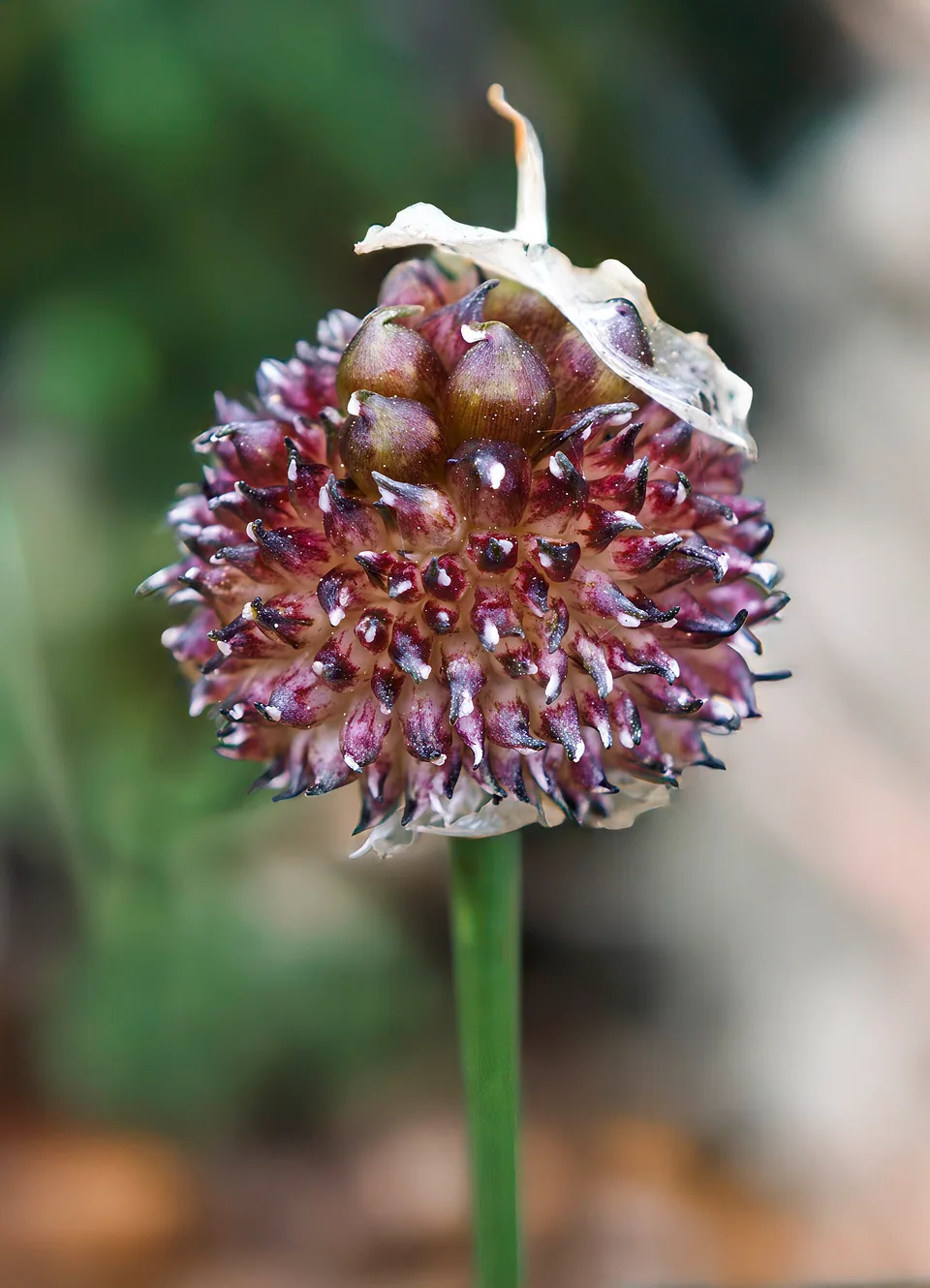


Cómo cultivar y cuidar Ajo salvaje
Allium vineale
Escrito por Emilio Marruso · última revisión
Tóxica para: Ganado, Personas · Por qué
De un vistazo
El ajo de viña es una vivaz muy resistente que aguanta la sequía y puede sobrevivir incluso una temporada entera en suelo encharcado. Sus hojas, flores y bulbos son comestibles y se usan como el cebollino, aunque son algo más duros. Dale sol parcial o pleno, pero vigílalo: se extiende rápido por semillas, bulbillos y bulbos hijos.
- Sol
Sol parcial o pleno
Qué dicen las fuentes (1)
Luz: De semisombra a pleno sol
It grows in various soils including heavy clay and prefers partial to full sun.
— Allium vineale (Crow Garlic, Field Garlic, Onion Grass, Stag's Garlic, Wild Garlic, Wild Onion) | North Carolina Extension Gardener Plant Toolbox [1] - Riego
Muy resistente a la sequía; los bulbos aguantan incluso una temporada entera en suelo encharcado
Qué dicen las fuentes (2)
Riego: Altamente resistente a la sequía
Drought tolerance: Wild garlic is highly resistant to drought. Plant growth slows during dry weather
— Wild garlic | CALS [4] Notas sobre el riego: Los bulbos pueden sobrevivir toda una temporada de crecimiento en suelo saturado de agua
Wild garlic grows successfully on a wide range of soil textures from heavy clay to coarse sand (Lazenby 1961a). Bulbs can survive an entire growing season in waterlogged soil.
— Wild garlic | CALS [4] - Frío
Aguanta inviernos de hasta −28,9 °C (−20 °F)
Muy rústica · USDA 5a · RHS H7 · Z5
Qué dicen las fuentes (2)
Rusticidad, zona más fría: 5a [mínima invernal de −28,9 a −26,1 °C (de −20 a −15 °F)]
USDA Plant Hardiness Zone: 5a, 5b, 6a, 6b, 7a, 7b, 8a, 8b
— Allium vineale (Crow Garlic, Field Garlic, Onion Grass, Stag's Garlic, Wild Garlic, Wild Onion) | North Carolina Extension Gardener Plant Toolbox [1] Rusticidad, zona más cálida: 8b [mínima invernal de −9,4 a −6,7 °C (de 15 a 20 °F)]
USDA Plant Hardiness Zone: 5a, 5b, 6a, 6b, 7a, 7b, 8a, 8b
— Allium vineale (Crow Garlic, Field Garlic, Onion Grass, Stag's Garlic, Wild Garlic, Wild Onion) | North Carolina Extension Gardener Plant Toolbox [1] - Cosecha
Hojas, flores y bulbos son comestibles: úsalos como el cebollino, aunque son algo más duros
- Plagas
Varios hongos pudren los bulbos bajo tierra, entre ellos la podredumbre blanca de la cebolla
- Atención
Se extiende con fuerza y al tirar quedan bulbos en la tierra: sácalos con un desplantador con el suelo húmedo
- Tamaño
30–90 cm de alto y 5–10 cm de ancho
Qué dicen las fuentes (2)
Altura adulta: 30.5-91.4 cm (1-3 pies)
Dimensions: Height: 1 ft. 0 in. - 3 ft. 0 in. Width: 0 ft. 2 in. - 0 ft. 4 in.
— Allium vineale (Crow Garlic, Field Garlic, Onion Grass, Stag's Garlic, Wild Garlic, Wild Onion) | North Carolina Extension Gardener Plant Toolbox [1] Anchura adulta: 5.1-10.2 cm (2-4 pulgadas)
Dimensions: Height: 1 ft. 0 in. - 3 ft. 0 in. Width: 0 ft. 2 in. - 0 ft. 4 in.
— Allium vineale (Crow Garlic, Field Garlic, Onion Grass, Stag's Garlic, Wild Garlic, Wild Onion) | North Carolina Extension Gardener Plant Toolbox [1] - Multiplicación
Por división, semilla, bulbillos aéreos y bulbos hijos
Qué dicen las fuentes (2)
Propagación: División, semilla, bulbillos aéreos, bulbillos de la base
Recommended Propagation Strategy: Division Seed Country Or Region Of Origin:
— Allium vineale (Crow Garlic, Field Garlic, Onion Grass, Stag's Garlic, Wild Garlic, Wild Onion) | North Carolina Extension Gardener Plant Toolbox [1] It can be found in disturbed areas, along roadsides, thickets, meadows, and woodlands spreading by seeds, aerial bulbils, and bulb offsets below ground.
— Allium vineale (Crow Garlic, Field Garlic, Onion Grass, Stag's Garlic, Wild Garlic, Wild Onion) | North Carolina Extension Gardener Plant Toolbox [1] - Seguridad
Comerlo en grandes cantidades puede intoxicar a personas y ganado
Resumen
El ajo silvestre es una maleza común de césped de la familia de las cebollas que se propaga por semillas, bulbilos aéreos y bulbos subterráneos. [1] Crece en diversos suelos, incluida la arcilla pesada, y prefiere pleno sol a semisombra. [1] Las hojas, flores y bulbos son comestibles, aunque la planta también está catalogada como de baja toxicidad para los humanos. [1]
Citado en inglés, como en la fuente.
Cuidados
Riego
Riego
Altamente resistente a la sequía
Qué dicen las fuentes (1)
Drought tolerance: Wild garlic is highly resistant to drought. Plant growth slows during dry weatherNotas sobre el riego
Los bulbos pueden sobrevivir toda una temporada de crecimiento en suelo saturado de agua
Qué dicen las fuentes (1)
Wild garlic grows successfully on a wide range of soil textures from heavy clay to coarse sand (Lazenby 1961a). Bulbs can survive an entire growing season in waterlogged soil.Luz
De semisombra a pleno sol
Qué dicen las fuentes (1)
It grows in various soils including heavy clay and prefers partial to full sun.Clima y frío
Rusticidad, zona más fría
5a [mínima invernal de −28,9 a −26,1 °C (de −20 a −15 °F)]
Qué dicen las fuentes (1)
USDA Plant Hardiness Zone:
5a, 5b, 6a, 6b, 7a, 7b, 8a, 8bRusticidad, zona más cálida
8b [mínima invernal de −9,4 a −6,7 °C (de 15 a 20 °F)]
Qué dicen las fuentes (1)
USDA Plant Hardiness Zone:
5a, 5b, 6a, 6b, 7a, 7b, 8a, 8bPropagación
División, semilla, bulbillos aéreos, bulbillos de la base
Qué dicen las fuentes (2)
Recommended Propagation Strategy:
Division
Seed
Country Or Region Of Origin:It can be found in disturbed areas, along roadsides, thickets, meadows, and woodlands spreading by seeds, aerial bulbils, and bulb offsets below ground.Cultivo
La planta
Ciclo de vida
perenne
Qué dicen las fuentes (2)
Life cycle: Perennial, reproduces by seed, bulbs, and aerial bulbletsLife Cycle:
Bulb
Perennial
Recommended Propagation Strategy:
DivisionFamilia
Amaryllidaceae
Qué dicen las fuentes (2)
Field Garlic is a common lawn weed in the onion family (Amaryllidaceae) that, while native to Europe, Africa, and the Middle East, has naturalized in much of the worldFamily: Amaryllidaceae (formerly Liliaceae)
Life cycle: Perennial, reproduces by seed, bulbs, and aerial bulbletsAltura adulta
30.5-91.4 cm (1-3 pies)
Qué dicen las fuentes (1)
Dimensions:
Height: 1 ft. 0 in. - 3 ft. 0 in.
Width: 0 ft. 2 in. - 0 ft. 4 in.Anchura adulta
5.1-10.2 cm (2-4 pulgadas)
Qué dicen las fuentes (1)
Dimensions:
Height: 1 ft. 0 in. - 3 ft. 0 in.
Width: 0 ft. 2 in. - 0 ft. 4 in.Problemas
Propagación agresiva de malezas
Síntoma: Crece agresivamente, propagándose por semillas, bulbillos aéreos y bulbillos subterráneos; considerado una maleza nociva por el USDA.
Qué hacer: Arranca a mano cuando el suelo esté húmedo, desentierra los bulbillos con una paleta; la siega lo debilita y evita la producción de semillas, pero no lo mata.
Qué dicen las fuentes (2)
It grows aggressively spreading by seeds, aerial bullets, and underground bulb offsets and is considered a noxious weed by the USDA.
— Allium vineale (Crow Garlic, Field Garlic, Onion Grass, Stag's Garlic, Wild Garlic, Wild Onion) | North Carolina Extension Gardener Plant Toolbox [1] Control: Hand-pull it when the soil is moist, digging out bulblets with a trowel. Mowing does not kill it but can weaken it and prevent seeding.
— Allium vineale (Crow Garlic, Field Garlic, Onion Grass, Stag's Garlic, Wild Garlic, Wild Onion) | North Carolina Extension Gardener Plant Toolbox [1] Alteración del sabor de la leche y la carne
Síntoma: Cuando lo consumen animales de pastoreo, puede producir un sabor desagradable en la leche y la carne.
Qué hacer: En pastizales con infestación leve, usa buenas prácticas de manejo para asegurar un crecimiento vigoroso de los pastos y leguminosas entre los episodios de pastoreo.
Hongos de pudrición de bulbos
Síntoma: Varios hongos causan daños extensos a los bulbos subterráneos, incluida la pudrición blanca de la cebolla.
Qué hacer: No se indica en las fuentes.
Qué dicen las fuentes (1)
Several fungi cause extensive damage to below-ground bulbs (DeFelice 2003). These include onion white rot
— Wild garlic | CALS [4] Difícil de erradicar arrancando a mano
Síntoma: El arranque a mano no es efectivo porque el follaje se rompe y el bulbillo queda en el suelo.
Qué hacer: Las plantas se pueden desenterrar, cuidando de eliminar los bulbillos subterráneos.
Qué dicen las fuentes (1)
Plants can be dug out, but care must be taken to remove the underground bulblets. Hand pulling is not affective because the foliage breaks and the bulblet is left behind.
— Wild Onion and Wild Garlic [3]
Remedios
Cada remedio indica qué dicen las fuentes oficiales; los remedios tradicionales sin fuente oficial aparecen marcados. Los perjudiciales están para que sepas evitarlos.
Cómo eliminarla
infestación de ajo silvestre
eliminación manual Funciona
Don’t add wild garlic bulbs or seed to your home compost bin, as it may not reach high enough temperatures to kill them.
— rhs.org.uk [6] Cómo: Para parches aislados de ajo silvestre, la extracción manual es el método más efectivo.
For isolated patches of wild garlic, hand removal is the most effective method.
— weedguide.cfaes.osu.edu [5] Qué dicen las pruebas For isolated patches of wild garlic, hand removal is the most effective method.
— weedguide.cfaes.osu.edu [5] Desentierra los bulbos con una pala de mano. No verificado
Remedio tradicional, no verificado por una fuente oficial.
Don’t add wild garlic bulbs or seed to your home compost bin, as it may not reach high enough temperatures to kill them.
— rhs.org.uk [6] Cómo: Es mejor desenterrar los bulbos con una pala de mano o una pala. De nuevo, esto funciona bien para áreas pequeñas y jardines.
Escarda en invierno No verificado
Remedio tradicional, no verificado por una fuente oficial.
Cómo: El control del ajo silvestre se puede lograr escardando durante el invierno y principios de la primavera para evitar que se formen nuevos bulbos.
siega Funciona en parte
Cómo: La siega o el laboreo cuando los tallos han comenzado a alargarse pero no están a plena altura evitan o reducen la producción de bulbillos.
Mowing or tillage when the stalks have started to lengthen but are not full height will prevent or reduce production of bulblets (Lazenby 1963).
— Wild garlic | CALS [4] Qué dicen las pruebas Mowing or tillage when the stalks have started to lengthen but are not full height will prevent or reduce production of bulblets (Lazenby 1963).
— Wild garlic | CALS [4] Sofoca con cartón y mantillo. Fuente oficial, sin prueba independiente
Cómo: Cubre con una capa de material compostable, como cartón, y luego una capa de unos 20 cm de materia orgánica.
Smother plants – cover with a layer of compostable material, such as cardboard, and then a layer about 20cm (8in) thick of organic matter
— rhs.org.uk [6] labranza repetida en otoño y primavera Funciona
Cómo: Un régimen de labranza en otoño seguido de labranza en primavera y un cultivo limpio, realizado durante varios años, reducirá la cantidad de bulbos en el suelo.
In large infested areas, a regime of fall tillage followed by spring tillage and a clean cultivated crop, if done for several years, will reduce the number of bulbs in the soil.
— weedguide.cfaes.osu.edu [5] Qué dicen las pruebas In large infested areas, a regime of fall tillage followed by spring tillage and a clean cultivated crop, if done for several years, will reduce the number of bulbs in the soil.
— weedguide.cfaes.osu.edu [5]
Venenosa para los animales
Según la fuente, citada textualmente. No es un consejo médico ni veterinario: si una persona o un animal pudo haber ingerido esta planta, contacta con un centro de toxicología o con un veterinario.
Can cause low toxicity in humans but has the potential to be poisonous to livestock if consumed excessively.
[1]- Partes venenosas
(Poison parts: All parts; bulbs, bulblets, flowers, and stems) Poison Toxic Principle: Sulfides
[1]- Principio tóxico
Poison Toxic Principle: Sulfides Causes Contact Dermatitis: No Poison Part: Flowers
[1]- Síntomas
Symptoms may include nausea, vomiting, and diarrhea. (Poison parts: All parts; bulbs, bulblets, flowers, and stems)
[1]- Gravedad
This plant has low severity poison characteristics. See below Description
[1]
Consumption of large quantities of wild garlic can cause poisoning in both people and livestock.
[4]- Partes venenosas
(Poison parts: All parts; bulbs, bulblets, flowers, and stems) Poison Toxic Principle: Sulfides
[1]- Principio tóxico
Poison Toxic Principle: Sulfides Causes Contact Dermatitis: No Poison Part: Flowers
[1]- Síntomas
Symptoms may include nausea, vomiting, and diarrhea. (Poison parts: All parts; bulbs, bulblets, flowers, and stems)
[1]- Gravedad
This plant has low severity poison characteristics. See below Description
[1]
Comestibilidad
Según la fuente, citada textualmente. No comas una planta basándote solo en esta página: los errores de identificación pueden ser peligrosos.
The leaves, flowers, and bulbs are edible and can be used similarly to chives, although they tend to be a bit tougher.
[1]The leaves, flowers, and bulbs are edible and can be used similarly to chives, although they tend to be a bit tougher.
[1]The leaves, flowers, and bulbs are edible and can be used similarly to chives, although they tend to be a bit tougher.
[1]The bulbs are occasionally used to flavor cooked dishes, but most people consider the flavor much inferior to that of domestic garlic.
[4]Livestock readily eat wild garlic leaves and shoots, but consumption of fresh material can taint milk and meat.
[4]
Valores orientativos
Valores de una fuente secundaria, no comprobados palabra por palabra como el resto de esta página. Úselos como punto de partida.
- Resiste la sequía
- SíValor orientativo, adáptalo a tu clima · Fuente secundaria
- pH del suelo
- 6-7Valor orientativo, adáptalo a tu clima · Fuente secundaria
- Nivel de cuidado
- MedioValor orientativo, adáptalo a tu clima · Fuente secundaria
- Crecimiento
- BajoValor orientativo, adáptalo a tu clima · Fuente secundaria
- Poda
- marzo, abril, febrero, marzo, abrilValor orientativo, adáptalo a tu clima · Fuente secundaria
Plantas similares
- Allium triquetrum Allium triquetrum
- Blue Globe Onion Allium caeruleum
- Ajoporro Allium ampeloprasum
- Garlic Chives Allium tuberosum
- Lily Leek Allium moly
- Cebolla Allium cepa
- Ornamental Onion Allium aflatunense
- Ornamental Onion Allium giganteum
Fuentes
Cada valor anterior se cita de estos documentos. Los enlaces llevan al editor original.
- Allium vineale (Crow Garlic, Field Garlic, Onion Grass, Stag's Garlic, Wild Garlic, Wild Onion) | North Carolina Extension Gardener Plant Toolbox · plants.ces.ncsu.edu, consultado
- Wild garlic | Integrated Crop Management · crops.extension.iastate.edu, consultado
- Wild Onion and Wild Garlic · extension.psu.edu, consultado
- Wild garlic | CALS · cals.cornell.edu, consultado
- weedguide.cfaes.osu.edu · weedguide.cfaes.osu.edu
- rhs.org.uk · rhs.org.uk
Escrito por Emilio Marruso · última revisión