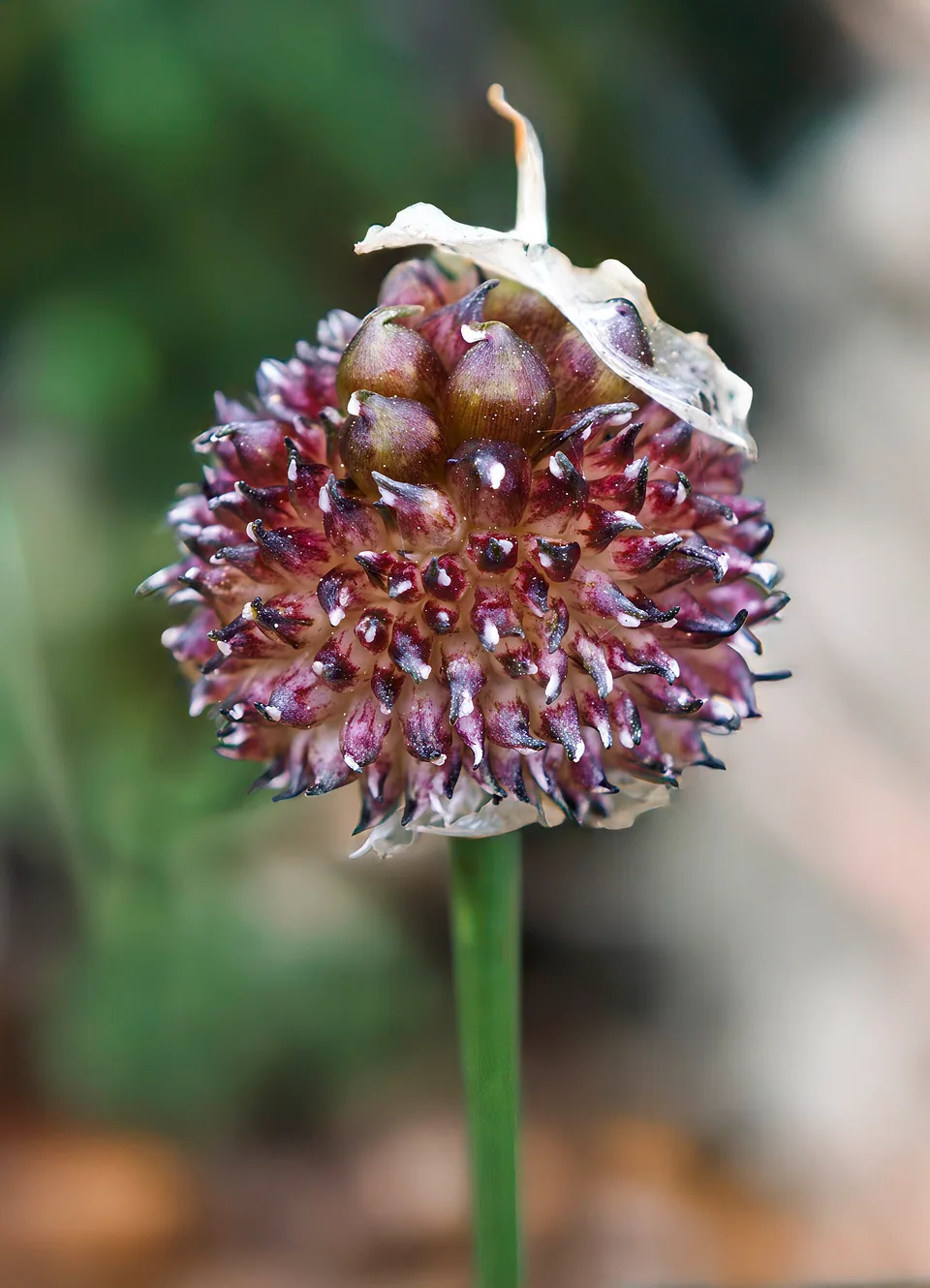


How to Grow and Care for Field Garlic
Allium vineale
Written by Emilio Marruso · last checked
Toxic to: Livestock, People · Why
At a glance
Wild garlic is a tough little perennial that shrugs off drought and can even survive a whole season in waterlogged soil. Its leaves, flowers and bulbs are edible and can be used like chives, though they are a bit tougher. Give it partial to full sun, but keep an eye on it: it spreads fast by seeds, bulbils and bulb offsets.
- Sun
Partial to full sun
What the sources say (1)
Light: Partial to full sun
It grows in various soils including heavy clay and prefers partial to full sun.
— Allium vineale (Crow Garlic, Field Garlic, Onion Grass, Stag's Garlic, Wild Garlic, Wild Onion) | North Carolina Extension Gardener Plant Toolbox [1] - Water
Very drought tolerant; the bulbs can even survive a whole season in waterlogged soil
What the sources say (2)
Watering: Highly resistant to drought
Drought tolerance: Wild garlic is highly resistant to drought. Plant growth slows during dry weather
— Wild garlic | CALS [4] Watering notes: Bulbs can survive an entire growing season in waterlogged soil
Wild garlic grows successfully on a wide range of soil textures from heavy clay to coarse sand (Lazenby 1961a). Bulbs can survive an entire growing season in waterlogged soil.
— Wild garlic | CALS [4] - Cold
Survives winters down to −20 °F (−28.9 °C)
Very hardy · USDA 5a · RHS H7 · Z5
What the sources say (2)
Hardiness, coldest zone: 5a [winter low −28.9 to −26.1 °C (−20 to −15 °F)]
USDA Plant Hardiness Zone: 5a, 5b, 6a, 6b, 7a, 7b, 8a, 8b
— Allium vineale (Crow Garlic, Field Garlic, Onion Grass, Stag's Garlic, Wild Garlic, Wild Onion) | North Carolina Extension Gardener Plant Toolbox [1] Hardiness, warmest zone: 8b [winter low −9.4 to −6.7 °C (15 to 20 °F)]
USDA Plant Hardiness Zone: 5a, 5b, 6a, 6b, 7a, 7b, 8a, 8b
— Allium vineale (Crow Garlic, Field Garlic, Onion Grass, Stag's Garlic, Wild Garlic, Wild Onion) | North Carolina Extension Gardener Plant Toolbox [1] - Harvest
Leaves, flowers and bulbs are edible: use them like chives, though they are a bit tougher
- Pests
Several fungi can rot the bulbs underground, including onion white rot
- Watch out
Spreads aggressively and pulling leaves bulbs behind: dig them out with a trowel when the soil is moist
- Size
1–3 ft tall and 2–4 in wide
What the sources say (2)
Mature height: 30.5-91.4 cm (1-3 ft)
Dimensions: Height: 1 ft. 0 in. - 3 ft. 0 in. Width: 0 ft. 2 in. - 0 ft. 4 in.
— Allium vineale (Crow Garlic, Field Garlic, Onion Grass, Stag's Garlic, Wild Garlic, Wild Onion) | North Carolina Extension Gardener Plant Toolbox [1] Mature width: 5.1-10.2 cm (2-4 in)
Dimensions: Height: 1 ft. 0 in. - 3 ft. 0 in. Width: 0 ft. 2 in. - 0 ft. 4 in.
— Allium vineale (Crow Garlic, Field Garlic, Onion Grass, Stag's Garlic, Wild Garlic, Wild Onion) | North Carolina Extension Gardener Plant Toolbox [1] - Propagation
By division, seed, bulbils on the flower stalk and bulb offsets
What the sources say (2)
Propagation: Division, seed, aerial bulbils, bulb offsets
Recommended Propagation Strategy: Division Seed Country Or Region Of Origin:
— Allium vineale (Crow Garlic, Field Garlic, Onion Grass, Stag's Garlic, Wild Garlic, Wild Onion) | North Carolina Extension Gardener Plant Toolbox [1] It can be found in disturbed areas, along roadsides, thickets, meadows, and woodlands spreading by seeds, aerial bulbils, and bulb offsets below ground.
— Allium vineale (Crow Garlic, Field Garlic, Onion Grass, Stag's Garlic, Wild Garlic, Wild Onion) | North Carolina Extension Gardener Plant Toolbox [1] - Safety
Eating large amounts can poison people and livestock
Overview
Field garlic is a common lawn weed in the onion family that spreads by seeds, aerial bulbils and bulb offsets below ground. [1] It grows in various soils including heavy clay and prefers partial to full sun. [1] The leaves, flowers and bulbs are edible, although the plant is also listed as having low toxicity to humans. [1]
Field Garlic care
How to water Field Garlic
Watering
Highly resistant to drought
What the sources say (1)
Drought tolerance: Wild garlic is highly resistant to drought. Plant growth slows during dry weatherWatering notes
Bulbs can survive an entire growing season in waterlogged soil
What the sources say (1)
Wild garlic grows successfully on a wide range of soil textures from heavy clay to coarse sand (Lazenby 1961a). Bulbs can survive an entire growing season in waterlogged soil.How much light Field Garlic needs
Partial to full sun
What the sources say (1)
It grows in various soils including heavy clay and prefers partial to full sun.How much cold Field Garlic can take
Hardiness, coldest zone
5a [winter low −28.9 to −26.1 °C (−20 to −15 °F)]
What the sources say (1)
USDA Plant Hardiness Zone:
5a, 5b, 6a, 6b, 7a, 7b, 8a, 8bHardiness, warmest zone
8b [winter low −9.4 to −6.7 °C (15 to 20 °F)]
What the sources say (1)
USDA Plant Hardiness Zone:
5a, 5b, 6a, 6b, 7a, 7b, 8a, 8bHow to propagate Field Garlic
Division, seed, aerial bulbils, bulb offsets
What the sources say (2)
Recommended Propagation Strategy:
Division
Seed
Country Or Region Of Origin:It can be found in disturbed areas, along roadsides, thickets, meadows, and woodlands spreading by seeds, aerial bulbils, and bulb offsets below ground.How to grow Field Garlic
The plant
Life cycle
perennial
What the sources say (2)
Life cycle: Perennial, reproduces by seed, bulbs, and aerial bulbletsLife Cycle:
Bulb
Perennial
Recommended Propagation Strategy:
DivisionFamily
Amaryllidaceae
What the sources say (2)
Field Garlic is a common lawn weed in the onion family (Amaryllidaceae) that, while native to Europe, Africa, and the Middle East, has naturalized in much of the worldFamily: Amaryllidaceae (formerly Liliaceae)
Life cycle: Perennial, reproduces by seed, bulbs, and aerial bulbletsMature height
30.5-91.4 cm (1-3 ft)
What the sources say (1)
Dimensions:
Height: 1 ft. 0 in. - 3 ft. 0 in.
Width: 0 ft. 2 in. - 0 ft. 4 in.Mature width
5.1-10.2 cm (2-4 in)
What the sources say (1)
Dimensions:
Height: 1 ft. 0 in. - 3 ft. 0 in.
Width: 0 ft. 2 in. - 0 ft. 4 in.Field Garlic pests and problems
Aggressive weed spread
Symptom: Grows aggressively, spreading by seeds, aerial bulbils and underground bulb offsets; considered a noxious weed by the USDA.
What to do: Hand-pull when the soil is moist, digging out bulblets with a trowel; mowing weakens it and prevents seeding but does not kill it.
What the sources say (2)
It grows aggressively spreading by seeds, aerial bullets, and underground bulb offsets and is considered a noxious weed by the USDA.
— Allium vineale (Crow Garlic, Field Garlic, Onion Grass, Stag's Garlic, Wild Garlic, Wild Onion) | North Carolina Extension Gardener Plant Toolbox [1] Control: Hand-pull it when the soil is moist, digging out bulblets with a trowel. Mowing does not kill it but can weaken it and prevent seeding.
— Allium vineale (Crow Garlic, Field Garlic, Onion Grass, Stag's Garlic, Wild Garlic, Wild Onion) | North Carolina Extension Gardener Plant Toolbox [1] Tainting of milk and meat
Symptom: When consumed by pastured livestock, it can produce a disagreeable taste in milk and meat.
What to do: In lightly infested pastures, use good management practices to ensure vigorous growth of grasses and legumes between grazing episodes.
Bulb rot fungi
Symptom: Several fungi cause extensive damage to below-ground bulbs, including onion white rot.
What to do: Not stated in the sources.
What the sources say (1)
Several fungi cause extensive damage to below-ground bulbs (DeFelice 2003). These include onion white rot
— Wild garlic | CALS [4] Hard to eradicate by hand-pulling
Symptom: Hand pulling is not effective because the foliage breaks and the bulblet is left behind.
What to do: Plants can be dug out, taking care to remove the underground bulblets.
What the sources say (1)
Plants can be dug out, but care must be taken to remove the underground bulblets. Hand pulling is not affective because the foliage breaks and the bulblet is left behind.
— Wild Onion and Wild Garlic [3]
Remedies
Each remedy shows what official sources say about it; traditional remedies without an official source are marked as such. Harmful ones are listed so you know to avoid them.
Getting rid of it
wild garlic infestation
hand removal Works
Don’t add wild garlic bulbs or seed to your home compost bin, as it may not reach high enough temperatures to kill them.
— rhs.org.uk [6] How: For isolated patches of wild garlic, hand removal is the most effective method.
For isolated patches of wild garlic, hand removal is the most effective method.
— weedguide.cfaes.osu.edu [5] What the evidence says For isolated patches of wild garlic, hand removal is the most effective method.
— weedguide.cfaes.osu.edu [5] digging out bulbs with a trowel Not verified
Traditional remedy, not verified by an official source.
Don’t add wild garlic bulbs or seed to your home compost bin, as it may not reach high enough temperatures to kill them.
— rhs.org.uk [6] How: It is better to actually dig the bulbs out with a trowel or shovel. Again, this works well for smaller areas and gardens.
hoeing in winter Not verified
Traditional remedy, not verified by an official source.
How: Controlling wild garlic can be accomplished by hoeing during the winter and early spring to prevent new bulbs from forming.
mowing Partly works
How: Mowing or tillage when the stalks have started to lengthen but are not full height will prevent or reduce production of bulblets.
Mowing or tillage when the stalks have started to lengthen but are not full height will prevent or reduce production of bulblets (Lazenby 1963).
— Wild garlic | CALS [4] What the evidence says Mowing or tillage when the stalks have started to lengthen but are not full height will prevent or reduce production of bulblets (Lazenby 1963).
— Wild garlic | CALS [4] smothering with cardboard and mulch Official source, not independently tested
How: Cover with a layer of compostable material, such as cardboard, and then a layer about 20cm of organic matter.
Smother plants – cover with a layer of compostable material, such as cardboard, and then a layer about 20cm (8in) thick of organic matter
— rhs.org.uk [6] repeated fall and spring tillage Works
How: A regime of fall tillage followed by spring tillage and a clean cultivated crop, done for several years, will reduce the number of bulbs in the soil.
In large infested areas, a regime of fall tillage followed by spring tillage and a clean cultivated crop, if done for several years, will reduce the number of bulbs in the soil.
— weedguide.cfaes.osu.edu [5] What the evidence says In large infested areas, a regime of fall tillage followed by spring tillage and a clean cultivated crop, if done for several years, will reduce the number of bulbs in the soil.
— weedguide.cfaes.osu.edu [5]
Is Field Garlic toxic to pets?
Reported by the source, quoted verbatim. This is not medical or veterinary advice: if a person or an animal may have eaten this plant, contact a poison control centre or a veterinarian.
Can cause low toxicity in humans but has the potential to be poisonous to livestock if consumed excessively.
[1]- Poisonous parts
(Poison parts: All parts; bulbs, bulblets, flowers, and stems) Poison Toxic Principle: Sulfides
[1]- Toxic principle
Poison Toxic Principle: Sulfides Causes Contact Dermatitis: No Poison Part: Flowers
[1]- Symptoms
Symptoms may include nausea, vomiting, and diarrhea. (Poison parts: All parts; bulbs, bulblets, flowers, and stems)
[1]- Severity
This plant has low severity poison characteristics. See below Description
[1]
Consumption of large quantities of wild garlic can cause poisoning in both people and livestock.
[4]- Poisonous parts
(Poison parts: All parts; bulbs, bulblets, flowers, and stems) Poison Toxic Principle: Sulfides
[1]- Toxic principle
Poison Toxic Principle: Sulfides Causes Contact Dermatitis: No Poison Part: Flowers
[1]- Symptoms
Symptoms may include nausea, vomiting, and diarrhea. (Poison parts: All parts; bulbs, bulblets, flowers, and stems)
[1]- Severity
This plant has low severity poison characteristics. See below Description
[1]
Edibility
Reported by the source, quoted verbatim. Do not eat a plant on the basis of this page alone: identification mistakes can be dangerous.
The leaves, flowers, and bulbs are edible and can be used similarly to chives, although they tend to be a bit tougher.
[1]The leaves, flowers, and bulbs are edible and can be used similarly to chives, although they tend to be a bit tougher.
[1]The leaves, flowers, and bulbs are edible and can be used similarly to chives, although they tend to be a bit tougher.
[1]The bulbs are occasionally used to flavor cooked dishes, but most people consider the flavor much inferior to that of domestic garlic.
[4]Livestock readily eat wild garlic leaves and shoots, but consumption of fresh material can taint milk and meat.
[4]
Indicative values
Values from a secondary source, not checked word for word like the rest of this page. Use them as a starting point.
- Drought tolerant
- yesIndicative value, adapt it to your climate · Secondary source
- Soil pH
- 6-7Indicative value, adapt it to your climate · Secondary source
- Care level
- MediumIndicative value, adapt it to your climate · Secondary source
- Growth rate
- LowIndicative value, adapt it to your climate · Secondary source
- Pruning
- March, April, February, March, AprilIndicative value, adapt it to your climate · Secondary source
Similar plants
- Allium triquetrum Allium triquetrum
- Blue Globe Onion Allium caeruleum
- Broadleaf wild leek Allium ampeloprasum
- Garlic Chives Allium tuberosum
- Lily Leek Allium moly
- Onion Allium cepa
- Ornamental Onion Allium aflatunense
- Ornamental Onion Allium giganteum
Sources
Every value above is quoted from these documents. Links lead to the original publisher.
- Allium vineale (Crow Garlic, Field Garlic, Onion Grass, Stag's Garlic, Wild Garlic, Wild Onion) | North Carolina Extension Gardener Plant Toolbox · plants.ces.ncsu.edu, consulted
- Wild garlic | Integrated Crop Management · crops.extension.iastate.edu, consulted
- Wild Onion and Wild Garlic · extension.psu.edu, consulted
- Wild garlic | CALS · cals.cornell.edu, consulted
- weedguide.cfaes.osu.edu · weedguide.cfaes.osu.edu
- rhs.org.uk · rhs.org.uk
Written by Emilio Marruso · last checked