
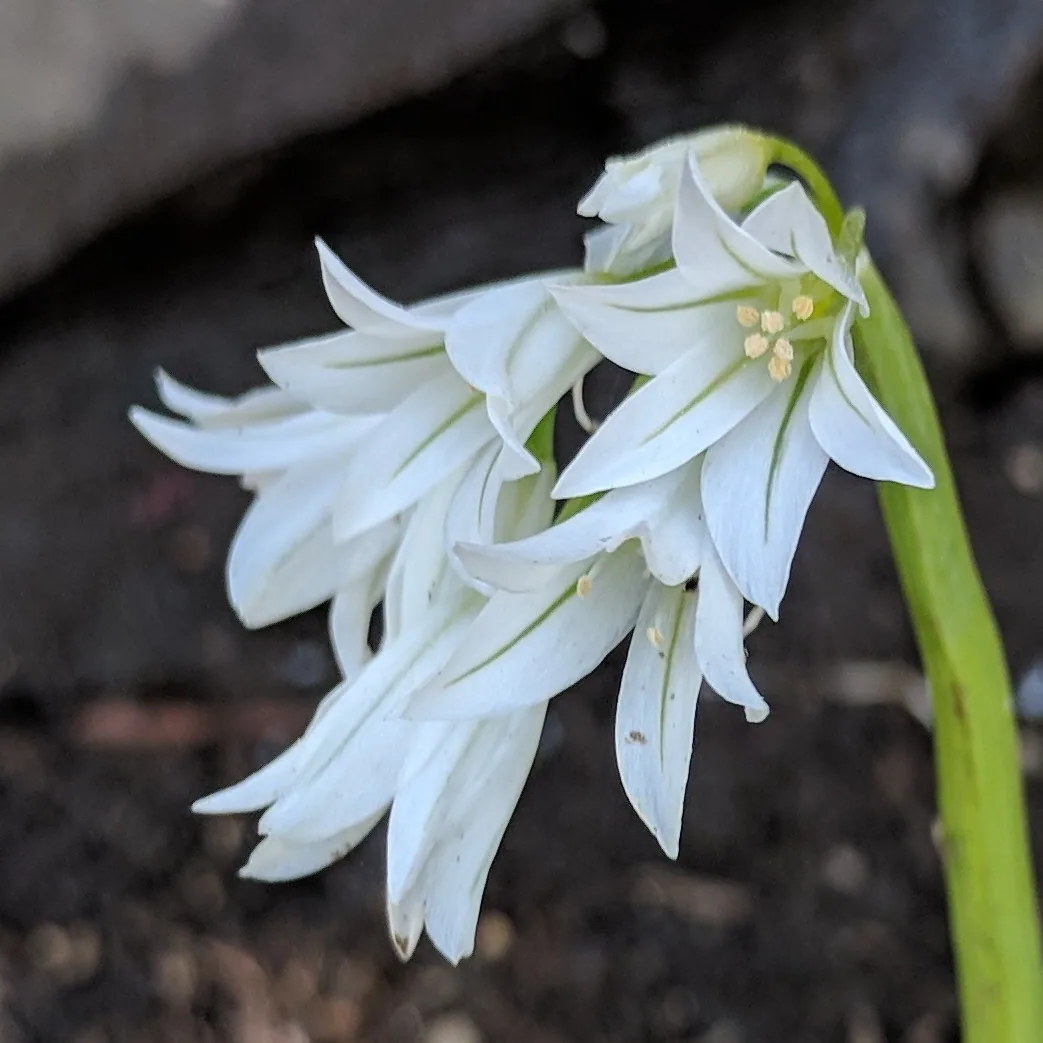

How to Grow and Care for Allium triquetrum
Allium triquetrum
Written by Emilio Marruso · last checked
Classified as poisonous · Why
At a glance
Three-cornered leek is a little plant you can eat from top to bottom: the bulbs and leaves raw or cooked, and the juicy flowers raw, with a mild garlic flavor. It loves full sun but also tolerates shade, and you can pick fresh leaves from late fall until spring. Just keep an eye on it, because it spreads easily.
- Sun
Full sun, but it also tolerates shade
- Water
Moderate watering; it does not tolerate drought
What the sources say (3)
Watering: Moderate
Water moderate Hardiness Zone 8+ Soil textures sandy,
— Three-Cornered Leek (Allium triquetrum) — Practical Plants [6] Watering notes: Prefers a rich moist but well-drained soil; drought intolerant
Prefers a rich moist but well-drained soil [1]
— Three-Cornered Leek (Allium triquetrum) — Practical Plants [6] Drought intolerant ## Propagation This section contains historical
— Three-Cornered Leek (Allium triquetrum) — Practical Plants [6] - Cold
Survives winters down to 10 °F (−12.2 °C)
Hardy in cold winters · USDA 8 · RHS H5 · Z8
What the sources say (1)
Hardiness, coldest zone: 8 [winter low −12.2 to −6.7 °C (10 to 20 °F)]
Hardiness Zone 8+ Soil textures sandy, loamy Soil
— Three-Cornered Leek (Allium triquetrum) — Practical Plants [6] - Soil
Rich soil that stays moist but drains well
What the sources say (2)
Watering notes: Prefers a rich moist but well-drained soil; drought intolerant
Prefers a rich moist but well-drained soil [1]
— Three-Cornered Leek (Allium triquetrum) — Practical Plants [6] Drought intolerant ## Propagation This section contains historical
— Three-Cornered Leek (Allium triquetrum) — Practical Plants [6] - Planting
Plant the dormant bulbs in late summer
What the sources say (1)
Planting: Late summer (dormant bulbs)
planting out the dormant bulbs in the late summer of the following year
— Allium triquetrum - Useful Temperate Plants [5] - Harvest
Leaves from late fall to spring, bulbs in early summer; the flowers are eaten raw
What the sources say (2)
Harvest: Bulb in early summer when the plant has died down; leaves from late autumn until spring
It is harvested in early summer when the plant has died down
— Three-Cornered Leek (Allium triquetrum) — Practical Plants [6] The leaves are available from late autumn until the spring
— Three-Cornered Leek (Allium triquetrum) — Practical Plants [6] - Watch out
Spreads by bulbs and seeds: remove faded flowers before they make seed
- Propagation
By seed, or divide the clumps in summer after the plants die down
What the sources say (2)
- Sowing
Sow seed as soon as it is ripe; stored seed in spring
Overview
Three-cornered leek is a bulbous perennial that spreads by bulbs and seeds and is treated as an invasive non-native plant in the UK. [3] It prefers a rich, moist but well-drained soil and is shade tolerant. [6][5] The bulb, leaves and flowers are eaten raw or cooked, with a mild garlic flavour. [6]
This record is incomplete: the sources we read do not cover every field yet.
Not yet covered by our sources: Hardiness, warmest zone
Allium triquetrum care
How to water Allium triquetrum
Watering
Moderate
What the sources say (1)
Water
moderate
Hardiness
Zone 8+
Soil textures
sandy,Watering notes
Prefers a rich moist but well-drained soil; drought intolerant
How much light Allium triquetrum needs
How much cold Allium triquetrum can take
Hardiness, coldest zone
8 [winter low −12.2 to −6.7 °C (10 to 20 °F)]
What the sources say (1)
Hardiness
Zone 8+
Soil textures
sandy, loamy
SoilHardiness, warmest zone
Not stated in the sources we read.
How to propagate Allium triquetrum
How to grow Allium triquetrum
The plant
Family
Amaryllidaceae
What the sources say (1)
Amaryllidaceae Allium ## Allium triquetrum L. First published in Sp. Pl.: 300 (1753) This species is acceptedAllium triquetrum pests and problems
Invasive spread
Symptom: It spreads by both bulbs and seeds and becomes undesirable in gardens.
What to do: Persistent hand-weeding to dig up the bulbs and removing faded flower heads before they produce seed.
What the sources say (1)
getting rid of it takes persistent hand-weeding to dig up the bulbs, as well as removing the faded flower heads before they mature to produce seeds
— Three-cornered leek (<em>Allium triquetrum</em>) | BBC Gardeners World Magazine [3]
Remedies
Each remedy shows what official sources say about it; traditional remedies without an official source are marked as such. Harmful ones are listed so you know to avoid them.
Getting rid of it
invasive spread
digging out bulbs Not verified
Traditional remedy, not verified by an official source.
Follow up treated areas each year.
— tiakitamakimakaurau.nz [8] How: Dig out the plants; seeds and bulbs need disposal. Small amounts can be rotted in a covered water barrel and bulbs can be crushed; otherwise remove to greenwaste or landfill.
pull out the whole plant Partly works
Ensure no plant material is left on site.
— weedbusters.org.nz [9] How: Dig or pull out small infestations and dispose of all plant material at a landfill or refuse transfer station; pulling in December or January is more likely to bring out the entire plant, while later the tops come away and leave the bulbs in the ground.
Physical removal - Dig or pull-out small infestations. Dispose of all plant material at a landfill or refuse transfer station.
— weedbusters.org.nz [9] What the evidence says I can control Allium triquetrum somewhat by trying to pull the entire plant.
— ucanr.edu [10] overplanting with taller species Not verified
Traditional remedy, not verified by an official source.
How: Overplant the cleared area with taller species to stop the weed coming back.
seed spread
removing flowers before seed Partly works
How: Remove the flowers to reduce seed formation when there is no time to weed properly.
Removing the flowers may help reduce seed formation when there isn't time to properly weed.
— ucanr.edu [10] What the evidence says Removing the flowers may help reduce seed formation when there isn't time to properly weed.
— ucanr.edu [10]
Calendar
Planting
Late summer (dormant bulbs)
What the sources say (1)
planting out the dormant bulbs in the late summer of the following yearHarvest
Bulb in early summer when the plant has died down; leaves from late autumn until spring
Months as given by the sources, which are mostly from the United States (northern hemisphere). In the southern hemisphere they shift by about six months.
Edibility
Reported by the source, quoted verbatim. Do not eat a plant on the basis of this page alone: identification mistakes can be dangerous.
Similar plants
- Blue Globe Onion Allium caeruleum
- Broadleaf wild leek Allium ampeloprasum
- Field Garlic Allium vineale
- Garlic Chives Allium tuberosum
- Lily Leek Allium moly
- Nodding Onion Allium cernuum
- Onion Allium cepa
- Ornamental Onion Allium aflatunense
Sources
Every value above is quoted from these documents. Links lead to the original publisher.
- Allium triquetrum (ALLTQ)[Overview]| EPPO Global Database · gd.eppo.int, consulted
- Allium triquetrum L. | Plants of the World Online | Kew Science · powo.science.kew.org, consulted
- Three-cornered leek (<em>Allium triquetrum</em>) | BBC Gardeners World Magazine · gardenersworld.com, consulted
- Allium triquetrum, Three-cornered Leek: identification, distribution, habitat · first-nature.com, consulted
- Allium triquetrum - Useful Temperate Plants · temperate.theferns.info, consulted
- Three-Cornered Leek (Allium triquetrum) — Practical Plants · practicalplants.org, consulted
- Allium triquetrum • New Zealand Plant Conservation Network · nzpcn.org.nz, consulted
- tiakitamakimakaurau.nz · tiakitamakimakaurau.nz
- weedbusters.org.nz · weedbusters.org.nz
- ucanr.edu · ucanr.edu
Written by Emilio Marruso · last checked